
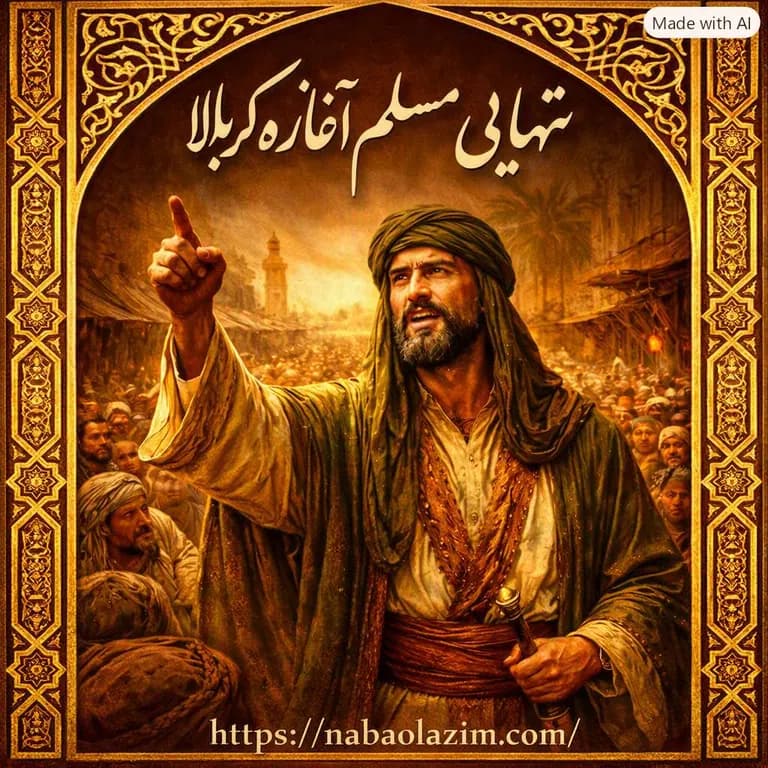
Muslim’s Loneliness, the Beginning of the Road to Karbala (3): Forerunner of the Storm
Author: Hamed Sarem
Aparat
The Politics of Terror: Behind the Scenes of the Umayyad Conspiracy
A precise analysis of the events of Ashura unveils a terrifying truth: the martyrdom of Sayyid al-Shuhada, peace be upon him, was neither a self-chosen incident nor merely the result of the Kufans’ invitation; rather, it was an “Umayyad conspiracy” to eliminate the truth. By reflecting on the historical documents and correspondence of that era, it becomes unmistakably clear that Imam Husayn, peace be upon him, in departing from Medina and Mecca, did so not out of free choice but under the constraint of necessity. History’s testimony to Umayyad pressure
History’s Testimony to Umayyad Pressure
When “Ibn Abbas,” in his reply to Yazid’s letter, unveils the reality, his words constitute an unassailable document against the Umayyads. He addresses Yazid fearlessly, saying: “It was you who pursued Husayn, peace be upon him, until he fled from the Sanctuary of the Prophet to Mecca, and from there he was driven toward the Iraqi lands.” This statement contains within it a “precise point” and a “profound truth”: through a policy of fear and terror, the Umayyads constricted the circumstances of the Imam of the Age so severely that leaving the Hijaz was not a “choice,” but the only “means of escape” from hands stained with the blood of those lying in wait for the life of the Messenger of God’s son. Ibn Abbas explicitly confesses: “The blood of my family drips from your sword, and history is responsible for avenging this injustice.”
Turning Threat into a Historic Opportunity
Therefore, contrary to prevailing assumptions, it was not the Kufans’ letters that became the driving force behind the Imam’s departure; rather, it was “Umayyad terror” that drove the Imam out of the safe haven of the Hijaz. The truth is that the Umayyads had placed the Imam at the “crossroads of martyrdom”: whether he remained in the Hijaz or went to Karbala, the impure hands of the descendants of Saqifa were intent on shedding his pure blood.
Yet amid all this, the art of the “historical Imam” was to transform this deadly threat into a “momentous confrontation between truth and falsehood.” Imam Husayn, peace be upon him, transformed this sinister scenario of the Umayyads into a stage for the manifestation of light. Through his presence in Karbala, he proclaimed the truth not in the dark recesses of hypocrisy, but from the heights of history, so that forever he might shatter the darkness of the companions of Saqifa with the radiance of his guidance and bring the invalidity of Umayyad policy before the tribunal of eternity. Karbala is not the place of the Imam’s slaughter, but the place where the legitimacy of the Umayyads was slain; it is where “blood” triumphed over the “dagger,” and truth became everlasting at the height of estrangement.
Author: Hamed Sarem
Tags:NabaolAzim
Related articles
Comments
No comments yet.
