
Hazrat Qasim ibn al-Hasan: The Educational Miracle of Ashura and the Secret of "Sweeter Than Honey"
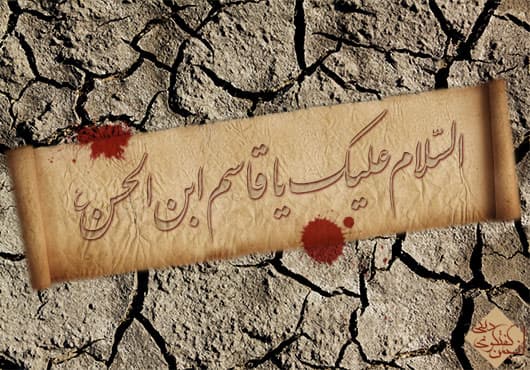
The sixth article in the series "In Lament for the Solomon of Karbala".
The culture of Karbala and Ashura showed the world a cultural miracle: Umayyad culture turns the human being into a devil, to the point that it does not even show mercy to children.
Naba al-Azim; Hamed Sarem - Throughout history, God has sent many guides for humankind. Whenever these guides were doubted and denied by communities, proof and evidence entered the scene. The guides explained the truth of their claim with argument, and showed their connection to the Truth through miracle. Whenever the argument is complete and the evidence of miracle is present, believing in that guide becomes a rational necessity.
Imam Husayn Demanded Evidence and Proof
The son of the Master of the Prophets, in Karbala, offered proof to all of history and also showed a miracle. He stood among the army again and again, delivered sermons, stated his proof to them, and demanded proof from them for their insistence on disbelief and denial: "Say: bring your proof, if you are truthful." Sayyid al-Shuhada placed the verses of the Qur'an as judge before them, brought proof from the Qur'an, and recounted the prophetic words to them, but they paid no heed. The Qur'anic and prophetic proofs of Sayyid al-Shuhada are always alive. Therefore no one can remain neutral toward the event of Ashura, because Ashura carries argument and proof, and is itself a proof. The proof carries evidence because the words of Sayyid al-Shuhada, again and again in Karbala, exposed the irrationality of the Umayyads. The logic of Aba Abdillah is very clear and explicit: God never places the authority and guardianship of people in the hands of a corrupt and wicked person like Yazid, and God would not be pleased with people becoming successors of the Prophet who prepared the ground for Yazid's caliphate. God stated the wali in the Qur'an and the Prophet interpreted it at Ghadir. Therefore the proof of Sayyid al-Shuhada is as firm as the proof of Ghadir, and an evidence as clear as the Noble Qur'an.
Miracle as Evidence for Condemning the Rivals of the Prophets
In order to guide their communities, the prophets showed them miracles in addition to establishing proof. Some prophets revived the dead; for some, the staff became a dragon and the sea split; others brought forth a camel from a mountain, so that everyone would know they were truthful in their claim and that revelation truly came to them. Miracle and evidence have always stood alongside proof.
Miracle has different arenas. Once, Moses, peace be upon him, brings a miracle before the magicians. Another time, Jesus revives the dead before physicians. And the Noble Prophet brings, before a poetic people, a miracle of the kind of speech. (1) What matters in a miracle is the inability of opponents to bring anything like it, whether the miracle is speech or the splitting of the moon.
Miracle has different arenas. Once, Moses, peace be upon him, brings a miracle before the magicians. Another time, Jesus revives the dead before physicians. And the Noble Prophet brings, before a poetic people, a miracle of the kind of speech. (1) What matters in a miracle is the inability of opponents to bring anything like it, whether the miracle is speech or the splitting of the moon.
The Competition of Different Cultures and Schools
Different cultures and schools are competing in human societies. Every school claims to bring its followers to perfection. Various cultures and intellectual schools compete with one another in this claim. In this, all cultures and schools share one point: they only promise the reform and perfection of the individual and society. Intellectual schools merely present theories, but they can never present, before the thought and theory is implemented in society, a practical example of the persons and society trained according to that path. Rather, a theory or culture is implemented in a society for many years, in individual and social dimensions, and only after many generations have been shaped by that thought and idea can that culture be analyzed.
The Confrontation of the Culture of Karbala with the Culture of Banu Umayyah and Other Schools
Karbala is the land in which tawhid and the culture of tawhid became manifest. Karbala was the confrontation of two cultures: the Umayyad culture and the culture of tawhid. From one angle, Karbala is a culture and a school, a culture and school that claims that the only path to human perfection and felicity is here. The culture of Karbala, rooted in Ghadir, stands against the culture of the Umayyads, rooted in Saqifah. Karbala is not merely a culture; it also presents in Karbala the practical result of Husayni training, and by presenting these practical examples it calls other cultures and schools to compete.
Umayyad Culture Turns the Human Being into a Devil
The Umayyads displayed their culture and school clearly in Karbala. When they cut off water from the tents of Aba Abdillah, peace be upon him, and did not even show mercy to children, they showed the level of the culture that claims to compete with the culture of Shi'ism. Human beings in the Umayyad culture and school fall to the lowest depths of humiliation, to the point that they do not even show mercy to children. Umayyad culture turns the human being into a devil, because Umayyad culture is rooted in Saqifah.
The culture of Karbala and Ashura, in addition to its different faces and angles, has shown the world a cultural miracle. The culture of Ashura is not only theory and does not merely speak of shoulds and should-nots. In the realm of theory and speech, there are many speakers and wordsmiths. Many people weave theories and design the future of humanity. But do they reach the desired destination? This is a question that even the theorists themselves are unable to answer in a fitting way.
The culture of Karbala and Ashura, in addition to its different faces and angles, has shown the world a cultural miracle. The culture of Ashura is not only theory and does not merely speak of shoulds and should-nots. In the realm of theory and speech, there are many speakers and wordsmiths. Many people weave theories and design the future of humanity. But do they reach the desired destination? This is a question that even the theorists themselves are unable to answer in a fitting way.
Hazrat Qasim, the Educational Miracle of Karbala
Karbala is a culture that contains within itself the practical example and output of that theory. Karbala has shown a miracle called Qasim ibn al-Hasan, peace be upon him. The noble Qasim, the adolescent commander of the field of tawhid in Ashura, is an educational miracle. He is the miracle of the culture of Shi'ism and the People of the House. He is truly a miracle, in the sense that all cultures claiming perfection and progress, and all theories seeking to build a beautiful world, are unable to produce such an example; until now, they have not been able to present a youth like Hazrat Qasim ibn al-Hasan, peace be upon him. Qasim is the son of Imam Hasan al-Mujtaba, peace be upon him, and he grew up in the lap of Sayyid al-Shuhada.
Hazrat Qasim, All Heroism and Gnosis
On the night of Ashura, Sayyid al-Shuhada released his companions from their pledge. Many of those who had accompanied him from Mecca and Medina left the camp of Sayyid al-Shuhada and preferred flight to remaining. Only those companions of Aba Abdillah al-Husayn, peace be upon him, remained who were firm like mountains. Sayyid al-Shuhada promised all of them martyrdom and joining the Messenger of God. In that moment, Hazrat Qasim ibn al-Hasan, peace be upon him, that brave one who had not yet reached maturity, asked his uncle Sayyid al-Shuhada: will I also be among the martyrs? Sayyid al-Shuhada asked him: "My son, how is death in your view?" Hazrat Qasim replied: "My uncle, it is sweeter than honey."
Three Dimensions of Hazrat Qasim's Personality
Hasani courage on one side, Alawi gnosis on another, and Husayni love for martyrdom on the third shaped the personality of Hazrat Qasim ibn al-Hasan, peace be upon him. It is a personality whose reaches can only be found in Shi'i culture. The question and answer between him and Sayyid al-Shuhada show that his view of death and martyrdom was a deep view. Hearing the phrase "sweeter than honey" about death from a mature, worshipping, and ascetic man is astonishing, let alone from a thirteen-year-old youth. How is it possible for someone to reach such growth and perfection, to possess such gnosis, and to be so truth-seeking and truth-loving that he considers death sweeter than honey? Is this anything other than the pure culture and school of the People of the House? Can such steadfastness, courage, and gnosis together in perfection be found outside the school of the People of the House? Which claimant can train a human being so truth-seeking, courageous, and knowing that he speaks about death in this way, insists on going to the battlefield, and does not rest until drinking that cup of honey? Karbala and the culture of Ashura presented such a youth to history, and this is the educational miracle of the culture of Ashura. Qasim ibn al-Hasan, peace be upon him, forces all cultures, schools, and claimants to kneel before the culture of Ashura.
The Gnosis of Hazrat Qasim Made Martyrdom Sweeter Than Honey
The martyrdom-seeking of the noble Qasim ibn al-Hasan, peace be upon them both, was not mere passion and heroism, because passion and heroism not based on sound gnosis become crippled in the field of action. Claimants of heroism whose hearts are empty of gnosis are like hollow drums that beat the drum of war in times of safety and calm, but are not people of action in battle. Hazrat Qasim, however, sought martyrdom in a very serious scene. On the day of Ashura, when he asked his uncle for permission to fight, Sayyid al-Shuhada, peace be upon him, strongly refrained from allowing him to go to the battlefield. In that moment of battle, the noble Qasim had seen how the commanders and supporters of his oppressed uncle were martyred in loneliness. He did not step back and insisted on seeking the honey of martyrdom. His insistence only bore fruit through the testament of his father, Imam Hasan al-Mujtaba, peace be upon him, who had firmly instructed him not to abandon helping Sayyid al-Shuhada. Therefore the heart of Hazrat Qasim, peace be upon him, was full of gnosis and awareness, and his action was entirely conscious heroism.
Hazrat Qasim's Awareness of Imam Husayn's Goals
Hazrat Qasim, peace be upon him, expressed in his battle verses the same slogans and goals as Sayyid al-Shuhada. His rajaz verses show that he knew well that he stood in the camp of truth and knew falsehood well. Therefore the noble Qasim ibn al-Hasan is the example and model to which the culture of Ashura calls. It is an example and model that different schools and cultures are incapable of producing in such a practical and comprehensive form. Thus Hazrat Qasim ibn al-Hasan, peace be upon him, is the educational and cultural miracle of Sayyid al-Shuhada in Karbala, a miracle that will open the path of guidance until the time of the Appearance and will train many Ashura-like youth.
Notes
1- An allusion to the narration of Ibn Sikkit, according to which the miracle of every age corresponded to the conditions and forms of argumentation of that age: al-Kafi, Islamic edition, vol. 1, p. 24.
Author: Hamed Sarem
Comments
No comments yet.