
Did Umar set Lady Fatimah’s house on fire?!!
Author: Hamed Sarem
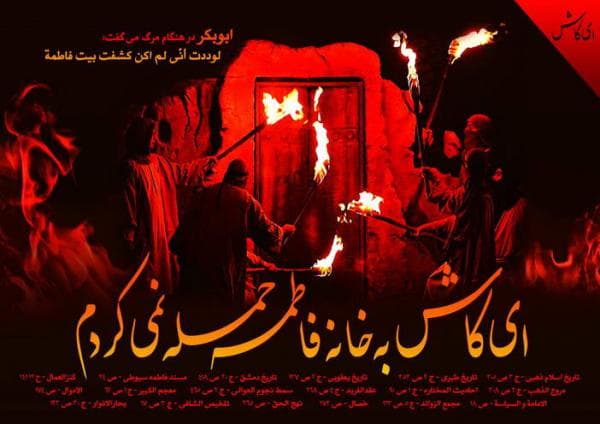
Statement of the objection:
What is established in the narrations is that it has not been proven that Umar (l) burned the house of Lady Fatimah (peace be upon her); rather, Umar (l) confined himself to a prudent threat.
Nowhere in the sound narrations is the burning of Lady Fatimah’s house (peace be upon her) explicitly stated. If a mere threat is deemed equivalent to the burning of Lady Fatimah’s house, then the threats narrated from the Noble Messenger (s) must likewise be understood literally, as he says:
“Indeed, Allah commanded me to burn Quraysh.”
God commanded me to burn Quraysh.
Al-Naysaburi, Muslim ibn al-Hajjaj Abu al-Husayn al-Qushayri (d. 261 AH), vol. 4, p. 2197, hadith 2865, Chapter: “The Characteristics by Which the People of Paradise and the People of Hell Are Recognized in This World,” Book of Faith, Chapter: “Clarification of Major Sins and the Greatest of Them,” edited by Muhammad Fu'ad Abd al-Baqi, publisher: Dar Ihya' al-Turath al-'Arabi – Beirut.
Abu Hurayrah reported that the Messenger of Allah (peace and blessings be upon him) said: “By Him in Whose Hand is my soul, I had intended to order that firewood be gathered, then to order that the call to prayer be made, then to appoint a man to lead the people in prayer, and then to go to men and burn their houses over them. By Him in Whose Hand is my soul, if any one of them knew that he would find a fat meaty bone or two good pieces of meat, he would surely attend the ‘Isha’ prayer.”
By Him in Whose Hand is my soul, I intended to order the gathering of firewood, then to instruct the muezzin to make the call to prayer, appoint someone to lead the people in prayer, and myself go to the homes of those who had stayed behind and set their houses ablaze over them.
Al-Bukhari al-Ju‘fi, Muhammad ibn Isma‘il Abu ‘Abdullah (d. 256 AH), Sahih al-Bukhari, vol. 1, pp. 231, 618, Book of Congregation and Imamate, chapter: “The Obligation of Congregational Prayer,” edited by Dr. Mustafa Dib al-Bugha, publisher: Dar Ibn Kathir, al-Yamamah–Beirut, 3rd edition, 1407 AH / 1987.
Yet no rational person infers from the preceding narrations that the Prophet of Islam (peace be upon him) actually burned Quraysh or those absent from congregational prayer; rather, one understands that the Prophet’s intention was to underscore the importance of calling people to the matter of tawhid and congregational prayer. Therefore, insisting that ‘Umar al-Faruq burned the house of Lady Fatimah (peace be upon her) is unfair and stems from prejudice.
Critical Review:
Equating these two threats is a false analogy, for there is no similarity whatsoever between the threat to burn the house of Fatimah and the threat reported from the Messenger of God concerning those absent from congregational prayer; for:
Firstly: This report is found in your books, and you must adduce evidence that is authoritative for us;
Secondly: Its implication cannot be accepted, for it is inconsistent with the Prophet’s noble character that he would threaten people with burning merely over a recommended act, rather than an obligatory one. When God Himself has not issued such a threat, can the Prophet threaten people with burning solely because they did not attend congregational prayer? The recommended status of an act conflicts with a threat of burning and is incompatible with the principles of the Sharia.
Thirdly: According to the reports of al-Tabari and Ibn Abi Shaybah, ‘Umar swore that if those gathered in the house of the Commander of the Faithful, peace be upon him, did not come out to pledge allegiance to Abu Bakr, he would burn the house with its occupants. Lady Fatimah, peace be upon her, also recalled ‘Umar’s words to the Commander of the Faithful, peace be upon him, and al-Zubayr, and swore by God that ‘Umar would fulfill his oath:
“By God, the gathering of these people in your house will not prevent me, should they assemble there, from ordering that the house be burned over them.” He said: When ‘Umar left, they came to her, and she said: “You know that ‘Umar came to me and swore by God that, if you returned, he would surely burn the house over you. By God, he will indeed carry out what he swore to do.”
By God, the gathering of these people in your house will not prevent the house from being burned. When ‘Umar departed, ‘Ali (a) and al-Zubayr returned to the house. The Prophet’s noble daughter said to ‘Ali and al-Zubayr: “‘Umar came to me and swore that if your gathering recurred, he would burn the house over you. By God, he will do what he has sworn!”
Ibn Abi Shaybah al-Kufi, Abu Bakr ‘Abd Allah ibn Muhammad (d. 235 AH), al-Kitab al-Musannaf fi al-Ahadith wa al-Athar, vol. 7, p. 432, hadith 37045, Kitab al-Maghazi, chapter: “What Has Been Reported concerning Abu Bakr’s Caliphate and His Conduct during the Ridda,” edited by Kamal Yusuf al-Hut, publisher: Maktabat al-Rushd, Riyadh, first edition, 1409 AH.
On the other hand, it is certain that the Commander of the Faithful, peace be upon him, paid no heed to Umar’s threats and was not willing to pledge allegiance.
Muhammad ibn Isma'il al-Bukhari writes:
“Fatimah became angry with Abu Bakr over this matter and therefore shunned him; she did not speak to him until she passed away. She lived for six months after the Prophet, peace and blessings be upon him, ... and he did not pledge allegiance during those months.”
Lady Fatimah, peace be upon her, became angry with Abu Bakr, severed relations with him, and did not speak to him until her death. She lived for six months after the Prophet (peace be upon him) ... and Ali (peace be upon him) did not pledge allegiance to Abu Bakr during those six months.
Al-Bukhari al-Ju'fi, Muhammad ibn Isma'il Abu Abd Allah (d. 256 AH), Sahih al-Bukhari, vol. 4, p. 1549, hadith no. 3998, The Book of Military Expeditions, chapter: The Expedition of Khaybar; edited by Dr. Mustafa Dib al-Bugha; publisher: Dar Ibn Kathir, al-Yamamah–Beirut; 3rd edition, 1407 AH / 1987.
Al-Naysaburi, Muslim ibn al-Hajjaj Abu al-Husayn al-Qushayri (d. 261 AH), Sahih Muslim, vol. 3, p. 1380, hadith no. 1759, The Book of Jihad and Military Expeditions, chapter: The Prophet’s statement, “We do not leave inheritance”; edited by Muhammad Fu'ad Abd al-Baqi; publisher: Dar Ihya' al-Turath al-'Arabi, Beirut.
Therefore, ʿUmar’s oath that, if they did not pledge allegiance, he would set the house on fire is a definite and certain matter. On the other hand, the Commander of the Faithful, peace be upon him, did not come forward to pledge allegiance; thus, ʿUmar carried out his threat and set the house ablaze.
Another testimony to this matter is a report that al-Balādhurī transmits concerning it:
“He did not pledge allegiance. Then ʿUmar came carrying a firebrand. Fāṭimah met him at the door and said: ‘O son of al-Khaṭṭāb! Do you see yourself setting my door on fire?!’ He replied: ‘Yes.’”
When ʿAlī, peace be upon him, did not pledge allegiance to Abū Bakr, ʿUmar went toward Fāṭimah’s house, peace be upon her, carrying a flame of fire. Fāṭimah, peace be upon her, came behind the door of the house and said: “O son of al-Khaṭṭāb! Do you intend to burn my house?” ʿUmar replied: “Yes!”
Al-Balādhurī, Aḥmad ibn Yaḥyā ibn Jābir (d. 279 AH), Ansāb al-Ashrāf, vol. 1, p. 252.
Fourthly: as noted above, ʿUmar’s oath that he would burn the house together with its occupants is certain. Since he swore this oath, either he acted upon its import—which establishes the Shiʿi position—or he did not act upon it. In that case, he was required to offer expiation for breaking his oath. Can you find any evidence, even a single weak narration, that ʿUmar paid the expiation for breaking his oath?
Fifth: We maintain that Umar carried out his threat, for Abu Bakr—who had ordered the burning and assault upon the House of Revelation—became deeply remorseful toward the end of his life.
Abu Bakr said: “Indeed, I regret nothing in this world except three things I did and wished I had not done, three things I left undone and wished I had done, and three things I wished I had asked the Messenger of Allah, peace and blessings be upon him, about. As for the three things I wished I had not done: I wished that I had not violated Fatimah’s house in any respect, even if they had closed it against us for war….”
I regret nothing in this world except three things that I did, three things that I did not do, and three things that I wish I had asked the Messenger of God (PBUH) about: I wished that I had not violated the sanctity of Fatimah’s house, even if it had been closed for war….”
Al-Tabari, Muhammad ibn Jarir (d. 310 AH), Tarikh al-Tabari, vol. 2, p. 353, publisher: Dar al-Kutub al-Ilmiyyah, Beirut;
Al-Dhahabi, Shams al-Din Muhammad ibn Ahmad ibn Uthman (d. 748 AH), Tarikh al-Islam wa-Wafayat al-Mashahir wa-al-A'lam, vol. 3, p. 118, edited by Dr. Umar Abd al-Salam Tadmuri, publisher: Dar al-Kitab al-Arabi, Lebanon/Beirut, first edition, 1407 AH / 1987 CE.
The Shafi‘i scholar al-Mas‘udi states explicitly in his book Ithbat al-Wasiyyah that Umar set the house on fire:
“They attacked him, burned his door, forcibly brought him out of it, and pressed the Lady of Women against the door until she miscarried Muhsin.”
“... Then they set out for Ali’s house, assaulted him, set his house on fire, and forcibly brought him out of the house. They pressed the leader of women (Fatimah) between the wall and the door until she miscarried her child, Muhsin.”
Al-Masʿūdī, Abū al-Ḥasan ʿAlī ibn al-Ḥusayn ibn ʿAlī (d. 346 AH), Ithbāt al-Waṣiyyah, p. 143.
Tāj al-Dīn al-Subkī includes al-Masʿūdī among the Shāfiʿī scholars and regards him as a historian, jurist qualified to issue fatwas, and eminent scholar:
“ʿAlī ibn al-Ḥusayn ibn ʿAlī al-Masʿūdī, author of historical works: the book Murūj al-Dhahab fī Akhbār al-Dunyā; the book Dhakhāʾir al-ʿUlūm; the book al-Istidhkār li-mā Marra min al-Aʿṣār; the book al-Tārīkh fī Akhbār al-Umam; the book Akhbār al-Khawārij; the book al-Maqālāt fī Uṣūl al-Diyānāt; the book al-Rasāʾil; and other works. It has been said that he was descended from ʿAbd Allāh ibn Masʿūd, may God be pleased with him. He was originally from Baghdad, where he resided for a time, though he lived mostly in Egypt. He was a traditionist and mufti, an eminent scholar, and a man of wit and curious reports.”
ʿAlī ibn al-Ḥusayn al-Masʿūdī was the author of historical books, including Murūj al-Dhahab ... and other works. It is said that he was a descendant of ʿAbd Allāh ibn Masʿūd; originally from Baghdad, he lived there for a period and spent most of his life in Egypt. He was a traditionist, qualified to issue fatwas, a scholar, and so forth.
al-Subkī, Tāj al-Dīn ibn ʿAlī ibn ʿAbd al-Kāfī (d. 771 AH), Ṭabaqāt al-Shāfiʿiyyah al-Kubrā, vol. 3, p. 456; edited by Dr. Maḥmūd Muḥammad al-Ṭanāḥī and Dr. ʿAbd al-Fattāḥ Muḥammad al-Ḥilw; publisher: Hajr for Printing, Publishing, and Distribution, 1413 AH, 2nd edition.
Sixth: Even if he had merely issued a threat, that threat alone could call into question the legitimacy of the caliphate of the caliphs, for it establishes that Lady Fāṭimah, the Commander of the Faithful, and their companions opposed Abū Bakr’s caliphate. This matter challenges the myth of a consensus in pledging allegiance to Abū Bakr.
Conclusion:
In view of the second caliph’s decisive resolve and the oaths he swore, and, on the other hand, in light of the evidence found in Sunni books, ʿUmar ibn al-Khaṭṭāb did not merely confine himself to threats; rather, he also put them into action.
Response to Doubts Group
The Research Institute of Ḥaḍrat Walī al-ʿAṣr (may God hasten his relief)
The Research Institute of Ḥaḍrat Walī al-ʿAṣr (may God hasten his relief)
Author: Hamed Sarem
Related articles

Comments
No comments yet.