Imam al-Hadi and the Management of the Shi'a Crisis
Author: Hamed Sarem
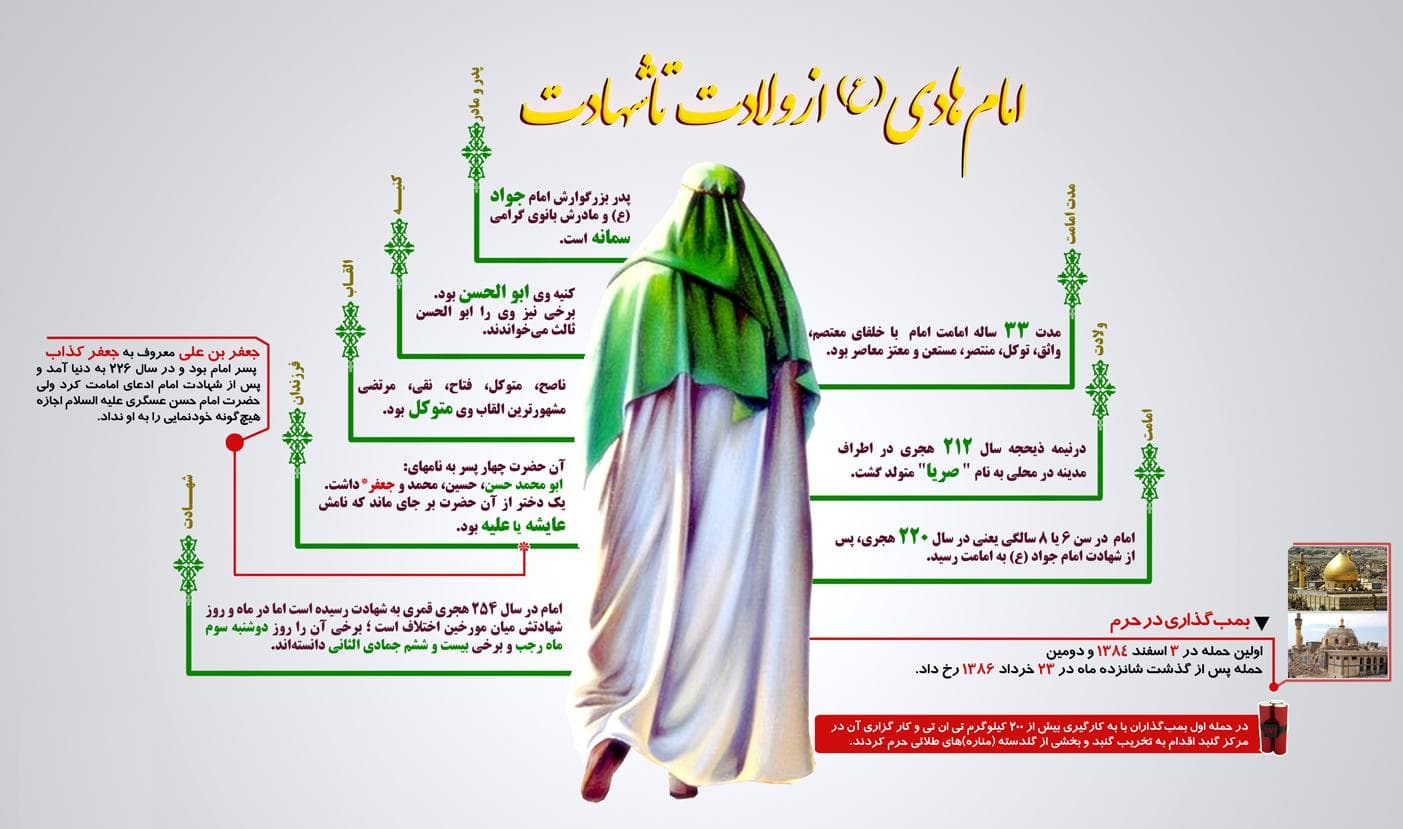
Imam al-Hadi (a) was the son of Imam al-Jawad (a) and the tenth star among the twelve guiding Imams of the Shi'a. He lived at the same time as six bloodthirsty caliphs of Banu al-Abbas: al-Mu'tasim, al-Wathiq, al-Mutawakkil, al-Muntasir, al-Musta'in, al-Mu'tazz, and al-Mu'tamid. In the end, he was poisoned by al-Mu'tamid and attained martyrdom (1).
The Conditions of Imam al-Hadi's Era
The time of Imam al-Hadi (a) was perhaps among the hardest periods the Shi'a experienced. On one side there was widespread killing of the Shi'a, and on the other side Imam al-Hadi was under surveillance and at times imprisoned. This reduced the connection between the body of the Shi'a community and Imam al-Hadi (a) to a minimum. At the same time, the spread of theological doubts from rival schools, the translation of philosophical books, and the spread of philosophical doubts placed Shi'a society in serious danger. Beyond all this, the occultation of the Imam of the Age (may God hasten his relief) was near, after the son of Imam al-Hadi, Imam Hasan al-Askari (a).
Preserving Shi'ism through the Guidance of the Guide of the Family of Muhammad (s)
Undoubtedly, if we consider Shi'ism as a religion and school without taking into account the presence of the infallible Imam within it, the survival of Shi'ism until today has no logical justification. This sect has had very few opportunities in its history to speak and live freely. Throughout history, the great figures of the Shi'a were pursued, spent their lives in prisons, or were martyred. The general body of the Shi'a too, because of their belief in the Household and their known love for the Household, faced the severest economic and social pressures and even widespread massacre.
Under such conditions, a group that was a minority compared to all Islamic schools should normally have collapsed from its roots. But Shi'ism has remained until today and, in the Islamic sciences of theology, jurisprudence, exegesis, and more, stands ahead of all schools and traditions. Undoubtedly, it has no rival in these matters. This did not occur except through the divine imamate of the Shi'a Imams.
The storms that surrounded the Shi'a in Imam al-Hadi's time should normally have led to the destruction of Shi'ism. But the guidance of the Guide of the family of Muhammad (s) not only prevented the true Shi'a school from collapsing; it enabled it to continue its path with strength. Through Imam al-Hadi's divine imamate, Shi'ism was even able to pass through the greatest crisis of its time: the occultation.
The insulting and bloodthirsty Abbasid caliphs were so wicked and unbelieving that during the time of that great Imam the Husayni sanctuary was destroyed and visitors of Husayn were martyred for the crime of visiting Abu Abdillah. They were a serious danger to the Shi'a. Yet apart from the bloodthirsty Abbasid caliphs, Shi'ism also faced an internal challenge.
The Order to Kill the Lying Extremist
At this time, Shi'ism faced internal crises as well: deviant currents that arose from within Shi'ism. A group following the desire of the soul launched the deviant current of exaggeration, a current that seriously challenged the body of Shi'ism and Shi'a teachings.
To fight this great deviation, Imam al-Hadi (a), given the harsh conditions of his time, adopted two paths. The first was scholarly guidance of the Shi'a and conveying correct beliefs to them. The second, which occurred among the later Shi'a Imams, was the physical removal of Shi'a liars. One of the innovators and liars attributed to Shi'ism was Faris ibn Hatim. Imam al-Hadi (a) ordered his killing, and he was sent to his doom by one of the Shi'a.
Faris was the son of Hatim ibn Mahwayh al-Qazwini. He was an extremist in belief, one of the famous liars and innovators. It is narrated that Imam al-Hadi (a) ordered his killing, declared his blood unprotected, and guaranteed Paradise for the one who killed him. Junayd found him and killed him (2).
Purifying Shi'a Belief
This command of the Imam is important from several aspects. Considering that in Imam al-Hadi's time there were many liars and no shortage of deviant sects, the Imam did not order the killing of the leaders of rival sects. Rather, he announced that the blood of Faris, who was an extremist, was unprotected.
It must be noted that this act of the Imam was a purification of Shi'a belief from deviation into exaggeration. The extremists entered Shi'a scholarly society wearing the garment of hypocrisy, with an outward appearance of Shi'ism and intense love for the Imam. Their danger was greater than opposing deviant sects, because they could easily gain access to the Shi'a hadith heritage, which by Imam al-Hadi's time had become a very large collection of narrations from the past Imams, and introduce change and distortion into it.
The Absence of Fabricated Narrations by the Blessing of Imam al-Hadi (a)
The Shi'a hadith heritage never fell into the hands of opponents of the Household, and the opponents were never able to create even the smallest breach in this collection of wisdom and divine sciences. But the current of extremists, which arose from within Shi'ism, was a great danger to the scholarly heritage of the Shi'a. For this reason, the Imam physically removed from the community those who were harmful and dangerous to the scholarly future of Shi'ism, so that today the purest hadith collections would be in the possession of the Shi'a, collections in which, undoubtedly, no trace of fabrication is seen (3).
The order to kill such people, who were agitating Shi'ism from within, caused Shi'a society to be able to face the crisis of occultation with internal calm. When it faced the occultation of its Imam, it was not afflicted by an internal problem.
The Function of the Agency Network
Among the acts of Imam al-Hadi (a) was creating the agency network widely across all Shi'a lands. Through this, the Imam could easily supervise and manage all Shi'a affairs. Although this agency network had very effective and special functions in the time of Imam al-Hadi and Imam Hasan al-Askari (a), it was also one of the most important factors in preserving Shi'a cohesion during the occultation.
This was because the network of agents was a safe and trusted path for Shi'a society to connect with an Imam who was many farsakhs away from where the Shi'a lived. This path, which the Shi'a had used and become accustomed to during the lives of two Imams, and whose correctness and trustworthiness they had become certain of, was the most reliable path during the Minor Occultation for connecting with the Hidden Imam. This network had passed its test among the Shi'a and was trusted. Moreover, the people who formed the body of this network were mostly among the great Shi'a figures and had been endorsed by the two Imams from the time of Imam al-Hadi and Imam Hasan al-Askari (a). Therefore, the Shi'a did not face a problem in communicating with the Imam who lived behind the veil of occultation, the Minor Occultation. This connection with the infallible Imam was not a place of doubt or suspicion.
Honoring Jurists to Prepare for the Era of Occultation
The agency network was one of the methods for preparing the Shi'a for the era of occultation. Another was magnifying the status of Shi'a scholars and those knowledgeable in the statements of the Household. Honoring them can be considered one of Imam al-Hadi's far-sighted measures for the time of the Master of the Age's occultation.
A Shi'a jurist (4) debated a Nasibi and, in argument, defeated him and exposed the corruption of his belief. Then he came to Imam al-Hadi (a) and was honored by entering the presence of that noble Imam. In the Imam's gathering, a group of elders from Banu Hashim and Banu Abbas were seated, and there was a special place for Imam al-Hadi (a) at the head of the gathering. When this jurist entered, the Imam invited him to the upper part of the gathering and seated him in his own special place. This was heavy for Banu Hashim and Banu Abbas, because that jurist was neither from Banu Hashim nor from Banu Abbas.
In response to the objection of Banu Hashim, the Imam said: “How do you deny his elevated station when God has elevated his place? Truly, defeating a Nasibi by means of the divine proofs he has learned is better than every honor and lineage” (5).
The Heavy Duty of the Shi'a during the Occultation
By drawing attention to the rank and duty of the jurists, the Imam placed on their shoulders the burden of guidance and preventing the community from misguidance. He said: “Were it not, after the occultation of the Qa'im (may God hasten his relief), for scholars who call to him, guide toward him, and defend his religion, no one would remain on earth except that he would apostatize.”
Therefore, one of the elements of preparing Shi'a society for the age of occultation is drawing attention to the Shi'a jurists. On one side this prepares the community; on the other, it defines a duty for jurists: in the time of occultation, the jurist must perform three tasks: 1. call toward the Imam of the Age; 2. guide toward the Imam of the Age; 3. scientifically defend the religion of the Imam of the Age.
Imam al-Hadi (a) says: “These scholars preserve the hearts of the Shi'a just as the captain of a ship holds its rudder; and these scholars are the best ones before God” (6).
Notes
1. Bihar al-Anwar, vol. 50, p. 114, chapter on his names, titles, teknonyms, and birth.
2. Usul al-Kafi, Kamara'i translation, vol. 3, p. 553, chapter on the birth of the Master (a).
3. A fabricated narration means a false and lying narration made by a liar and attributed to the Imam. Such a hadith never entered Shi'a hadith collections. What is disputed and discussed among Shi'a scholars is weak narration. A weak narration does not mean a fabricated narration; its problem is only weakness in the chain that attributes the report to the Imam, and this same weak narration can become authentic when joined with contextual indicators. Therefore, fabrication, which does not exist among the Shi'a, is fundamentally different from weakness of narration, and the two must not be confused.
4. Here, jurist does not mean the modern technical meaning; rather it means the sense used in narrations, though jurist in today's technical sense is broader than its usage in narrations.
5. al-Ihtijaj, vol. 2, p. 500.
6. Ibid.
Author: Hamed Sarem
Related articles

Comments
No comments yet.