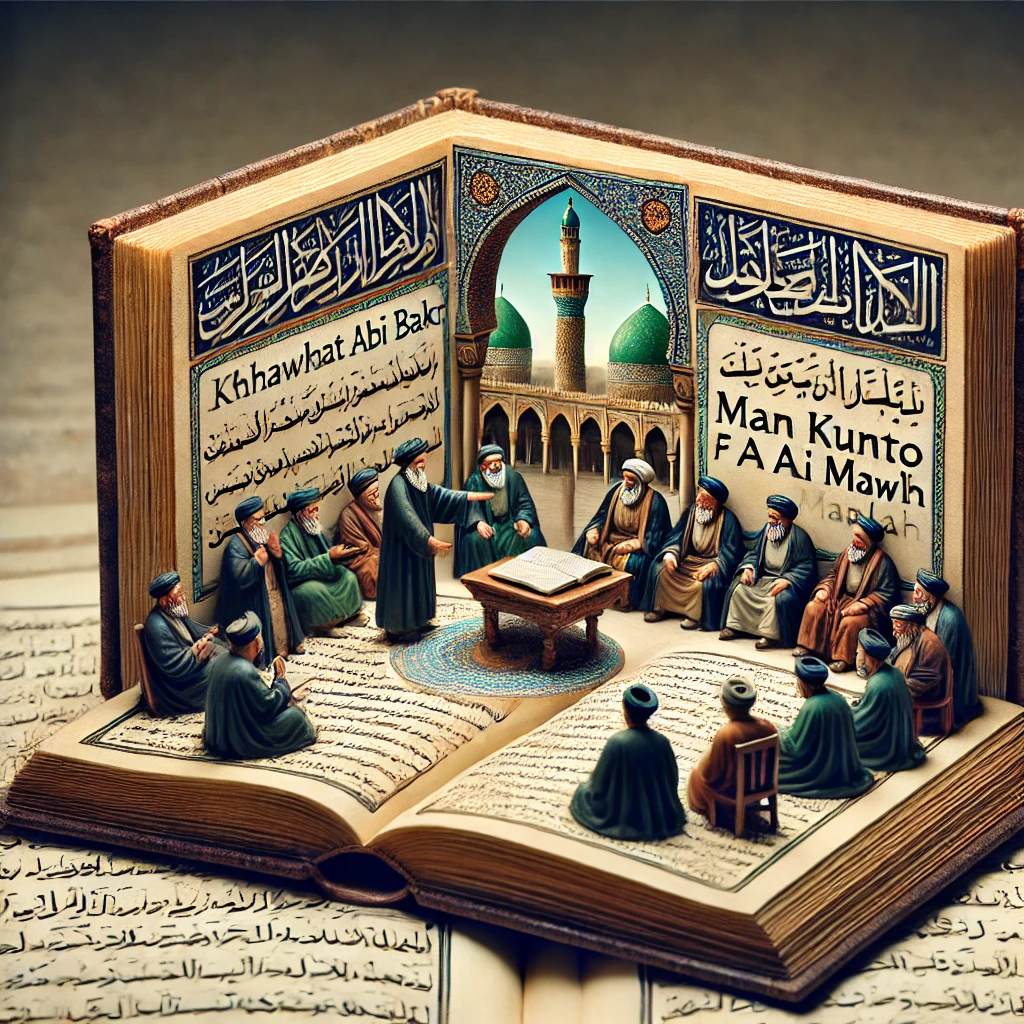
Allama Mir Hamid Husayn’s Methodology in Defending the Ahl al-Bayt (peace be upon them): A Comparative Analysis of Hadith-Criticism Approaches in ‘Abaqat al-Anwar
Author: Hamed Sarem
Abstract
Sayyid Mir Hamid Husayn, one of the most eminent Shi‘i scholars, especially in his books such as ‘Abaqat al-Anwar, defended the legitimacy of the Ahl al-Bayt (peace be upon them) and critiqued the views of opponents through the use of precise scholarly and argumentative methods. This abstract examines his principal methods and approaches in critiquing and analyzing hadiths and the arguments of opponents:
1. Refuting the arguments of opponents: Sayyid systematically refutes the arguments of opponents by using mutawatir hadiths and analyzing the conduct of the Companions.
2. Examining the chains of transmission and meanings of hadiths: Through a precise examination of chains of transmission and an analysis of the implications of hadiths, he exposes the weaknesses in the arguments of opponents.
3. Attention to the circumstances in which hadiths were issued: Sayyid gives particular attention to the circumstances and time in which hadiths were issued, demonstrating that many hadiths were pronounced under specific conditions.
4. Using Sunni hadiths: He uses Sunni hadiths to refute the arguments of opponents.
5. Countering fabricated hadiths: By carefully examining fabricated and weak hadiths, Sayyid invalidates the arguments of opponents.
These methods not only emphasize the importance of fairness, precision, and commitment to truth, but also demonstrate that the virtues of the Ahl al-Bayt (peace be upon them) are undeniable and that any attempt to distort them will face scholarly and ethical challenges. This abstract can serve as a model for researchers in the fields of hadith, doctrine, and history.
Reason: A Shield against Deception and Lies
Reason is a divine gift that enables human beings to distinguish truth from falsehood. When reason encounters the truth, it acknowledges it and does not rebel against it. This quality has made reason a divine proof for all people. God has founded His program of guidance upon this very reason and has sent proofs whose truthfulness becomes manifest through rational consideration.
Yet, in opposition to the current of guidance, misguiders have always sought to prevent reason from making sound discernments. Since reason never accepts falsehood in place of truth, misguiders resort to falsification and deception. By concealing facts and presenting events in a distorted manner, they try to lead reason into error. Their aim is for human beings to choose, mistakenly, the path of darkness instead of moving toward the light. Their wicked schemes manifest themselves in the form of extraordinary fabrications, document forgery, document destruction, distortion, concealment of facts, and even false testimony. These methods have been repeated many times throughout history and continue even today. The result is the inversion of truth, such that falsehood presents itself to people as truth.
Throughout history, the hypocrites who spared no conspiracy during the lifetime of the Noble Prophet (peace be upon him) continued their betrayals after his passing as well. They sought to keep society away from the truth and to marginalize the Prophet’s Ahl al-Bayt (peace be upon them)—who were the most deserving of closeness to the Prophet and the most knowledgeable among them. Their principal aim was to deprive human society of the knowledge and light of the Ahl al-Bayt (peace be upon them). Meanwhile, some writers, too, were engaged in concealing facts and obscuring the sun of guidance. They exerted every effort to hide the divine light of guidance in darkness and to introduce ignorant people to later generations as signs of guidance.
Allamah Mir Hamid Husayn: A Scholar Who Turned Doubts into a Joke
Against these obscurantist efforts, eminent thinkers and scholars, through sacrifice and renunciation of worldly pleasures, devoted all their strength and lives to research and writing. Through precise and methodical investigations, they refuted falsehood and established the truth. One of these great figures was Allamah Sayyid Mir Hamid Husayn al-Hindi. Through tireless effort and unparalleled self-sacrifice, he was able to introduce his master, the Commander of the Faithful, Ali (a), to the people in the light. He acted in such a way that no one could deny this great truth through fabrication, concealment of the truth, or distortion of established realities. But by what research method did he attain this success? In previous writings, we examined his method of assessing chains of transmission and arguing from principles; in this article, we will examine his method of responding to the distortions and objections in the book Tuhfah Ithna Ashariyyah.
Sayyid Mir Hamid Husayn, in addition to his scholarly qualities and precision in discussion, observed the utmost care in the accuracy of quotations and in attributing words to different individuals. Since lies must always be colored to resemble truth in order to provide a pretext for making falsehood acceptable, the late Allamah Mir Hamid Husayn scrutinized the book Tuhfah Ithna Ashariyyah line by line and word by word. Indeed, it appears as though Tuhfah Ithna Ashariyyah does not contain even a single sentence that is correct and consistent with reality. The contradictions and inconsistencies in the statements of the author of Tuhfah and his students and teachers have become so evident that no share of truth can be found in Tuhfah. Like his forefather, Prophet Abraham (a), who left no excuse for idolaters, Allamah Mir Hamid left no excuse for those who keep the Commander of the Faithful, Ali (a), in darkness and turn away from him.
The author’s greatness, his precision, his mastery of the sciences, his pursuit of statements, his fidelity in transmission, and his practical commitment to the rules of research—all of these become evident in his methods of answering objections or critiquing arguments. With the strongest proofs and most decisive evidence, he closed every path and excuse and repelled every doubt and ambiguity, so that opponents were left with no way to disparage the school, challenge the proof, or weaken the hadith—except that he repelled it in the best manner and answered with elegant responses: “with subtle investigations, beautiful precision, demonstrative arguments, prophetic obligations, Alid proofs, and Razavi refutations.” In all of this, he cited Sunni books and argued from the statements of their leading scholars in various sciences and disciplines.
He answered or criticized every word that appeared in Tuhfah. He often responded to the author of Tuhfah’s words with what that author himself had stated in the same book or in his other works, and at times refuted them with the words of his father and other teachers and shaykhs. This went so far that the twelfth chapter of Tuhfah became a collection of poetic letters and Indian phrases at which people laughed. At times, he also discussed the words of its author’s teacher and father, Wali Allah Dihlawi, and the words of his students, especially Muhammad Rashid al-Din Khan Dihlawi and Haydar Ali Fayzabadi. Indeed, he answered and investigated everything that those fanatical deniers of truths—such as the sons of Taymiyyah, Jawzi, Hajar, and many others—had advanced to disparage the school of the Ahl al-Bayt.
Abaqat al-Anwar: An Encyclopedia That Showed the World the Light of the City of Knowledge
In examining the famous hadith, “Ana Madinat al-Ilm wa Aliyyun Babuha” (“I am the city of knowledge, and Ali is its gate”), Allamah Mir Hamid Husayn responded with unparalleled precision and depth to all the objections and criticisms raised by Dihlawi and others. In one complete volume, he established this narration comprehensively and argumentatively from the standpoint of its chain of transmission alone. He then clearly expounded the imamate of the Commander of the Faithful, Ali (a), through a precise examination of the hadith’s import and by relying on this hadith. In one volume, the investigating Allamah answered every objection to this famous hadith raised in Tuhfah Ithna Ashariyyah. But his work did not end there; in the second volume, he addressed all those who had objected to this hadith from every possible angle. With this breadth and precision, he examined and investigated the Hadith of the City of Knowledge across two volumes.
With unparalleled comprehensiveness and precision, Allamah Mir Hamid Husayn answered all the objections of prominent Sunni scholars, from the early authorities to the later ones, from every city and land. This breadth and depth of research made Abaqat al-Anwar into a theological, scholarly, and historical encyclopedia. This work is among the most important and extensive books in the field of doctrinal discussions, written in a rigorous scholarly manner and according to all the standards of a research-based and academic inquiry.
Abaqat al-Anwar is recognized not merely as a defensive book, but as an unparalleled scholarly and historical reference in the field of beliefs. Through this work, Allamah Mir Hamid Husayn not only clearly demonstrated the truth of the Ahl al-Bayt (a), but also left for later researchers a model of deep and methodical inquiry. Thus, this book became a theological, scholarly, and historical encyclopedia and one of the most important and extensive works written on doctrinal disputes. In what follows, we set out some important aspects of the book’s features in its method of scholarly discussion.
Quoting the Opponent’s Words in Full: A Fair and Scholarly Method
The practice of Shiite scholars is generally to quote the opponent’s words in full and then respond to them. Sayyid Mir Hamid Husayn likewise quoted, without addition or omission—and even without paraphrase—the words of Dihlawi and everyone who sought to criticize them. After quoting the passage as a whole, he then quotes it sentence by sentence and responds.
Comprehensive Coverage: Fundamental and All-Encompassing Responses
Allamah Mir Hamid Husayn does not content himself with brief answers. He does not consider a merely dismissive or counterargumentative reply sufficient; rather, he considers every aspect of an objection, answers it from different angles, and leaves no aspect unattended. He responds in a fundamental and radical manner, so that what Shi‘i opponents have built upon deception, distortion, and prejudice is destroyed from its very foundations.
Hadith al-Thaqalayn and Ibn al-Jawzi’s Critique: A Precise Examination of a Key Hadith
Hadith al-Thaqalayn is among the most important hadiths used as evidence for the Imamate of the Ahl al-Bayt (peace be upon them). Ibn al-Jawzi included this hadith in his book al-‘Ilal al-Mutanahiyah fi al-Ahadith al-Wahiyah. In this book, he collected unreliable and fabricated reports. He transmits the report as follows:
“A hadith concerning the bequest regarding the ‘Itrah: ‘Abd al-Wahhab al-Anmati informed us; he said: Muhammad ibn al-Muzaffar informed us; he said: Ahmad ibn Muhammad al-‘Atiqi narrated to us; he said: Yusuf ibn al-Dakhil narrated to us; he said: Abu Ja‘far al-‘Uqayli narrated to us; he said: Ahmad ibn Yahya al-Halwani narrated to us; he said: ‘Abd Allah ibn Dahir narrated to us; he said: ‘Abd Allah ibn ‘Abd al-Quddus narrated to us, from al-A‘mash, from ‘Atiyyah, from Abu Sa‘id, who said: The Messenger of Allah, peace and blessings be upon him, said: I leave among you two weighty things: the Book of Allah and my ‘Itrah; and these two shall not separate until they come to me at the Pond. So see how you treat them after me.”
He then impugns this hadith and says:
“This hadith is not sound. Ahmad, Yahya, and others declared ‘Atiyyah weak. Yahya said of Ibn ‘Abd al-Quddus: He is nothing; he is a malicious Rafidi. And Ahmad and Yahya said of ‘Abd Allah ibn Dahir: He is nothing; there is no good in one who writes hadith from him.”
Allamah Sayyid Mir Hamid Husayn offers 156 responses to Ibn al-Jawzi’s objection. Some of these arguments are as follows:
1. Refuting the claim that the hadith is weak: Some Sunni scholars, citing authoritative hadith books, rejected the weakness of this hadith and regarded it as authentic.
2. Examining the narrators: The reliability of narrators such as ‘Atiyyah, Ibn ‘Abd al-Quddus, and ‘Abd Allah ibn Dahir has been carefully examined.
3. Sunni scholars’ criticism of Ibn al-Jawzi: A group of Sunni scholars, including Sibt Ibn al-Jawzi, al-Sakhawi, al-Samhudi, Ibn Hajar al-Makki, and al-Manawi, criticized Ibn al-Jawzi’s mistake in including this hadith in al-‘Ilal al-Mutanahiyah.
- Sibt Ibn al-Jawzi: He expressed astonishment that this hadith had escaped his grandfather’s notice.
- Al-Sakhawi and al-Samhudi: They considered the inclusion of this hadith in al-‘Ilal al-Mutanahiyah incorrect and warned against this error.
Ibn Hajar al-Makki and al-Manawi: They regard this mistake as resulting from Ibn al-Jawzi’s oversight or error.
Many Sunni scholars have considered the hadith in question authentic and have rejected the claim that it is weak.
A Critique of the Hadith Attributed to the Prophet Regarding Abu Bakr: Examining a Historical Fabrication
While responding to opponents of the well-known hadith, “I am the city of knowledge and Ali is its gate,” Ibn al-Jawzi cited a hadith claiming that the Prophet ﷺ said: “God did not place anything in my breast except that He placed it in Abu Bakr’s breast.”
Criticisms of this hadith:
1. Contradiction with reality: This hadith is inconsistent with historical and logical evidence.
2. Explicit declaration that the hadith is fabricated: Many Sunni scholars, including Ibn al-Jawzi, al-Tibi, Ibn Qayyim al-Jawziyya, and others, have deemed this hadith fabricated.
Ibn Qayyim: He described this hadith and other similar hadiths concerning Abu Bakr’s merits as fabricated and devoid of اعتبار.
Examples of these fabricated hadiths include:
God’s manifestation on the Day of Resurrection specifically for Abu Bakr.
The Prophet’s affection for Abu Bakr’s white hair as a sign of Paradise.
Conclusion:
In addition to contradicting reality, these traditions have been identified by leading Sunni scholars as fabricated hadiths and are not reliable for citation. This is a brief and condensed example of Allamah Sayyid Mir Hamid Husayn’s investigation into one of Ibn al-Jawzi’s objections. As can be seen in this summary, he demolished from its foundations the edifice of concealing the truth concerning the Ahl al-Bayt, peace be upon them.
Allamah Mir Hamid Husayn: Defender of the Sanctuary of Wilayah and Illuminator of Truths
Given the breadth of Allamah Mir Hamid Husayn’s research and his scholarly comprehensiveness, no room remains for objection or doubt concerning the proofs that establish the legitimacy of Amir al-Mu'minin Ali, peace be upon him. Allamah Sayyid Mir Hamid Husayn worked in such a manner that he left no space for doubts and objections to roam. It should not be forgotten that the efforts of the author of ‘Abaqat al-Anwar reveal the reality that some people, under the pretext of examining chains of transmission and warning the public about fabricated and invented reports, also set aside many sound and reliable narrations—under the guise of goodwill—on the pretext that they are fabricated and forged. This is itself a clear instance of concealing the truth.
In this scholarly struggle, Allamah Mir Hamid Husayn did not confine himself to criticizing the book Tuhfah Ithna ‘Ashariyyah. He thoroughly demolished all that the opponents had constructed through such tools as the burning of documents, fabrication of documents, concealment, and distortion. He not only exposed the distortions in Tuhfah Ithna ‘Ashariyyah, but also subjected all the companions and supporters of this current to meticulous criticism and examination in this regard. In every subject he addressed, he left none of the opponents’ words unanswered and responded to all their objections.
This mujahid and defender of the sanctuary of Wilayah did not confine himself merely to the objections and statements of the opponents; rather, he also addressed and answered objections and criticisms that they had not raised but might have raised. For example, regarding the well-known hadith, “The likeness of my Ahl al-Bayt among you is like Noah’s Ark...,” although Dihlawi only challenged the hadith’s implication and did not impugn its chain of transmission, Allamah Mir Hamid Husayn, in addition to examining its implication, also discussed its chain. May God have mercy on Sayyid; he mentions the names of 92 transmitters of this noble hadith, beginning with major Sunni figures such as al-Shafi‘i, Ahmad ibn Hanbal, and Muslim ibn al-Hajjaj, and continuing to his own contemporaries. This action was a firm response to Ibn Taymiyyah, who had accused this hadith of fabrication and forgery in harsh language. With scholarly rigor and precision, Allamah Mir Hamid Husayn answered these baseless claims and clearly established the authenticity of the hadith.
This comprehensive and meticulous approach of Allamah Mir Hamid Husayn not only rendered the opponents’ distortions and objections ineffective, but also presented an unparalleled model of scholarly inquiry and defense of the truth of the Ahl al-Bayt, peace be upon them. Through these efforts, he safeguarded the sanctuary of Wilayah and preserved the truths from every form of distortion and concealment.
The Hadith of the Ahl al-Bayt and Noah’s Ark: An Example of Allamah Mir Hamid Husayn’s Scholarly and Comprehensive Method
The hadith likening the Ahl al-Bayt to Noah’s Ark is an example of Allamah Mir Hamid Husayn’s scholarly, comprehensive, and expansive method in examining the opponents’ views and responding to them. Allamah Mir Hamid Husayn discussed other narrations with the same breadth and comprehensiveness, including narrations such as the Hadith of Position, which is mutawatir and has been transmitted in the two Sahihs. This breadth of discussion, the critique of the opponents’ views, and the documentary establishment of narrations from the perspective of the opponents’ leading scholars have made ‘Abaqat al-Anwar a tableau displaying the depth of this group’s prejudice and hostility toward Amir al-Mu'minin Ali, peace be upon him. This book clearly shows how much slander, falsehood, and concealment have been employed to deprive Amir al-Mu'minin Ali, peace be upon him, of his right. It is as though lies, slander, and distortion were this group’s foremost principle and scholarly method.
An Examination of the Hadith: «أنت مني بمنزلة هارون من موسى»
The hadith, “You are to me as Aaron was to Moses,” which is certainly mutawatir, is transmitted in the two Sahihs, and whose soundness and firmness have been emphasized by leading imams, was examined meticulously by Allamah Mir Hamid Husayn. In numerous chapters, he examined the chain of transmission of this hadith in order to answer al-Amidi and his prejudiced followers, who had claimed that this hadith is not sound.
It is clear that had he not addressed this aspect of these two hadiths, no one could have objected to him, for Dihlawi—whose response is at issue—had not addressed this aspect. Yet ‘Abaqat al-Anwar, which was composed to establish the Imamate of the Immaculate Imams, necessarily had to respond to this absurd claim uttered by these people and demonstrate to the scholarly community the extent of their prejudice and how they resort to lies and slander.
Consulting Primary Sources: One of Allamah Mir Hamid Husayn’s Important Methods
One of the important methods of Allamah Sayyid Mir Hamid Husayn is to consult the original sources from which objections have been transmitted. This method leads to the discovery of many truths that are highly significant for those who genuinely wish to know the truth. Among these benefits is the exposure of Dihlawi’s plagiarism from others.
The Exposure of Dihlawi’s Plagiarism
One of the most important points that the Allamah intends to make is that Dihlawi presented nothing new; rather, everything he brought forth had already been mentioned in the books of earlier scholars. Sayyid, may Allah have mercy on him, even proved that the book Tuhfah Ithna ‘Ashariyyah was plagiarized from the book Sawa‘iq by Nasr Allah Kabuli, with additions from the statements of his father and Husam al-Din Saharanpuri, the author of Marafid. Likewise, ‘Abd al-‘Aziz Dihlawi’s book Bustan al-Muhaddithin was plagiarized from the book Kifayat al-Mutatalli‘ by Taj al-Din Dahan. This is a great benefit, demonstrating that Dihlawi possessed little originality in his research.
The Exposure of the Falsity of Many Attributions
By consulting the original sources that raised the objections, the baselessness of many attributions also becomes evident. It becomes clear that in the words of this group, in their disputation with the Imamiyyah, there are statements and attributions that have no basis or reality whatsoever. Throughout his investigations, he points to such cases and presents examples of them:
Some, in response to the Hadith al-Tayr, have said: “Ibn al-Jawzi included it in the book al-Mawdu‘at.” This attribution is false.
They have attributed to Hafiz Yahya ibn Ma‘in, concerning the hadith “I am the City of Knowledge,” that he said: “This hadith has no chain of transmission at all.” This attribution is entirely false.
They have attributed to al-Tirmidhi, concerning the hadith “I am the City of Knowledge,” that he said: “This hadith is objectionable and strange.” This attribution is baseless.
They have attributed criticism of the hadith “I am the City of Knowledge” to Shams al-Din Ibn al-Jazari. This attribution is false.
Ibn Taymiyyah attributed to the two Sahihs a hadith that is alleged to be found in them, saying:
“Do you not see that it is established in the two Sahihs that the Prophet, peace and blessings be upon him, in the hadith concerning the captives, when he sought counsel from Abu Bakr, Abu Bakr proposed ransom; and when he sought counsel from ‘Umar, ‘Umar proposed killing. Then the Prophet said: I shall inform you of your companion. O Abu Bakr, you are like Abraham, who said: «فَمَنْ تَبِعَنِي فَإِنَّهُ مِنِّي وَ مَنْ عَصانِي فَإِنَّكَ غَفُورٌ رَحِيمٌ», and like Jesus, who said: «إِنْ تُعَذِّبْهُمْ فَإِنَّهُمْ عِبادُكَ وَ إِنْ تَغْفِرْ لَهُمْ فَإِنَّكَ أَنْتَ الْعَزِيزُ الْحَكِيمُ». And O ‘Umar, you are like Noah, who said: «رَبِّ لا تَذَرْ عَلَى الْأَرْضِ مِنَ الْكافِرِينَ دَيَّاراً», and like Moses, who said: «رَبَّنَا اطْمِسْ عَلى أَمْوالِهِمْ وَ اشْدُدْ عَلى قُلُوبِهِمْ فَلا يُؤْمِنُوا حَتَّى يَرَوُا الْعَذابَ الْأَلِيمَ». ”
However, no such hadith exists in the two Sahihs.
Some have denied al-Bayhaqi’s narration of the hadith of resemblances: “Whoever wishes to look at Adam in his knowledge and at ... should look at Ali ibn Abi Talib.” This denial was in response to Allamah al-Hilli, who had cited al-Bayhaqi’s narration as evidence. Sayyid answered this denial in detail.
Fakhr al-Razi claimed that Ibn Ishaq did not transmit the Hadith of Ghadir, and that his failure to transmit it proves the weakness of this hadith. This claim is false, for Ibn Ishaq was not unaware of the transmission of the Hadith of Ghadir; rather, he was among the transmitters of this hadith, and a group transmitted it from him.
Shaykh Ali al-Qari and Wali Allah al-Dihlawi attributed the following fabricated hadith:
“Follow the two who come after me, Abu Bakr and Umar” («اقتدوا باللذين من بعدي أبي بكر و عمر»)—meaning, “Follow me, and after me follow Abu Bakr and Umar”—was attributed to the two Sahihs, but this attribution is false and baseless. Al-Hakim explicitly stated in his Mustadrak that the two of them, al-Bukhari and Muslim, did not transmit this hadith.
Among the benefits of this method is that it exposes part of the tampering by this fanatical and obstinate group with hadiths and the statements of scholars. This subject is extremely broad, and if it were collected, it would itself become an independent book. It is not inappropriate to mention an example of it:
Tampering with Hadiths by This Group: Examples of Deliberate Distortion and Alteration
One clear example of tampering with hadiths is the alteration of the hadith: «إن عليّا مني و أنا من عليّ و انه ولي كل مؤمن من بعدي» (“Ali is from me, and I am from Ali, and he is the guardian of every believer after me”). Al-Tirmidhi transmitted this hadith in full, but al-Baghawi omitted the word «بعدي» and attributed it to al-Tirmidhi. This alteration was also repeated by a group, including Saharanpuri, the author of al-Marafid, and Mawlawi Hasan Ali Muhaddith, a student of Mawlawi Abd al-Aziz al-Dihlawi.
Muhammad ibn Mutamad Khan Badakhshi even claimed, in a treatise entitled Radd al-Bid‘ah, that the word «بعدي» in this hadith is fabricated.
Shah Wali Allah al-Dihlawi also transmitted this hadith in its complete wording in his book Izalat al-Khafa’. Yet, when responding to it, he substituted the word «أنا» for «انه» and omitted the word «بعدي», just as al-Baghawi and his followers had done.
These deliberate alterations in hadiths indicate an effort to distort the truths and diminish the standing of Amir al-Mu’minin Ali (peace be upon him). Such acts not only call these individuals’ scholarly credibility into question, but also reveal their fanaticism and hostility toward the Ahl al-Bayt (peace be upon them).
Examining the Chains and Implications of Hadiths: Allamah Mir Hamid Husayn’s Scholarly Method
For a hadith to be admissible as evidence, its chain of transmission must first be evaluated, and then its indication of the claim must be established completely. This principle lies at the center of many of Sayyid Mir Hamid Husayn’s responses and discussions. His method for examining chains is as follows:
1. Citing the hadith along with its chain of transmission: he narrates the hadith with its complete chain, or through all reliable sources when multiple chains exist.
2. Assessing the status of the principal narrator: the status of the hadith’s principal narrator is examined in all available chains.
3. Examining common narrators: the status of narrators who are shared by several chains, or by all of them, is analyzed.
4. Analyzing the circumstances of the other narrators: the circumstances of the remaining narrators are examined according to the views of Sunni scholars of al-jarḥ wa al-taʿdīl.
5. Attention to weaknesses in the chain: defects in the chain, such as irsāl and other shortcomings, are taken into account.
Even if the opponent has not cited a hadith, Sayyid examines and refutes its chain when a similar report exists in the opponent’s sources, in order to demonstrate the weakness of the opponent’s argument.
Examination of the Hadith Cited by al-ʿĀṣimī
To counter the hadith, “I am the city of knowledge and ʿAlī is its gate,” al-ʿĀṣimī cited a hadith from the Noble Prophet (PBUH) that attributes particular qualities to some of the Companions:
Abū Bakr: the most compassionate person toward the community.
ʿUmar: the strictest in the matters of God.
ʿUthmān: the most truthful out of modesty.
Muʿādh ibn Jabal: the most knowledgeable regarding what is lawful and unlawful.
Zayd ibn Thabit: the most learned in jurisprudence.
Ubayy ibn Ka'b: the foremost reciter.
Abu Ubaydah: the trustee of the community.
Examination of the Hadith’s Chain of Transmission
Sayyid Mir Hamid Husayn examined this hadith in detail and enumerated its weaknesses as follows:
1. All chains revolve around Anas ibn Malik: Anas ibn Malik, whose enmity toward Amir al-Mu'minin Ali (peace be upon him) is well known, is the principal narrator of this hadith.
2. The weakness of the narrators: Some chains include narrators such as Abu Qilabah, Khalid al-Hadhdha', Abd al-Wahhab al-Thaqafi, Muhammad ibn al-Muthanna, Waki' ibn al-Jarrah, and others, whom scholars of al-jarh wa al-ta'dil have judged weak or accused of lying.
3. The mursal nature of some chains: Some chains are mursal, and a mursal hadith is weak and inadmissible as evidence according to the majority of hadith scholars.
Hadith Scholars’ Views on the Hadith
Sayyid reports that scholars such as Ibn Hajar, al-Nawawi, and al-Suyuti emphasized the weakness of the hadith and regarded it as mursal. He also points to al-'Asimi’s direct transmission from Abu Qilabah and Qatadah without mentioning a chain, and critiques these cases as well from various perspectives.
Final Analysis
This examination shows that the hadith cited by al-'Asimi suffers from fundamental defects in both its chain and its content. Relying on weak and mursal reports to counter documented and reliable hadiths is an unprincipled method, and the contradiction in al-'Asimi’s reasoning reveals the groundlessness of his view.
Examining the Circumstances of Hadith Issuance and Analyzing Them
One of Sayyid Mir Hamid Husayn’s methods in examining hadiths is to pay attention to the circumstances in which they were issued. This approach has a significant effect on discovering the truth and properly understanding texts. As an example, two hadiths are examined:
The Hadith of ‘Abd Allah ibn Mas‘ud’s Approval:
Dihlawī has narrated a hadith in which the Noble Prophet (PBUH) said: “I have approved for you what Ibn Umm ‘Abd (‘Abd Allah ibn Mas‘ud) approved.” At first glance, this hadith appears to indicate the Prophet’s absolute approval of Ibn Mas‘ud’s decisions. However, through a precise examination of the circumstances in which the hadith was issued and the accompanying evidence, Sayyid Mir Hamid Husayn shows that this hadith is confined to a specific matter and cannot stand against the Hadith al-Thaqalayn, which emphasizes the status of the Ahl al-Bayt, peace be upon them.
This hadith appears in al-Hakim’s al-Mustadrak and refers to an event in which the Prophet asked Ibn Mas‘ud to recite the Qur’an. After he recited the verses, the Prophet praised him and said: “I have approved for you what Ibn Umm ‘Abd approved.” Yet the context of the narration indicates that this statement was limited to his approval of God, the Prophet, and the religion of Islam.
Conclusion and Analysis:
Examining the circumstances in which hadiths were issued reveals their precise meaning and prevents incorrect interpretations. Sayyid Mir Hamid Husayn has shown that many hadiths have been used—through superficial readings or even distortion—to oppose the authentic hadiths of the Ahl al-Bayt (peace be upon them). Yet careful analysis shows that these hadiths not only lack the power to oppose them, but in their more accurate versions, they affirm the exalted status of the Ahl al-Bayt.
An Enduring Legacy of Research and Defending the Truth
Through these precise and scholarly methods, ‘Allamah Mir Hamid Husayn not only rendered the distortions and objections of opponents ineffective, but also presented an unparalleled model of scholarly inquiry and defense of the legitimacy of the Ahl al-Bayt (peace be upon them). Through these efforts, he safeguarded the sanctuary of wilayah and preserved the truths from every form of distortion and concealment.
Dihlawī’s Challenges to the Hadith al-Thaqalayn: An Examination of Sayyid Mir Hamid Husayn’s Responses
In an effort to counter the virtues of the Ahl al-Bayt, peace be upon them, ‘Abd al-‘Aziz Dihlawī compared the Hadith al-Thaqalayn with other hadiths in order to weaken the standing of the Ahl al-Bayt. In response to this approach, Sayyid Mir Hamid Husayn, may God have mercy on him, offered notable scholarly and historical critiques, a summary and analysis of which follows:
The Guidance of ‘Ammar: A Contradiction in the Conduct of the Companions
Dehlavi counters the Hadith al-Thaqalayn with a tradition from the Prophet, peace and blessings be upon him and his family: “Follow the guidance of Ammar.”
Sayyid Mir Hamid Husayn emphasizes that Ammar ibn Yasir was among the loyal Shi'a of the Commander of the Faithful, peace be upon him, and that he refrained from pledging allegiance to Abu Bakr. He then points to the contradictory conduct of other Companions toward this tradition:
Umar ibn al-Khattab turned away from Ammar’s guidance.
Uthman transgressed against him.
Many leaders of Quraysh and Companions, such as Talha, al-Zubayr, and Mu'awiya, showed hostility toward him; ultimately, Mu'awiya’s army was responsible for his martyrdom.
If Ammar’s guidance is a criterion for truth, why was this criterion not followed? This contradiction shows that the tradition cited by Dehlavi cannot replace the Hadith al-Thaqalayn.
Ibn Mas'ud’s Approval: A Contradiction in Uthman’s Conduct
Dehlavi has countered the Hadith al-Thaqalayn with this narration from the Prophet, peace and blessings be upon him and his family: “For you, I have approved what Ibn Umm Abd approved.”
Sayyid refers to Uthman’s opposition to and improper treatment of Ibn Mas'ud, including his public humiliation. Such treatment of a figure whose approval is presented as a criterion of truth is contradictory.
These actions show that Ibn Mas'ud’s approval, as a criterion of truth, was ignored in practice. Therefore, this tradition cannot replace the Hadith al-Thaqalayn.
The Knowledge of Mu'adh ibn Jabal: Unawareness of Religious Rulings
Another tradition related by Dehlavi is: “The most knowledgeable among you regarding what is lawful and unlawful is Mu'adh ibn Jabal.”
Sayyid Mir Hamid Husayn, citing historical evidence, points to Mu'adh's ignorance of religious rulings and his financial violations. How can someone who was ignorant of religious rulings be presented as a standard of knowledge?
This hadith contradicts historical reality and cannot be cited as a scholarly criterion.
The Companions Are Like Stars: Contradictions in the Conduct of the Companions
The well-known hadith, “My companions are like stars ...,” was also cited by Dihlawi to counter the Hadith al-Thaqalayn.
Sayyid has reported numerous instances of the Companions’ ignorance of the Qur'an and religious rulings, and even the commission by some of them of major sins such as usury and lying. Can such conduct portray stars capable of guiding humankind?
This hadith conflicts with the improper conduct of many of the Companions and cannot be cited as a criterion of truthfulness.
Sayyid Mir Hamid Husayn’s Analysis of Dihlawi’s Approach
In many instances, Dihlawi relied on hadiths that are either weak in chain of transmission or conflict with history and reason. This shows his lack of commitment to the standards of scholarly research.
Sayyid Mir Hamid Husayn demonstrated that Dihlawi engaged in a form of systematic distortion, because through selective transmission and the distortion of texts, he sought to weaken the status of the Ahl al-Bayt.
Throughout all his critiques, Sayyid emphasized adherence to research ethics and criticized bias and the use of unreliable sources.
Conclusion: An Enduring Legacy of Research and Defense of Truth
Sayyid Mir Hamid Husayn’s method not only demonstrates his scholarly depth, but also serves as a model for researchers, emphasizing the importance of fairness, precision, and commitment to truth. An examination of his critiques leads us to conclude that the virtues of the Ahl al-Bayt, peace be upon them, are not only undeniable; rather, efforts such as Dihlawi’s works, more than succeeding in weakening these virtues, reveal the ethical and scholarly challenges inherent in those works themselves.
Through these precise and scholarly methods, Sayyid Mir Hamid Husayn not only rendered the distortions and objections of his opponents ineffective, but also presented an unparalleled model of academic research and defense of the truthfulness of the Ahl al-Bayt (a). Through these efforts, he safeguarded the sanctity of wilāyah and preserved the truths from every kind of distortion and concealment.
Critique and Refutation in the Sayyid’s View, May God Have Mercy on Him: Scholarly and Argumentative Methods
In his analysis and research, Sayyid Mir Hamid Husayn employed strong scholarly and argumentative methods, one of the most prominent of which was the method of refutation. In criticizing the views and arguments of his opponents, he acted so masterfully that responding to them is almost impossible. His books are full of powerful and challenging refutations that challenge the reader’s mind. Below, we examine examples of these methods:
Refuting al-Dihlawi’s Arguments Regarding the Hadith of Ghadir
‘Abd al-‘Aziz al-Dihlawi, in criticizing the Hadith of Ghadir, stated that if the Prophet, peace and blessings be upon him and his family, had intended to appoint an Imam and caliph, he should have said so explicitly so that no disagreement would arise. In response, the Sayyid, may God have mercy on him, cites the hadith, «الأئمة من بعدي اثنا عشر» (“The Imams after me are twelve”), and shows that this hadith is clear in its meaning for followers of the Imami school, while Ahl al-Sunnah seek only to divert its meaning by resorting to unwarranted interpretations.
Refuting the Hadith «خوخة أبي بكر»
Some have cited the hadith «خوخة أبي بكر», which is said to indicate Abu Bakr’s caliphate. In criticizing this argument, the Sayyid, may God have mercy on him, gives precedence to the hadith «من كنت مولاه فعليّ مولاه», which clearly points to the imamate of ‘Ali, peace be upon him. He shows that the Hadith of Ghadir explicitly and decisively establishes the wilāyah of the Commander of the Faithful, ‘Ali (a), and that the hadith «خوخة أبي بكر» cannot replace it.
Refuting Ibn Kathir’s Claim about the Merit of Fasting on the Day of Ghadir
In criticizing Abu Hurayrah’s hadith concerning the merit of fasting on the Day of Ghadir, Ibn Kathir said: how can fasting for one day equal sixty months, while fasting in Ramadan equals ten months? The Sayyid, may God have mercy on him, refutes this statement by citing Sunni hadiths concerning the merit of fasting on particular days, such as the twenty-seventh of Rajab and the fasts of ‘Arafah. He shows that special merits for specific days also exist in Sunni hadiths, and that this claim is unfounded.
Refuting Ibn Ruzbihan’s Claim Regarding the Supplications of the Commander of the Faithful
Regarding the supplications of the Commander of the Faithful, peace be upon him, against those who concealed the Hadith of Ghadir, such as Anas ibn Malik and Jarir ibn ‘Abd Allah al-Bajali, Ibn Ruzbihan claimed that this was contrary to the ethics of the Commander of the Faithful. By citing the supplications of the Prophet, peace and blessings be upon him and his family, the Commander of the Faithful, peace be upon him, and other Companions, the Sayyid, may God have mercy on him, invalidates this claim. He shows that praying for the guidance or punishment of those who conceal the truth existed in the conduct of the Prophet and the Imams (a).
Countering Fabricated Hadiths:
1. Contradiction with the traditions concerning the virtues of the Companions: Through a careful examination of the traditions on the virtues of the Companions, Sayyid shows that many of these traditions conflict with the actual conduct of the Companions. For example, in criticizing the tradition “The most merciful of my community toward my community is Abu Bakr,” he refers to actions by Abu Bakr that refute this claim.
2. Contradiction with the traditions concerning consultation: In criticizing the tradition “Indeed, consultation belongs to the Emigrants and the Helpers,” Sayyid shows that the caliphate of the first three caliphs took place without genuine consultation with the Emigrants and the Helpers, and that this tradition cannot serve as proof of the legitimacy of their caliphate.
3. Contradiction with fabricated traditions about the Imamate: By examining traditions such as “Had there been a prophet after me, it would have been Umar,” Sayyid demonstrates the weakness of their chains of transmission and their import, arguing that these traditions cannot prove Umar’s virtue.
In his criticism and analysis of traditions, Sayyid Mir Hamid Husayn refutes the arguments of his opponents through uncompromising and precise methods, responding to every attempt to distort the truth with strong and firm evidence.
The Uncompromising Pen of Allamah Mir Hamid Husayn
The pen of Sayyid Mir Hamid Husayn waged an uncompromising struggle against treacherous pens. With unparalleled decisiveness and complete steadfastness, his pen rose to confront pens that had embarked on the path of distortion, fabrication, and the obliteration of truth. With a serious and unyielding approach, he identified even the smallest errors and deviations and, through firm arguments and decisive proofs, answered every doubt and distortion.
In this scholarly battle, his pen did not merely offer simple refutation; rather, with scrupulous precision and reliance on rational and historical criteria, it revealed the truth from amid erroneous and fabricated interpretations. His uncompromising decisiveness on this path reflects the depth of his knowledge and his commitment to safeguarding authentic teachings. This seriousness and firmness in defending the truth have made his writings an enduring model in the history of scholarly criticism and analysis.
The End of the Discourse, the Beginning of Enlightenment
By authoring the unparalleled work ʿAbaqāt al-Anwār, Allamah Sayyid Mir Hamid Husayn not only mounted a firm and scholarly defense of the truth of the Ahl al-Bayt, peace be upon them, but also presented an unrivaled model for hadith and doctrinal studies. The comprehensiveness of his work—including its precise examination of chains of transmission, its all-encompassing analysis of the implications of traditions, its attention to the circumstances of their issuance, and its use of reliable Sunni sources—provided a decisive and irrefutable response to the distortions of Abd al-Aziz Dihlawi in Tuḥfah Ithnā ʿAshariyyah.
His methods, including the systematic criticism of fabricated traditions and the identification of distortions, not only succeeded in discrediting Dihlawi’s doubts but also blocked the way to any similar attempt in the future. He showed that the virtues of the Ahl al-Bayt, peace be upon them, are a truth that not only remains immune to distortions but becomes ever clearer through scholarly and ethical arguments.
With courage and steadfastness, Allamah Mir Hamid Husayn exposed numerous distortions and slanders and paved the way for those who seek reason and truth. Although opponents of Saqifah lineage and Umayyad disposition continually sought to create ambiguity and pollute the scholarly atmosphere, his immense scholarly struggle pierced this dark climate and made manifest the truth of the Commander of the Faithful, peace be upon him, and the Imams, the Pure Ones, peace be upon them.
Ultimately, he emerged not only as a defender of truth but also as a great and eternal model for researchers and seekers of truth. His struggle in defense of religion and the truth of Islam made him a mighty and honorable champion for the history of Shiʿism and Islamic scholars.
Today’s Responsibility, Tomorrow’s Enlightenment
O seekers of truth and lovers of justice! Now that another page in the history of enlightenment and the defense of truth has been turned by the pen of Allamah Mir Hamid Husayn, it is time for you, too, to set foot upon this luminous path. Through his great scholarly struggle, he removed the darkness of distortion and fabrication from the face of truth and paved the way for thinkers and truth-seekers. Yet this path still needs the light of your pens and the resounding voice of justice.
Distortions and lies never fall silent unless lovers of truth rise against them. You, who hold love for light and knowledge in your hearts, can continue this path. Every word you speak, every pen that glides across paper in defense of truth, and every moment devoted to enlightenment is a step toward making the truth manifest.
Let us, through learning, research, and tireless effort, safeguard the precious legacy of earlier scholars and preserve the truth against waves of darkness. This responsibility is not merely a scholarly duty; it is an ethical commitment. Now is the time for each of us, with a pen in hand and love in heart, to kindle another lamp on the path of seeking truth.
Please share this text, discuss it, and offer your opinion. Every conversation, every comment, and every response from you will be an instance of enlightenment and a step in supporting the truth. By sharing these ideas, you too can become part of this great movement in defense of truth. Every word you publish will be a light that breaks the darkness.
Together, through dialogue and unity, we can keep the truth alive and shine light into the heart of darkness. Rise and take this mission upon your shoulders. Today, supporting the truth depends on your pen, thought, and action.
This text has been freely abridged, summarized, and rewritten based on the book Nafahat al-Anwar, a valuable work by Ayatollah Milani. In this process, the concepts of the book have been presented in a simple and fluent manner to facilitate understanding for readers. The scholarly value and core content of this work have also been preserved. These efforts have been undertaken solely to convey the concepts in the best possible way, and the rights of the original author have always been observed.