




• Nabaolazim
  • Gallery
    • All
    • Video
    Historical Roots of the Murder of Imam Hussein (Peace be upon him)(2)

    Historical Roots of the Murder of Imam Hussein (Peace be upon him)(2)

    Historical Roots of the Murder of Imam Hussein (Peace be upon him)(1)

  • Fourteen innocents
    • All
    • Imam Ali (peace be upon him).
    • Imam Hasan (Peace Be Upon Him)
    • Imam Husayn (Peace Be Upon Him)
    • صاحب الزمان (عجل الله تعالی فرجه الشریف)
    Historical Roots of the Murder of Imam Hussein (Peace be upon him)(2)

    Historical Roots of the Murder of Imam Hussein (Peace be upon him)(2)

    Historical Roots of the Murder of Imam Hussein (Peace be upon him)(1)

    Living Faithfully: A Brief Reflection on the Qur’anic Concept of Hope (1)

    Living Faithfully: A Brief Reflection on the Qur’anic Concept of Hope (2)

    Living Faithfully: A Brief Reflection on the Qur’anic Concept of Hope (1)

    Living Faithfully: A Brief Reflection on the Qur’anic Concept of Hope (1)

    “Mir Hamid Hussain and the Analysis of the Methodology of Understanding Islamic Texts: A Reinterpretation of Implications in ‘Abaqat al-Anwar'”

    The Methodology of Allama Mir Hamid Hussain in Defending the Ahl al-Bayt (A): A Comparative Analysis of Hadith Criticism Approaches in Iqbāṭ al-Anwār

    The example of the calf worship of the people during the time of Imam Hasan (AS).

    The example of the calf worship of the people during the time of Imam Hasan (AS).

    Mir Hamid Hussain and the Scientific Methods in Critiquing the Arguments of Ahl al-Sunnah: How Did He Distinguish Truth from Distortions?

     “Mir Hamed Hussain and Scientific Methods in Critiquing Sunni Arguments: How to Separate Truth from Distortions?”

    “Mir Hamid Hussain and the Analysis of the Methodology of Understanding Islamic Texts: A Reinterpretation of Implications in ‘Abaqat al-Anwar'”

    “Mir Hamid Hussain and the Analysis of the Methodology of Understanding Islamic Texts: A Reinterpretation of Implications in ‘Abaqat al-Anwar'”

    • Imam Baqir (Peace Be Upon Him)
    • Imam Jawad (Peace Be Upon Him)
    • Imam Hasan al-Askari (Peace Be Upon Him)
    • Imam Hasan (Peace Be Upon Him)
    • Imam Husayn (Peace Be Upon Him)
    • Imam Reza (Peace Be Upon Him)
    • Imam Sajjad (peace be upon him)
    • Imam Sadiq (peace be upon him)
    • Imam Ali (peace be upon him).
    • Imam Kazim (Peace Be Upon Him)
    • Imam Hadi (Peace Be Upon Him)
    • The Great Prophet (Peace and Blessings Be Upon Him and His Family)
    • Lady Fatima Zahra (Peace Be Upon Her)
    • صاحب الزمان (عجل الله تعالی فرجه الشریف)
  • Quran
  • Imamat
  • Characters
    • All
    • Abrar
    • The Wicked and Enemies of Ahlul Bayt

    Is Muawiyah behind the murder of Ali (AS)? Analysis of the bloody relationship between the Umayyads and the Jews in the killing of the Commander of the Faithful”

    “Mu’awiyah: the special agent and practical embodiment of Saqifah.”

    The Only Authentic Narration About Mu’awiya / The Difference Between True Islam and Umayyad Islam

    The Faith of Abu Talib (AS)

    “Mir Hamid Hussain and the Analysis of the Methodology of Understanding Islamic Texts: A Reinterpretation of Implications in ‘Abaqat al-Anwar'”

    “Mir Hamid Hussain and the Analysis of the Methodology of Understanding Islamic Texts: A Reinterpretation of Implications in ‘Abaqat al-Anwar'”

    Scholarly, Documented, and Rigorous: The Methodology of Allama Mir Hamid Hussain in Analyzing the Sources of Narrations

    Scholarly, Documented, and Rigorous: The Methodology of Allama Mir Hamid Hussain in Analyzing the Sources of Narrations

    Mir Hamid Hussain and the Scientific Methods in Critiquing the Arguments of Ahl al-Sunnah: How Did He Distinguish Truth from Distortions?

    Mir Hamid Hussain and the Scientific Methods in Critiquing the Arguments of Ahl al-Sunnah: How Did He Distinguish Truth from Distortions?

    **”Abqat al-Anwar”: A Remarkable and Well-Documented Defense of the Imamate of the Ahl al-Bayt (AS)**

    **”Abqat al-Anwar”: A Remarkable and Well-Documented Defense of the Imamate of the Ahl al-Bayt (AS)**

  • Contact Us
  • Login / Register
  • English
    • فارسی
    • العربية
No Result
View All Result
  • Nabaolazim
  • Gallery
    • All
    • Video
    Historical Roots of the Murder of Imam Hussein (Peace be upon him)(2)

    Historical Roots of the Murder of Imam Hussein (Peace be upon him)(2)

    Historical Roots of the Murder of Imam Hussein (Peace be upon him)(1)

  • Fourteen innocents
    • All
    • Imam Ali (peace be upon him).
    • Imam Hasan (Peace Be Upon Him)
    • Imam Husayn (Peace Be Upon Him)
    • صاحب الزمان (عجل الله تعالی فرجه الشریف)
    Historical Roots of the Murder of Imam Hussein (Peace be upon him)(2)

    Historical Roots of the Murder of Imam Hussein (Peace be upon him)(2)

    Historical Roots of the Murder of Imam Hussein (Peace be upon him)(1)

    Living Faithfully: A Brief Reflection on the Qur’anic Concept of Hope (1)

    Living Faithfully: A Brief Reflection on the Qur’anic Concept of Hope (2)

    Living Faithfully: A Brief Reflection on the Qur’anic Concept of Hope (1)

    Living Faithfully: A Brief Reflection on the Qur’anic Concept of Hope (1)

    “Mir Hamid Hussain and the Analysis of the Methodology of Understanding Islamic Texts: A Reinterpretation of Implications in ‘Abaqat al-Anwar'”

    The Methodology of Allama Mir Hamid Hussain in Defending the Ahl al-Bayt (A): A Comparative Analysis of Hadith Criticism Approaches in Iqbāṭ al-Anwār

    The example of the calf worship of the people during the time of Imam Hasan (AS).

    The example of the calf worship of the people during the time of Imam Hasan (AS).

    Mir Hamid Hussain and the Scientific Methods in Critiquing the Arguments of Ahl al-Sunnah: How Did He Distinguish Truth from Distortions?

     “Mir Hamed Hussain and Scientific Methods in Critiquing Sunni Arguments: How to Separate Truth from Distortions?”

    “Mir Hamid Hussain and the Analysis of the Methodology of Understanding Islamic Texts: A Reinterpretation of Implications in ‘Abaqat al-Anwar'”

    “Mir Hamid Hussain and the Analysis of the Methodology of Understanding Islamic Texts: A Reinterpretation of Implications in ‘Abaqat al-Anwar'”

    • Imam Baqir (Peace Be Upon Him)
    • Imam Jawad (Peace Be Upon Him)
    • Imam Hasan al-Askari (Peace Be Upon Him)
    • Imam Hasan (Peace Be Upon Him)
    • Imam Husayn (Peace Be Upon Him)
    • Imam Reza (Peace Be Upon Him)
    • Imam Sajjad (peace be upon him)
    • Imam Sadiq (peace be upon him)
    • Imam Ali (peace be upon him).
    • Imam Kazim (Peace Be Upon Him)
    • Imam Hadi (Peace Be Upon Him)
    • The Great Prophet (Peace and Blessings Be Upon Him and His Family)
    • Lady Fatima Zahra (Peace Be Upon Her)
    • صاحب الزمان (عجل الله تعالی فرجه الشریف)
  • Quran
  • Imamat
  • Characters
    • All
    • Abrar
    • The Wicked and Enemies of Ahlul Bayt

    Is Muawiyah behind the murder of Ali (AS)? Analysis of the bloody relationship between the Umayyads and the Jews in the killing of the Commander of the Faithful”

    “Mu’awiyah: the special agent and practical embodiment of Saqifah.”

    The Only Authentic Narration About Mu’awiya / The Difference Between True Islam and Umayyad Islam

    The Faith of Abu Talib (AS)

    “Mir Hamid Hussain and the Analysis of the Methodology of Understanding Islamic Texts: A Reinterpretation of Implications in ‘Abaqat al-Anwar'”

    “Mir Hamid Hussain and the Analysis of the Methodology of Understanding Islamic Texts: A Reinterpretation of Implications in ‘Abaqat al-Anwar'”

    Scholarly, Documented, and Rigorous: The Methodology of Allama Mir Hamid Hussain in Analyzing the Sources of Narrations

    Scholarly, Documented, and Rigorous: The Methodology of Allama Mir Hamid Hussain in Analyzing the Sources of Narrations

    Mir Hamid Hussain and the Scientific Methods in Critiquing the Arguments of Ahl al-Sunnah: How Did He Distinguish Truth from Distortions?

    Mir Hamid Hussain and the Scientific Methods in Critiquing the Arguments of Ahl al-Sunnah: How Did He Distinguish Truth from Distortions?

    **”Abqat al-Anwar”: A Remarkable and Well-Documented Defense of the Imamate of the Ahl al-Bayt (AS)**

    **”Abqat al-Anwar”: A Remarkable and Well-Documented Defense of the Imamate of the Ahl al-Bayt (AS)**

  • Contact Us
  • Login / Register
  • English
    • فارسی
    • العربية
No Result
View All Result
نباالعظیم
No Result
View All Result
Home Characters Abrar

The Faith of Abu Talib (AS)

by nabaolazim
2025-01-27
in Abrar, Abu Talib, 'Imran ibn Abd al-Muttalib, Characters, Companions of Ahlul Bayt
0 0
0
115
VIEWS
اشتراک گذاری در واتسپاشتراک گذاری در تلگراماشتراک گذاری در لینکدین

The Prophet (PBUH) said: “On the Day of Judgment, I will intercede for Abu Talib in such a way that all jinn and mankind will be astonished.”

The author is Hamed Sarem.

“Abstract”

This article examines the role of Abu Talib (AS) in supporting the Prophet of Islam (PBUH) and defending Islam. Satan has always strived to extinguish the divine light of guidance, but God, with His power, prevented the destruction of the path of guidance. At Ghadir Khumm, Satan’s last hope to extinguish the light of guidance was dashed. However, the enemies of Islam, particularly the party of Samiri, attempted to deviate the path of guidance by creating seditions and innovations. One of these conspiracies was the insult to the father of the Commander of the Faithful, Abu Talib (AS), and the fabrication of false hadiths such as the hadith of “Dahdah,” which was propagated by Mughirah ibn Shu’bah, an enemy of the Banu Hashim. Imam Ridha (AS), in refuting these fabricated hadiths, confirmed the faith of Abu Talib (AS) and described him as a companion of the prophets and the righteous. Abu Talib (AS) played a significant role in supporting Islam through unparalleled sacrifices, such as placing his son in the Prophet’s (PBUH) place to protect him and threatening to kill the leaders of Quraysh. After the passing of Abu Talib (AS), the Prophet (PBUH) attended his funeral and promised him great intercession on the Day of Judgment. This article, based on reliable Shi’a sources, examines the faith and status of Abu Talib (AS) and highlights his role in Islamic history.

“On the Day of Judgment, I will intercede for Abu Talib in such a way that all jinn and mankind will be astonished.”

“On the occasion of the anniversary of the passing of Abu Talib, the father of Ali (pbuh);”

(pbuh stands for “peace be upon him.”)

“The Prophet attended the funeral of Abu Talib and said to those present: ‘On the Day of Judgment, I will intercede for Abu Talib in such a way that all jinn and mankind will be astonished.'”

Religion and Thought Group of “Student News Agency” – Hamed Sarem:
Satan has always strived to extinguish the divine light, sparing no effort in this endeavor. At times, he teaches the fire-worshippers of Nimrod to ignite flames in order to burn Abraham (AS), the iconoclast of prophetic history, in the fire. At other times, he instructs the Samiri to replace monotheism with a golden calf. Yet again, he teaches the devilish to crucify Jesus, aiming to extinguish the light of guidance. However, “the hand of God is above their hands,” and Jesus, by the will of God, ascended to the heavens, while someone resembling him was crucified. The Samiri’s calf was burned by Moses (AS), and the fire turned into a garden for Abraham (AS). God will never allow the path of guidance to be closed. Satan’s last hope was also dashed at Ghadeer, for the disbelievers will never be able to extinguish the light of guidance: “Today, the disbelievers have despaired of your religion.”

Despite Satan’s knowledge of the truth of God’s words, he refused to prostrate before Adam, even standing against God despite knowing the divine punishment, declaring, “I will mislead Your servants.” Satan also knew that with Ghadeer, the religion of Islam was perfected, and with Ghadeer, there would be no deviation or distortion for anyone seeking the truth. Yet, Saqifa emerged, repeating the story of Samiri and his calf. However, this time, those whose hearts were illuminated by Ghadeer refused to bow before the Samiri’s calf, even if it meant sacrificing their lives to preserve Ghadeer.

Insulting the Father of the Commander of the Faithful, Ali (AS): The Injustice Done to Him

The Party of Samiri did not cease their mischief. At every moment, through creating sedition, deviation, and innovation, they sought to extinguish the path of guidance. Time and again, they created sedition, deviation, and innovation. However, their innovations never found a place in the school of the followers of Ghadeer throughout history. Among the schemes of the devilish was the insult and disrespect toward the father of the Commander of the Faithful, Ali ibn Abi Talib (AS). The party of Samiri spared no injustice or oppression against the Commander of the Faithful, Ali (AS), from insulting him to cursing him from the pulpits. Despite knowing that Ali (AS) was the soul of the Prophet, they did not stop there and even attacked the faith of his father. This false accusation was an insult to the status of the Commander of the Faithful, as they called his noble father a disbeliever—God forbid.

Fabrication of False Hadiths

They fabricated the false hadith of “Dahdah” (a shallow pool of Hellfire) for Abu Talib. The hadith of Dahdah (Hellfire) was propagated by Mughirah ibn Shu’bah, a devoted supporter and close companion of Abu Sufyan from the era of ignorance. It claimed that Abu Talib is in Dahdah (a pool of fire), wearing fiery shoes that cause his brain to boil from the heat. (Here, we must apologize to Imam Mahdi (AS) and the Commander of the Faithful (AS) for narrating this fabricated hadith.) All these narrations trace back to Mughirah ibn Shu’bah, who was among the haters of the Banu Hashim, the killers of Lady Fatimah (AS), and a loyalist of the Umayyad dynasty.

As for the verse, “Indeed, you cannot guide whom you love, but Allah guides whom He wills” (28:56), they apply it to Abu Talib, even though this verse was revealed in Medina. As mentioned in Al-Hujjah ala al-Dhahib, its context of revelation relates to the polytheists of the Battle of Uhud. When the Prophet’s tooth was broken, he said, “O God, guide my people, for they are ignorant,” and God revealed this verse about them. Some have also said that the verse was revealed regarding those who refrained from migration (1).

When this fabricated narration was mentioned in the presence of Imam Ridha (AS), he said: “The enemies of God have lied. Indeed, Abu Talib is among the companions of the prophets, the truthful, the martyrs, and the righteous, and what excellent companions they are.” He further said, “If you doubt the faith of Abu Talib, your end will be the Fire” (2).

Hostility Toward the Ahl al-Bayt (AS)

Sayyid ibn Tawus writes:
“We have not seen or heard that in considering anyone a Muslim, they resort to the strictness they apply in the case of Abu Talib. This is because their known approach is that they consider any disbeliever a Muslim based on the slightest solitary report they find, even if it contains only a small hint supporting their claim. However, their enmity toward the Hashimites has reached such a level that they deny the faith of Abu Talib, despite clear evidence proving it. (3)“

Who truly is Abu Talib, that there is so much disagreement about his faith? And what is the significance of whether he believed or not? Many of the Prophet’s close relatives did not believe, while many who were not close to him did. So why do some insist on his disbelief, while others insist on his faith?

In response, it must be said that since the followers of Satan’s path could not find any flaw in the Commander of the Faithful, Ali (AS), and could never take even the slightest issue with him—despite their deep-seated hatred for him—they targeted his noble father. They tried to portray him as a disbeliever, hoping to diminish the lofty status of the Commander of the Faithful in their deluded minds. However, it must be said: “O fly, the realm of the Simurgh is not your playground. You only expose yourself and trouble us.”

He, who stands at a rank equal to the successors of the prophets, cannot be imagined as a disbeliever. Therefore, the Shia unanimously believe in his faith. Some of his characteristics are mentioned here to draw attention to his high status and to further prove the necessity of his faith.

Threats of Killing the Leaders of Quraysh

Abu Talib (may God be pleased with him) risked his life and the lives of his tribe to support the Prophet of God in Mecca. In defending the Prophet, he went so far as to order the killing of the leaders of Mecca. On the night the Prophet ascended to the heavens (Mi’raj), Abu Talib did not see him in Mecca. He called all his children and servants, armed them, and commanded them to go to the Kaaba in the morning. Each of them was to stand beside one of the leaders of Quraysh, who were seated around the Kaaba—all of whom were among the most prominent figures in Mecca. Abu Talib instructed them that if they did not find the Messenger of God in the morning or hear any news of him, he would signal for the leaders of Mecca to be killed, and they were to carry out this order.

At sunrise, the Prophet returned. When Abu Talib saw him, he stood up joyfully and kissed the space between the Prophet’s eyes. Then he said: “O son of my brother, I swear by God, if you had been delayed, not a single one of Mecca’s leaders would have remained alive…” (4)

Sacrificing His Son for the Sake of the Prophet

The Valley of Abu Talib was one of the most difficult periods in the life of the Prophet. During this harsh siege, the men of Banu Hashim defended the Prophet’s life to ensure that the enemies would not harm him at night. Among them, Abu Talib’s defense of the Prophet was truly admirable, demonstrating the strength of his faith in the Prophet. He would have his son sleep in the Prophet’s place at night so that if any harm were intended for the Prophet, Abu Talib’s son would be the one sacrificed (5).

Can it be claimed that Abu Talib, who defended the Prophet with such intensity and sacrifice, did not believe in his prophethood? If there is even a shred of fairness, it must be acknowledged that faith had deeply penetrated Abu Talib’s heart. After the passing of Abu Talib (AS), by the order of the Prophet, Ali (AS) washed his body, and the Prophet attended his funeral. Addressing those present, he said: “On the Day of Judgment, I will intercede for Abu Talib in such a way that all jinn and mankind will be astonished” (6).

The Prophet, during the lifetime of Abu Talib, was honored and protected by his support.

As long as Abu Talib was alive, the Prophet was honored in Mecca, and no one dared to harm him. However, after Abu Talib passed away, the Quraysh united to persecute the Prophet and hinder his mission. The Angel Gabriel (AS) descended upon the Prophet and said: “God sends you His greetings and says: ‘Leave Mecca, for your supporter and protector has passed away'” (7).

There is much to say about the status and faith of Abu Talib. Shi’a scholars, from ancient times to the present, have authored numerous books on the virtues of Abu Talib, which cannot all be mentioned in this brief text (8). Therefore, we will only refer to the narration of Imam Ridha (AS), which highlights the knowledge and greatness of the father of Ali (AS) and proves the true faith and belief of Abu Talib (AS).
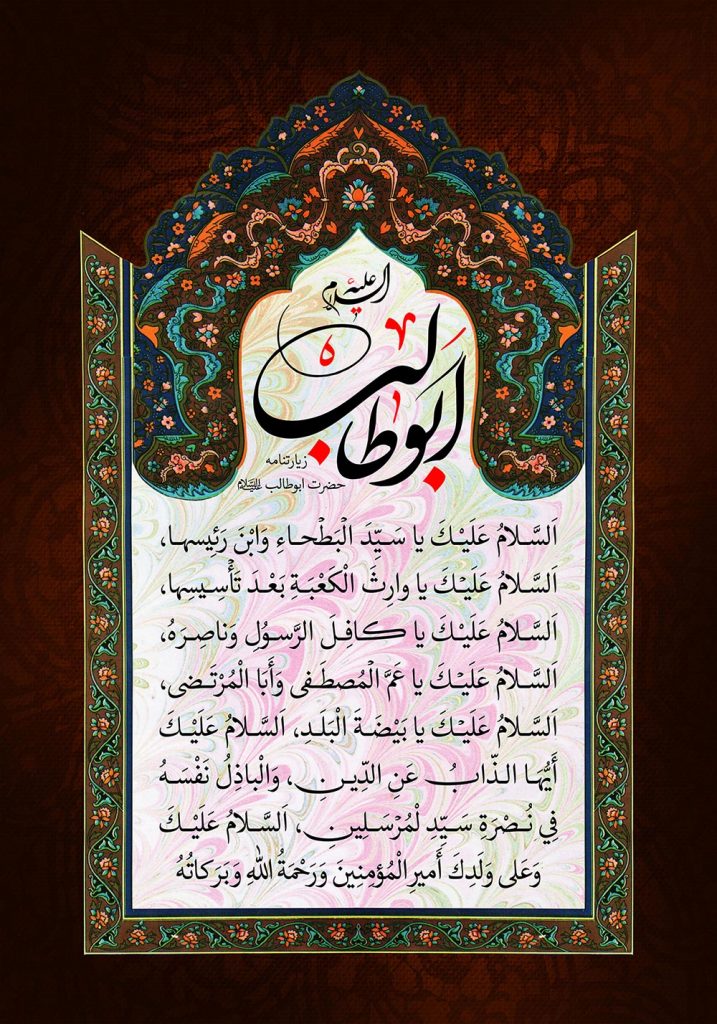
In some later books, there are ziyarat-namahs (visitation supplications) that, upon searching earlier sources, no trace of them can be found. Through research, two ziyarat-namahs about Abu Talib (AS) have been cited. In addition to examining the chain of transmission (sanad) of these ziyarat-namahs, their content can also be analyzed. By searching for the phrases in these two ziyarat-namahs in earlier books, one can find some narrations and historical accounts on this matter. For example, the phrase “Kafil al-Rasul” (the guardian of the Prophet) is reflected in a similar form in the ziyarat of the Prophet (PBUH). Other parts of these ziyarat-namahs also align with the faith of Abu Talib (AS), his relationship with the Prophet and Ali (AS), and his support for these two great figures. However, since these ziyarat-namahs have not been found in ancient texts, it might be said that these texts are a compilation of historical and narrational themes gathered into one collection. Rather, they serve as a model for researchers and scholars who came after.

The Inscription on the Ring of Abu Talib

Imam Ridha (AS) said:
“On the ring of Abu Talib, these words were inscribed:
‘Raditu Billahi Rabban, wa bi-ibni akhi Muhammadan Nabiyyan, wa bi-abni Ali Wasiyyan.’
(I am content that Allah is my Lord, that my brother’s son Muhammad (PBUH) is the Prophet, and that my son Ali (AS) is the successor.) (9)“

Footnotes:


  1. Al-Khisal / Translated by Kamarei, Vol. 2, p. 39: “Why did Abu Talib not officially join the party of Islam?…” p. 36.
  2. Bihar al-Anwar – Al-Allamah al-Majlisi – Vol. 35 – pp. 110–111.
  3. Sayyid ibn Tawus in Tara’if, p. 87, as quoted from: Al-Ghadir (Persian) – Al-Sheikh al-Amini (Translated by a group of translators) – Vol. 14 – pp. 343–346.
  4. Iman Abi Talib – Al-Sheikh al-Mufid – pp. 23–24: “Sheikh Mufid writes that this narration is unanimously agreed upon by historians and biographers.”
  5. Al-Sahih min Sirah al-Imam Ali (AS) – Al-Sayyid Ja’far Murtada al-Amili – Vol. 2 – pp. 81–84.
  6. Iman Abi Talib – Al-Sheikh al-Mufid – pp. 25–26.
  7. Iman Abi Talib – Al-Sheikh al-Mufid – pp. 24–25.
  8. Some of these books include:
    • Iman Abi Talib by Sheikh Mufid,
    • Al-Hujjah ala al-Dhahib ila Takfir Abi Talib by Sayyid Fakhhar ibn Ma’d al-Musawi (d. 630 AH),
    • Abu Talib: Mu’min Quraysh by Abdullah al-Khunayzi,
    • Abu Talib: Batal al-Islam by Al-Khalid by Sayyid Haydar Muhammad Sa’id al-Arfi,
    • And Al-Sahih min Sirah al-Imam Ali (AS) also discusses this topic in part.
  9. Al-Sahih min Sirah al-Imam Ali (AS) – Al-Sayyid Ja’far Murtada al-Amili – Vol. 2 – pp. 102–104

“Study the Persian text of the article.”

Studying the article in Arabic

Tags: 'Imran ibn Abd al-Muttalib**The Inscription on the Ring of Abu Talib**Abu TalibHAMED SAREMNaba_Al_AzimNaba-ol-AzimNabaolAzimThe Faith of Abu TalibThe Intercession of Abu TalibZiyarat-nameh of Abu Talib
SendShareShare
Previous Post

 “Mir Hamed Hussain and Scientific Methods in Critiquing Sunni Arguments: How to Separate Truth from Distortions?”

Next Post

The recognition of the Imam’s status in the Quran is the key to unlocking the doors of liberation from crises and turmoil.

مقالات مرتبط

“Mir Hamid Hussain and the Analysis of the Methodology of Understanding Islamic Texts: A Reinterpretation of Implications in ‘Abaqat al-Anwar'”
Abqat al-Anwar

“Mir Hamid Hussain and the Analysis of the Methodology of Understanding Islamic Texts: A Reinterpretation of Implications in ‘Abaqat al-Anwar'”

2025-01-04
185
Banu Umayya

Is Muawiyah behind the murder of Ali (AS)? Analysis of the bloody relationship between the Umayyads and the Jews in the killing of the Commander of the Faithful”

2025-04-27
239
Mir Hamid Hussain and the Scientific Methods in Critiquing the Arguments of Ahl al-Sunnah: How Did He Distinguish Truth from Distortions?
Abqat al-Anwar

Mir Hamid Hussain and the Scientific Methods in Critiquing the Arguments of Ahl al-Sunnah: How Did He Distinguish Truth from Distortions?

2024-12-29
162
Scholarly, Documented, and Rigorous: The Methodology of Allama Mir Hamid Hussain in Analyzing the Sources of Narrations
Abqat al-Anwar

Scholarly, Documented, and Rigorous: The Methodology of Allama Mir Hamid Hussain in Analyzing the Sources of Narrations

2025-01-19
166
Characters

The Only Authentic Narration About Mu’awiya / The Difference Between True Islam and Umayyad Islam

2025-04-20
315
Characters

“Mu’awiyah: the special agent and practical embodiment of Saqifah.”

2025-04-20
74

Categories

  • Abqat al-Anwar
  • Abrar
  • Abu Talib, 'Imran ibn Abd al-Muttalib
  • Banu Umayya
  • Characters
  • Companions of Ahlul Bayt
  • Fourteen innocents
  • Ghadir
  • Hamed Sarem
  • Imam Ali (peace be upon him).
  • Imam Hasan (Peace Be Upon Him)
  • Imam Husayn (Peace Be Upon Him)
  • Imamat
  • Indices
  • Mahdism
  • Mu'awiya ibn Abi Sufyan
  • Quran
  • Seyyed Mir Hamid Hussain Hindi
  • Shia books
  • Tasheed al-Mata'en
  • The Wicked and Enemies of Ahlul Bayt
  • Theological books
  • Uncategorized
  • Video
  • Wahhabism
  • What does Shi'a say?
  • صاحب الزمان (عجل الله تعالی فرجه الشریف)
  • کربلا

Tags

'Imran ibn Abd al-Muttalib About Shia Islam Abqat al-Anwar Al-Naba Al-Azim Al-Tuhfa al-Ithna Ashariyya Alzam (Obligation) Awaiting Imam Mahdi Ayatollah Milani Banu Umayya emam ali Expectation Hadith of Ghadir Hadith of Thaqalayn Hamed Sarem Karbala Knowledgeable_Guide Mahdi Methodology of Mir Hamid Hussain Hindi Mir Hamid Husayn. Mu'awiya muaviye Naba-ol-Azim Naba al-Azeem NabaolAzim Naba_Al_Azim Proper Worship Proving the Legitimacy of Shi'ism Seyyed Mir Hamid Hussain Hindi Shia Sunni Muslims Syed Ijaz Hussain The book Nafahat al-Azhar The differences between Shi'a and Sunni. The Faith of Abu Talib The Intercession of Abu Talib The methodology of the book *Abaqat al-Anwar*. The Samiri's Calf The Samiri's Calf in this Ummah The truthfulness of Shi'a. What does Shia say? What the Shia Say Who is Imam Hussain (A.S.)? Who is Imam Hussain (peace be upon him)? Ziyarat-nameh of Abu Talib حامد صارم
  • فارسی
  • English
  • العربية

Archives

Categories

© 1403 NabaolAzim - All rights reserved.

Welcome Back!

Login to your account below

Forgotten Password?

Retrieve your password

Please enter your username or email address to reset your password.

Log In
Login
Use Phone Number
Use Email Address
Not a member yet? Register Now
Reset Password
Use Phone Number
Use Email Address
Register
Already a member? Login Now

Add New Playlist

No Result
View All Result
  • Nabaolazim
  • Gallery
  • Fourteen innocents
  • Quran
  • Imamat
  • Characters
  • Contact Us
  • Login / Register
  • فارسی
  • العربية

© 1403 NabaolAzim - All rights reserved.