A Claim of Weakening or an Admission of Authenticity? Examining the Internal Contradiction in al-Bukhari’s Critique of the Hadith of al-Thaqalayn in Light of ‘Abaqat al-Anwar
Author: Hamed Sarem
What Did Ahmad ibn Hanbal Say? What al-Bukhari Reported Differs from What Ahmad Wrote
If someone considers a hadith “munkar” (rejected), would he include it in his most authoritative book? Al-Bukhari made such a claim concerning Ahmad ibn Hanbal and the Hadith of al-Thaqalayn. Yet al-Musnad says otherwise.
Abstract:
Muhammad ibn Isma‘il al-Bukhari, in al-Tarikh al-Saghir, claimed that Ahmad ibn Hanbal regarded the Hadith of al-Thaqalayn, transmitted through ‘Abd al-Malik ibn Abi Sulayman, as “munkar” (rejected). Employing an analytical-critical method and drawing on the findings of ‘Allamah Mir Hamid Husayn al-Hindi in ‘Abaqat al-Anwar fi Ithbat Imamat al-A’immah al-Athar, this study examines and critiques that claim.
The study’s findings show that al-Bukhari’s claim faces an internal contradiction in three respects: first, ‘Abd al-Malik ibn Abi Sulayman—the pivotal transmitter impugned by al-Bukhari—is praised as trustworthy in authoritative Sunni biographical sources, including the works of Ibn Ma‘in, Ibn Sa‘d, and al-Dhahabi. Second, Ahmad ibn Hanbal himself transmitted this very hadith in al-Musnad, a work which, according to Ahmad’s own explicit statement and the affirmation of scholars such as Shah Wali Allah al-Dihlawi in Hujjat Allah al-Balighah, serves as the criterion for judging the soundness and unsoundness of hadiths within the Islamic community. Third, as Taqi al-Din Ibn al-Salah attests in ‘Ulum al-Hadith, Ahmad ibn Hanbal explicitly prohibited the recording of “munkar” hadiths in the Musnad—making the presence of the Thaqalayn narration therein irreconcilable with al-Bukhari’s claim.
Moreover, ‘Allamah Mir Hamid Husayn, through the method of ilzam—namely, arguing against an opponent on the basis of his own sources and criteria—demonstrates the tawatur (mass transmission) of the Hadith of al-Thaqalayn by citing 187 transmitters from Sunni sources across thirteen centuries. The defenses offered by al-Hafiz Ibn Hajar al-‘Asqalani in al-Qawl al-Musaddad fi al-Dhabb ‘an al-Musnad and Jalal al-Din al-Suyuti in al-Dhayl al-Mumahhad likewise confirm that even Sunni scholars regarded Ahmad’s Musnad as free of munkar and fabricated hadiths.
The conclusion is that al-Bukhari’s claim accords neither with Ahmad ibn Hanbal’s scholarly practice, nor with the content of al-Musnad, nor with the judgment of leading Sunni scholars; it therefore lacks the scholarly validity required to weaken the Hadith of al-Thaqalayn.
Keywords: Hadith al-Thaqalayn, al-Bukhari, al-Tarikh al-Saghir, Ahmad ibn Hanbal, al-Musnad, ‘Abaqat al-Anwar, Mir Hamid Husayn, the method of ilzam, tawatur, narrator criticism.
In the field of Islamic hadith studies, the “Hadith al-Thaqalayn,” owing to its explicit indication of the religious authority and leadership of the Ahl al-Bayt (peace be upon them), has consistently been the focus of attention and analysis among scholars of different schools. In this hadith, the Noble Prophet (peace be upon him) speaks of two weighty legacies, namely the Qur’an and the Ahl al-Bayt. It has been transmitted through numerous chains in multiple Sunni sources and, from the standpoint of its isnad, enjoys the highest degree of authenticity.
Nevertheless, some critics, including Shah ‘Abd al-‘Aziz Dihlawi in his book Tuhfah Ithna ‘Ashariyyah, have sought to discredit this hadith by relying on statements attributed to al-Bukhari in al-Tarikh al-Saghir and to Ahmad ibn Hanbal. One of Dihlawi’s most conspicuous methodological shortcomings is the strategy of “concealing tawatur”: by disregarding the multiplicity of chains, he reduces a report transmitted by more than twenty Companions to a solitary khabar al-wahid confined to the transmission of Zayd ibn Arqam.
2. Establishing Tawatur: A Prerequisite for Any Isnād Criticism
Before examining the criticisms attributed to al-Bukhari, it is necessary to establish the definitive tawatur of this hadith. Once the tawatur of a hadith has been proven, any criticism of the isnad of one particular chain does not impugn the hadith itself. This is precisely the sequence employed by ‘Allamah Mir Hamid Husayn in ‘Abaqat al-Anwar.
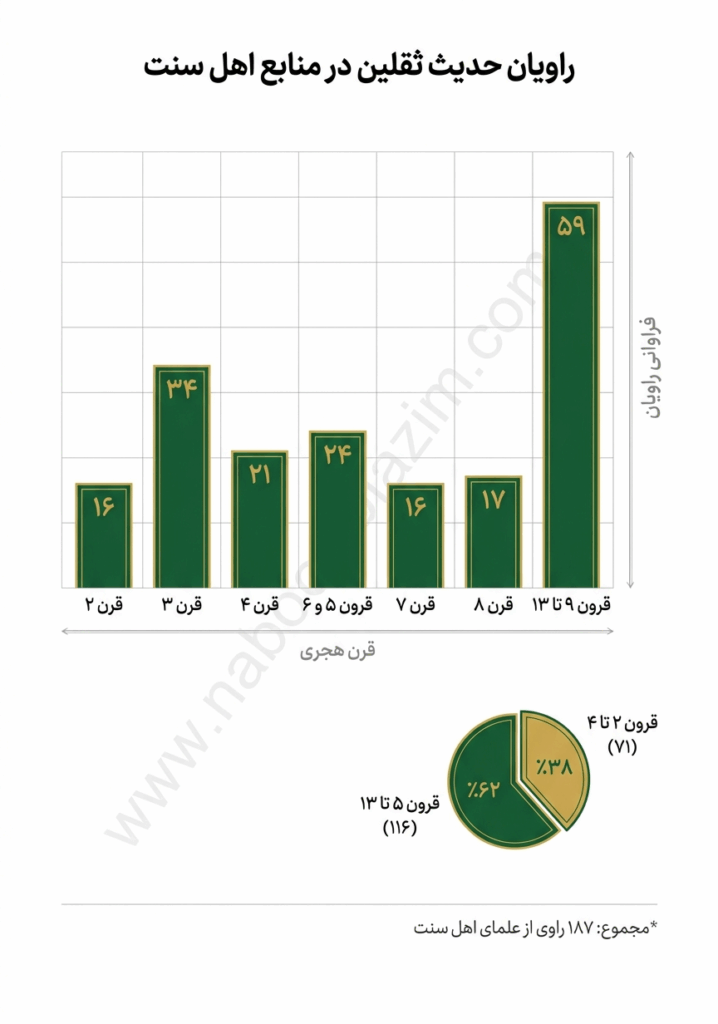
Based on Allameh’s meticulous induction and investigation, the names of 187 eminent Sunni scholars and traditionists have been identified who preserved and recorded the chain of transmission of the Hadith al-Thaqalayn over thirteen centuries. The historical distribution of these transmitters shows that the chain transmitting this hadith has never suffered an interruption at any point:
| Hijri century | Number of transmitters |
|:---:|:---:|
| 2nd century | 16 transmitters |
| 3rd century | 34 transmitters |
| 4th century | 21 transmitters |
| 5th and 6th centuries | 24 transmitters |
| 7th century | 16 narrators |
| 8th century | 17 narrators |
| 9th to 13th centuries | 59 narrators |
| Total | 187 narrators |
This volume of transmission refutes the claim that the Hadith al-Thaqalayn is a “solitary report” even before any further discussion of its chains of transmission, and it unquestionably establishes the tawatur of this noble hadith across all generations.
3. Prominent Narrators: al-Suddi versus Isnād Reductionism
To demonstrate the weakness of Dehlawi’s approach, it is enough to examine the reliability of the principal narrators of this hadith in the second Hijri century. Narrators such as Saʿid ibn Masruq al-Thawri (the father of Sufyan al-Thawri, unanimously accepted by the two Shaykhs), al-Aʿmash (whom al-Dhahabi called “Shaykh al-Islam” and “the reliable hadith master”), and ʿAbd al-Malik ibn Abi Sulayman (whom Sufyan al-Thawri and Ibn al-Mubarak bestowed with the title “the Balance”) are among the principal pillars of the Sunni canonical collections and musnads.
It is here that the “destructive paradox” of Dehlavi’s approach becomes apparent: if a critic seeks to reject a hadith transmitted through these narrators on the pretext of weakness in its chain, he has in fact demolished the foundation of the authority of al-Bukhari, Muslim, and the entire science of narrator-criticism in his own school.
Part One: Examining al-Bukhari’s Criticism; a Claim at Odds with Sunni Principles Themselves
1.1 The Text of the Claim and the Context in Which It Was Raised
One of the most prominent objections that Shah ʿAbd al-ʿAziz Dehlavi raises in «تحفه اثنا عشریه» against the chains of transmission of the Hadith al-Thaqalayn is his reliance on a statement recorded by Muhammad ibn Ismaʿil al-Bukhari in «التاریخ الصغیر». Adopting a reductionist approach, al-Bukhari, reporting from Ahmad ibn Hanbal, writes concerning the chain “ʿAbd al-Malik ibn Abi Sulayman, from ʿAtiyyah al-ʿAwfi, from Abu Saʿid al-Khudri,” who transmitted the text «تَرَكْتُ فِيكُمُ الثَّقَلَيْنِ»: “This category of Kufan hadiths consists of munkar hadiths.”
In «عبقات الأنوار», Allamah Mir Hamid Husayn challenges this claim with meticulous precision and from within the discourse of Sunni scholarship itself. The Allamah’s method in this critique is the method of «الإلزام»—that is, demonstrating the invalidity of a claim on the basis of the very principles and sources to which the opposing party is committed. This approach doubles the force of the argument, because it confronts the critic with the internal contradictions of his own school.
1.2 The First Challenge: The Reliability of the Narrators Deemed “Munkar”
Before anything else, one must ask: are the narrators in the chain that al-Bukhari termed “munkar” truly impugned according to Sunni biographical evaluation? The answer is an unequivocal no.
Abd al-Malik ibn Abi Sulayman al-‘Arzami—who stands at the head of this chain—is a figure whom Sufyan al-Thawri and Abdullah ibn al-Mubarak, two pillars of Sunni hadith scholarship, bestowed with the epithet “al-Mizan” (the Scale). This title is itself the most eloquent testimony to his lofty standing among the leading hadith scholars. How could a transmitter who is himself regarded as the “scale” by which narrations are assessed be a narrator of “munkar” (rejected) hadiths?
This contradiction constitutes the first serious breach in al-Bukhari’s claim. Casting aspersions on the narrations of these transmitters, before impugning the Hadith of al-Thaqalayn, jeopardizes the credibility of a considerable portion of the chains of transmission in Sunni Sahih collections and Musnads; for these same transmitters appear in countless chains of hadiths accepted by Sunnis.
Part Two: The Paradox of Ahmad ibn Hanbal—The Contradiction Between Claim and Practice
2.1 Presenting the Paradox: The Musnad as Documentary Evidence for the Defense
Yet the most significant and decisive response to al-Bukhari’s claim lies not in abstract discussions of narrator criticism, but in Ahmad ibn Hanbal’s own book, al-Musnad. In ‘Abaqat al-Anwar, the scholar Mir Hamid Husayn highlights this point with exceptional subtlety: Ahmad ibn Hanbal—the very person to whom al-Bukhari attributes the alleged weakening—has transmitted the Hadith of al-Thaqalayn through multiple routes and sound chains, on the authority of such Companions as Zayd ibn Arqam, Zayd ibn Thabit, and Abu Sa‘id al-Khudri, in his own al-Musnad.
This fact gives rise to an insoluble logical paradox: if Ahmad truly regarded these hadiths as “munkar” (rejected), why did he record them in his most important scholarly work? Accepting both claims at once—namely, that he considered them “munkar” and that he transmitted them—would require accusing Ahmad ibn Hanbal of “tadlis and talbis” (deceptive concealment and misrepresentation), an accusation no fair-minded scholar is prepared to accept.
2.2 The Status of al-Musnad in the Sunni Hadith Heritage
To grasp the depth of this paradox, one must properly understand the position of al-Musnad within the Sunni hadith system. This work is not an ordinary collection; rather, as Ahmad himself explicitly stated and leading Sunni scholars attested, it is the “imam” and the reference for resolving the community’s disagreements.
According to Hanbal ibn Ishaq, after completing the compilation of the book, Ahmad ibn Hanbal gathered his children and close relatives and stated with complete clarity:
“I have compiled and selected this book from among more than 750,000 hadiths. Therefore, whenever Muslims disagree over any hadith from the Messenger of God (PBUH), refer to this book: if it is found therein, it is acceptable; otherwise, it is not authoritative.”
Abd Allah ibn Ahmad likewise stresses that his father extracted and selected the hadiths of the Musnad from among more than 700,000 hadiths, and that he did not commit any narration to writing unless he had fully memorized it and was confident of its soundness. According to reports by al-Khatib al-Baghdadi and Ibn al-Munadi, the book’s final total is approximately 30,000 hadiths (excluding repetitions), transmitted from about 700 Companions.
The Chief Judge Taj al-Din al-Subki and the hadith master Abu Musa al-Madini also explicitly affirmed that this book is one of the great foundational works of the Muslim community and a reliable reference for hadith scholars.
2.3 Ahmad’s Rigorous Criteria in Selecting Transmitters and Texts
Ahmad ibn Hanbal’s precision in compiling al-Musnad was not confined to selecting from among hundreds of thousands of hadiths; he also displayed unparalleled scrupulousness in evaluating transmitters. Abu Musa al-Madini testifies that, in this book, Ahmad narrated only from those whose truthfulness and religious integrity had been established in his view, and he turned away from every transmitter against whose trustworthiness even the slightest criticism existed.
‘Abd Allah ibn Ahmad relates a concrete example of this rigor: “I asked my father about ‘Abd al-‘Aziz ibn Aban. He said: I did not include anything from him in the Musnad, for when he narrated the hadith of the prescribed prayer times, I abandoned him.” This example shows that Ahmad would exclude all of a narrator’s reports from the Musnad even because of a single dubious narration.
Yet the height of this caution appears in an event that occurred during Ahmad’s final illness, at the threshold of his death. ‘Abd Allah relates that, on his deathbed, his father ordered a line to be drawn through a hadith—apparently in conflict with other well-known hadiths of the Prophet (PBUH)—and that it be removed from the book. This was despite the fact that the transmitters of that hadith were trustworthy; solely because of its textual contradiction, Ahmad was unwilling to retain it in his own “standard.”
2.4 Conclusion: The Rational Impossibility of the Existence of a “Munkar” Report in Ahmad’s Musnad
With this clear picture of Ahmad ibn Hanbal’s methodology, the paradox reaches its peak: how could a figure who, even on his deathbed, worried about the presence of a conflicting report in his book; who scrutinized transmitters with utmost meticulousness; and who regarded his book as the decisive criterion for the disagreements of the Ummah, record the Hadith al-Thaqalayn in that very book through several chains and wordings while—according to al-Bukhari’s claim—considering it “munkar”?
This contradiction is not a subsidiary objection but a “rational impossibility.” The transmission of the Hadith al-Thaqalayn in al-Musnad is, in itself, Ahmad’s seal of approval upon its soundness and authority; any claim to the contrary stands in manifest conflict with his written and practical conduct.
Part Three: Testimony of Leading Sunni Scholars to the Authoritativeness of the Musnad; Closing the Door to Every Excuse
3.1 Shah Wali Allah al-Dihlawi’s Explicit Admission: The Final Blow to the Son’s Claim
In this regard, there is no testimony more decisive than the admissions of Shah Wali Allah al-Dihlawi—the father of that very Shah Abd al-Aziz, author of Tuhfat al-Ithna Ashariyyah. In ‘Abaqat al-Anwar, Allamah Mir Hamid Husayn most astutely employs this testimony as an “intra-family proof.”
In Hujjat Allah al-Balighah (p. 134), Shah Wali Allah classifies the hadith books and places Musnad Ahmad among those books whose authors are renowned for “reliability, probity, retention, and mastery of the disciplines of hadith,” and who never relaxed their stringent conditions for transmitting narrations. He explicitly states:
“Musnad Ahmad belongs to this class of books, for Imam Ahmad made it a foundational criterion by which sound hadith may be distinguished from unsound hadith, and he himself said: ‘Do not accept whatever is not in this book.’”
He likewise writes in al-Insaf:
“Ahmad made his Musnad a scale (criterion) for recognizing the hadiths of the Prophet (PBUH). Thus, whatever is found in it—even if through a single route—has an origin and basis; and whatever is not found in it has no origin.”
These statements foreclose every possible excuse on the part of Shah Abd al-Aziz and those who share his views. The father himself has supplied the finest instrument for critiquing the son: if Musnad Ahmad is the “criterion” and everything contained in it “has an origin,” then the Hadith of al-Thaqalayn, which occurs therein through multiple chains, certainly “has an origin,” and the claim that it is “rejected” is utterly false.
Umar ibn Muhammad Arif al-Nahrawani also writes in Manaqib Ahmad ibn Hanbal, quoting Hafiz Ibn Asakir:
“The greatest book compiled in the field of the hadiths of al-Mustafa (peace be upon him) is the monumental Musnad of Imam Ahmad. It is a precious book, for the hearing and acquisition of which people endure the hardships of travel… Imam Ahmad’s purpose in compiling it was that it should serve as a reference and criterion for assessing narrations.”
Even Shaykh ʿAbd al-Ḥaqq al-Dihlawī—one of the scholarly pillars of the Dihlawī family—acknowledges, in “Asmāʾ Rijāl al-Mishkāt,” in his biographical notice on Aḥmad ibn Ḥanbal, that his Musnad is widely known among the people and that more than 30,000 hadiths have been collected in it.
3.2 The Devastating Paradox: Either Ahmad Is a “Liar and a Mudallis,” or the Hadith of al-Thaqalayn Is Authentic
In light of all these acknowledgements, every fair-minded researcher faces a logical dilemma:
First option: Aḥmad ibn Ḥanbal regarded the Hadith of al-Thaqalayn as “munkar,” yet transmitted it through multiple chains in his “criterion,” which—according to the testimony of Shāh ʿAbd al-ʿAzīz’s father—contains nothing except that which “has an origin.” In that case, Aḥmad was a “liar and a mudallis” who forbade others from transmitting munkar hadiths while not abiding by this himself.
Second option: Aḥmad ibn Ḥanbal considered the Hadith of al-Thaqalayn authentic and reliable, and transmitted it in “al-Musnad” for precisely this reason. In that case, al-Bukhārī’s claim that Aḥmad regarded this hadith as “munkar” is a sheer falsehood.
No fair-minded scholar accepts the first option. Therefore, the second option is the only possible logical conclusion.
Part Four: Sunni Scholars’ Defenses of al-Musnad and the Final Refutation of the Claim
4.1 Ibn Hajar al-‘Asqalani and al-Qawl al-Musaddad: Defending al-Musnad against Its Critics
In the history of Sunni hadith scholarship, some scholars sought to place «al-Musnad» below the canonical Ṣiḥāḥ collections. Al-Nawawi and al-‘Iraqi took steps in this direction, and al-‘Iraqi even claimed that the Musnad contains weak and mawḍū‘ (fabricated) hadiths.
Yet these claims did not go unanswered. Jalal al-Din al-Suyuti relates that «Shaykh al-Islam»—namely, al-Hafiz Ibn Hajar al-‘Asqalani, the Commander of the Faithful in hadith according to the Sunnis—authored an independent work entitled «al-Qawl al-Musaddad fi al-Dhabb ‘an al-Musnad» (The Sound Statement in Defense of the Musnad) to refute these accusations. In the preface to this book, Ibn Hajar explicitly refutes the allegation of those who supposed that fabricated hadiths had found their way into Ahmad’s Musnad.
In this book, Ibn Hajar answered, one by one, the nine hadiths cited by al-‘Iraqi and the fifteen hadiths cited by Ibn al-Jawzi as fabricated hadiths in the Musnad, defending them all.
4.2 Al-Suyuti and al-Dhayl al-Mumahhad: Completing the Defenses
The effort to vindicate Ahmad’s Musnad was not limited to Ibn Hajar. In «Tadrib al-Rawi», Jalal al-Din al-Suyuti states that Ibn Hajar had omitted some of the hadiths criticized by Ibn al-Jawzi; therefore, al-Suyuti composed an independent treatise entitled «al-Dhayl al-Mumahhad», in which he defended 24 additional hadiths of the Musnad, in order to preserve this great book from every blemish.
These successive and continuous defenses by the greatest Sunni hadith scholars are themselves the clearest proof of the lofty standing of al-Musnad within the Sunni hadith tradition. When their Commander of the Faithful in hadith writes an independent book in defense of the Musnad, there remains no room for impugning its hadiths—let alone for attributing such impugnment to Ahmad himself.
4.3 Ibn al-Salah’s Decisive Statement: Ahmad Himself Was a Stern Critic of “Munkar” Hadiths
If anyone still doubts the invalidity of al-Bukhari’s claim, the words of Taqi al-Din Ibn al-Salah in ʿUlum al-Hadith dispel every doubt. He relates from Ahmad ibn Hanbal that he repeatedly used to say:
“Do not write down these unfamiliar hadiths, for they are ‘munkar,’ and most of them have been transmitted by weak narrators.”
This report is the final nail in the coffin of al-Bukhari’s claim. Ahmad ibn Hanbal not only refrained from transmitting munkar hadiths himself, but also prohibited others from writing them down. How could someone who held such a position record, through numerous chains, in a book he called the community’s “imam” and “criterion,” a hadith that he regarded as munkar?
This contradiction is not merely an objection that can be explained away; rather, it is an “ordinary impossibility.” If anyone insists upon this contradiction, he has in fact made Ahmad ibn Hanbal an instance of these noble verses:
“O you who believe, why do you say what you do not do?” (O believers, why do you say something that you do not do?)
“Do you command people to righteousness and forget yourselves?” (Are you enjoining people to goodness while forgetting yourselves?)
No fair-minded researcher would be willing to attribute such an accusation to Ahmad ibn Hanbal. Therefore, the only logical conclusion is that al-Bukhari’s claim—as it has been alleged—is false and unfounded.
Conclusion: Summary of the Arguments and Final Judgment
The detailed examination conducted in this article—drawing upon the methodology of Allamah Mir Hamid Husayn in «عبقات الأنوار»—shows that al-Bukhari’s claim that Ahmad ibn Hanbal regarded the Kufan narrations concerning the Hadith of al-Thaqalayn as “munkar” is invalid from four independent and mutually complementary perspectives:
First—from the perspective of narrator criticism: the transmitters in the chain under consideration, including ‘Abd al-Malik ibn Abi Sulayman, who bears the epithet «المیزان», are among the eminent trustworthy narrators of Ahl al-Sunnah; impugning them endangers the reliability of a broad body of chains in the Sahih collections.
Second—from the perspective of Ahmad’s own practice: Ahmad ibn Hanbal himself transmitted the Hadith of al-Thaqalayn through numerous chains in «المسند». Transmitting a hadith deemed “munkar” in a book that is the “criterion” of the community is an “ordinary impossibility.”
Third—from the perspective of the testimony of leading scholars: Shah Wali Allah al-Dihlawi—the father of the very person who authored Tuhfah—explicitly affirmed that everything found in Ahmad’s Musnad “has an origin.” This admission closes the door to every possible pretext.
Fourth—regarding scholarly defenses: the greatest Sunni hadith scholars, from Ibn Hajar al-‘Asqalani to Jalal al-Din al-Suyuti, have defended the standing of al-Musnad against accusations that it contains fabricated hadiths by authoring independent works. These defenses establish the Musnad’s status as one of the authoritative foundations of the Ummah.
Consequently, attributing the judgment that the Hadith of al-Thaqalayn is “munkar” to Imam Ahmad ibn Hanbal is a claim incompatible with his practical conduct, his rigor in compiling the Musnad, his explicit prohibition against recording munkar hadiths, and the comprehensive defenses mounted by leading Sunni scholars for the Musnad’s reliability. Scientifically and historically, this claim is untenable; and the definitive tawatur of the Hadith of al-Thaqalayn—which was established in this article’s introduction by citing 187 transmitters across thirteen centuries—remains firm and unassailable.