
The Prayer of the Two Idols of Quraysh in the Words of the Late Muhammad Isma'il Khwaju'i Mazandarani
Author: Hamed Sarem

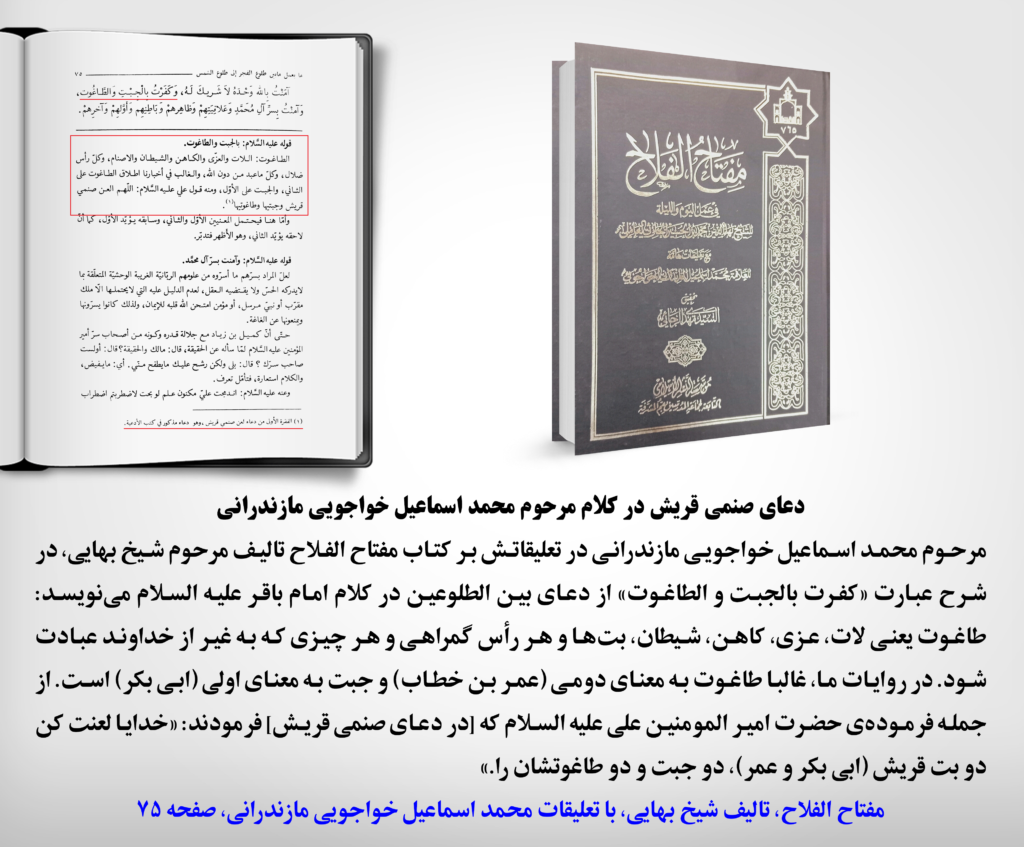
In this annotation, the late Isma'il Khwaju'i cites the Prayer of the Two Idols of Quraysh in interpreting the statement concerning al-Jibt and al-Taghut. This indicates the prayer’s renown in his time and this Shi'i scholar’s reliance on this noble prayer.
Biography of the Late Isma'il Khwaju'i
Muhammad Isma'il Khwaju'i Mazandarani (1100–1173 AH), known as Mulla Isma'il Khwaju'i, was a jurist, theologian, philosopher, mathematician, and leading traditionist of the Afsharid era, and one of the greatest scholars of the twelfth Islamic century. Among the events of his time was the Afghan upheaval in Iran, especially in Isfahan. Mulla Mahdi Naraqi was among his students.
Birth and background: Mulla Isma'il Khwaju'i was born in Mazandaran in 1100 AH. Because of his life, studies, and writings in Isfahan, he became known as “Isfahani.” After moving to the Khwaju quarter in 1133 AH, he also became known as “Khwaju'i.” Before the Safavid period, this quarter was known as “Bagh-e Kardan” and “Tarazabad”; later, because Seljuk and Safavid eunuchs resided there, it became known as “Khwaju.”
Teachers and living conditions: Precise information about his teachers is unavailable, but he probably studied under Baha' al-Din Muhammad Isfahani (Fadil Hindi) and Mulla Muhammad Tonekaboni (Fadil Sarab). The middle of Khwaju'i’s life coincided with the Afghan attack and famine in Isfahan (1134–1137 AH), which devastated the city and led to the loss of many scholars and libraries. Through his efforts, Khwaju'i revived Isfahan’s scholarly seminary.
Skills and works: Khwaju'i was proficient in jurisprudence, legal theory, theology, philosophy, mathematics, astronomy, and literature, and played an important role in transmitting Sadrian philosophy (al-Hikmah al-Muta'aliyah) to later generations. Among his important works are Miftah al-Falah, Jami' al-Shatat, Ibtal al-Zaman al-Mawhum, Risalat Sahw al-Nabi, and a marginal commentary on al-Arba'in. Some of his renowned students were Mulla Muhammad Mahdi Naraqi, Aqa Muhammad Bidabadi, Mirza Abu al-Qasim Mudarris, and Mulla Mihrab Gilani.
Death: Khwaju'i died in 1173 AH.
Miftah al-Falah fi 'Amal Yawm wa Laylah
Miftah al-Falah fi 'Amal Yawm wa Laylah, by Shaykh Baha'i, is a book on the practices of day and night in six chapters. Throughout its chapters, the author raises numerous precise scholarly and hadith-based discussions and addresses the affirmation and rejection of various theories. Among other matters, he provides a detailed discussion of the Tasbih of Lady Fatimah (peace be upon her). In different sections and on various occasions, he also discusses such topics as the etiquette of dressing, eating and drinking, walking, recognizing the sun’s decline, and the etiquette of using the siwak.
In each chapter of the book, after citing several traditions and various materials, Shaykh Baha'i proceeds to explain the wording of the traditions and clarify some of the ambiguous or difficult points in that chapter.
This book is adorned with the annotations of the eminent scholar Muhammad Isma'il Mazandarani Khwaju'i (one of the notable figures of the thirteenth Islamic century).
Author: Hamed Sarem
Related articles
Comments
No comments yet.
