
The Supplication of the Two Idols of Quraysh: An Early Document and Its Historical Examination in Shiʿi Sources
Author: Hamed Sarem

The Supplication of the Two Idols of Quraysh
The Supplication of the Two Idols of Quraysh is one of the well-known supplications in Shiʿi culture and has been transmitted in devotional sources. It speaks against two unnamed figures as the “two idols of Quraysh” (ṣanamā Quraysh). Some Shiʿi researchers and commentators have identified these two figures with the first and second caliphs, Abū Bakr and ʿUmar. This identification is based on certain phrases in the supplication that refer to oppression, deviation, and usurpation of rights.
Citing the Supplication of the Two Idols of Quraysh in an Early Document
In the earliest Persian translations of the Noble Qurʾan, the Supplication of the Two Idols of Quraysh was cited in order to determine the meaning of jibt and ṭāghūt.
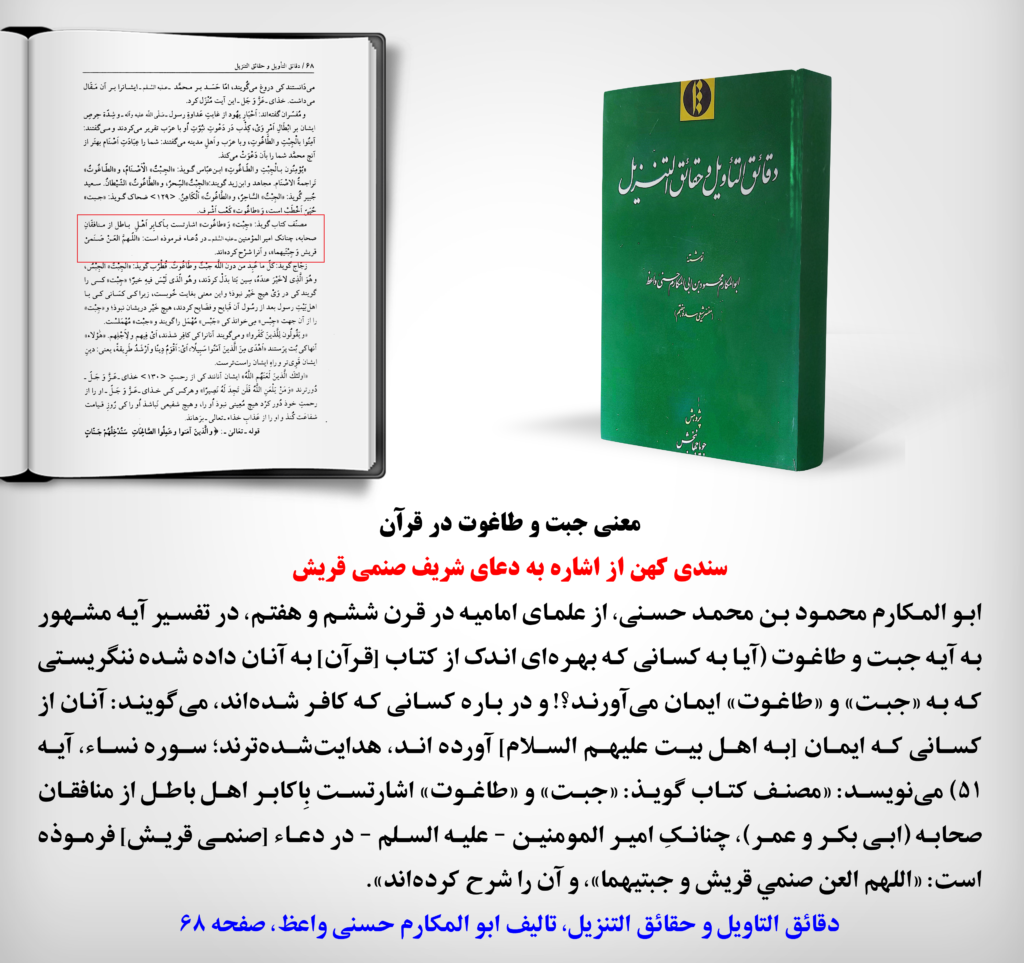
Daqāʾiq al-Taʾwīl wa Ḥaqāʾiq al-Tanzīl
According to the available evidence, Persian was the first language to have the opportunity to be used in translating the Noble Qurʾan. It was a good fortune for Persian speakers that, after Arabic speakers—whose honored Qurʾanic text is regarded as the greatest artistic and literary masterpiece in their language—they were able to become acquainted with the lofty meanings of this heavenly book. In the boundless treasury of Persian writings, many old and new translations and commentaries are found, demonstrating the efforts of Persian scholars to expand Qurʾanic knowledge among Persian speakers.
Among these Qurʾanic studies is Daqāʾiq al-Taʾwīl wa Ḥaqāʾiq al-Tanzīl, a valuable work of commentary written by a Shiʿi scholar. The author of Daqāʾiq al-Taʾwīl was Abū al-Makārim Maḥmūd ibn Muḥammad al-Ḥasanī al-Wāʿiẓ, a Shiʿi scholar of the seventh Islamic century who lived in Fars.
Unfortunately, we do not have much information about Abū al-Makārim al-Ḥasanī. Besides Daqāʾiq al-Taʾwīl—which is discussed briefly in this article—one of his works is Balābil al-Qalāqil, mentioned in the preceding lines.
Other Works of the Commentator
The author of Daqāʾiq al-Taʾwīl and Balābil al-Qalāqil also had a collection of theological treatises, a copy of which is held in the Malek National Library; it is probably the only accessible manuscript of this work. In a catalogue compiled for Persian jurisprudential books, Professor Muḥammad-Taqī Dāneshpazhūh discussed the two commentaries and these theological treatises; see: Fehrestvāreh-ye Fiqh-e Hezār-o Chahārsad-Sāleh-ye Eslāmī dar Zabān-e Fārsī, Scientific and Cultural Publishing Company, 1367 SH. Of Daqāʾiq al-Taʾwīl wa Ḥaqāʾiq al-Tanzīl, which is the main subject of this discussion, apparently only one copy is known: a manuscript preserved in the library of the former Senate of Iran. A microfilm of it is also available at the University of Tehran.
Author: Hamed Sarem
Related articles

Comments
No comments yet.

