
The Jewish Disciple: An Analysis of the Influence of Jewish Sources on the Structure of Umar’s Caliphate (4)
Abstract:
This article analytically and structurally re-examines the incident in which Hafsa, daughter of Umar ibn al-Khattab, brought to the Prophet of Islam’s house a book containing the story of Prophet Joseph. In the historical context of the Prophet’s ideological war against the Jews in Medina, and the Jews’ history of distorting and eliminating prophets, this event is regarded not as an individual error, but as a sign of a systematic project of intellectual infiltration and the engineering of religious authority and leadership. The bone that Hafsa brought with her was not merely the bearer of an ancient text; rather, it was a tool for redefining epistemic authority and, ultimately, for paving the way for a gradual transition from the institution of prophetic leadership to a structure reliant on external and distorted sources.
Keywords: Hafsa, Jews, the story of Joseph, distortion, religious authority, leadership, Saqifa, legitimacy, prophethood
Introduction:
In narrative sources, including al-Bayhaqi’s Shu‘ab al-Iman and ‘Abd al-Razzaq’s Musannaf, it is reported that Hafsa, the daughter of the second caliph, came to the Prophet with a shoulder blade containing a story about Prophet Joseph and read it to him. The Noble Prophet, reacting strongly with a stern expression, said: «لو أتاكم يوسف وأنا بينكم فاتبعتموه وتركتموني، لضللتم». This reaction cannot be merely an educational admonition or a critique of the content; rather, within the historical context of the Prophet’s relations with the Jews and Hafsa’s strategic position in the household of prophethood, it carries a meaning that is broader and more grave.
Medina: the meeting point of prophethood and the project of distortion
Medina was not merely the site of the Prophet’s military conflict with the Jews; it was also an arena of soft warfare over religious authority and leadership. Although tribes such as Banu Qurayza, Banu Nadir, and Banu Qaynuqa retreated from physical battlefields, they sought, under the cover of texts, interpretation, and the retelling of stories, to revive their former authority. In these circumstances, when a text from the narratives of the prophets, outside the system of Muhammadan revelation, enters from within the Prophet’s household, the matter goes beyond personal reading.
The decayed bone: the symbol of an instrument of silent killing
The Qur’an characterizes the Jews by three traits: distortion, concealment, and the killing of prophets. Removing a prophet does not necessarily occur by the sword; rather, it begins by taking epistemic authority out of his hands, or by seizing leadership after the Prophet. The bone that Hafsa brought with her contained a Torah-based account which the Prophet himself had already conveyed in the form of revealed scripture. This unequal repetition was threatening, because it showed that a current was at work seeking to measure the Prophet’s scholarly legitimacy against earlier texts and, from that very point, prepare the ground for moving beyond him.
Hafsa: from privileged access to a potential role in a network of influence
Hafsa was not merely a woman; she was the Prophet’s wife, the daughter of one of the most important political figures of early Islam, and someone aware of internal decisions. Her role in disclosing the Prophet’s secret, in conspiracies, and even in influencing the course of power establishes her position as a strategic element in the political analysis of the prophetic era. In this analysis, Hafsa is not merely the transmitter of a text; rather, she is placed within a network that, through the instrument of storytelling, seeks the gradual removal of living authority and its replacement with dead written memories.
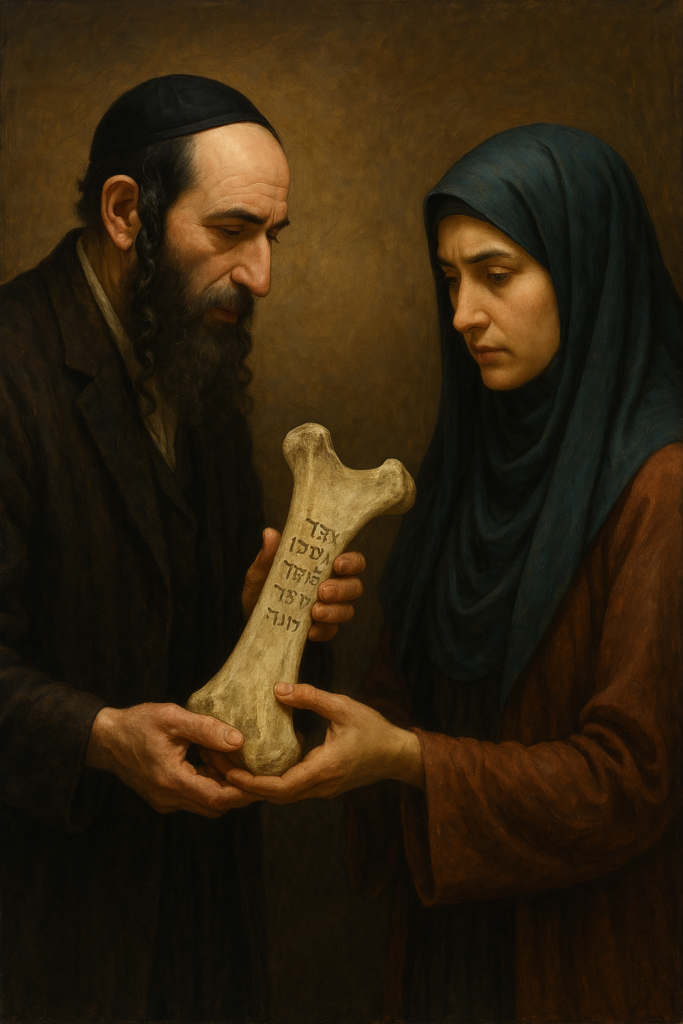
A symbolic image of the connection between women of influence and Jewish scholars
4. The Prophet’s response: declaring the failure of a historical scenario. The Prophet neither declared the text distorted nor raised the question of its correctness or incorrectness. Rather, he warned under oath: “If you leave me and follow Joseph, you will go astray.” This response is political and structural more than epistemic: the axis of authority in Islam must not be transferred to the past or to another, even if that other is a prophet such as Joseph. This reaction is not a denial of the narrative; rather, it affirms present authority and prevents the gradual displacement of the authority figure.
5. From the bone to Saqifah: the quiet engineering of legitimacy. When epistemic authority is separated from the Prophet, political authority too can easily be appropriated. What occurred at Saqifah was the logical continuation of the very process begun by Hafsah’s bone. Changing the source for understanding religion prepares the ground for changing the form of leadership. Here, the Jewish project dealt its most effective blow not with a blade, but with a quiet interpretation.
The episode of Hafsah’s bone, though seemingly simple, reveals—when structurally analyzed and situated in its historical context—a systematic project to displace epistemic authority and political leadership and to weaken the foundation of prophetic leadership. This event is not only a reflection of Judaism’s distorted past, but also a sign of the enemy’s intellectual infiltration into the secure sanctuary of revelation. In a profound response, the Prophet, by emphasizing his own authority, exposed an attempt at collapse.
The Four Scenarios for the Origin of Hafsah’s Bone: From Jewish Infiltration to Doubt in Prophethood
What appears at first to be merely a family event—the bringing of a piece of “Torah” by Hafsah into the Prophet’s home—contains, at its depth, a discursive earthquake. The bone on which a text from the “Jewish heritage” is inscribed is not merely an object; it is a document of infiltration, the failure of authority, and doubt in the faith of those who stood in the circle closest to the Prophet.
But where did this text come from? More importantly, why did it appear in Hafsa’s hands? Four possible scenarios must be analyzed with precision and depth:
1. Hafsa’s direct connection with the Jewish sources of Medina
If Hafsa received this bone directly from the Jewish rabbis, the matter goes beyond “intellectual proximity.” In this scenario, Hafsa is not merely a recipient of a report; rather, she possesses a degree of trust and connection with the Jewish scholarly network that enabled her to obtain a piece of their preserved heritage.
The key point is this: the Jews, especially the rabbis, never easily placed their scholarly heritage at the disposal of outsiders—not even for money, pleas, or threats. What had remained from successive generations of scribes and preservers of the Torah was guarded like a hereditary رمز of the Jewish people’s intellectual power. Therefore, for Hafsa to possess such a report, she must either have gained access to the depth of their trust or have passed through channels open only to “allies within the structure.”
2. Transmission through an intermediary, to gauge the Prophet’s reaction
If the bone had reached Hafsa through an intermediary, the operation becomes more complex. In this case, we are faced with a discursive engineering: Hafsa, in the role of transmitter, brings the message of the Torah into the very heart of the prophetic sanctuary, yet at a tactical distance from the original source, so that the possibility of denial, testing, or diverting the reaction may remain available.
Intermediaries in soft warfare are shadow soldiers. Even if their identities are not clear, their mission is to test the Prophet’s tolerance in the face of an alternative authority. Here, however, the Prophet responds not with a neutral question, but by establishing “distortion and falsehood”; this indicates that the text presented had not entered the scene to explain the truth, but rather to compete with revelation.
3. The Source of the Bone: Umar ibn al-Khattab and Systematic Infiltration from Within
In this scenario, Hafsa carries a paternal project. Umar, who in authoritative sources such as Sahih al-Bukhari is noted for his interest in reading the Torah and consulting the People of the Book, likely collected the report himself and placed it at his daughter’s disposal. If so, Hafsa is not merely a loyal daughter, but the ideological assistant of a project that seeks, from within, to weaken the Prophet’s authority.
What Was the Aim of This Project?
Instilling the notion that “knowledge outside revelation also possesses authenticity”;
Testing the Prophet’s response to non-revelatory sources;
And, in the long term, opening the way to legitimizing the discourse of the People of the Book within Islamic civilization.
In this analysis, the bone is the beginning of a project that would later manifest itself in politics, jurisprudence, and narrative-making through figures influenced by the People of the Book and a covertly Hebraic Islam.
4. Why did Hafsa show this bone to the Prophet? Motives and behavioral scenarios
Now, regardless of its origin, one must ask: what was Hafsa’s motive in presenting this text?
There are three possible hypotheses:
An assertion of the power of alternative knowledge: perhaps she wished to show that other sources also existed that could provide answers, and perhaps were even more precise than the Prophet; a hidden message to the effect that: «Knowledge is not your monopoly.»
Surrender to the appeal of the rival discourse: in this scenario, Hafsa has in some sense been intellectually captivated. A person who lives in the vicinity of revelation yet turns to a distorted narrative shows an inward decay of faith.
Carrying out a mission on behalf of a hidden network: in the theory of psychological operations, an actor is sometimes unaware of the dimensions of the mission itself. Hafsa may have been unwittingly, yet purposefully, carrying out a phase of a project of «testing authority».
Conclusion: The Bone That Tested Faith
In all four scenarios, whether Hafsa herself obtained the report or received it from her father or an intermediary, the conclusion is the same: she showed the Prophet a report that she believed could serve as an alternative or complement to revelation. This signifies the absolute collapse of faith in the singularity of the Prophet’s authority.
More dangerously still, if Umar was the source of the report, this disbelief in the Prophet’s authority is systemic and sequential.
📌 Ultimately, Hafsa’s bone not only carried the Torah; it also carried this message: «We do not have complete faith in your prophethood; there is another authority in which we also believe.»
And instead of being buried in the earth, this bone remained in history like a ghost: the ghost of a quiet yet effective betrayal.
Concluding Remarks:
A precise examination of the episode concerning Hafsa’s bone and the reading of the text of the story of Joseph in the presence of the Prophet cannot be analyzed merely as an individual act or personal curiosity. Given its historical context, Hafsa’s position within the household of prophethood, and Umar ibn al-Khattab’s intellectual and behavioral ties with the People of the Book, this event points to clear evidence of a subtle and gradual project aimed at shifting religious authority and leadership from the Prophet to external sources.
The Prophet’s decisive reaction to this event, without addressing the correctness or incorrectness of the text, indicates that the issue was not the content of the account but the very legitimacy of bringing it into the household of revelation. By warning of the community’s deviation should it follow Joseph instead of himself, the Prophet in fact unveiled a historical plan to transfer epistemic authority and leadership.
In this analysis, Hafsa and Umar were not merely unaware executors of an external scenario; rather, they were conscious and effective actors in the process of “engineering leadership” after the Prophet—a process that gradually prepared the ground for separating scholarly authority from revelation and transforming it into a composite source of the Torah, personal ijtihad, and political rationality.
Based on the analytical data of this article and the report presented, it may be said that Hafsa’s and Umar’s faith in the Prophet’s absolute authority was subject to doubt, suspension, and even practical denial. Undoubtedly, Umar and his daughter were professional hypocrites and did not have even the slightest faith in the Prophet. When someone within the Prophet’s own household turns to a text of the People of the Book and sets it before revelation, they have in fact called into question belief in the “finality of authority in the Prophet.” If this doubt was designed by Umar and carried out by Hafsa, it can no longer be regarded as a simplistic error or a lapse of faith; rather, it must be considered a link in the chain of infiltration that began with the bone and came to fruition at Saqifa.
Suggested questions for further research:
Was Hafsa’s bone not the key through which Torah-based narratives entered the domain of prophethood?
Why did the Prophet not critique the story, yet insist on his own authority?
Was the root of Saqifa not in the council, but rather in a decayed bone that undermined the legitimacy of revelation?
Were Hafsa and her father not two sides of a single joint project?
4840 — Hafsa came to the Prophet, peace and blessings be upon him, with a written account of the story of Joseph on a shoulder blade, and began reading it to him. The Prophet’s face changed color, and he said:
“By Him in Whose Hand is my soul, if Joseph were to come to you while I am among you, and you followed him and abandoned me, you would certainly go astray.”
Shuʿab al-Īmān, al-Bayhaqī
Al-Muṣannaf, ʿAbd al-Razzāq
Hafsa came to the Prophet with a book in which the story of Prophet Joseph had been written and began reading it to him. The Prophet’s face changed, and he said: “By Him in Whose Hand is my soul, if Joseph were to come to you while I am among you, and you followed him and abandoned me, you would certainly go astray.”
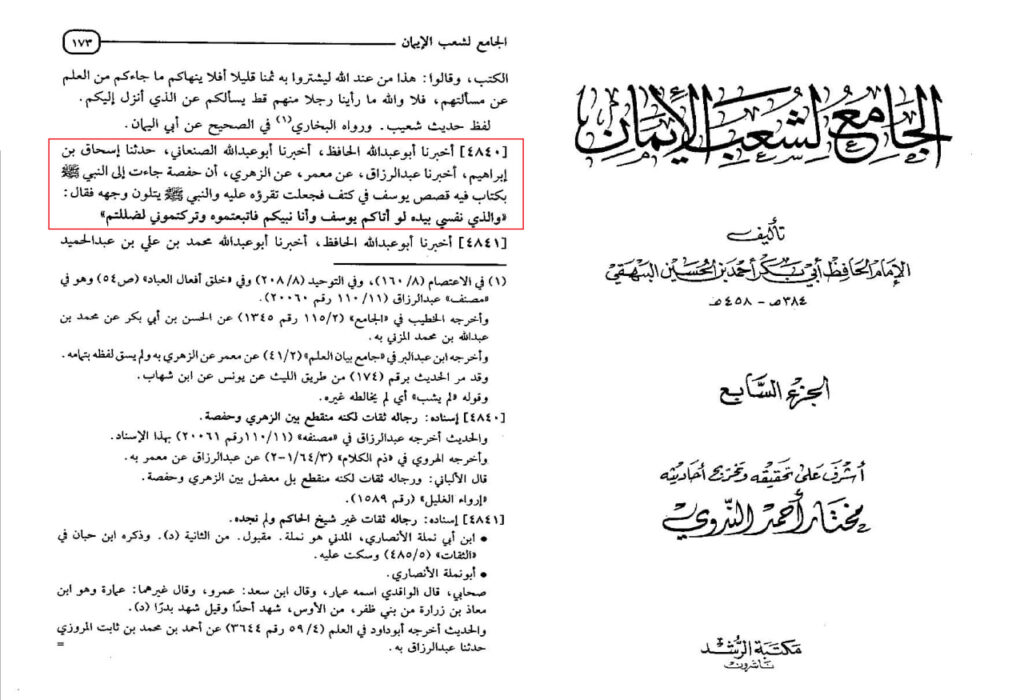
Hafsa came to the Prophet, peace and blessings be upon him, with a shoulder blade on which a book containing the story of Joseph was written, and she began reading it to him. The Prophet’s face began to change color, and he said: “By Him in Whose hand is my soul, if Joseph were to come to you while I am among you, and you followed him and abandoned me, you would surely go astray.”
Hafsa came to the Prophet with a book in which the story of Prophet Joseph was written and read it to him. Then the Prophet’s complexion changed, and he said: “I swear by the One in Whose hand is my soul: if Joseph were to come to you while I was among you, and you abandoned me and followed him, you would go astray.”
Al-Bayhaqi, Shuʿab al-Īmān.
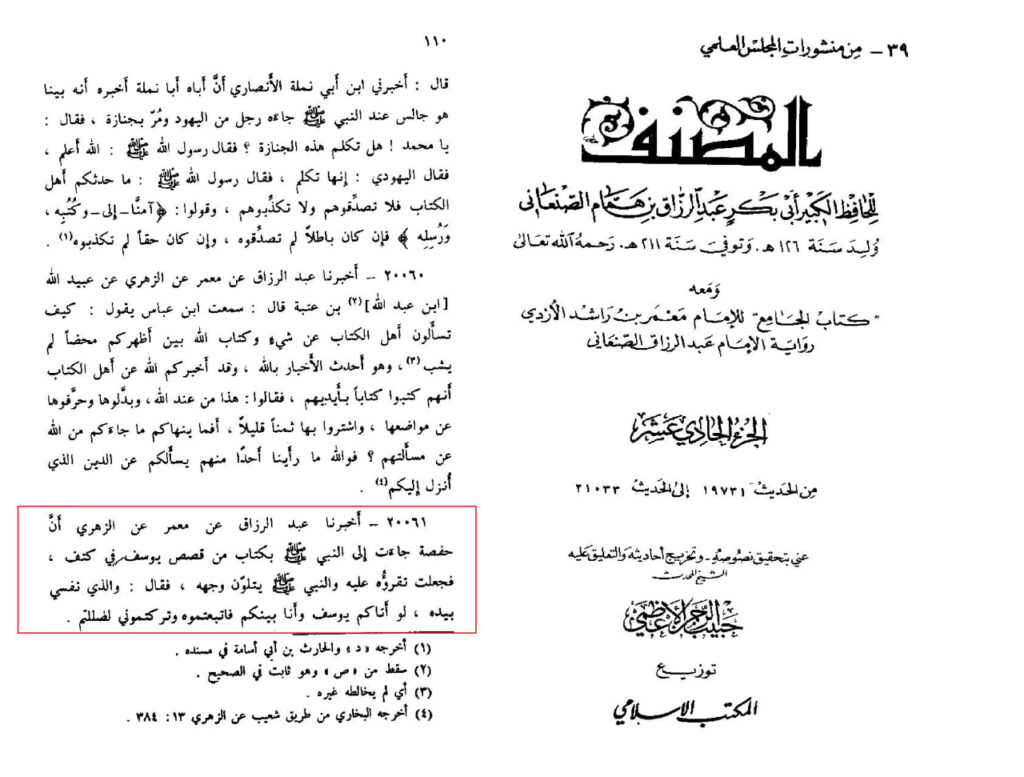
Hafsa came to the Prophet, peace and blessings be upon him, with a shoulder blade on which a book containing the story of Joseph was written, and she began reading it to him. The Prophet’s face began to change color, and he said: “By Him in Whose hand is my soul, if Joseph were to come to you while I am among you, and you followed him and abandoned me, you would surely go astray.”
Hafsa came to the Prophet with a book in which the story of Prophet Joseph was written and read it to him. Then the Prophet’s complexion changed, and he said: “I swear by the One in Whose hand is my soul: if Joseph were to come to you while I was among you, and you abandoned me and followed him, you would go astray.”
Shuʿab al-Īmān by al-Bayhaqī
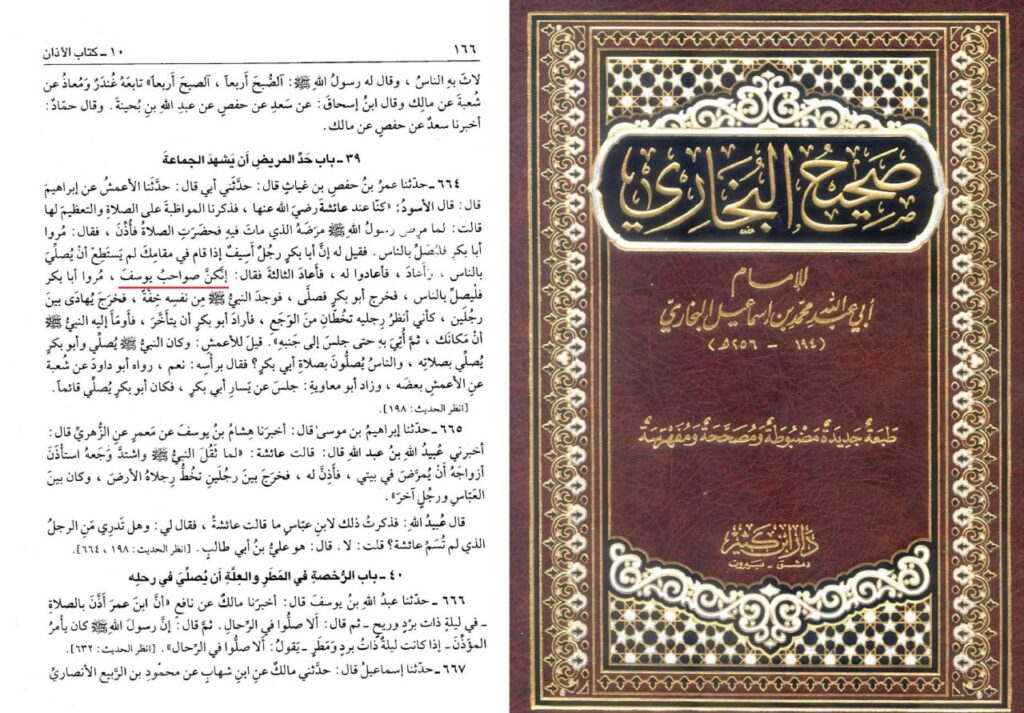
Near the end of his life, during the incident of Abu Bakr leading the prayer, when Aisha disobeyed the Prophet’s instruction, the Prophet likewise used this expression about her:
"Indeed, you are the companions of Joseph."
The Prophet said to Aisha: You are like the women around Joseph.
Ṣaḥīḥ al-Bukhārī
Related articles

Comments
No comments yet.
