Jewish Disciple: An Analysis of the Influence of Jewish Sources on the Structure of Umar’s Caliphate (2)
Author: Hamed Sarem
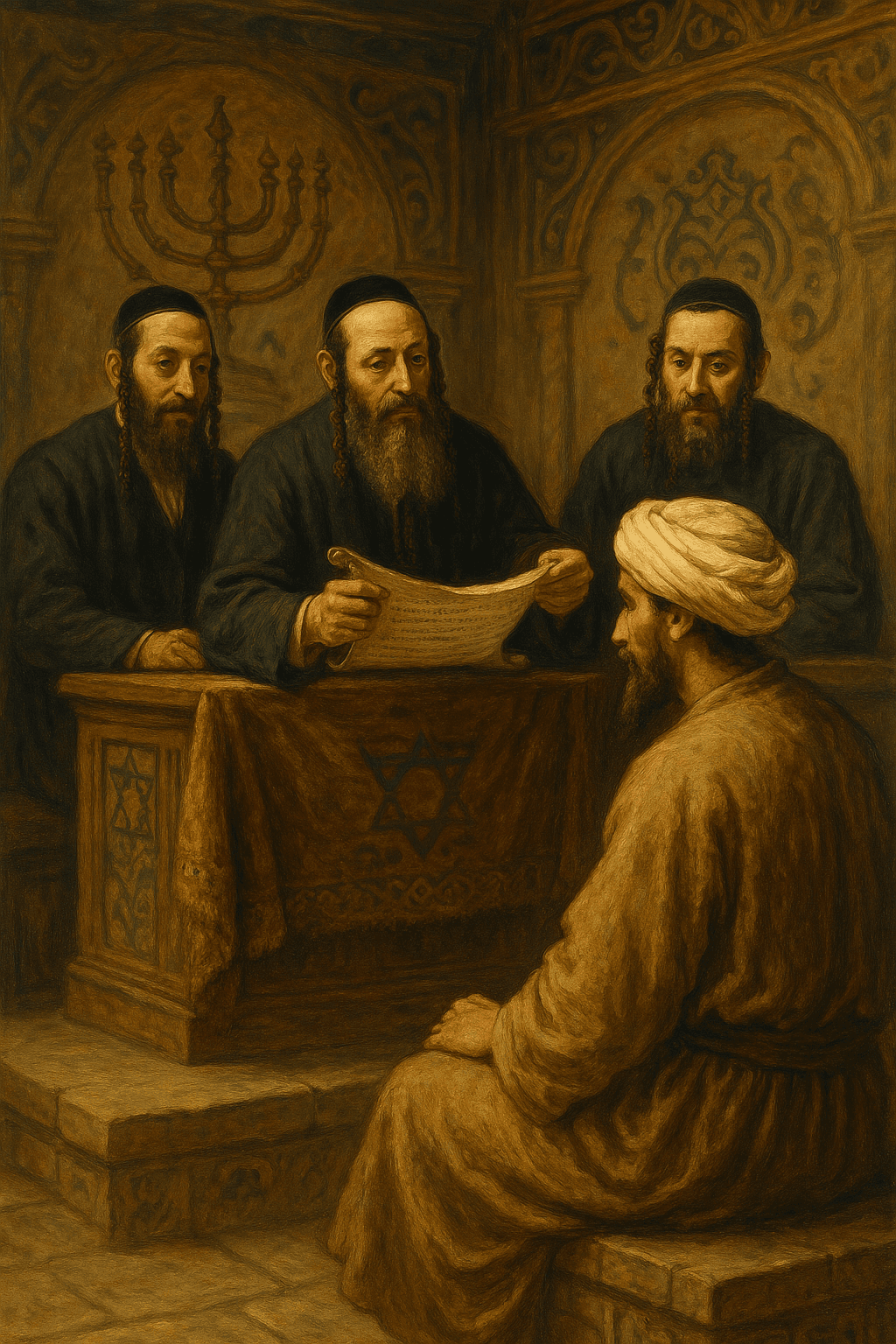
Jewish Disciple: Reassessing the Influence of the Torah on Umar’s Policies
Umar ibn al-Khattab brought the Torah to the Messenger of God for promotion.
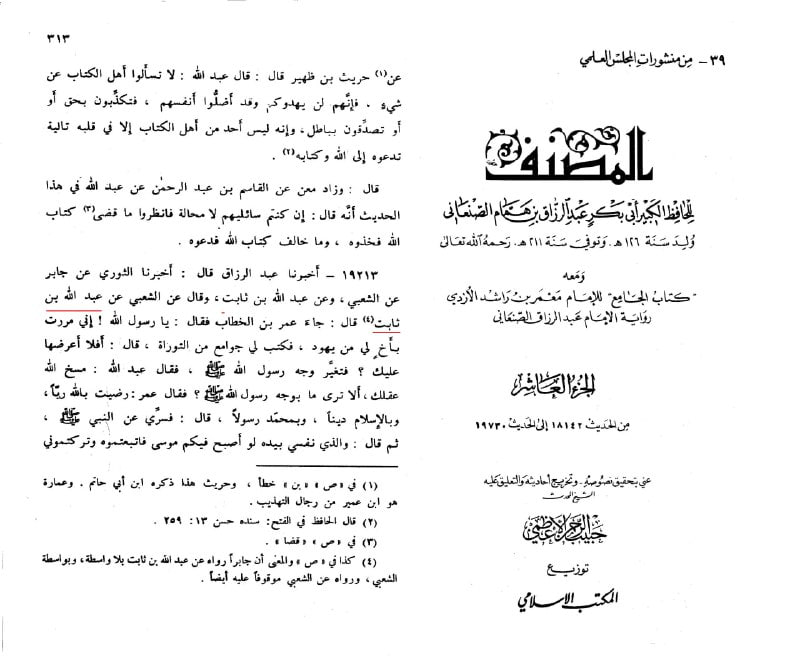
1. Through Abdullah ibn Thabit: 19213 — Abd al-Razzaq said: Al-Thawri informed us, from Jabir, from al-Sha‘bi, and from Abdullah ibn Thabit. He said: from al-Sha‘bi, from Abdullah ibn Thabit, who said: Umar ibn al-Khattab came and said: “O Messenger of God, I passed by a Jewish brother of mine, 👉🏼 and he wrote for me comprehensive passages from the Torah. Shall I not present them to you?” The face of the Messenger of God, may God bless him and grant him peace, changed. Abdullah said: “May God distort your mind! Do you not see what is on the face of the Messenger of God, may God bless him and grant him peace?” Umar said: “I am pleased with God as Lord, with Islam as religion, and with Muhammad as Messenger.” He said: The Prophet, may God bless him and grant him peace, was then relieved and said: “By Him in whose hand is my soul, if Moses were among you this morning and you followed him and abandoned me, you would have gone astray. You are my share among the nations, and I am your share among the prophets.” 📕 Musannaf of Abd al-Razzaq al-San‘ani
2. From Jabir ibn Abdullah al-Ansari: 15156 — Surayj ibn al-Nu‘man narrated to us; he said: Hushayk narrated to us; Mujalid informed us, from al-Sha‘bi, from Jabir ibn Abdullah, that Umar ibn al-Khattab came to the Prophet, may God bless him and grant him peace, with a book he had obtained from some of the People of the Book. He read it to the Prophet, may God bless him and grant him peace, who became angry and said: “Are you perplexed about it, O son of al-Khattab? By Him in whose hand is my soul, I have brought it to you white and pure. Do not ask them about anything, lest they tell you something true and you deny it, or something false and you believe it. By Him in whose hand is my soul, if Moses were alive, he would have no choice but to follow me.” 🔶 It conveys the same meaning, with the difference that at the end he says: even if Moses were alive, he would have no alternative but to follow me. 📕 Musnad Ahmad, al-Risalah edition; 📕 Sunan al-Darimi
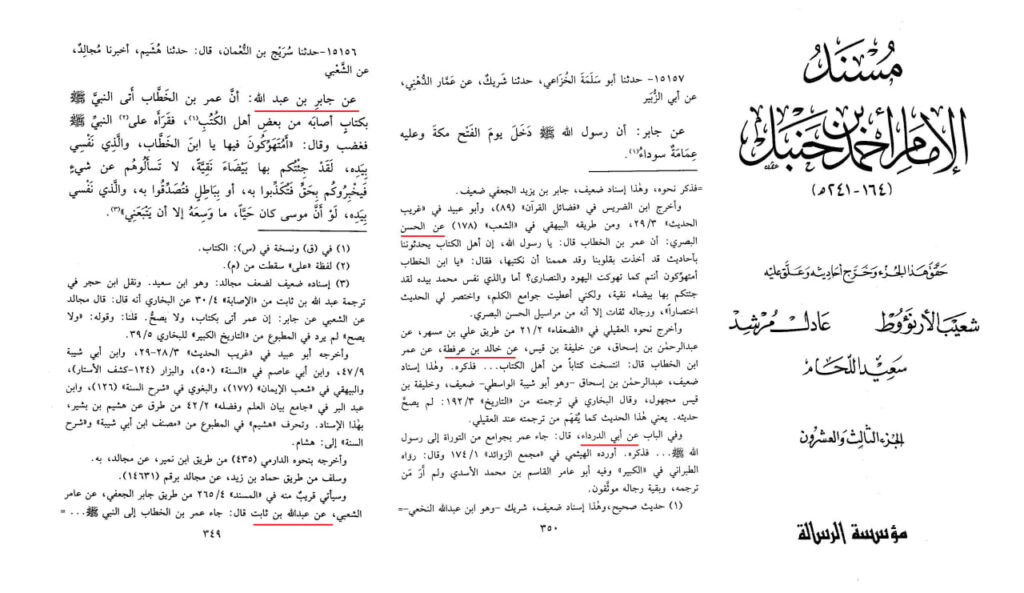
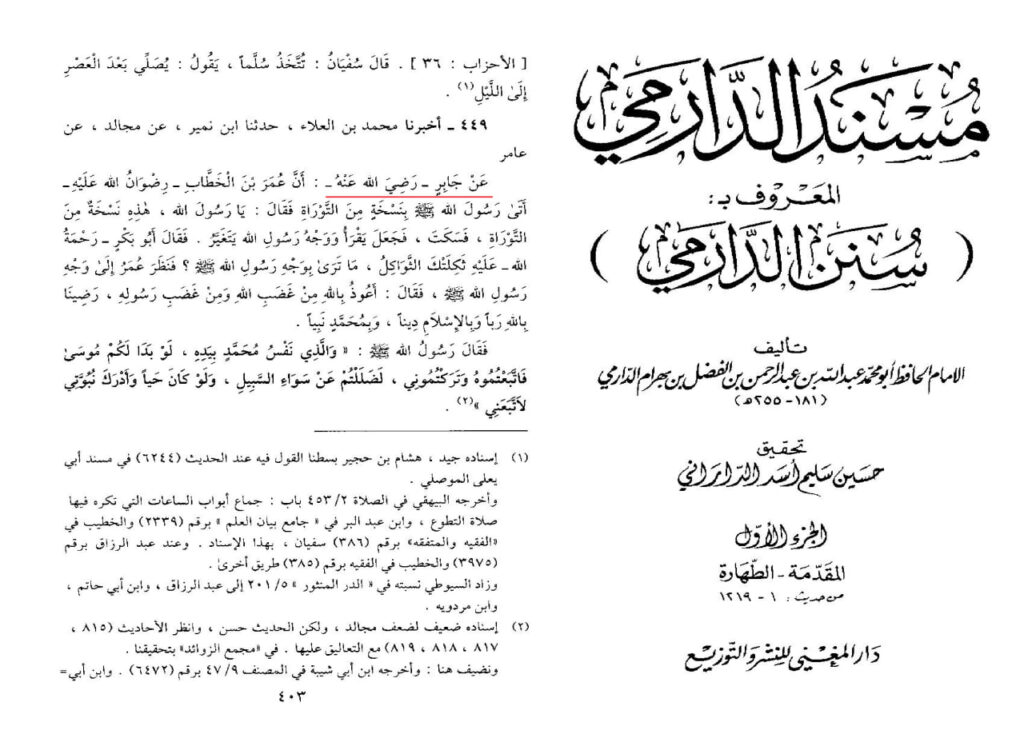
Abdullah al-Turki, the editor of al-Bidayah wa al-Nihayah by Ibn Kathir, considers the narration to meet Muslim’s criteria: “Its chain of transmission meets the criteria of Muslim.” 📕 al-Bidayah wa al-Nihayah
Ibn Abi ‘Asim says that the hadith is sound: its narrators are trustworthy except Mujalid ibn Sa‘id, who is weak; however, the hadith is sound because it has different chains. “A sound hadith; its chain consists of trustworthy narrators apart from Mujalid, namely Ibn Sa‘id, for he is weak. But the hadith is sound due to routes which I indicated in al-Mishkah (177), and then I traced some of them in al-Irwa’ (1589).” 📕 Kitab al-Sunnah, Ibn Abi ‘Asim
Al-Baghawi narrates Jabir’s report with an important alteration, in which Umar says to the Prophet that we are amazed by the hadiths of the Jews and asks whether they should write down some of them.
From al-Sha‘bi, from Jabir ibn ‘Abd Allah, from the Prophet, may Allah bless him and grant him peace, when Umar came to him and said: “We hear hadiths from Jews which amaze us; do you think that we should write down some of them…” 📕 Sharh al-Sunnah, al-Baghawi.
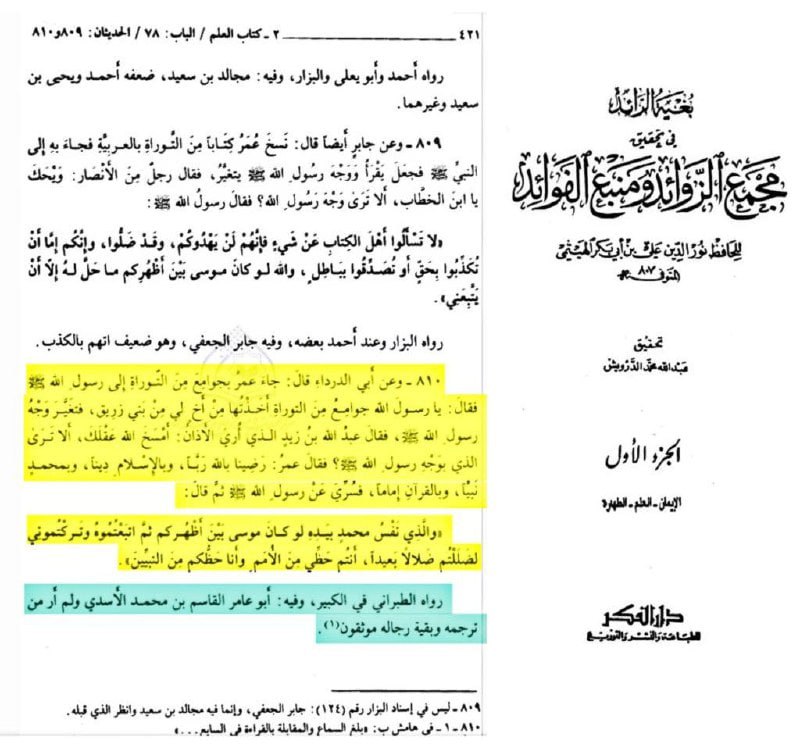
3. From Abu al-Darda’: 810 — Abu al-Darda’ said: “Umar brought compendia from the Torah to the Messenger of Allah.” Al-Tabarani narrated it in al-Kabir. Its chain includes Abu ‘Amir al-Qasim ibn Muhammad al-Asadi, for whom I have not found a biographical entry; the rest of its narrators are deemed trustworthy. 📕 Majma‘ al-Zawa’id wa Manba‘ al-Fawa’id
Final Analysis
Umar’s relationship with the Jews was not merely an ordinary interaction or scholarly curiosity. His use of the explicit expression «أخي من اليهود» (“my Jewish brother”) indicates a deep, intellectual, and trusting bond unprecedented among the Companions. This expression not only provoked a strong reaction from the Noble Prophet, peace and blessings be upon him and his family, but was also wholly at odds with the Qur’anic teaching: «لَتَجِدَنَّ أَشَدَّ النَّاسِ عَداوَةً لِلَّذينَ آمَنُوا الْيَهُود».
According to historical and theological analysis, such interactions paved the way for the entry of Torah-based concepts and Isra’iliyyat into the Islamic tradition—an influence whose traces were later seen in jurisprudence, exegesis, and even the policies of the second caliphate.
For this reason, examining this episode is not merely a historical rereading; rather, it is a critique of a point of strategic deviation within the structure of the Islamic Ummah—a point at which distorted Jewish teachings entered Muslims’ religious discourse through deception and continued into subsequent centuries.
This dossier, with documents and scans of authoritative books, is being published on the site coherently for the first time, so that the veil may be lifted from a reality that had long remained hidden beneath the dust of sanctity.
Author: Hamed Sarem
Related articles

Comments
No comments yet.