The Battle of Mir Hamid Husayn’s Critical Thought Against Dihlavi’s Systematic Falsehoods: Illuminating the Truth Amid the Darkness of Distortion
Author: Hamed Sarem
Abstract
This article examines the deliberate, organized, and coherent fabrications of ʿAbd al-ʿAzīz Dihlawī and his like-minded associates concerning the most important doctrinal issues, and explains the responses of the late Mīr Ḥāmid Ḥusayn, which are grounded in the method of critical thinking. By extensively employing tools such as distortion, concealment, and deception, Dihlawī sought to obscure the truths related to the status of the Ahl al-Bayt (peace be upon them). He also attempted to mislead his audience by embellishing the outward appearance of his discourse so that it would seem entirely scholarly and consistent with the rules of debate.
The late Mīr Ḥāmid Ḥusayn responded to these distortions and deliberate deviations through an analytical and critical approach. While exposing the systematic nature of these falsehoods, he clarified the truth and removed the mask from these distortions by relying on authoritative sources and scholarly analyses. Ultimately, this study shows that critical thinking and impartial analysis are effective tools for confronting systematic lies and restoring truth to the sphere of religious thought and belief.
Systematic Fabrication: A Tool for Deception and the Destruction of Social Structures
One clear instance of injustice is fabrication. Among all human peoples, regardless of their creed or path, fabrication is regarded as reprehensible and unacceptable. Lying in speech and action is exceedingly reprehensible and ugly; it has been strongly condemned in all religions, which have promised punishment and chastisement for it. Fabrication, however, which specifically involves widespread misguidance and deception, is even more vile and ugly. Ordinary lies are generally deceptions limited to a particular individual or group and usually have short-term effects. Fabrication, especially in its broad and deliberate form, becomes a complex instrument capable of deceiving society on a wider scale. Fabrication is not merely superficial; it has a deeper destructive effect because it is continuously disseminated with the aim of creating false beliefs among people. Compared with individual lies, such falsehoods have far broader and more serious effects on society. Fabrication refers to a particular kind of lying that is disseminated in an organized manner by groups or institutions in order to manipulate public opinion and direct people’s beliefs and conduct. This orderly, coherent, and purposeful fabrication is described as a “systematic” lie. Unlike individual lies, this kind of lying is not only spread regularly and deliberately, but is also employed as a tool to bring about intentional changes in the course of collective and individual thinking. These lies can weaken individuals’ capacity for critical thought and negatively affect their life choices. This kind of lying can undermine social and intellectual structures and lead to the collapse of social norms.
Systematic lying is not merely a simple false claim; rather, it is a complex process in which lies are presented in a structured manner and for a specific purpose, in various forms. The purpose of these lies is usually to mislead the audience and steer them toward a false truth or a particular orientation. Unlike individual or accidental lies, this kind of lie generally appears to be supported by fabricated or distorted sources and other sophisticated tools that gain the audience’s trust.
Tools of Systematic Lying
Systematic lying uses numerous tools to conceal the truth and direct the audience toward particular objectives. Some of the principal tools in this regard are distortion, the dressing of truth in falsehood, and concealment.
Systematic Lying in the Realm of Books
Systematic lying has numerous tools. One of these tools is the writing of books. A book can engage in systematic lying and enlist particular means to carry out this act. Such a book is designed as a purposeful instrument for distorting realities, changing public opinion, or supporting a particular ideology. A book that engages in systematic lying is a powerful instrument for distorting facts and influencing public opinion. Identifying and confronting such books requires careful analysis, investigation of sources, scholarly mastery of the subject, and access to reliable sources. A book that engages in systematic lying and has been written to prove, confirm, or refute a particular ideology can have broad and profound effects at different levels of society, the family, and individuals. These effects may be short-term or long-term, and their intensity and scope will vary according to the degree of public acceptance of the content and the means of propaganda. Systematic lying in the domain of books and ideology has always been used throughout human history as an important tool for consolidating or acquiring power, distorting realities, and directing public opinion. These books not only distort the truth, but also divert the course of the intellectual and social progress of societies. Therefore, a profound understanding of this phenomenon and of the methods for confronting it is necessary to safeguard human values. Many books throughout history have engaged in fabrication; here, however, we examine a book that has engaged in systematic deception. Tuhfah-yi Ithnā ʿAshariyyah, authored by ʿAbd al-ʿAzīz Dihlawī, is among the books that have engaged in “organized lying.” The late Mīr Ḥāmid Ḥusayn, author of ʿAbaqāt al-Anwār (the most important critique of Tuhfah-yi Ithnā ʿAshariyyah), writes concerning the author of Tuhfah-yi Ithnā ʿAshariyyah: “In this book, he has attacked and objected to the beliefs and views of the Shiʿa in general and the Twelver sect in particular—in their principles, branches, ethics, manners, and all their beliefs and practices—using expressions outside the bounds of propriety and words beyond the etiquette and conventions of debate, and in the manner of books written by novices, which are closer to rhetoric than to proof ... He has filled the book with fabrications and heinous accusations” (ʿAbaqāt al-Anwār—Ḥadīth al-Thaqalayn, Isfahan edition, vol. 6, p. 1198). In a “holistic examination” of Tuhfah-yi Ithnā ʿAshariyyah, one can conclude that this book has employed all the tools of “organized lying” for this purpose.
Tools of Systematic Lying
Systematic lying uses numerous tools to conceal the truth and direct the audience toward particular goals. Some of the principal tools in this regard are distortion, disguising truth with falsehood, and concealment.
Systematic Lying in the Realm of Books
Systematic lying has numerous tools. One of these tools is the writing of books. A book can engage in systematic lying and employ particular means to carry it out. Such a book is designed as a purposeful instrument for distorting realities, changing public opinion, or supporting a particular ideology. A book that engages in systematic lying is a powerful instrument for distorting facts and influencing public opinion. Identifying and confronting such books requires careful analysis, investigation of sources, scholarly mastery of the subject, and access to reliable sources. A book that engages in systematic lying and is written to prove, confirm, or reject a particular ideology can have extensive and profound effects at different levels of society, the family, and individuals. These effects may be short-term or long-term, and their intensity and scope vary according to the degree of public acceptance of the content and the tools of propaganda. Systematic lying in the realm of books and ideology has always been used throughout human history as an important instrument for consolidating or acquiring power, distorting realities, and directing public opinion. These books not only distort the truth, but also divert the course of the intellectual and social advancement of societies. Therefore, a deep understanding of this phenomenon and of methods for confronting it is necessary for safeguarding human values. Many books throughout history have engaged in fabrication, but here we examine a book that engaged in systematic deception: Tuhfah Ithna ‘Ashariyyah, authored by ‘Abd al-‘Aziz Dihlawi, is among the books that has engaged in “organized lying.” The late Mir Hamid Husayn, author of ‘Abaqat al-Anwar (the most important critique of Tuhfah Ithna ‘Ashariyyah), writes about the author of Tuhfah Ithna ‘Ashariyyah: “In this book, the beliefs and opinions of the Shi‘a in general, and of the Twelver sect in particular—in their principles, branches, ethics, manners, and all their beliefs and practices—have been attacked and objected to with expressions outside the bounds of decency, words beyond the etiquette and conventions of debate, and in the style of books for novices, which is closer to rhetorical address than to proof... He has made the book full of calumnies and heinous accusations” (‘Abaqat al-Anwar—Hadith al-Thaqalayn, Isfahan edition, vol. 6, p. 1198). In a “holistic examination” of Tuhfah Ithna ‘Ashariyyah, one may conclude that this book has employed all the tools of “organized lying” for this aim. The tools of systematic lying employ diverse methods and means to conceal the truth and redirect the audience’s thinking toward particular goals and hidden motives. This complex and purposeful process can effectively divert people’s beliefs and decisions by using various methods such as manipulating information, distorting realities, and fabricating lies. Through the precise scholarly critiques and objections that the late Mir Hamid Husayn raises concerning the method of Tuhfah Ithna ‘Ashariyyah, we seek to show the approach of “fabricated and calculated lies” in this book. In this regard, the three principal tools most frequently used in “strategic deception” are as follows: disguising truth with falsehood. Disguising truth with falsehood is one of the most complex and subtle tools of systematic lying. In this method, part of the truth is mixed with a lie so that the lie appears more natural and acceptable. This technique is usually employed deliberately to create false trust in the audience. Since parts of the truth stand alongside the lie, the audience tends to assume that the entire claim is correct. More precisely, it is a stratagem in which falsehood is adorned in the form of truth, such that recognizing falsehood becomes difficult, and those seeking the truth fall into the trap of lies and deceit. Dihlawi, too, like his predecessors and the Umayyad-Jewish current, has benefited from this tool. For example, in order to make his false claim appear sound, Dihlawi, in criticizing Hadith al-Thaqalayn, cites only a portion of the hadith and omits to mention the number of its narrators, thereby clearly violating the principles of research. While referring only to a brief phrase from the hadith, he avoids mentioning that it has been narrated by more than twenty Companions. Such disregard for reliable chains and narrators prevents the hadith itself from being properly recognized and distorts its true understanding. In reality, by doing this he seeks to show that the Imami claim lacks documentation. In another example, in response to Hadith al-Thaqalayn, Dihlawi relies on a saying that some have attributed to the Noble Prophet (peace and blessings be upon him and his family): “Take half of your religion from this Humayra’ (A’ishah).” Although Hadith al-Thaqalayn is frequently transmitted and mutawatir in Sunni sources, he brings this report in opposition to Hadith al-Thaqalayn in order to confuse and mix truth with falsehood. By this very act, he attempts to clothe falsehood in the garb of truth and to present A’ishah as equal to—indeed, superior to—the Thaqalayn, although ‘Allamah Mir Hamid Husayn, citing the texts of the leading Sunni imams and hadith preservers, has refuted the invalidity of this report. In many instances, in order to divert his audience’s mind from reality, he presents reports as counterarguments to Hadith al-Thaqalayn and Hadith Madinat al-‘Ilm, attempting to introduce other individuals as scholarly authorities in place of the Prophet’s Household and the Commander of the Faithful. ‘Abd al-‘Aziz Dihlawi considered Hadith al-Thaqalayn to be contradicted by the hadith, “Follow the guidance of ‘Ammar,” meaning that the Prophet commanded people to refer to ‘Ammar for guidance and not to the Thaqalayn. Yet ‘Allamah Mir Hamid Husayn replies that ‘Ammar was among the Shi‘a of ‘Ali (peace be upon him) and refrained from pledging allegiance to Abu Bakr. He then asks sarcastically: This is the guidance of ‘Ammar; why, then, did they not act upon his guidance? At one time he introduces ‘Ammar as one to whom people must cling for guidance, at another Ibn Mas‘ud, and elsewhere other individuals. That is, he tries every means to clothe anyone other than the Ahl al-Bayt (peace be upon them), and especially the Commander of the Faithful ‘Ali (peace be upon him), in the garment of leadership and obedience, presenting them as truths that must be obeyed. Despite all this unfairness toward the Commander of the Faithful ‘Ali (peace be upon him), they portray themselves as his lovers, and this itself is another disguise. It is striking that some Sunni writers, such as ‘Abd al-‘Aziz Dihlawi, claim to be the true followers of the Ahl al-Bayt (peace be upon them), to have boarded their Ark of Salvation, and to follow them. They raise such claims as a means of diminishing the value of the Shi‘a and taunting their religion. This led ‘Allamah Mir Hamid Husayn to present some of their offensive statements regarding the Imams of the Ahl al-Bayt (peace be upon them), so as to reveal the truth and show the scholarly community that the Sunnis’ aim in these cases is merely to reject the Shi‘a and their beliefs—whether through praising the Ahl al-Bayt and claiming love and obedience toward them, or through attacking, denying, and disparaging them. The author of ‘Abaqat shows these contradictions in Dihlawi and those like him—such as Ibn ‘Arabi, Ibn Khaldun, and Ibn Taymiyyah—and at times their open disrespect toward the Imams of the Ahl al-Bayt (peace be upon them), even while claiming love and allegiance to the Ahl al-Bayt. What can this hypocritical conduct be called other than disguising truth with falsehood?! Effects of disguising truth with falsehood: this method has particular effects on the audience and on its process of thinking:
1. Gaining trust: When a message or claim contains elements of truth, the audience naturally shows greater trust in it. This is because truth is inherently convincing, and by seeing these honest elements, the audience is likely to believe the entire message. This gaining of trust is a powerful tool for accepting content, even if part of it is misleading. 2. Creating confusion: Combining truth and falsehood makes it difficult for the audience to discern the full truth. Since elements of truth are scattered among incorrect information, distinguishing the two becomes difficult for the audience. This confusion benefits anyone who intends to deceive or control the audience’s mind. 3. Reducing the effect of criticism: The presence of some truth in a claim or message creates a kind of defensive shield for the claimant. Critics may be unable to reject it completely and decisively, because parts of the claim are verifiable and correct. This increases public acceptance of the claim, even if part of it is false or misleading. Ultimately, disguising truth with falsehood is a tool for controlling thoughts, directing beliefs, and misleading individuals or societies; confronting it requires critical thinking and careful attention to details. This approach produces a society far removed from thought and accompanied by blind prejudice.
Concealment of the Truth
Concealment of the truth means hiding parts of information that could clarify existing realities. In this method, portions of information that may conflict with the ideology or the main objective are omitted. This causes the audience to encounter only one particular narrative, one-sidedly and without awareness of other information. Dihlawi also used this tool extensively for “engineered lying.” He saw no scholarly or ethical obstacle to concealing the truth. It is, of course, necessary to note that the use of “deceptive concealment” was an enduring method of confronting the truth and the light of the Prophet of Mercy. His predecessors, too, had ordered the burning of the Prophet of Mercy’s hadiths and prohibited the writing of prophetic hadith for one hundred years. When, for political reasons, they turned to writing prophetic hadith, they were able to lay the foundation for “organized lying” through fabricated and distorted hadiths. For success in this sphere, “structural secrecy” (concealment) played a central role. The book Tuhfah Ithna ‘Ashariyyah, which primarily seeks to criticize Shi‘i proofs for establishing the imamate of the Commander of the Faithful ‘Ali (peace be upon him), attempts to restrict these proofs to a few particular verses and hadiths and portray them as baseless and weak. In this book, Dihlawi does not even refer to many pieces of evidence from the Noble Qur’an and narrations that indicate the immediate caliphate of the Commander of the Faithful (peace be upon him). Through this “purposeful concealment,” he has induced his audience to believe that the proofs for establishing this great truth are very few and insignificant. Then, continuing the policy of “deceptive concealment,” he has portrayed even the few proofs he mentions as fragile, baseless, and weak, without using sound and scholarly methods. It cannot be accepted that Dihlawi was unaware of all these Qur’anic verses and narrations—transmitted by Sunnis—in arguing for the imamate of the Commander of the Faithful (peace be upon him). Undoubtedly, he engaged in “systematic deception.” Interestingly, beyond this widespread concealment, he has also engaged in these “fabricated and calculated lies” in various other parts and aspects. For example, concerning Hadith al-Ghadir, Dihlawi claimed that argument from this hadith depends on the word “mawla” meaning “awla” (more entitled). He then claimed that lexicographers refuse to use this word in that sense. In reality, he has cast the words of lexicographers into the obscurity of concealment and, by dancing between truth and falsehood, has sought to destabilize the indication of Hadith al-Ghadir. He has, of course, hidden many facts in the shadow of silence. This practice is also very frequent among his peers and those of the same persuasion. Among such examples is the concealment of the truth and distortions in transmitting the hadith, “I am the city of knowledge and ‘Ali is its gate.” One of the most important examples is the removal of this hadith from Sahih al-Tirmidhi and al-Baghawi’s Masabih al-Sunnah. Yet it should be noted that a group of prominent Sunni authors have narrated this hadith from al-Tirmidhi, showing that they saw this hadith in al-Tirmidhi’s book and that this report was later removed from it. Among these individuals are:
Ibn al-Athir in Jamiʿ al-Usul. Muhammad ibn Talhah al-Shafiʿi in Matalib al-Suʾul. Al-Suyuti in Tarikh al-Khulafaʾ. Ibn Hajar al-Makki in al-Sawaʿiq al-Muhriqah. Al-Zurqani al-Maliki in Sharh al-Mawahib al-Ladunniyyah.
In addition, this hadith has also been transmitted from the book Masabih al-Sunnah by a number of others, including:
Muhibb al-Tabari in al-Riyad al-Nadirah and Dhakhaʾir al-ʿUqba. Al-Qari in al-Mirqat fi Sharh al-Mishkat. Ahmad ibn Fadl al-Makki in Wasilat al-Maʾal.
Al-Tirmidhi also narrated the hadith: “Ali is from me, and I am from Ali, and he is the wali of every believer after me.” However, al-Baghawi omitted the word “baʿdi” (“after me”) when transmitting this hadith and attributed it to al-Tirmidhi. Some scholars, including Sahranfuri, the author of al-Marafid, and Mawlawi Hasan Ali Muhaddith (a student of Mawlawi ʿAbd al-ʿAziz Dihlawi), followed al-Baghawi in this concealment and hiding of the truth. Muhammad ibn Muʿtamid Khan Badakhshi even claimed in a treatise called Radd al-Bidʿah that the word “baʿdi” in this hadith is fabricated. Shah Wali Allah Dihlawi likewise quoted this hadith from al-Tirmidhi in full in one passage of Izalat al-Khafaʾ; however, when confronted with the Shiʿi argument based on this hadith, he introduced distortions and omissions into it. He substituted the word “ana” for “innahu,” which is itself a distortion, and omitted the word “baʿdi,” as did al-Baghawi and his followers.
Effects of Concealment (Hiding the Truth)
Continuing the discussion of hiding the truth and its consequences, it should be noted that this method not only limits the understanding of realities, but can also lay the groundwork for the formation of false and deviant beliefs in people’s minds. Just as Dihlawi used this method to distort the truth in various issues, others too, by concealing and distorting information, seek to impose a particular viewpoint on their audiences. In this context, hiding the truth becomes a tool for directing and changing people’s thoughts toward specific aims. The effects of this method at the individual and social levels, especially in religious and historical fields, are of particular importance.
1. Rendering the perspective one-dimensional: Concealing the truth causes the audience to view the matter only from a limited angle and prevents them from attaining a comprehensive understanding of it. When part of reality is deliberately ignored, a person encounters only a portion of the truth, which naturally leads to an oversimplified and one-dimensional perspective. In the case of Dihlawi, by concealing many religious proofs that indicate the immediate caliphate of Imam Ali (peace be upon him), he presents a one-sided image of this truth that prevents its full understanding. Such concealments can lead not only in religious spheres but also in other fields to the formation of mistaken opinions and decisions. 2. Reinforcing false beliefs: Concealing the truth strengthens false and incomplete beliefs in the audience's mind. When information is presented incompletely and selectively, a person makes analyses based on erroneous data, ultimately leading to the formation of false beliefs. In the case of Dihlawi, by omitting key parts of hadiths and Qur'anic verses, he causes his audience to be unable to comprehend the truth fully and consequently to develop mistaken beliefs concerning religious issues. This kind of concealment, especially in religious societies, can reinforce doubts and create division among members of society. 3. Engineering and directing public opinion: Concealing the truth is a tool that can be used to guide and alter public opinion. In this process, by concealing key information and presenting distorted narratives, the minds of the audience are directed toward particular outlooks. Under such circumstances, many truths deliberately remain hidden from public view, and only information selected for a specific purpose is made available. In confronting the implication of the Hadith of Ghadir, Dihlawi deliberately conceals the meaning of the word “mawla” and disregards many proofs and evidences. Such methods not only mislead the audience but also leave profound effects on their intellectual orientations.
Analysis and Examination of the Dimensions of Concealing the Truth
In analyzing and examining the dimensions of concealing the truth, it must be emphasized that this act, rather than being a simple or accidental error, is employed as a complex and purposeful strategy for directing thoughts and changing attitudes. Concealing the truth at different levels—from the individual to the social and religious—can leave serious and profound effects. Dihlawi employed examples of these methods through silence and the concealment of religious truths, thereby directing the minds of his audience toward particular beliefs. These methods can, in any religious context, lead to deviation from realities and misguidance.
In the face of such concealments, the necessity of sources such as the book ʿAbaqāt al-Anwār, as an instrument of clarification and awareness-raising, becomes more evident than ever. By presenting solid and authentic documentation, this book has been able to confront these distortions and help society attain a more precise understanding of issues. Awareness-raising and clarification therefore appear essential as fundamental tools for preventing the acceptance of distorted information.
Distortion
Distortion means a conscious or unconscious alteration in the content, meaning, or concept of truth. In this process, events or information are manipulated in a manner that presents an image different from reality. Instances of distortion are extremely broad and can even include changes in the time, place, or sequence of events. Distortion, as a form of falsehood, is usually carried out deliberately and subtly. This act often causes the audience to imagine that they have attained the truth and to suppose that they are moving along the right path, while in reality they have been directed toward a wrong and misleading path. Distortion is a highly deceptive method of diverting the mind from reality; it operates as though it simultaneously carries out both concealment (hiding the truth) and talbīs (mixing truth with falsehood). In his book Tuḥfah Ithnā ʿAshariyyah, Dihlawi, like his coreligionists, made extensive use of methods of distortion. In numerous cases, he resorted to semantic distortion and spared no effort to divert the minds of his book’s readers. In what follows, we examine examples of his distortions.
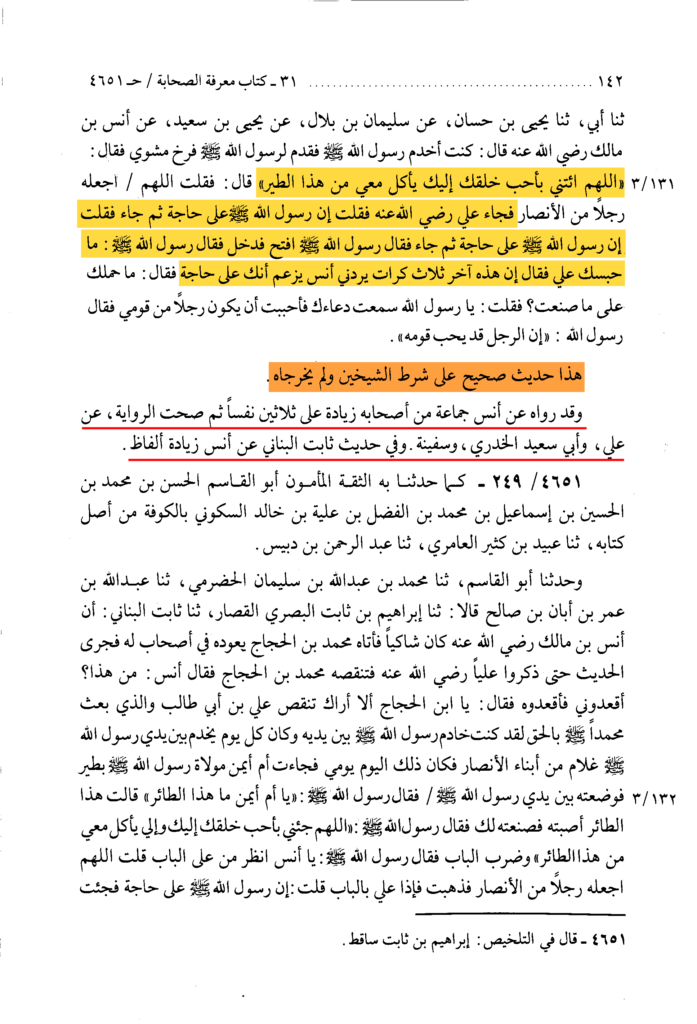
Distortion of the Hadith of the Roasted Bird (Hadith of the Roasted Fowl)
The Hadith of the Roasted Bird is a report transmitted concerning the virtue of Imam Ali (peace be upon him). According to this hadith, the Noble Prophet (peace be upon him and his family) intended to eat the meat of a roasted bird and asked God to send to him His most beloved creature so that he might share this food with him. After this supplication, Imam Ali (peace be upon him) entered, and the Prophet (peace be upon him and his family) received him. This report appears in Shi‘i and Sunni sources. The Hadith of the Roasted Bird (Hadith of the Roasted Fowl) is recognized as one of the merits of Imam Ali (peace be upon him). Shi‘i theologians have used this hadith to establish Imam Ali’s priority in the matter of the Imamate and caliphate. This hadith indicates that Imam Ali (peace be upon him) is the most beloved creature in the sight of God, and this belovedness is evidence of his superiority over others.
The Argument of Shi‘i Theologians
Shaykh al-Mufid, relying on the implication of the Hadith of the Roasted Bird, argued that Imam Ali’s being the most beloved creature to God demonstrates his superiority. In Shaykh al-Mufid’s view, God’s love is based on truth and justice, not on caprice. Therefore, if Imam Ali (peace be upon him) is God’s most beloved creature, this means that he is superior in deeds, worship, and virtue. Accordingly, Imam Ali (peace be upon him) is the most deserving person for the Imamate and caliphate, because it is not permissible for God to give precedence, in the matter of prophethood and caliphate, to one with lesser merit (mafdul) over one with greater merit (fadil). Sayyid al-Murtada, too, in the book al-Fusul al-Mukhtarah, while transmitting Shaykh al-Mufid’s words, emphasized that the creature most beloved to God has greater reward and recompense than others. Such a person is undoubtedly superior to others in deeds and worship, and this superiority is firm evidence of Imam Ali’s virtue over all people except the Prophet of Islam (peace be upon him and his family). The Hadith of the Roasted Bird has been cited by Shi‘i theologians as one of the important proofs for establishing Imam Ali’s virtue and superiority. This hadith shows that Imam Ali (peace be upon him) is God’s most beloved creature, and this belovedness establishes his superiority in deeds, worship, and virtue. Therefore, Imam Ali (peace be upon him) is the most deserving person to succeed the Prophet of Islam (peace be upon him and his family) and to assume the office of the Imamate and caliphate.
Text of the Hadith:
“The Prophet (peace be upon him and his family) had a bird before him, and he said: ‘O God, bring to me Your most beloved creature, that he may eat this bird with me.’ Abu Bakr came, but he turned him away. Then Umar came, but he turned him away. Then Ali came, and he permitted him [to enter].” (al-Nasa’i, Khasa’is Amir al-Mu’minin, vol. 1, p. 29, hadith 10; al-Tamimi al-Mawsili, Musnad Abi Ya‘la, vol. 7, p. 105.) A roasted fowl had been brought for the Prophet (peace be upon him and his family). The Prophet said: “O God, send to me Your most beloved creature, so that he may eat from this fowl.” Then Abu Bakr came, but the Prophet did not receive him. After that Umar came, and he too was not received. Then Ali (peace be upon him) came, and the Prophet received him.
Dehlavi’s Distortion in Interpreting the Hadith
In order to confuse readers, Dehlavi resorted to semantic distortion, interpreting the phrase “أَحَبِّ خَلقِک” (the most beloved of Your creation) as “the person most fond of eating”! This interpretation is not only inconsistent with the apparent meaning of the hadith, but is also utterly trivial and illogical from a rational standpoint. Dehlavi and those who share his view must explain what is meant by “the person most fond of eating” and how they attribute such a baseless interpretation to the Prophet (PBUH). This interpretation is so superficial and unreasonable that one would not expect even ordinary people to utter such words. Dehlavi was unable to deny the hadith itself, because it is mutawatir and sound in terms of its chain of transmission. Therefore, instead of denying it, he resorted to semantic distortion and interpreted the meaning of the hadith in an incorrect and misleading manner. This is despite the fact that such an interpretation is entirely at odds with the apparent wording of the hadith and the historical evidence. The late Mir Hamid Husayn, in the book ‘Abqat al-Anwar, responded to this distortion and asked: if this supplication of the Prophet (PBUH) does not constitute a virtue for Imam Ali (PBUH), why did other individuals, such as Anas and Aisha, insist that other people should also partake of this food? Why did those around the Prophet (PBUH) not understand this superficial and meaningless interpretation? These questions clearly show that Dehlavi distorted reality and presented the meaning of the hadith in an incorrect and misleading way. By semantically distorting the Hadith of the Roasted Bird, Dehlavi sought to divert readers’ minds and cast doubt upon the virtue of Imam Ali (PBUH). Yet this distortion is not only incompatible with the apparent meaning of the hadith and historical evidence, but is also utterly trivial and unacceptable from a rational standpoint. This example clearly shows how Dehlavi employed methods of distortion to turn people away from the facts.
Distortion of the Hadith of Wilayah
The Hadith of Wilayah is among the hadiths extensively transmitted in Shi‘i and Sunni sources, and it clearly states the distinguished position of the Commander of the Faithful, Ali (PBUH), within the Muslim community. This hadith not only establishes the virtue of Imam Ali (PBUH) over all members of the community, but also presents him as being on a par with the Noble Prophet (PBUH). The content of this hadith explicitly states that after the Prophet (PBUH), Imam Ali (PBUH) is the wali and guardian of every believer, and no one within the sphere of faith can have a wali other than Ali (PBUH). This hadith clearly shows that those who assumed leadership of the community after the Prophet (PBUH) had usurped Imam Ali’s (PBUH) right. Nevertheless, some Sunni scholars, including Dehlavi’s coreligionists, have resorted to distortion and alteration of the text of the hadith in order to weaken it and diminish its implications. For example, al-Tirmidhi narrated in his book the hadith: “إِنَّ عَلِيًّا مِنِّي وَ أَنَا مِنْ عَلِيٍّ، وَ إِنَّهُ وَلِيُّ كُلِّ مُؤْمِنٍ مِنْ بَعْدِي” (Ali is from me and I am from Ali, and he is the wali of every believer after me). However, al-Baghawi, one of the Sunni hadith scholars, omitted the word “بعدی” (after me) from this hadith and attributed it to al-Tirmidhi. This distortion caused the hadith’s indication of Imam Ali’s (PBUH) wilayah after the Prophet (PBUH) to be diminished. After al-Baghawi, another group of Sunni scholars, including Saharanpuri (the author of the book ‘Marafiz’) and Mawlawi Hasan Ali Muhaddith (a student of Mawlawi Abd al-Aziz Dehlavi), followed al-Baghawi’s method and repeated the same distortion. Muhammad ibn Mu‘tamad Khan Badakhshi even claimed in a treatise entitled ‘Radd al-Bid‘ah’ that the word “بعدی” in this hadith was fabricated and added! This claim was made despite the fact that the hadith has been transmitted with its complete wording in reliable Sunni sources. On the other hand, Shah Wali Allah Dehlavi, a well-known Sunni scholar, quoted this hadith in full from al-Tirmidhi in his book ‘Izalat al-Khafa’. But when he proceeded to interpret and respond to this hadith, he resorted to distortion. He substituted the word “أنا” (I) for “إِنَّهُ” (he), and omitted the word “بعدی”. Thus, the distorted hadith became: “أَنَا وَلِيُّ كُلِّ مُؤْمِنٍ” (I am the wali of every believer). This distortion completely removed Imam Ali’s (PBUH) wilayah from the hadith and wholly altered its meaning. Distortion in the Hadith of Wilayah has occurred in several forms: 1. Omitting part of the hadith: omitting the word “بعدی,” which indicates Imam Ali’s (PBUH) wilayah after the Prophet (PBUH). 2. Altering the structure of the hadith: replacing the word “أنا” with “إِنَّهُ,” which changes the meaning of the hadith. 3. Claiming that part of the hadith is fabricated: claiming, without providing reliable evidence, that the word “بعدی” was added. These distortions show that some Sunni scholars altered the text of the hadith in order to weaken Imam Ali’s (PBUH) position and diminish the implications of the Hadith of Wilayah. These actions are not only contrary to scholarly and ethical principles in transmitting hadith, but also call the اعتبار of Sunni hadith sources into question. The Hadith of Wilayah clearly establishes the virtue and wilayah of Imam Ali (PBUH) after the Prophet (PBUH). However, some Sunni scholars, including Dehlavi and his followers, have sought to weaken its implications by distorting this hadith. These distortions include omitting part of the hadith, altering its structure, and claiming that part of its text is fabricated. Such actions are not only unacceptable from a scholarly perspective, but also demonstrate an effort to deviate from historical and narrational facts.
Abd al-Aziz Dehlavi’s Distortion and Fabrication Regarding Lady Fatimah’s (PBUH) Anger
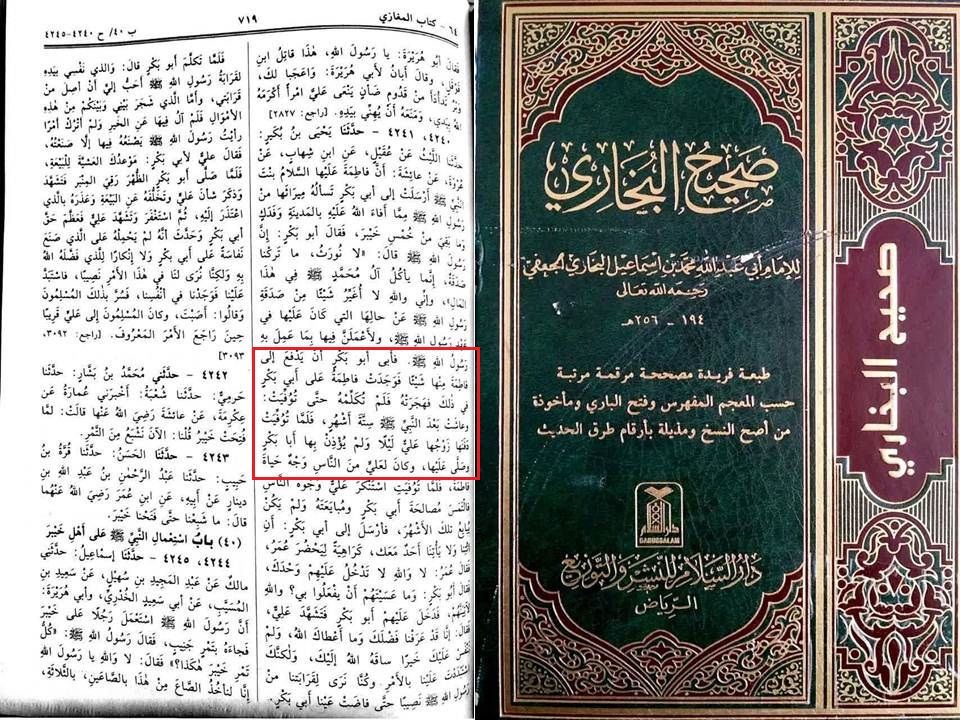
Lady Fatimah’s (PBUH) anger toward Abu Bakr is one of the established historical facts that has been transmitted even in the most authentic Sunni sources. Nevertheless, Abd al-Aziz Dehlavi sought to conceal or deny this fact. In Tuhfah Ithna ‘Ashariyyah, he made incorrect claims regarding Lady Fatimah’s (PBUH) satisfaction with Abu Bakr, claims that conflict with historical reality and reliable Shi‘i and Sunni sources. These distortions were made with the aim of concealing the fact that Abu Bakr lacked the qualifications for the caliphate, and that Lady Fatimah’s (PBUH) dissatisfaction with him indicates that he had departed from the religion.
Abd al-Aziz Dehlawi’s Claim
Dehlawi writes in his book: “As for the Imamiyyah, the author of Muhajjaj al-Salikin and other scholars among them have narrated that when Abu Bakr saw that Fatimah (peace be upon her) had turned away from him, abandoned him, and thereafter did not speak about Fadak, this matter weighed heavily upon him. He therefore wished to win her satisfaction. He came to her and said: ‘O daughter of the Messenger of Allah (peace be upon him), I affirm your claim; however, I saw that the Messenger of Allah (peace be upon him) used to distribute Fadak and give from it to the poor, the needy, and the wayfarer, after your provisions and those of the workers had been secured from it.’ Fatimah (peace be upon her) said: ‘Act as my father, the Messenger of Allah (peace be upon him), used to act.’ Abu Bakr said: ‘I call Allah to witness that I shall act in that manner.’ Fatimah (peace be upon her) said: ‘By Allah, you shall act in that manner.’ Abu Bakr said: ‘By Allah, I shall act in that manner.’ Fatimah (peace be upon her) said: ‘O Allah, bear witness!’ Thus, she became satisfied and took a covenant from Abu Bakr. Abu Bakr also gave them their provisions from Fadak, distributed the remainder, and gave it to the poor, the needy, and the wayfarer. This passage has been transmitted in the book Muhajjaj al-Masakin and other reliable Imamiyyah books. From this passage it is clearly understood that Abu Bakr affirmed al-Zahra’s (peace be upon her) claim; however, he regarded her non-possession of Fadak and the Prophet’s (peace be upon him) practice until his death as an obstacle to her ownership, just as this matter is established among the entire community …” (Source: Dehlawi, Abd al-Aziz [d. 1239 AH], Tuhfah Ithna Ashariyyah, p. 565, publisher: Maktabat al-Haqiqah, 1415 AH.)
Examining Dehlawi’s Claim and the Distortions Committed
Dehlawi’s claim is open to criticism from several angles and demonstrates his extensive distortions aimed at concealing historical facts: 1. Fabrication of a non-existent book: Dehlawi claims that the book Muhajjaj al-Salikin is among the reliable Shi‘i sources and that it contains a narration stating that Lady Fatimah (peace be upon her) was satisfied with Abu Bakr. The reality, however, is that no such book has ever existed in Shi‘i sources. This claim demonstrates the clear fabrication and invented nature of the source upon which Dehlawi relies. This distortion not only calls Dehlawi’s scholarly credibility into question, but also reveals his attempt to deceive readers and distort historical facts.
2. Fabrication of an invented narration: Dehlawi attributes to the Shi‘ah a narration that does not exist in any reliable Shi‘i source. This fabricated narration indicates falsehood and deliberate distortion. By doing so, Dehlawi sought to present an inaccurate picture of Lady Fatimah’s (peace be upon her) position and to conceal the historical fact that she remained dissatisfied with Abu Bakr until the end of her life. 3. Interpretive distortion and alteration of content: In his fabricated narration, Dehlawi claims that Lady Fatimah (peace be upon her) became satisfied with Abu Bakr after speaking with him. Yet reliable historical and hadith sources, including Sahih al-Bukhari and Sahih Muslim, explicitly state that Lady Fatimah (peace be upon her) remained displeased with Abu Bakr until the end of her life and was even angry with him. Through interpretive distortion, Dehlawi sought to invert this truth. 4. The aim of the distortion: The principal reason for these distortions is to conceal the fact that Abu Bakr lacked the qualification for the caliphate and that Lady Fatimah’s (peace be upon her) dissatisfaction with him indicates that he had departed from the religion. By fabricating narrations and distorting historical facts, Dehlawi sought to conceal this reality and keep readers from understanding this historical truth.
Shi‘i Scholars’ Response to Dehlawi’s Distortions
The late Allamah Sayyid Muhammad Musawi Lakhnawi, one of the great Shi‘a scholars, responded to these distortions of Dihlawi in his book Tashyid al-Mata'in. He emphasizes that the book Muhajjaj al-Salikin and its author are unknown among Shi‘a scholars, and that these claims lack any scholarly or historical basis. He writes: “We do not know the book Muhajjaj al-Salikin or its author. Although Dihlawi has mentioned the names of many Shi‘a scholars and their works, he has not mentioned the name of this book or its author. Citing such a book, which Shi‘a scholars do not know, indicates ignorance and unfamiliarity with the etiquette of scholarly debate.” (Source: al-Musawi al-Lakhnawi, al-Sayyid Muhammad Quli, Tashyid al-Mata'in li-Kashf al-Dagha'in, vol. 3, pp. 192–193.) ‘Abd al-‘Aziz Dihlawi’s claim that Lady Fatimah (peace be upon her) was pleased with Abu Bakr rests on a fabricated report that does not exist in Shi‘a sources. This claim not only conflicts with reliable historical and hadith sources, but also reveals Dihlawi’s attempt to distort historical truths and weaken the standing of the Ahl al-Bayt (peace be upon them). The responses of Shi‘a scholars, including Allamah Musawi Lakhnawi, clearly show that these claims lack any scholarly and historical foundation. These distortions were made to conceal the fact that Abu Bakr was not qualified for the caliphate, and that Lady Fatimah’s (peace be upon her) displeasure with him indicates that he had departed from the religion.
Substituting the Virtues of the Ahl al-Bayt and the Semantic Distortion of the Hadith of Manzilah: A Scheme to Conceal the Truth
One of the deep-rooted methods used by Dihlawi’s like-minded associates to conceal the truth is to substitute the virtues of the Ahl al-Bayt (peace be upon them) and attribute them to others. This method, accompanied by fabrication and distortion, has sought to extinguish the light of the virtues of the Commander of the Faithful, ‘Ali (peace be upon him). For example, concerning Imam ‘Ali (peace be upon him), the Noble Prophet (peace and blessings be upon him and his family) said in the Hadith of Manzilah: “أما ترضى أن تكون مني بمنزلة هارون من موسى إلا أنه لا نبي بعدي” — “Are you not pleased that your position in relation to me should be like Aaron’s position in relation to Moses, except that there will be no prophet after me?” This hadith is mutawatir, and a group of the Companions have transmitted it. Ibn ‘Abd al-Barr, one of the leading Sunni scholars, says of this hadith: “This report is among the most firmly established and most authentic hadiths.” 📚 al-Isti‘ab, vol. 3, p. 1097. Yet, in the course of substitution and distortion, they fabricated a report with the following content: “أبو بكر و عمر منی بمنزلة هارون من موسی” — “Abu Bakr and ‘Umar are to me in the position of Aaron to Moses.” This fabricated report, transmitted in Tarikh Baghdad, has itself been acknowledged as forged by Sunni scholars, including al-Dhahabi.
A Greater Step in the Semantic Distortion of the Hadith
But distortion does not end with substitution. Dihlawi, one of the key figures of this current, also took a major step in the semantic distortion of the Hadith of Manzilah. He analyzes the phrase “إلا أنه لا نبي بعدي” by claiming that the word “إلا” here signifies a disjunctive exception. This distorted interpretation has been advanced in order to deny many of the virtues of the Commander of the Faithful, ‘Ali (peace be upon him). In response, the late Mir Hamid Husayn, citing Sunni works on legal theory, demonstrates that the basic rule regarding exception is that it is connected, not disjunctive. Therefore, Dihlawi’s statement contradicts the rules of the Arabic language and the principles accepted among Sunni scholars, and it has no validity.
Substitution and Distortion: A Scheme to Conceal the Truth
This spiritual distortion and historical fabrication is only part of a larger plan to conceal the virtues of the Ahl al-Bayt, peace be upon them. Mu'awiya, one of the leading figures of this current, openly ordered: “Fabricate for the other Companions something comparable to whatever has been narrated about Imam Ali, peace be upon him.” These actions are attempts that, behind a deceptive façade, have risen against the truth and set history on a course of deviation. Nevertheless, the Hadith of Manzilah and the other virtues of Amir al-Mu'minin Ali, peace be upon him, continue like a radiant light to illuminate the way for seekers of truth; despite all these distortions, the truth will remain enduring and steadfast.
Distortion of the Hadith of the “Rebellious Group” and Ahmad ibn Hanbal’s Evasion of Accountability
One of the hadiths that clearly proves the damnation and rebellion of Mu'awiya and his followers is the well-known hadith of the “rebellious group.” This hadith has been transmitted in Sahih al-Bukhari and other reliable sources. In it, the Noble Prophet (peace be upon him and his family) says to Ammar ibn Yasir: “A rebellious and transgressing group will kill you. They call you to the Fire, while you call them to Paradise.” This hadith plainly exposes the wicked face of Mu'awiya and the Banu Umayya and shows that they had deviated from the path of truth. Nevertheless, Mu'awiya’s supporters and some Sunni scholars have resorted to distortion and evasion of accountability in order to conceal this truth. A prominent example of this distortion and evasion is the stance of Ahmad ibn Hanbal, one of the leading Sunni figures, toward this hadith. Distortion.
Ahmad ibn Hanbal’s Distortion and Evasion of Accountability
In a narration transmitted in al-Sunnah by Abu Bakr ibn al-Khallal, it is stated: “Aḥmad ibn Muḥammad ibn Ḥāzim and ʿAbd Allāh ibn al-ʿAbbās al-Ṭayālisī informed us that Isḥāq ibn Manṣūr related to them that he said to Abu ʿAbd Allāh: The Prophet’s saying, peace and blessings of Allah be upon him, to Ammar: ‘The rebellious group will kill you.’ He said: ‘I do not speak about it.’ Al-Ṭayālisī added: ‘Leaving it is safer.’” (al-Sunnah by Abu Bakr ibn al-Khallal, vol. 2, p. 462, hadith 720, Dar al-Rayah edition.) Ishaq ibn Mansur says: I asked Ahmad ibn Hanbal about the Prophet’s statement (peace be upon him and his family) to Ammar: “A rebellious group will kill you.” Ahmad ibn Hanbal replied: “I do not speak about this matter.” Al-Tayalisi further added: “It is better to refrain from speaking about this narration.” This position of Ahmad ibn Hanbal and other Sunni scholars demonstrates their effort to distort historical facts and conceal the true face of Mu'awiya and the Banu Umayya. The reasons for this distortion and evasion of accountability are: 1. Fear of the truth being exposed: the hadith of the “rebellious group” clearly shows that Mu'awiya and his followers were a rebellious group outside the religion, who martyred Ammar ibn Yasir, one of the Prophet’s great Companions (peace be upon him and his family). This truth is unacceptable to the supporters of Mu'awiya and the Umayyad caliphs because it calls their status into question. 2. Spiritual distortion: by remaining silent concerning this hadith and refusing to interpret it, scholars such as Ahmad ibn Hanbal sought to distort its meaning and evade its implications. This silence is a form of spiritual distortion that keeps audiences from understanding the truth. 3. Preserving the status of the Umayyad caliphs: the supporters of Mu'awiya and the Umayyad caliphs have always tried to portray them as pure and faultless. Accepting this hadith means accepting the fact that Mu'awiya and his followers were a rebellious group outside the religion who even martyred the Prophet’s Companions (peace be upon him and his family). 4. Fear of weakening the school: Ahmad ibn Hanbal and other Sunni scholars knew that accepting this hadith could weaken their school, because it shows that caliphs accepted by them, such as Mu'awiya, had deviated from the path of truth. The hadith of the “rebellious group” is among the explicit and reliable hadiths that proves the damnation and rebellion of Mu'awiya and his followers. Nevertheless, Sunni scholars, including Ahmad ibn Hanbal, have resorted to distortion and evasion of accountability to conceal this truth. This distortion and silence demonstrate their effort to preserve the status of the Umayyad caliphs and conceal Mu'awiya’s true face. These actions not only harm Islamic history, but also mislead audiences and weaken Islamic unity.
“Distorting the truth, suppressing evidence, and fabricating lies have always been the longstanding policy of Dehlavi’s fellow believers.”
It may be imagined that only Dehlawi committed such a feat of distortion, fabrication, and deviation, but the reality is beyond this. Misrepresentation and alteration are not limited to the examples mentioned here, nor is hostility to the truth confined to Dehlawi. In fact, inversion of facts and distortion are a path upon which his co-religionists have always trodden. As an example, we refer only to some of the deviations of this current; for if we were to enumerate all of Dehlawi’s distortions, it would become an independent book, and if we were to list the aberrations of his co-religionists, a library full of volumes would result.
The Current of Distortion among Dehlawi’s Co-religionists:
One of the clear signs of the current of distortion among Dehlawi’s co-religionists is the repressive approach they have adopted toward criticism and the reporting of historical facts. This outlook not only restricts freedom of expression and the search for truth, but also casts a veil over historical realities so that their own misrepresentations and innovations may appear more firmly established. In this regard, a quotation from the book Ṭabaqāt al-Ḥanābilah by Ibn Abī Yaʿlā clearly reveals this approach: "لا يجوز لأحد أن يذكر شيئا من مساويهم ولا يطعن عَلَى أحد منهم بعيب ولا بنقص فمن فعل ذلك فقد وجب عَلَى السلطان تأديبه وعقوبته ليس له أن يعفو عنه بل يعاقبه ويستتيبه فإن تاب قبل منه وإن ثبت عاد عليه بالعقوبة وخلده الحبس حتى يموت أو يراجع." An accurate translation of this passage reveals the depth of this outlook: "It is not permissible for anyone to mention anything of their evil deeds, nor to fault any one of them for a defect or shortcoming. Whoever does so, it becomes incumbent upon the ruler to discipline and punish him, and he has no right to pardon him. Rather, he must torture him and demand his repentance. If he repents, it is accepted; but if he does not, he must torture him again and sentence him to life imprisonment, until he dies or recants his view." This view is a clear example of the current of distortion and suppression of truth: people are not only prevented from stating reality, but are threatened with the harshest punishments for seeking to disclose facts. This policy plainly shows how Dehlawi’s co-religionists have sought, through distortion, elimination, and intimidation, to create an inverted image of history and prevent criticism and reform. If these policies are viewed alongside other similar instances, it becomes clear that this current is not merely an individual error, but an organized and longstanding policy whose sole aim is to conceal the truth.
Distorting the Truth: History’s Tears in Mourning for Karbala
Karbala is the most heavenly narrative of the earth: an event that embraced pure blood, hearts that resisted oppression, and endless tears. Karbala is a cry that was never silenced; it is a language that will proclaim the truth until the Day of Resurrection. Yet this light has always been a thorn in the eyes of those who have hidden themselves in the darkness of denial and distortion.
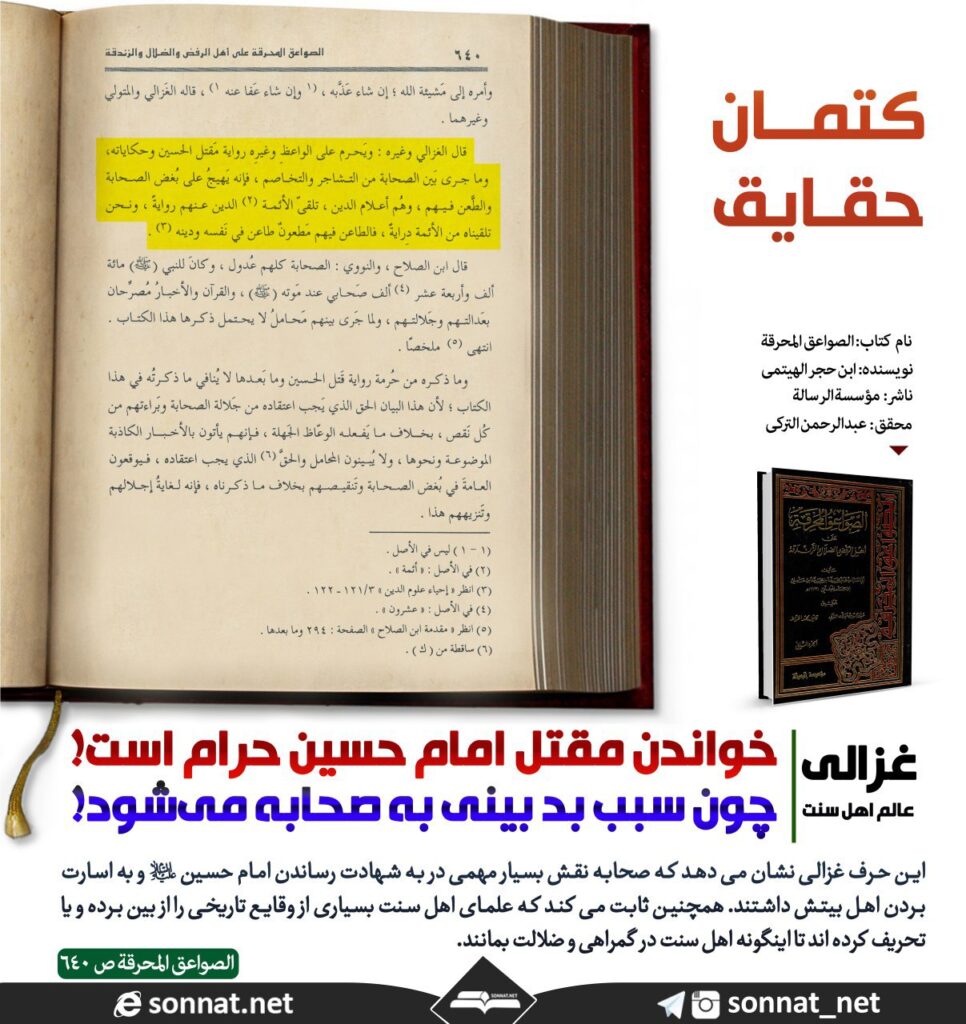
🔻 Al-Ghazali, one of the renowned Sunni scholars, says: "Reading the maqtal of Imam Husayn is forbidden, because it causes ill feeling toward the Companions!" Can one hear this sentence and not weep? Can one’s heart fail to tremble at seeing a truth of such magnitude thus placed in chains? This statement is not merely a legal ruling; it is a bitter admission of the role of certain Companions in a tragedy that made the heavens weep and plunged the earth into blood.
Karbala: A Wound on the Heart of Distortion
Can one speak of Karbala without choking back tears? Can one remember the loneliness of Husayn (peace be upon him) without one’s heart burning? With this fatwa, al-Ghazali seeks to conceal the wound that history has inflicted upon the heart of truth. He wants to hide from view the bloodstained hands of those who brought Karbala about. But how can the light of truth be extinguished? How can Zaynab (peace be upon her) be forgotten—she who stood amid the ashes of the tents and raised the call of truth?
Concealment and Fear of the Truth
Why is reading the maqtal of Imam Husayn (peace be upon him) forbidden? Why are they afraid to hear the account of Husayn’s (peace be upon him) oppression? Is it not because every word of this account lifts the veil from the faces of those who thirsted for his blood? Is not this prohibition a bitter confession that those who have hidden behind the mask of the Companions played a direct role in this tragedy?
Karbala: A Lamp in the Heart of Darkness
But they are heedless of this great truth: Karbala is alive. Karbala is not an event, but a school. Husayn’s blood (peace be upon him) still boils upon the earth, and his cry echoes in the ears of history. No distortion can extinguish the truth; no fatwa can snatch light from the heart of the nights. Karbala is a tear that wells up in the heart of every oppressed person. It is a story, every corner of which sets the soul ablaze. Every step Husayn (peace be upon him) took, every drop of blood that was shed, is a message that will resound in the souls of humankind until the Day of Resurrection.
The Message of Karbala: An Eternal Truth
Reading the maqtal of Imam Husayn (peace be upon him) is not only not forbidden; rather, it is a divine duty—a duty that revives hearts and brings souls closer to the truth. Those who fear this truth have themselves confessed to their stained hands. Yet Karbala is a truth that never remains bound in darkness.
Karbala is tears. Karbala is a cry. Karbala is a lamp that no storm has the power to extinguish. This light will forever show the way to seekers of truth.
Systematic Distortion: A Tool for Altering the Course of History and Religion
Systematic distortion is an act undertaken with the aim of deliberately and purposefully changing the public understanding of religious and historical truths. In this process, information, teachings, and events are specially manipulated so that erroneous concepts, or concepts contrary to the truth, replace them in people’s minds. In this regard, currents of distortion—including among the coreligionists of Dehlavi—have altered not only the history of Islam but also religious truths through such tools as fabricated and selective narrative-making, such that many Muslims have fallen into ambiguity and confusion regarding the truth and authenticity of their religious and sectarian history.
The Effects of Distortion on Public Beliefs and Society
1. Altering public beliefs: Distortions, especially in religious and historical contexts, can completely transform public beliefs. Many systematic distortions, particularly in an environment where religion is directly intertwined with politics and power, can alter public perceptions. For example, distortions concerning the virtues of the Ahl al-Bayt (peace be upon them) in comparison with the Companions have caused many followers of Ahl al-Sunnah to be unable to gain a correct understanding of Islam’s historical truth and the Ahl al-Bayt’s actual position. Although widely transmitted facts exist, such as the Hadith of Manzilah and Imam Ali’s (peace be upon him) special status in the Qur’an and Sunnah, many historical and religious distortions have caused confusion and historical ignorance among people. A striking example of these distortions is the alteration of reliable accounts concerning historical figures and events, seen in books such as “Tarikh Baghdad” and other Sunni historical sources, where the virtues of Imam Ali (peace be upon him) have been deliberately distorted and presented in favor of others, such as Abu Bakr and Umar.
2. Reinforcing prejudice and creating division: Distortions not only change public beliefs, but also reinforce religious and ethnic prejudices. One of the most important effects of historical distortions is the creation of mental and religious boundaries through which individuals or groups set themselves against others. These changes and manipulations in historical and religious narratives can reinforce both individual and collective prejudices. For instance, distortions regarding the martyrdom of Imam Husayn (peace be upon him) and the conduct of the Companions in the event of Karbala have, in many Sunni sources—especially in the works of al-Ghazali and figures such as Ibn Taymiyyah—deliberately created a negative perception of the Ahl al-Bayt. These distortions have not only caused deep rifts among Muslims, but in some cases have even led to religious wars and conflicts.
3. Defaming and discrediting opponents: One of the prominent features of systematic distortions is the defamation and discrediting of opponents. In this regard, currents of distortion, including among Dehlawi’s coreligionists, have always sought deliberately to manipulate historical writings that might run contrary to their ideas. Distortions made in Islamic history, especially in cases dealing with the events of Karbala and the role of the Companions therein, have clearly been carried out with the aim of undermining figures such as Imam Husayn (peace be upon him) and the Ahl al-Bayt (peace be upon them). These attacks have not only discredited prominent religious figures, but have also led Muslims astray in their understanding of Islamic history. Among the important examples of these distortions are the omission or alteration of historical details related to Karbala, which many Sunni scholars and hadith transmitters have included in their works.
The Dangerous Consequences of Systematic Distortion
1. Misguidance on the religious path: One of the greatest dangers of systematic distortion is leading people astray on the religious path. Many distortions in Islamic history have caused Muslims to deviate from their proper path. Distortions concerning the position of the Ahl al-Bayt and their virtues in the Qur’an and Hadith, especially in Sunni sources, have made Muslims unable to understand the true concepts of Islam correctly. Historical misguidance presented in the form of distorted narratives of the events of Karbala and great religious figures not only changes people’s religious course, but also causes Muslims to distance themselves from sound teachings.
2. Distrust of religious and historical sources: When distortions occur extensively and systematically, people begin to doubt the authenticity of religious and historical sources. This distrust of reliable sources leads people to seek out unreliable sources and, as a result, prevents them from properly benefiting from religious truth. In such an environment, weakness in correctly understanding religion and history can lead society down a wrong path and toward extremism. In many cases, distortions concerning the Companions and the Ahl al-Bayt (peace be upon them) have caused a deep divide to arise among different groups of Muslims.
3. Reinforcement of erroneous and extremist ideas: Deliberate and selective distortions may lead to the strengthening of false and extremist ideas in society. In many cases, such distortions have produced mistaken ways of thinking among different groups and diverted society from the correct religious and human path. These intentional distortions and manipulations of history and religion have reinforced extremist ideas in many Islamic societies, ultimately leading to division and discord among Muslims.
4. Creating division and social tensions: Distortion in history and religion not only causes distrust, but can also create division and social tensions. These distortions place Muslims in a religious atmosphere filled with doubt and uncertainty, preventing them from preserving their Islamic unity. By presenting distorted versions of history and religion, people may be driven into hostility and conflict with one another.
"Moving Away from the Ahl al-Bayt: The Impact of Distortions on Muslims’ Religious Understanding"
Systematic and widespread distortion in Islamic history and religious teachings not only affects Muslims’ historical memory, but also changes the course of humanity’s future decisions. These distortions, carried out by Dehlavi’s co-religionists and similar currents, have caused misguidance, strengthened misplaced prejudices, and created division in society. Its most significant effect is that Sunni society has remained distant from the blessing of the Prophet’s Ahl al-Bayt, peace be upon them, while all humanity has been deprived of their pure knowledge—a knowledge in which ignorance had no place and which was connected to the source of revelation. To attain a correct understanding of history and religion, Muslims must carefully and knowingly discern the truths amid these distortions and continue to combat such manipulations, thereby preventing bewilderment and straying from the right path.
False Promise: The Black Hole That Devoured Reason and Humanity
Sometimes a person knowingly steps onto a dangerous path and prepares himself to face every eventuality. The same must be done in the path of research. A researcher should rely on nothing but proof and evidence, because he knows well that on this path he will encounter a mass of lies, distortions, and fallacies. A researcher seeking the truth must remain alert to every deception and false promise. False promises are often used as tools to deceive people and win their trust. When these promises are presented in a scholarly and documented form, they divert the researcher from the main path and trap him in flawed analyses. False promises are not only intellectually unsound; they ultimately lead to deceit and the distortion of truth. Though they may appear to inspire confidence, these promises in fact make a plaything of rationality and restrict independent thought. When a researcher encounters such promises and trusts them, he is in fact removing himself from the right path of research and the search for truth. This kind of deception is the greatest blow to rational thought and humanity, because knowledge and truth must be sought along the proper path, not through hollow and false promises. Promises that assure the researcher that all scholarly standards will be observed, while distortion and lies are concealed behind them, endanger scholarly credibility more than anything else. Research and scholarly inquiry must be founded on honesty and truth, and researchers must avoid false deceptions with complete care and awareness. Otherwise, the path of knowledge and truth becomes a black hole that devours rationality and humanity and drives them toward misguidance.
The Role of False Promises in Systematic Lying
False promises, as one of the complex and effective tools of systematic fabrication, play a key role in deceiving and misleading people. These promises are specifically designed to create false trust and conceal the liar’s real intentions. Promises such as “I have reliable sources,” “All this information is precise and scholarly,” or “I am telling the truth” temporarily instill in the audience a feeling of assurance and honesty, while behind these promises, distortions and false information are carefully concealed.
Effects of False Promises:
Creating initial trust: False promises serve as the first step in deceiving the audience and winning its trust. This false trust becomes the basis for accepting later information that is deliberately distorted and incorrect. Confusion and acceptance of lies: When the audience trusts promises of honesty and accepts the liar unquestioningly, lies are easily accepted without doubt. This process is in fact a major step in creating confusion and diverting people from the truth. Facilitating the process of fabrication: False promises, as effective tools, facilitate for liars more complex processes such as disguising falsehood as truth, concealing the truth, and distortion. In a sense, these promises pave the way for changing people’s understanding of realities, and thus lies are easily turned into truth.
Overall, false promises are used not only as a tool for winning trust, but also help facilitate fabrication and strengthen false systems, ultimately trapping audiences in a snare of misguidance.
“False Promises and the Deception of Researchers: An Analysis of Dehlavi’s Violation of Research Principles
In his investigations, Mir Hamid Husayn points to numerous instances in which Abd al-Aziz Dihlawi violated the rules of research and scholarly commitments in the book Tuhfa-yi Ithna 'Ashariyya. In this book, Dihlawi had laid down principles for research and debate, yet in practice he did not adhere to them and repeatedly violated them. These breaches of commitment not only call his scholarly credibility into question, but also reveal his attempt to deceive audiences and distort facts. Some of these commitments and the instances in which Dihlawi violated them are mentioned below: 1. The impermissibility of adducing unsound hadiths. Dihlawi explicitly states in his book: “The established rule among Ahl al-Sunna is that any hadith transmitted in a book whose author has not undertaken to ensure the authenticity of its hadiths—as al-Bukhari, Muslim, and the other compilers of the Sahih collections have done in their books—is not suitable for argumentation.” Nevertheless, Dihlawi himself repeatedly relied on weak and unsound hadiths. This contradiction shows that he adhered to this rule only when it served his interest; otherwise, he disregarded it. 2. Disregard for hadiths without chains of transmission. In response to the objection concerning Abu Bakr’s failure to join Usama’s army—regarding which the Messenger of Allah (PBUH) said: «لعن الله من تخلف عن جيش أسامة»—Dihlawi said: “A hadith considered authoritative by Ahl al-Sunna is one transmitted with a chain of transmission in the books of hadith scholars and judged authentic. But a hadith lacking a chain of transmission is never taken into consideration.” Nevertheless, Dihlawi in many instances relied on hadiths without chains of transmission or with weak chains. This double standard demonstrates his disregard for scholarly principles and his own commitments.
3. Arguing against the Shi'a on the basis of their own reports
In his book Tuhfa, Dihlawi accepted citations from Shi'a books and argumentation based on their reports found in their reliable books. He said: “For the reports of any one sect are not proof against another sect.” This commitment indicates that Dihlawi intended to reinforce his arguments by citing Shi'a sources. Yet in practice, instead of citing reliable Shi'a sources, he repeatedly relied on weak or fabricated reports. This conduct not only violates his commitment, but also calls his scholarly credibility into question.
4. The impermissibility of arguing against the Shi'a with Ahl al-Sunna hadiths
Throughout his investigations, Dihlawi follows his shaykh and his father, Wali Allah Dihlawi, and has a firm belief in him. Yet he contradicts what his father explicitly stated in one of his books, where his father said: “Debating the Imamiyya and the Zaydiyya by means of the hadiths of the two Sahihs and others is not valid.” This contradiction shows that Dihlawi adhered to principles only when they served his interest; otherwise, he disregarded them. 5. Ahl al-Sunna reports are subject to criticism in Shi'a thought. In his book, Dihlawi refers to the fact that the Shi'a criticize Ahl al-Sunna hadiths and do not believe in them. Accordingly, Muhammad Rashid Dihlawi, the student of the author of Tuhfa, said: “Every sect accepts reports transmitted through its own channels and criticizes reports transmitted through the channels of the opposing sect.”
Nevertheless, Dihlawi repeatedly relied on Ahl al-Sunna hadiths while knowing that these hadiths were not accepted by the Shi'a. This conduct demonstrates his disregard for the principles of debate and research.
Conclusion: Breach of Commitments and Deception of Public Opinion
In the book Tuhfa Ithna Ashariyya, Dihlawi had established scholarly and principled commitments for research and debate, yet he himself did not adhere to these commitments in practice. This breach of commitments not only calls his scholarly credibility into question, but also indicates his effort to deceive audiences and distort facts. By referring to these cases, Mr. Rahimahullah makes readers aware of Dihlawi’s deceptions and emphasizes the necessity of adhering to scholarly principles and trustworthiness in research. This conduct of Dihlawi and his co-religionists not only harms Islamic history, but also misleads audiences and weakens Islamic unity. Therefore, it is necessary that researchers and readers examine the works and claims of such individuals carefully and critically, and remain aware of their deceptions.
“Academic Fraud: From Deception to the Loss of Credibility and the Work’s Real Value”
A person who publishes another person’s book under his own name not only harms his own scholarly and ethical values, but also damages the scholarly and cultural community. Such a person is in fact trying to place himself in the position of an intellectual and scholar, while having no scholarly or rational foundation for what he has published. By fraudulently publishing the works of others, he effectively deprives himself of the genuine process of research and innovation and is unable to employ his own abilities to present new ideas and achievements. The character of such a person reveals a lack of scholarly and ethical self-confidence. In seeking scholarly prestige and fame, he is willing to use improper and deceitful means, demonstrating a lack of honesty, trustworthiness, and respect for others. In reality, instead of pursuing truth and the advancement of knowledge, such a person tries to secure a respected scholarly position by using the achievements of others. This kind of fraud is not only ethically reprehensible, but also has no scholarly value, because knowledge rests on honesty, independent research, and innovation. If a person publishes another’s work under his own name, he has in fact presented no new scholarly achievement and has merely committed a kind of fraud involving the views and works of others. Thus, such a person’s work has no scholarly value; it only deceives readers and disregards the genuine efforts of scholars and researchers. Indeed, this kind of fraud harms one’s character and damages one’s scholarly standing, because in the realm of knowledge such a person has neither credibility nor competence and is regarded by the scholarly community as a swindler and deceiver. If such a person engages in scholarly fields, he will eventually place himself in a position in which he can never take pride in what he has taken from others, nor create genuine and original works of his own in those fields. Academic theft, especially when someone publishes the writings of others under his own name, is not only a grave betrayal of knowledge and research, but also reveals that person’s immorality and dishonesty. In such circumstances, the thief not only violates the rights of others, but also forfeits his own scholarly and ethical worth. This action brings ugliness and impurity in both individual and social dimensions, for it shows that instead of relying on his own knowledge and abilities, the person has settled for theft and forgery.
Dihlawi and the Secrets of His Books: Lies and Distortions That Were Stolen!
In this field, the precision of the late Mir Hamid Husayn in analyzing and examining Dihlawi’s works is of particular importance. Owing to his scholarly meticulousness, he studied Dihlawi’s writings extensively and carefully and revealed that many of his books were in fact the product of theft from the works of others. For example, the well-known book Tuhfa Ithna Ashariyya was originally adapted from al-Sawa‘iq, written by Nasr Allah Kabuli, and it also contains additions by Dihlawi’s father and Husam al-Din Saharanpuri. This shows that Dihlawi had no innovation whatsoever in composing his works; rather, through theft and distortion of other scholarly works, he sought to gain credibility for himself. Likewise, the book Bustan al-Muhaddithin, written by Abd al-Aziz Dihlawi, is in fact a manipulated version of Kifayat al-Mutattali‘ by Taj al-Din Dahan. Academic theft not only severely calls the thief’s scholarly credibility into question, but also strips his work of every kind of scholarly value. A person who resorts to such methods to achieve his aims ignores ethical and scholarly principles, and consequently his work lacks authenticity and credibility. In truth, such a person cannot be recognized as a credible researcher or scholar, because honesty, trustworthiness, and originality in research are among the essential pillars of knowledge and learning. Hence, academic theft is not merely a scholarly violation; it is also a form of betrayal of the scholarly and cultural community. With documented analyses grounded in careful scrutiny, Allamah Mir Hamid Husayn alerts readers to the dangers of academic theft and similar deceptions. This warning should be regarded as a vital point for all researchers and scholars: knowledge and research bear fruit only on the path of honor and honesty, and any violation of these principles not only harms an individual’s scholarly standing but also weakens the entire scholarly and cultural community. In Islamic history, fabrications and distortions undertaken to deny the truth and undermine the position of the Ahl al-Bayt of the Prophet, peace and blessings be upon him and his family, have seriously affected the intellectual and religious course of Sunni society. These distortions and lies not only caused deviation from the Prophet’s authentic religion, but also gave rise to certain erroneous and irrational beliefs among Muslims. In addition to producing religious deviations, this historical process led to the formation of deep deficiencies in the religious thought of Sunni society, whose effects remain evident in today’s world.
Systematic Fabrication of Lies and Organized Distortion of the Truth: Deception, Forgery, and Concealment in the Service of Altering Realities"
The Effects of Historical Lies on Sunni Society Today
One of the greatest effects of these systematic lies is the reinforcement of unfounded prejudices within Sunni society. These prejudices have impeded proper reflection on and analysis of the Qur’an and the Prophet’s Sunnah, peace and blessings be upon him and his family, and have prevented recourse to reliable historical sources. Rather than Sunni Muslims turning to the Qur’an and their own reliable religious sources, they have relied more heavily on the statements of unreliable or distorted individuals. This situation has gradually led to the formation of a culture in which scholarly and intellectual inquiry has been marginalized.
Moving Away from the Qur’an and Failing to Refer to Reliable Sources
One consequence of historical distortions is the failure to give proper attention to the Qur’an and the Prophet’s Sunnah, peace and blessings be upon him and his family. The Qur’an, a book replete with profound and precise scholarly and ethical meanings, is regarded by many Sunnis more as a book to be recited for spiritual reward than as an intellectual and scholarly source. Consequently, many members of society emphasize merely reciting the verses of the Qur’an instead of properly understanding them, and remain heedless of their profound and epistemic concepts. Or they confine its understanding to the words of exegetes who themselves are agents of the inversion of truth.
Bigotry and the Absence of Rational Thought
Historical distortions have led many Sunnis, instead of following reason and logical reflection, to place greater emphasis on their religious prejudices. Rather than attending to Quranic foundations and historical realities, many Muslims unfairly defend historical figures on the basis of beliefs such as the justice of the Companions and the Glad-Tidings Recipients. For example, although Mu'awiyah and Yazid are known in history for their improper conduct, legendary views of these individuals and the Umayyad family have become widespread in many cases.
The Spread of Superstitions and Legends
One of the serious consequences of historical distortions and falsehoods is the spread of superstitions and legends in Sunni society. These superstitions include matters such as the justice of the Companions and the belief in the unquestionable superiority of figures such as Mu'awiyah and Yazid. Such ideas are not only at odds with reason and historical truth, but also lead to deviation from the main path and the most fundamental Islamic concepts. Instead of emphasizing the principles of the Quran and the Prophet's Sunnah, these legends are regarded as indisputable realities.
Warlikeness and Irrationality
These falsehoods and distortions have also laid the groundwork for the growth of a warlike and violent spirit among some Sunni groups. Ideas based on unfounded prejudices and an incorrect distinction between truth and falsehood—especially in political and religious matters—have caused many tensions in Islamic history and are still observed in some Sunni societies. This belligerence has not only led to internal crises and stark divisions among Muslims, but has also overshadowed many foundational Islamic principles, such as peace, empathy, and the promotion of knowledge and understanding. Ultimately, systematic falsehoods and history-shaping distortions concerning the Prophet's Ahl al-Bayt, peace and blessings be upon him and his family, not only caused deviation from the Prophet's true religion and the Quran, but also had serious and long-lasting consequences for the thought and conduct of Sunni society. These falsehoods led to unfounded prejudices, disregard for the Quran and authentic Islamic teachings, and the spread of superstitions and legends, all of which have affected a correct understanding of religion and Quranic principles. This issue should be presented as a serious warning to all Muslims: through careful research, recourse to reliable sources, and precision in religious thought, they should avoid every form of deviation and distortion of truth and follow the path of dignity and honesty in thought and action. In Islamic history, the fabrications and distortions carried out to deny the truth and undermine the status of the Prophet's Ahl al-Bayt, peace and blessings be upon him and his family, have seriously affected the intellectual and religious course of Sunni society. These distortions and falsehoods not only caused deviation from the Prophet's authentic religion, but also generated certain erroneous and irrational beliefs among Muslims. In addition to producing religious deviations, this historical process led to the formation of deep deficiencies in the religious thought of Sunni society, whose effects remain evident in today's world.
"Critical Thinking and the Examination of Systematic Falsehoods: An Analysis of the Work of the Late Mir Hamid Husayn in Confronting Scholarly, Historical, and Religious Distortions"
Critical Thinking and the Examination of Systematic Lies
The late Mir Hamid Husayn adopted a critical and scholarly approach in the face of systematic fabrication of lies and organized distortion of the truth, applying the principles of critical thinking to the greatest possible extent. Critical thinking generally means employing logical analysis, careful examination, evaluation of evidence, and questioning in the face of claims and arguments. By applying these principles, he was able to carry out a great struggle against currents that distorted the truth and to extract historical and religious realities from amid distortions and lies. What follows examines the principles of critical thinking that the late Mir Hamid Husayn employed in his work:
1. Questioning and the Search for Truth
The late Mir Hamid Husayn began by carefully questioning the available sources. Critical thinking begins with questioning and doubt; he never accepted existing information and quotations uncritically, but paid close attention to their roots and historical sources. This question-centered approach, in confronting distortions and lies—especially concerning the Ahl al-Bayt and Islamic history—enabled him to extract the truth from misleading and deceptive implications.
2. Analysis and Evaluation of Sources and Evidence
In critical thinking, evaluating sources and documents is of particular importance. The late Mir Hamid Husayn assessed the accuracy or falsity of information through careful examination and analysis of sources. He examined diverse sources, whether Sunni or Shi‘i, and avoided every form of unfounded partiality. As a result, he was able to expose many historical fabrications and distortions. In the book ‘Abaqat al-Anwar, he carefully examined Sunni and Shi‘i sources regarding the history of the Ahl al-Bayt and the distortions introduced into it. By citing precise evidence, he showed that many narratives and prevalent approaches concerning the Ahl al-Bayt—especially regarding Imam ‘Ali, peace be upon him—had been deliberately distorted. 3. Reconstructing the Truth from Amid Distortions: In confronting currents that distorted the truth, the late Mir Hamid Husayn did not merely address evidence and documentation; rather, through careful analysis and the integration of correct information, he reconstructed historical and religious truth. This process was carried out through precise and impartial analysis, grounded in the principles of critical thinking. He used scholarly foundations to demonstrate contradictions and distortions, and proved that many historical events, especially concerning the Ahl al-Bayt, had been subject to alteration and distortion.
4. Uncovering the Intentions and Hidden Objectives Behind Distortions
In critical thinking, analyzing the intentions and objectives underlying information and claims is an important part of evaluation. The late Mir Hamid Husayn, through his precise analysis of distortions, showed that many historical distortions and falsehoods were not accidental; rather, they were committed in order to divert people from the truth and to destroy the status of the Ahl al-Bayt and the divine messages. With a critical approach, he analyzed the objectives of those who sought to alter religious and historical truth.
5. Identifying Fallacies and Methods of Deception
Critical thinking also includes identifying fallacies and methods of deception in arguments and claims. The late Mir Hamid Husayn carefully analyzed deceptive methods in historiography and the crafting of narratives, showing how some individuals, in order to preserve their power and influence, distorted the truth and presented it to society in the form they desired. In ‘Abaqat al-Anwar, he particularly examined those who altered the truth in their own favor by forging documents and presenting fabricated narrations.
6. Defending Enlightenment and Rationality Against Prejudices
In confronting systematic fabrications and widespread distortions, the late Mir Hamid Husayn always emphasized enlightenment and the use of rationality. In the face of blind prejudices and the promotion of incorrect interpretations of the Qur’an and Islamic history, he sought to use logical and rational principles to pave the way for scholarly research and investigation. This approach is among the principles of critical thinking: defending the truth against erroneous notions and perceptions.
7. Reporting the Truth to the Scholarly and Religious Community
The late Mir Hamid Husayn, as a responsible researcher, also regarded his duty as not only discovering the truth but also conveying it to the scholarly and religious community. This transmission of truth was carried out through reliable sources and strong arguments, with the aim of making society aware of realities and removing errors and misconceptions.
Analysis of Successes and Limitations:
Successes: The late Mir Hamid Husayn, through the use of critical thinking, exposed many lies and distortions, and the book Abaqat al-Anwar became an authoritative reference in Islamic theology. He was able to uncover many concealments and fallacies of distortionist historians and present the truth to the scholarly community.
Despite these scholarly successes, there was still considerable resistance from distortionist currents, which prevented the full acceptance of these truths among part of the scholarly and religious community. Some individuals and groups attempted to ignore these studies or weaken them.
Ultimately, the late Mir Hamid Husayn, by employing critical thinking and scholarly principles, was able to preserve the truth of Islam and the status of the Ahl al-Bayt in the face of historical distortions and systematic lies. This approach was beneficial not only at that time, but also remained as a model for contemporary scholars and researchers to use in precise and impartial investigation of Islamic theology and religious concepts.
“Final Perspective”
The distortion of truth in the history of Islam, especially concerning the virtues of the Ahl al-Bayt (peace be upon them) and historical issues, has become one of the evident and noteworthy phenomena. These distortions have been carried out systematically, particularly by certain Sunni scholars such as Abd al-Aziz Dihlawi and those who share his views. The primary aim of these actions has been to weaken the standing of the Ahl al-Bayt (peace be upon them) and reinforce the position of the Sunni caliphs. Yet these actions have not only disrupted Islamic history, but have also left profound negative effects on the Muslim community and its religious thought.
Examples of these distortions include altering the meaning of the hadith of the roasted bird, omitting parts of the hadith of wilayah, fabricating narrations about Lady Fatimah’s (peace be upon her) satisfaction with Abu Bakr, and distorting the hadith, “a rebellious faction” (فئة باغیة). These distortions seek to falsify historical truth and conceal established historical realities. Yet such alterations have not only intensified the misguidance of Muslims, but have also reinforced baseless prejudices and caused division within the Muslim community.
Shi‘a scholars, including the late Mir Hamid Husayn and Allamah Musawi Lakhnawi, have stood against these distortions, relying on authoritative sources and their scholarly approach, and have clarified the truth of Islamic history. These responses have not only challenged the scholarly credibility of such distortions, but have also helped preserve Islamic unity and prevent the misguidance of Muslims. Through careful examination of sources and scholarly analysis, they have shown that the truth can never remain hidden and must be respected.
Conversely, the distortions that have been made have not only affected the truth, but have also led the religious thought of some Muslims astray. They have promoted baseless prejudices and the spread of superstitions, which disrupt a sound understanding of religion and authentic Islamic teachings. Consequently, these matters must be raised as a serious warning for all Muslims. It is essential that Muslims, through careful research and reference to reliable sources, avoid every form of deviation and distortion of the truth, and proceed along the path of truth and honesty.
Ultimately, these distortions have not only harmed the history of Islam, but have also resulted in the distortion of the very essence of religion and Qur’anic principles. This issue should concern Muslims, so that through careful and scholarly examination, everyone may avoid misguidance and move toward preserving Islamic unity and following the truth.
“In conclusion, what we must bear in mind is that the distortion of truth—especially concerning the Ahl al-Bayt (peace be upon them) and key issues in Islamic history—not only harms Islamic history, but also leads our intellectual paths astray. In this regard, the scholarly efforts of Shiite scholars, including the late Mir Hamid Husayn, to enlighten people and combat distortions are an example of commitment to truth and Islamic unity. Now it is your turn, dear readers, to share these points with others and express your views. Do you think these distortions are still ongoing? Your comments and suggestions can help clarify these issues further. We await your views, so that we may all walk on the path of truth.”