A Critical Analysis of Ibn Taymiyyah’s Objections to the Hadith of al-Thaqalayn and an Evaluation of Mir Hamid Husayn’s Responses in Abaqat al-Anwar
Author: Hamed Sarem
In the debate over Hadith al-Thaqalayn, the disagreement concerns more than the authenticity of a single report; the central question is whether this hadith, as Ibn Taymiyyah attempts to restrict its scope of meaning, is merely a recommendation to honor the Ahl al-Bayt, or whether, as Mir Hamid Husayn argues in ʿAbaqāt al-Anwār, it signifies their authority and the necessity of adhering to them. By carefully reconstructing Ibn Taymiyyah’s objections and assessing Mir Hamid Husayn’s responses on the basis of Sunni hadith sources, this article reexamines one of the most significant hadith debates concerning the question of the Imamate.
Abstract
Hadith al-Thaqalayn is among the most important texts that Mir Hamid Husayn examines in ʿAbaqāt al-Anwār in relation to the Imamate and the religious authority of the Ahl al-Bayt. In this case, ʿAbaqāt has a two-stage structure: first, establishing the hadith’s transmission and reliability and responding to objections concerning its chain of transmission; and second, analyzing its implications and answering interpretive objections. Since the documentary dimension and the mass transmission of Hadith al-Thaqalayn were examined in an earlier independent study within this project, and Ibn al-Jawzi’s objection has likewise been treated in a separate article, the present study reconstructs and evaluates only Ibn Taymiyyah’s objections and Mir Hamid Husayn’s responses. The primary source is volume nineteen of ʿAbaqāt al-Anwār in the edition published by Muʾassasat al-Maʿārif al-Islāmiyyah, while Nafahāt al-Azhār is used solely to check the structure and compare some reports. The research method is descriptive-analytical and based on reconstructing the argument. Ibn Taymiyyah’s objections are organized under five headings: restricting adherence to the Qur’an on the basis of the transmission in Ṣaḥīḥ Muslim; citing the report of Jābir; disputing the phrase “they will never separate”; relying on the fact that al-Bukhārī did not record the hadith; and reducing the instruction concerning the Ahl al-Bayt to observing their rights and refraining from ظلم against them. Examination of the responses shows that ʿAbaqāt does not rely on a single proof. Rather, it brings together the shared designation “the two weighty things,” the context of the testament, more explicit versions of the hadith, the distinction between the Prophetic text and a narrator’s explanation, hadith principles concerning chains and additions, and reports that the hadith was delivered on multiple occasions within a single argumentative system. The conclusion is that, on the basis of the accepted documentary establishment of the hadith in the earlier study, Ibn Taymiyyah’s minimal reading does not account for all the transmitted data cited by ʿAbaqāt. Nevertheless, precise judgment requires distinguishing among the hadith’s basic establishment, the obligation to adhere, the Ahl al-Bayt’s guiding authority, and the subsequent stage of identifying a specific Imam.
Keywords: ʿAbaqāt al-Anwār; Hadith al-Thaqalayn; Ibn Taymiyyah; Mir Hamid Husayn; Ahl al-Bayt; adherence; hadith implications.
In its examination of the hadiths concerning the Imamate, ʿAbaqāt al-Anwār is not merely a collection of scattered reports and supporting evidence; rather, it follows a relatively systematic model of hadith analysis. Mir Hamid Husayn usually begins the examination of each hadith with the question of its establishment: he gathers the sources and transmission routes, assesses the status of the narrators and the reliability of the sources, considers objections concerning the chain of transmission independently, and, after establishing the basis for the hadith’s issuance, turns to analyzing its implications. Consequently, evaluating any part of ʿAbaqāt without considering its place within the author’s overall argument may lead either to repeating earlier discussions or to assessing a piece of evidence apart from the system in which it is employed.
The present study forms part of a scholarly project to reconstruct the extensive dossiers of ʿAbaqāt al-Anwār in the form of independent, orderly, and citable articles for contemporary researchers. The aim of this project is neither to replace the original text nor to offer a simple summary of it; rather, it seeks to rearrange Mir Hamid Husayn’s argumentative structure in the language of contemporary research, preserve the position of each piece of evidence within the chain of reasoning, and establish a clear distinction among the presentation of the critic’s view, the author’s response, and the researcher’s assessment. In this article, ʿAbaqāt al-Anwār is the primary source of research, while Nafahāt al-Azhār, as a systematic abridgment of ʿAbaqāt, has been used as an auxiliary source for comparing the structure and tracing the discussions. The base edition for this study is volume nineteen of ʿAbaqāt al-Anwār, edited and translated by Gholam-Reza Mawlana Borujerdi and published by the al-Maʿārif al-Islāmiyya Institute in Qom (Kanturi, 1404 AH, vol. 19, p. 1).
In the dossier on the Hadith of al-Thaqalayn, the detailed discussions concerning its transmission routes, the reliability of its chain, and its mass transmission were examined earlier in an independent study, and Ibn al-Jawzi’s criticism of this hadith was likewise made the subject of a separate article. Accordingly, the present article does not seek to re-establish the mass transmission of the Hadith of al-Thaqalayn. Nevertheless, whenever Ibn Taymiyya relies, in advancing his objection, on the weakness of a passage, the exclusivity of a transmission route, or the absence of the hadith from a particular source, it is necessary to return to the earlier findings on its chain to the extent required for assessing that objection. This approach is also consistent with the structure of ʿAbaqāt itself, since Mir Hamid Husayn, in responding to the weakening of the passage “لن يفترقا,” repeatedly refers to his earlier investigations and demonstrations (Kanturi, 1404 AH, vol. 19, pp. 452–465).
The present article focuses on the criticisms Ibn Taymiyya raised concerning the Hadith of al-Thaqalayn. Part of his argument rests on the claim that, in some narrations, the command to hold fast refers only to the Qur’an, and that the expressions concerning the Ahl al-Bayt signify no more than an instruction to observe their rights and show them respect. Elsewhere, he disputes the authenticity of the passage “و عترتي... وإنهما لن يفترقا حتى يردا عليّ الحوض” and also factors the absence of certain wordings in some sources into his assessment of the hadith. In ʿAbaqāt, Mir Hamid Husayn examines these claims separately and responds to them by drawing on a body of hadith evidence, variant wordings and transmission routes, reports by hadith scholars, and accepted principles of hadith scholarship.
On this basis, the main research question may be formulated as follows: What premises does Ibn Taymiyya rely on to restrict the import of the Hadith of al-Thaqalayn to holding fast to the Qur’an or to an ethical exhortation concerning the Ahl al-Bayt, and how does Mir Hamid Husayn criticize these premises in ʿAbaqāt al-Anwār? The study will also examine which of ʿAbaqāt’s responses is, by itself, sufficient to refute Ibn Taymiyya’s claim, and which evidence plays a more corroborative and supplementary role within the overall argument.
The research hypothesis is that, once the results of the earlier chain analysis concerning the Hadith of al-Thaqalayn are accepted, the body of evidence Mir Hamid Husayn assembled in ʿAbaqāt poses a serious challenge to Ibn Taymiyya’s minimalist interpretation of the hadith, because that interpretation lacks sufficient capacity to account for all of the hadith’s wordings, transmission routes, and contextual indications. Nevertheless, methodologically, a distinction must be maintained between establishing the necessity of holding fast to and recognizing the authority of the Ahl al-Bayt, and inferring all the theological implications of the question of the Imamate. Accordingly, this article seeks, while fairly reconstructing ʿAbaqāt’s responses, to assess independently the scope of what each proof indicates.
2. Background, Sources, and Research Method
Numerous studies have been conducted on the Hadith of al-Thaqalayn, the reliability of its chains of transmission, and its place in the hadith sources of the two schools. Nevertheless, the question addressed by the present article has a narrower and more specific scope. This study concerns the reconstruction and assessment of the dispute between Ibn Taymiyyah and Mir Hamid Husayn regarding the Hadith of al-Thaqalayn, specifically at a point in the structure of ʿAbqāt al-Anwār where the author, after an extensive examination of the hadith’s chains, sources, and reliability, proceeds to critique Ibn Taymiyyah’s specific objections. Accordingly, this article is not a general study of the Hadith of al-Thaqalayn, but a focused examination of a particular dispute and of the manner in which ʿAbqāt responds to its premises. This study follows two earlier stages of the same project: first, an independent examination of the hadith’s isnād-related issues and tawātur, and second, a separate analysis of Ibn al-Jawzī’s objection. Where necessary, the findings of those two studies have been treated as prior premises for the present article.
The principal source of the study is volume nineteen of ʿAbqāt al-Anwār fī Imāmat al-Aʾimmat al-Aṭhār, Qom edition, Muʾassasat al-Maʿārif al-Islāmiyyah, ۱۴۰۴ق. The main section related to the critique of Ibn Taymiyyah appears on pages ۴۴۲–۴۷۰ of this volume and encompasses a continuous set of discussions: analysis of the import of the narration in Ṣaḥīḥ Muslim and use of the research of Muḥammad Amīn Sandī; assessment of the report of Zayd ibn Arqam; examination of the narration of Jābir; response to the weakening of the phrase «لن یفترقا»; and, finally, a detailed critique of another statement by Ibn Taymiyyah in the form of ten responses (Kintūrī, ۱۴۰۴ق, vol. ۱۹, pp. ۴۴۲–۴۷۰). Alongside the primary text, volume two of Nafḥāt al-Azhār, as a documented abridgment of ʿAbqāt al-Anwār, has been used to compare the structure of the material and verify certain passages. Furthermore, to avoid presenting Ibn Taymiyyah’s view solely through the work of his critic, the passages under discussion have been checked against Muḥammad Rashād Sālim’s critical edition of Minhāj al-Sunnah al-Nabawiyyah; the principal passage used in that edition is in volume seven, pages ۳۱۷–۳۱۸ (Ibn Taymiyyah, ۱۴۰۶ق, vol. ۷, pp. ۳۱۷–۳۱۸).
The research method is descriptive-analytical, with an emphasis on reconstructing the argument. First, each of Ibn Taymiyyah’s claims is formulated clearly and fairly, independently of the polemical tone of the disputational sources. Second, Mir Hamid Husayn’s response is divided into the components of the argument, and the relation of each response to the premise it seeks to refute is specified. The evidence that directly contributes to disproving the claim is then distinguished from supporting material and supplementary indications. In the final stage, the adequacy of each response is assessed; that is, it is examined whether the evidence presented directly refutes Ibn Taymiyyah’s claim or merely strengthens the opposing position.
In rewriting the material, fidelity in conveying the argument has been combined with the need for readability in a research text. Therefore, the Arabic expressions of Ibn Taymiyyah and Muḥammad Amīn Sandī, as well as the polemical formulations of ʿAbqāt, have not been quoted in full except where the wording itself is the subject of analysis; their content has instead been reported in precise Persian prose. By contrast, Prophetic narrations whose wording directly plays a role in the argument have been presented in Arabic, followed immediately by a fluent translation suited to the context of the argument. This method makes it possible both to place the argument’s primary material before the reader and to protect the article from an accumulation of lengthy quotations and breaks in the continuity of the analysis.
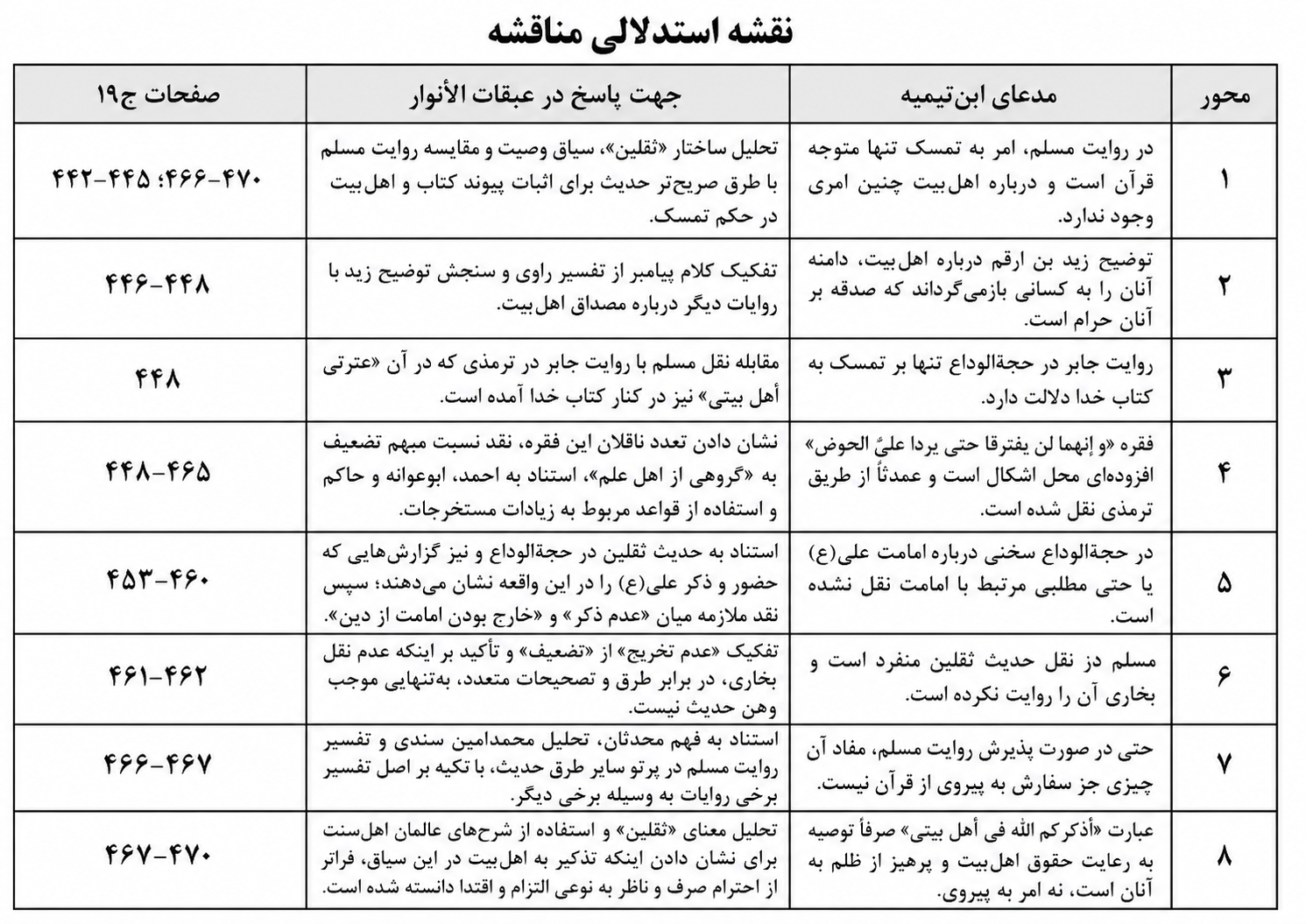
3. Map of Ibn Taymiyyah’s Objections and ʿAbqāt’s Responses:
The account in ʿAbqāt shows that Ibn Taymiyyah’s critique is not a single objection, but a set of hadith-related, semantic, and historical premises. The following table briefly presents the structure of the dispute.
4. The First Objection: Does the narration in Sahih Muslim restrict adherence to the Qur’an?
4.1. Formulation of the Objection
Ibn Taymiyya’s Citation of Zayd ibn Arqam’s Narration in Sahih Muslim
In responding to al-ʿAllāma al-Ḥillī’s argument, Ibn Taymiyya makes Zayd ibn Arqam’s narration in Sahih Muslim one of the principal foundations of his critique. In his view, the wording of this narration establishes a meaningful distinction between the Book of God and the Ahl al-Bayt: with regard to the Book of God, the Prophet (peace be upon him) explicitly speaks of “taking hold” and “holding fast,” whereas after mentioning the Ahl al-Bayt, he repeats the expression “أُذَكِّرُكُمُ اللهَ في أهلِ بيتي” three times. Ibn Taymiyya concludes from this difference in wording that, in this narration, the binding command to hold fast applies only to the Qur’an, while the passage concerning the Ahl al-Bayt should be understood as an injunction to observe their rights, honor them, and refrain from wronging them. He repeats this interpretation elsewhere in Minhāj al-Sunna, while responding to the argument based on the Hadith of Ghadir (Ibn Taymiyya, ۱۴۰۶ AH, vol. ۷, p. ۳۱۸).
The narration cited is as follows:
“O people, I am only a human being; it is imminent that my Lord’s messenger will come to me and I will respond. I am leaving among you two weighty things: the first of them is the Book of God, in which there is guidance and light, so take hold of the Book of God and hold fast to it … Then he said: And my Ahl al-Bayt. I remind you of God concerning my Ahl al-Bayt; I remind you of God concerning my Ahl al-Bayt; I remind you of God concerning my Ahl al-Bayt.”
Translation: O people, I am only a human being, and it is near that the messenger of my Lord will come to me and I will answer his call. I leave among you two weighty things; first, the Book of God, in which there is guidance and light. So take up the Book of God and hold fast to it... Then he said: And my Ahl al-Bayt; I remind you before God concerning my Ahl al-Bayt; I remind you before God concerning my Ahl al-Bayt; I remind you before God concerning my Ahl al-Bayt.
(Muslim, Ṣaḥīḥ Muslim, Book of the Virtues of the Companions, ḥadīth 2408a; also: Kanthuri, 1404 AH, vol. 19, p. 442 onward).
Accordingly, the point of dispute at this stage is not the very mention of the Ahl al-Bayt in the Hadith of the Two Weighty Things; rather, the issue is whether the difference between “فخذوا بكتاب الله واستمسكوا به” and “أذكّركم الله في أهل بيتي” entails that the ruling concerning holding fast applies exclusively to the Qur’an, or whether the shared designation “the Two Weighty Things,” the context of the testament, and the other transmission routes of the hadith preclude such a distinction. Mir Hamed Hossein’s response in ʿAbaqāt al-Anwār begins precisely from this point.
4-2. The Response of ʿAbaqāt: The Shared Designation “the Two Weighty Things” and the Context of the Testament
The First Response of ʿAbaqāt: The Signification of the Designation “the Two Weighty Things” and the Context of the Testament
In his first response to Ibn Taymiyyah, Mir Hamed Hossein highlights Muhammad Amin al-Sindi’s analysis in Dirāsāt al-Labīb. The starting point of this analysis is the very structure of Muslim’s narration. In this narration, the Prophet (peace be upon him) introduces the Qur’an and the Ahl al-Bayt under one shared designation, namely “the Two Weighty Things,” and makes this statement on the eve of his death, in the position of explaining what he would leave behind among the community after him. From al-Sindi’s perspective, this juxtaposition is not merely a verbal combination; rather, it indicates that both weighty things play an essential role in guiding the community after the Prophet.
Accordingly, one cannot conclude solely from the differences in wording in Muslim’s narration that the command to hold fast is restricted exclusively to the Qur’an and that the Ahl al-Bayt have no role in religious guidance. Sanadi even identifies, from a syntactical perspective, several possible readings of the expression “Ahl Baytī,” and in either case the connection of the Ahl al-Bayt with the narration’s main structure and with the issue of holding fast is preserved. Therefore, the threefold repetition of the recommendation concerning the Ahl al-Bayt cannot be regarded as a sentence wholly separate from the context of testament and guidance.
To reinforce this interpretation, Sanadi does not restrict himself to Muslim’s narration but consults other transmission routes of the Hadith of the Two Weighty Things. In some of these reports, including al-Tirmidhi’s narration, holding fast to the Book of God and to the ʿitra is stated more explicitly side by side. He therefore regards these routes as elucidating Muslim’s narration: a report whose wording is clearer can remove a possible ambiguity in another report. Ahmad’s narration is likewise used in this context as corroborating evidence.
The important point is that this stage of the response is primarily evidentiary and semantic, not isnad-based. The issue here is not to re-establish the authenticity or mass transmission of the Hadith of the Two Weighty Things, since these matters had already been examined earlier in the structure of ʿAbaqāt. The central question is whether Muslim’s narration can be interpreted in such a way that, unlike the Qur’an, the Ahl al-Bayt have no position whatsoever in guidance after the Prophet. Mir Hamid Husayn’s answer, based on isnad analysis, is negative. The shared designation “the Two Weighty Things,” the context of testament, the placement of the Ahl al-Bayt alongside the Book of God, and the more explicit transmission routes of the hadith all make such a complete separation between the Qur’an and the Ahl al-Bayt difficult to sustain.
Nevertheless, the limits of this argument must also be taken into account. The direct result of this stage is that Ibn Taymiyya’s minimalist interpretation—namely, reducing the passage concerning the Ahl al-Bayt to a merely ethical recommendation to respect them and observe their rights—is not readily compatible with the body of hadith evidence. Proving all the theological implications of the Imamate, including the designation of a particular imam and the precise limits of his authority, however, requires other proofs and further stages. This distinction makes the assessment of the response in ʿAbaqāt more precise and more scholarly.
4–3. More Explicit Transmission Routes as an Expositor of Muslim’s Narration
Interpretation of Muslim’s Narration in Light of the More Explicit Transmission Routes of the Hadith of the Two Weighty Things
The second stage of ʿAbaqāt’s response rests on the point that none of the chains of transmission of a hadith should be interpreted separately from the other narrations of that same hadith. If, in one chain, the manner in which an expression is connected is ambiguous, one may consult other chains that transmit the same meaning more explicitly in order to clarify it. In this regard, Mir Hamid Husayn, drawing on Muhammad Amin al-Sindi’s analysis, relies especially on al-Tirmidhi’s narration, because in this transmission, adherence to the Book of God and the ʿItrah is clearly presented side by side:
“Indeed, I am leaving among you that which, if you hold fast to it, you will never go astray after me. One of the two is greater than the other: the Book of God, a rope extended from heaven to earth, and my ʿItrah, the members of my household. They will never separate from one another until they come to me at the Basin. So consider how you will succeed me with regard to them.”
Translation: I am leaving among you something which, if you hold fast to it after me, you will not go astray: one of the two is greater than the other—the Book of God, a rope extended from heaven to earth, and my ʿItrah, my Ahl al-Bayt. These two will never separate from one another until they come to me at the Basin. So look carefully at how you will treat these two after me.
The importance of this narration for the present discussion lies not merely in the fact that another chain is added to the chains of the Hadith of the Two Weighty Things. The main point is its greater explicitness in explaining the relationship of the community to both weighty things. In Muslim’s narration, Ibn Taymiyya uses the difference between the wording concerning the Qur’an and the expression “أذكّركم الله في أهل بيتي” (“I remind you of God concerning my household”) to separate the ruling applicable to the two weighty things. In al-Tirmidhi’s transmission, however, the Book of God and the ʿItrah are placed within a single structure, and freedom from misguidance is linked to holding fast to this prophetic legacy. From this perspective, al-Tirmidhi’s narration can remove a possible ambiguity in how Muslim’s narration should be understood.
ʿAbaqāt further draws attention to a narration by Ahmad ibn Hanbal, which recounts this same connection between the Book and the ʿItrah in different wording:
“I am soon to be summoned and shall answer. I leave among you the two weighty things: the Book of God, Mighty and Glorious, and my progeny. The Book of God is a rope extended from heaven to earth, and my progeny are the People of my Household. The Subtle, the All-Aware has informed me that the two will never separate until they come to me at the Pond. So consider how you will treat them after me.”
Translation: I am soon to be summoned and shall answer the summons. I leave among you two precious things: the Book of God, Mighty and Glorious, and my progeny. The Book of God is a rope extended from heaven to earth, and my progeny are the People of my Household. The Subtle, the All-Aware has informed me that these two will not separate from one another until they come to me at the Pond. So consider how you will treat these two after me.
(Aḥmad ibn Ḥanbal, al-Musnad, hadith ۱۱۱۳۱; Qanṭūrī, ۱۴۰۴ AH, vol. 19, pp. ۴۴۲–۴۴۳)
This narration also emphasizes another point: the companionship of the Book and the progeny until their arrival at the Pond is presented as a report from God. In the argument employed by ʿAbaqāt, this expression is an indication that the bond between the two weighty things is not reduced to a merely emotional or ethical recommendation; rather, a lasting companionship between them along the path of guiding the community is presupposed.
Therefore, the function of the multiplicity of transmission routes in this section is not merely to increase the number of chains of transmission. A detailed discussion of the hadith’s isnādic reliability has already been undertaken, and here the various routes serve above all an interpretive and evidentiary role. If the wording of Muslim’s narration alone allows for two different readings, the more explicit transmissions of the same hadith can strengthen one of these readings and restrict the scope of the other. Accordingly, the argument of ʿAbaqāt is that Muslim’s narration must be understood within the total body of the transmission routes of the Hadith of the Two Weighty Things, rather than in isolation and separately from its other transmissions.
4–4. Evaluation
The response of ʿAbaqāt in this respect is more cogent when it is understood on the basis of the totality of the indications and transmission routes of the hadith, rather than by extracting all the implications of the authority of the Ahl al-Bayt solely from the title “the Two Weighty Things.” Muslim’s narration, in terms of its structure, places the Qur’an and the Ahl al-Bayt alongside one another, and this juxtaposition makes it difficult to separate their roles completely; nevertheless, the greater explicitness concerning adherence to the Ahl al-Bayt is found in other transmission routes, which complete and reinforce this indication.
Accordingly, Ibn Taymiyyah’s objection to the wording used in Muslim’s narration may raise a question of signification within the limits of that particular transmission; however, this question cannot be generalized to the hadith of the Two Weighty Things as a whole without taking the other transmission routes into account. When Muslim’s narration is considered alongside the more explicit reports of al-Tirmidhi, Ahmad, and other transmission routes, it becomes more difficult to interpret the hadith in a manner that completely excludes the Ahl al-Bayt from a position of guidance and authority. Thus, the strength of the response of ʿAbaqāt lies not in relying on a single word, but in reading the various transmission routes of the hadith as an interconnected interpretive whole.
5. Zayd ibn Arqam’s Report and the Problem of Identifying the Referent of the Ahl al-Bayt
After examining the import of Muslim’s narration, ʿAbaqāt al-Anwār turns to another part of Zayd ibn Arqam’s report: the part in which Zayd is asked whom “the Ahl al-Bayt” refers to, and he replies by mentioning those upon whom alms were forbidden after the Prophet (peace be upon him). Mir Ḥāmid Ḥusayn does not regard this explanation as sufficient to identify the referent of the Ahl al-Bayt fully, and compares it with other Prophetic traditions concerning the Ahl al-Bayt. In this connection, in addition to the words of Muḥammad ibn Yūsuf al-Ganjī al-Shāfiʿī, he cites traditions such as the Hadith of the Cloak and reports relating to the Mubahala, in order to show that the use of “the Ahl al-Bayt” in Prophetic traditions cannot be restricted solely on the basis of Zayd’s explanation (Kuntūrī, 1404 AH, vol. 19, pp. 446–448).
In the scholarly assessment of this section, a distinction must be made between two levels of ʿAbaqāt’s argument. The first level is a methodological point and is more fundamental to the present discussion: a narrator’s explanation of the referent of the title “the Ahl al-Bayt” is not the Prophet’s own statement. Therefore, such an explanation must be considered alongside the other traditions and evidence that use this title or specify its referents. On this basis, Zayd’s statement may be one piece of evidence in the discussion, but by itself it cannot determine the scope of the use of “the Ahl al-Bayt” in all Prophetic traditions.
The second level is a more severe judgment that Mir Ḥāmid Ḥusayn himself advances regarding the manner in which Zayd transmitted the report and in some cases speaks of deficiencies or distortion in his account.
An important point is that responding to Ibn Taymiyya’s argument does not necessarily depend on accepting this historical judgment. Even if no judgment is made about Zayd’s motive or the manner in which he transmitted the report, his explanation must still be weighed alongside the other narrations. The existence of multiple reports concerning the Ahl al-Bayt, including narrations that identify specific persons as falling under this designation, prevents a single transmitter’s explanation from being taken alone as the basis for interpreting all uses of “Ahl al-Bayt” in the Hadith of the Two Weighty Things.
One of the narrations that merits attention in this regard is the Hadith of the Cloak in Sahih Muslim:
“The Messenger of Allah, peace and blessings be upon him, went out one morning wearing a patterned cloak of black hair. Al-Hasan ibn ʿAli came, and he brought him under it; then al-Husayn came and entered with him; then Fatimah came, and he brought her under it; then ʿAli came, and he brought him under it. Then he said: ‘Allah only wishes to remove impurity from you, O People of the Household, and to purify you thoroughly.’”
Translation: The Messenger of God (peace be upon him) went out one morning wearing a patterned cloak made of black hair. Al-Hasan ibn ʿAli came, and the Prophet placed him under the cloak; then al-Husayn came and entered; after him, Fatimah came, and the Prophet also brought her under the cloak; then ʿAli came, and he too was brought under it. Then he said: “Allah only wishes to remove impurity from you, O People of the Household, and to purify you thoroughly.”
(Muslim, Sahih Muslim, Book of the Virtues of the Companions, chapter on the virtues of the Household of the Prophet; also: Qanturi, 1404 AH, vol. 19, p. 447)
At the very least, this narration clearly shows that ʿAli, Fatimah, al-Hasan, and al-Husayn (peace be upon them) fall within the scope of “Ahl al-Bayt.” Of course, this narration alone cannot establish that the term “Ahl al-Bayt” is restricted in all hadith usages; however, for the present discussion, what matters is that the identification of the referent of Ahl al-Bayt should not rest solely on a single transmitter’s explanation.
6. Citing Jabir’s narration concerning the Farewell Pilgrimage
To reinforce his interpretation of the Hadith of al-Thaqalayn, Ibn Taymiyya cites Jabir’s narration in Sahih Muslim—a narration in the report of the ʿArafah sermon that emphasizes adherence to the Book of God. In his view, this transmission supports the idea that what the Prophet (peace be upon him) identified as the means of protection from misguidance is the Book of God, rather than the Book and the Ahl al-Bayt together.
In response, Mir Hamid Husayn draws attention to another narration from the same Jabir in Jamiʿ al-Tirmidhi, which reports the wording of the hadith more fully and places the Prophet’s progeny alongside the Book of God (Kenturi, 1404 AH, vol. 19, p. 448):
“I saw the Messenger of God (peace and blessings be upon him) during his pilgrimage, on the Day of ʿArafah, delivering a sermon while mounted on his al-Qaswa’ camel. I heard him say: ‘O people, I have left among you that which, if you hold fast to it, you will never go astray: the Book of God and my progeny, the members of my household.’”
Translation: I saw the Messenger of God (peace be upon him) during the pilgrimage, on the Day of ʿArafah, delivering a sermon while mounted on al-Qaswa’. I heard him say: O people, I have left among you something which, if you hold fast to it, you will not go astray: the Book of God and my progeny, the members of my household.
The main point of Abaqāt’s response here is not to re-establish the validity of the hadith’s chain of transmission, since the detailed examination of its routes and chains is a separate stage. The issue in this section is how differences among the transmissions are used in the semantic argument. The mere fact that one route mentions only the Book of God does not, by itself, establish that the Ahl al-Bayt were absent from the Prophet’s original statement. A transmission’s silence regarding one part of the content differs from denying that part, especially when another transmission from the same Companion reports a more extensive form of the statement.
Accordingly, Ibn Taymiyya’s argument could establish the conclusion he intended only if it were shown that Jabir’s shorter transmission in Ṣaḥīḥ Muslim was not merely a concise report of the sermon, but evidence that the Ahl al-Bayt were absent from the Prophet’s original statement. Abaqāt’s citation of the Tirmidhi narration places precisely this transition from “non-mention” to “non-issuance” under dispute.
Consequently, the value of this response lies less in adding a new chain of transmission than in comparing two forms of the same report and preventing an inference of negation from silence. On this basis, the Muslim narration cannot be used, without considering Jabir’s fuller transmission, as independent evidence that adherence is restricted to the Book of God.
7. Debate over the phrase “لن یفترقا” (“They will never separate”)
7.1. The Form of the Objection and the Place of the Isnād Discussion
Critique of the Weakening of the Clause “لن یفترقا” (“They will never separate”)
Does the phrase “لن یفترقا” belong exclusively to al-Tirmidhi?
Ibn Taymiyya attributes the passage stating that the Book and the Ahl al-Bayt will not separate until they reach the Pond to al-Tirmidhi’s narration, and then adds that some scholars or hadith masters did not accept this addition (Ibn Taymiyya, 1406 AH, vol. 7, p. 318). Mir Hamid Husayn examines this claim in Abaqat from two angles. First, he demonstrates that this wording is not exclusive to al-Tirmidhi and that it has also been reported in other sources and through other chains. He then objects to Ibn Taymiyya’s method of citing scholars’ weakening of the report, since attributing the weakening of a hadith to an unspecified group of “scholars” or “hadith masters,” without identifying them or transmitting documented statements of their judgments, is insufficient to establish the weakness of a passage of the hadith (Kanturi, 1404 AH, vol. 19, pp. 448–453).
The importance of this response lies in the fact that it precisely defines the point at issue. If the claim is that the phrase “لن یفترقا” was regarded as weak by some hadith critics, merely attributing this view in general terms to several scholars cannot replace presenting the relevant biographical and hadith evidence. This is especially so when the same phrase or its meaning has been transmitted in more than one source and through several chains; establishing its weakness then requires a specific examination of each chain and an explicit identification of the critics. Thus, at this stage, the response in Abaqat is concerned less with re-establishing the soundness of the hadith than with showing that the evidence offered to weaken it is insufficient.
7–2. Critique of citing the “Questioning of Ahmad ibn Hanbal”
Another focus of Mir Hamid Husayn’s response is Ibn Taymiyya’s citation of a report concerning a question put to Ahmad ibn Hanbal. Here, Abaqat distinguishes between two entirely different matters: that Ahmad was asked about a hadith, and that Ahmad considered that hadith weak. The mere occurrence of a question does not indicate a negative answer or a judgment of weakness. Therefore, if this report is to serve as evidence for weakening the hadith, it must be clarified who asked the question, what exactly was asked, and what answer Ahmad ibn Hanbal gave.
Mir Hamid Husayn also points out that Ahmad ibn Hanbal himself transmitted the Hadith of al-Thaqalayn in the Musnad through several chains. Therefore, one cannot infer his judgment that the hadith was weak solely from a report in which the fact of the question is mentioned but Ahmad’s answer is unclear (Kanturi, 1404 AH, vol. 19, pp. 449–452).
This section of ʿAbaqāt’s response is logically clear and defensible, and does not even depend on a final judgment concerning the authenticity of all the hadith’s transmission routes. A question, in itself, is neither authentication nor weakening. To turn it into evidence in hadith criticism, one must provide the answer or a clear indication of Aḥmad’s judgment. In the absence of such an indication, citing “the question addressed to Aḥmad” cannot bear the expected probative burden.
7–3. Mustakhraj Works and Authentications: The Value and Limits of the Argument
ʿAbaqāt subsequently broadens the discussion, especially in response to Ibn Taymiyya’s “other statement,” and, in defense of the passage “لن یفترقا,” cites its transmission in Abū ʿAwāna’s Mustakhraj, as well as al-Ḥākim al-Naysābūrī’s authentication of it in al-Mustadrak ʿalā al-Ṣaḥīḥayn. Mīr Ḥāmid Ḥusayn then, by citing views from Ibn al-Ṣalāḥ and Zayn al-Dīn al-ʿIrāqī concerning the status of mustakhraj works and the considerable value of the additions found in them, seeks to show that the absence of a phrase from the shorter form of Muslim’s narration, by itself, does not justify setting that phrase aside from the body of the hadith’s transmission routes (Qintūrī, 1404 AH, vol. 19, pp. 463–465).
Nevertheless, in the scholarly evaluation of this argument, a distinction must be made between criticizing Ibn Taymiyya’s claim and finally establishing the authenticity of a hadith addition. The presence of a passage in Abū ʿAwāna’s Mustakhraj and its authentication by al-Ḥākim constitute significant evidence against the claim that it is generally weak; yet this evidence does not mean that every addition should be deemed authentic merely because it appears in a mustakhraj, without examining its independent chain. A final judgment concerning each route still requires examination of the chain, the transmitters, and the principles of the hadith critics.
Therefore, the more limited yet important conclusion that this section of ʿAbaqāt provides with greater confidence is this: the passage “لن یفترقا” cannot be presented as a known addition that has been widely weakened without identifying its critics and presenting the grounds for their weakening in the face of the multiple transmission routes and existing authentications. This is sufficient to criticize the absolute form of Ibn Taymiyya’s claim, although a detailed judgment concerning the authenticity of each individual route must still be pursued in an independent isnad study.
8. Ibn Taymiyya’s Other Statement: The Farewell Pilgrimage, Ghadīr, and al-Bukhārī’s Failure to Record It
Ibn Taymiyya’s “Another Argument” and the Tenfold Responses of ʿAbaqāt
In the continuation of his discussion, Ibn Taymiyya takes his objection beyond a verbal dispute concerning the Hadith of al-Thaqalayn and links it to the Farewell Pilgrimage and the issue of the imamate. His argument is that if the imamate of ʿAlī, or the meaning cited by the Imāmī Shiʿa from the Hadith of al-Thaqalayn, had been part of the Prophet’s public and essential message, one would have expected this matter to have been clearly stated and transmitted at the broad gathering of Muslims during the Farewell Pilgrimage. According to his claim, the sermons of the pilgrimage mentioned neither ʿAlī’s imamate nor even the name of that venerable figure as part of such a public message.
Ibn Taymiyya then supplements this historical premise with several hadith-related and interpretive considerations: he cites Muslim’s report of the Ghadīr event, draws attention to the absence of the hadith from Ṣaḥīḥ al-Bukhārī, regards the phrase “لن یفترقا” as problematic, and interprets the expression “أذكّركم الله في أهل بيتي” not as a command to follow the Ahl al-Bayt, but as an exhortation to observe their rights and refrain from wronging them. Thus, his argument is an interconnected set of historical, hadith-related, and interpretive premises, rather than a single objection (Ibn Taymiyya, ۱۴۰۶ق, vol. 7, pp. ۳۱۷–۳۱۸; Qanṭūrī, ۱۴۰۴ق, vol. 19, pp. ۴۵۳–۴۵۴).
In ʿAbaqāt al-Anwār, Mīr Ḥāmid Ḥusayn examines this set in the form of ten responses. To preserve the argumentative structure of the text while avoiding dispersion, these ten responses may be organized under three principal axes: first, a critique of Ibn Taymiyya’s historical premises concerning the Farewell Pilgrimage and the issue of conveying the message; second, an examination of his objections concerning the chains, sources, and reliability of the hadith’s passages; and third, an assessment of his interpretive reading of “al-Thaqalayn” and the expression “أذكّركم الله في أهل بيتي”. This division does not eliminate the tenfold form of the responses in ʿAbaqāt; rather, it clarifies the relationship among them and makes Mīr Ḥāmid Ḥusayn’s line of reasoning easier for the reader to follow.
8–1. The Issuance of the Hadith of al-Thaqalayn at the Farewell Pilgrimage
The first محور of the response in ʿAbaqāt concerns Ibn Taymiyya’s claim that the Hadith of al-Thaqalayn was not presented at the public gathering of the Farewell Pilgrimage. In criticizing this claim, Mīr Ḥāmid Ḥusayn first of all cites Jābir’s narration of the sermon on the Day of ʿArafah, in which the Book of God and the ʿItrat are mentioned alongside one another. He then presents reports from a number of Sunni scholars, including al-Samhūdī and Ibn Ḥajar, who accepted or reported that the Hadith of al-Thaqalayn was delivered at the Farewell Pilgrimage. Accordingly, from the perspective of ʿAbaqāt, the non-presentation of the Hadith of al-Thaqalayn during the pilgrimage cannot be accepted as a blanket proposition (Qanṭūrī, ۱۴۰۴ق, vol. 19, pp. ۴۵۸–۴۶۱; Ḥusaynī Mīlānī, vol. 2, pp. ۷۰–۷۳).
Mir Hamid Husayn goes on to consider the differences among the reports concerning the time and place in which the hadith was uttered. In some transmissions, the hadith is reported at ʿArafah and during the Farewell Pilgrimage; in others, at Ghadir Khumm; in some, in Medina and during the final days of the Prophet’s life; and in other narrations, after the return from Taʾif. ʿAbaqāt does not regard this difference as evidence of contradiction among the reports; rather, it raises the possibility that the hadith was repeated on several important occasions. According to this interpretation, on various occasions and in proportion to the importance of the subject, the Prophet repeatedly emphasized the status of the Book and the Ahl al-Bayt.
From an evaluative standpoint, this body of evidence offers a direct response to the general form of Ibn Taymiyya’s claim; for if the utterance of the Hadith of the Two Weighty Things at ʿArafah or during other stages of the Farewell Pilgrimage is established, one cannot categorically say that this مضمون was not raised during the pilgrimage.
8.2. al-Bukhari’s Failure to Include the Hadith: Absence of Transmission or Evidence of Weakness?
Another point cited by Ibn Taymiyya is that the report under discussion appears in Sahih Muslim, whereas al-Bukhari did not transmit it in his Sahih. In ʿAbaqāt, Mir Hamid Husayn does not consider this point sufficient to weaken the hadith, and emphasizes that the failure of a report to appear in Sahih al-Bukhari does not, in itself, mean that it is weak. In the hadith tradition of Sunnis, there are many sound reports that al-Bukhari did not include in his book; indeed, not all sound hadiths were compiled in the two Sahihs.
To strengthen this response, ʿAbaqāt draws attention to reports and authentications outside Sahih al-Bukhari, including al-Hakim al-Nishapuri, who judged some chains of the Hadith of the Two Weighty Things authentic in al-Mustadrak ʿala al-Sahihayn. Mir Hamid Husayn’s point in citing this evidence is that the reliability of a hadith cannot be assessed solely by its presence or absence in a single book; rather, the entire body of its chains, transmission routes, and the judgments of hadith scholars concerning it must be taken into account (Qunturi, ۱۴۰۴ AH, vol. 19, pp. 461–462).
From the standpoint of hadith criticism, the central point of the response is clear: failure to include a hadith is not identical with declaring it weak. The fact that al-Bukhari did not include a hadith in his book shows only that the report was not part of his selected collection; without some further evidence, this fact cannot justify the conclusion that al-Bukhari considered the hadith weak or that the hadith was actually weak.
Therefore, if al-Bukhari’s failure to transmit the report is to play a role in Ibn Taymiyyah’s argument beyond that of a merely bibliographical fact, another indication must be provided showing that this omission resulted from a defect in the hadith’s reliability. In the absence of such an indication, judgment concerning the Hadith of al-Thaqalayn should rest on direct examination of its chains of transmission, the multiplicity of its routes, and the evaluations of hadith scholars, rather than merely on the report’s absence from Sahih al-Bukhari. In this respect, the response in Abaqat directly targets the basis of the argument, without requiring that the entire isnad discussion of the Hadith of al-Thaqalayn be repeated once again in this section.
8.3. The Meaning of “أذكّركم الله في أهل بيتي”
The final point of disagreement concerns the meaning of the phrase relating to the Ahl al-Bayt. Ibn Taymiyyah understands the expression “أذكّركم الله في أهل بيتي” as referring to observing the rights of the Ahl al-Bayt, preserving their sanctity, and refraining from wronging them; he does not infer from it the necessity of following them or their religious authority.
In Abaqat, Mir Hamid Husayn opposes this minimalist interpretation. In his view, the phrase should not be understood apart from the hadith’s overall structure. In the same narration, the Qur’an and the Ahl al-Bayt are introduced under the shared designation “the two weighty things” (al-Thaqalayn); in other routes, adherence to both is stated explicitly, and in a number of reports the inseparability of the Book and the عترت until they reach the Pond is emphasized. Accordingly, the meaning of the sentence concerning the Ahl al-Bayt must be understood in light of this body of indications, rather than independently and severed from the other components of the hadith.
To strengthen this interpretation, Abaqat also cites explanations by a number of Sunni commentators and scholars concerning the reason for designating the Qur’an and the Ahl al-Bayt as “the two weighty things.” In these accounts, the importance, value, and guiding role of both weighty things are emphasized, and from this association the necessity of attending to and referring to both is inferred (Kinturi, 1404 AH, vol. 19, pp. 466–470).
The strength of this response lies in the fact that it does not derive the meaning of the sentence “أذكّركم الله في أهل بيتي” from an isolated expression; rather, it examines it within a set of internal and external indications of the hadith. If the sentence is considered on its own, it may bear a range of meanings, from respect and observance of rights to a form of commitment and following. The argument of Abaqat, however, is that the designation “the two weighty things,” the explicit mention of adherence in other routes, and reports of the non-separation of the Book and the عترت make a purely ethical and minimalist interpretation insufficient to explain all the components of the hadith.
Accordingly, the conclusion of this stage is not that all the implications of the authority of the Ahl al-Bayt can be established from the phrase “أذكّركم الله” alone; rather, the point made in ʿAbaqāt is that, when this phrase is situated within the complete context of the Hadith of the Two Weighty Things, it cannot readily be detached from the hadith’s guidance-related indications and reduced merely to a recommendation to observe the rights of kinship.
9. Scholarly Evaluation of the Structure of ʿAbaqāt’s Responses
One of the most important features of Mir Hamid Husayn’s response is that he makes the type of response correspond to the type of objection. Wherever the issue concerns indication, recourse is made to the narrative context, the structure of the wording, and transmission routes that can interpret one another; and wherever the objection concerns the reliability of the hadith, the discussion shifts to the multiplicity of transmission routes, the authentications of hadith scholars, and established principles of hadith criticism. Thus, the responses are not merely an accumulation of evidence; rather, each body of evidence is employed in its proper place.
Another strength is that a substantial part of ʿAbaqāt’s argument is structured on the basis of sources, hadith scholars, and principles accepted within the Sunni hadith tradition. In responding to Ibn Taymiyya, Mir Hamid Husayn does not rely solely on Imami theological premises; rather, he seeks to assess Ibn Taymiyya’s claim from within the very hadith framework to which the critic belongs. This increases the argumentative capacity of the response in the context of debate.
The distinction between the Prophetic text and the narrator’s explanation is another merit of this method of response. This issue becomes especially significant in the discussion of Zayd ibn Arqam, because the narrator’s explanation of the referent of “the Ahl al-Bayt” should not, without comparison with other narrations, be regarded as identical with the Prophet’s intended meaning. This distinction makes it possible to assess the narrator’s report in its proper place and compare it with other hadith evidence.
Likewise, in ʿAbaqāt, the silence of one transmission route or the failure of a compiler to cite a report is not, by itself, taken as grounds for concluding that the hadith did not originate. If part of the hadith’s content is absent from one transmission, other routes are used to assess the possibility that the first transmission was a shorter or more concise report. The same logic can be seen in the discussion of the hadith’s absence from Sahih al-Bukhari: the fact that a narration is missing from one book, without any additional indication, is not treated as equivalent to the author’s ruling that the hadith is weak.
Most importantly, ʿAbaqāt assigns two distinct functions to the multiplicity of transmission routes. The multiplicity of routes can be effective in assessing the authenticity of a hadith at the stage of establishment; yet it also acquires an independent importance at the stage of signification. At times, one route reports the مضمون in summary, while another expresses that same مضمون more explicitly. In such cases, the more explicit route can play an explanatory role in understanding the concise route. This attention to the semantic function of the multiplicity of routes is a noteworthy element in the argumentative structure of ʿAbaqāt al-Anwār and shows that collecting the routes in this work was not undertaken solely to increase the documentary evidence of transmission.
10. Research Findings
First, Ibn Taymiyya’s criticism of the Hadith of al-Thaqalayn cannot be reduced to a single objection. His argument consists of several distinct premises: the manner in which Muslim’s report signifies, the silence of some transmissions regarding mention of the Ahl al-Bayt, the dispute over the phrase «لن یفترقا», the absence of the hadith’s takhrīj from Ṣaḥīḥ al-Bukhārī, and finally the interpretation of the statement concerning the Ahl al-Bayt as no more than a recommendation to observe their rights. Reconstructing the responses of ʿAbaqāt shows that each of these premises must be assessed separately, because answering one objection does not, in itself, remove another.
Second, one of ʿAbaqāt’s most important methods in this debate is to assess the various transmission routes of the hadith alongside one another. Nevertheless, this method should not be formulated as a simple and general difference between Ibn Taymiyya’s method and that of Mir Hamid Husayn. Before entering this debate, Mir Hamid Husayn had undertaken an extensive discussion of the sources, transmission routes, and authenticity of the hadith. Accordingly, in this section, consulting multiple routes serves primarily comparative and exegetical functions: at times to clarify the ambiguity of a transmission, at times to answer the claim that a phrase is confined to a single source, and at times to assess the claim that a passage is weak.
Third, if the conclusion of the preceding isnad study—that the Hadith of al-Thaqalayn is established with very strong evidence—is accepted as the basis for this stage, the body of evidence examined poses a serious challenge to interpreting the hadith as merely an ethical recommendation to respect the Prophet’s family. The placing of the Qur’an and the Ahl al-Bayt under the common designation “al-Thaqalayn,” the explicit mention of holding fast in some routes, the report that the two will not separate until they reach the Pond, and the presentation of the hadith in the context of the Prophet’s testament, taken together, form a set of indications that delineates for the Ahl al-Bayt a role extending beyond merely observing the rights of kinship.
11. Conclusion
This study reconstructed and evaluated Ibn Taymiyya’s objections to the Hadith of the Two Weighty Things, relying directly on volume 19 of “ʿAbaqāt al-Anwār.” Contrary to the preliminary versions of this research, “Nafahāt al-Azhār” is not the primary source here, but rather an auxiliary instrument for checking and abridging. Ibn Taymiyya’s statements were also compared with Muhammad Rashad Salim’s critical edition of “Minhāj al-Sunna,” so that his critique would not be transmitted through the report of a critic.
Regarding the first محور, it became clear that Ibn Taymiyya infers from the difference in wording in Muslim’s transmission that adherence is restricted to the Qur’an. ʿAbaqāt, however, employs the shared designation “the Two Weighty Things,” the context of the testament, and the more explicit routes of al-Tirmidhi and Ahmad to complete the indication. In the discussion of Zayd ibn Arqam, distinguishing the Prophetic text from the narrator’s explanation and assessing it against other reports provides a more important methodological response than attributing a motive to the narrator. In the narration of Jabir, the existence of an explicit route through al-Tirmidhi shows that the silence of one transmission is insufficient to deny the mention of the Ahl al-Bayt. Concerning “they will never separate,” ʿAbaqāt challenges restricting the phrase to al-Tirmidhi and attributing its weakening to an unidentified group by invoking the multiplicity of transmissions, the presence of the hadith in Ahmad’s Musnad, Abu ʿAwāna’s Mustakhraj, and al-Hakim’s authentications. In another statement by Ibn Taymiyya, the report that the hadith was uttered at ʿArafah and Ghadir, together with distinguishing the fact that al-Bukhari did not record it from declaring it weak, constitutes an important part of the response.
The final result is that, on the basis of the isnad-related conclusion of the project’s earlier research, Ibn Taymiyya’s objections are insufficient to restrict the Hadith of the Two Weighty Things to a merely ethical recommendation concerning the Ahl al-Bayt. Scholarly precision, however, requires that the conclusion be staged: first, the establishment of the hadith’s authenticity; second, its indication of the obligation to accept and adhere; third, establishing a form of guidance-based authority for the Ahl al-Bayt; and fourth, determining the detailed referent of the Imam and its theological implications. ʿAbaqāt pursues these stages within its larger system. This very distinction both better reveals the depth of Mir Hamid Husayn’s argument and transforms the project of rewriting ʿAbaqāt from a defensive abridgment into research that can be assessed and used by contemporary scholars.
Sources
Ibn Taymiyya, Ahmad ibn ʿAbd al-Halim. (1406 AH). “Minhāj al-Sunna al-Nabawiyya fī Naqḍ Kalām al-Shīʿa al-Qadariyya,” edited by Muhammad Rashad Salim, first edition, vol. 7. Riyadh: Imam Muhammad ibn Saud Islamic University.
Ahmad ibn Hanbal. “Al-Musnad,” narration of Abu Saʿid al-Khudri, hadith no. 11131 (in the Mu’assasat al-Risāla edition: vol. 17, p. 211).
Tirmidhi, Muhammad ibn Isa. Al-Jamiʿ / Sunan al-Tirmidhi, hadith nos. 3786 and 3788.
Al-Hakim al-Nishapuri, Muhammad ibn Abdullah. Al-Mustadrak ʿala al-Sahihayn, vol. 3, p. 118, and the chains of transmission of Hadith al-Thaqalayn cited by Abaqat.
Husayni Milani, Sayyid Ali. Nafahat al-Azhar fi Khulasat Abaqat al-Anwar, vol. 2, section “Criticism of Ibn Taymiyyah.” Qom: Center for Islamic Truths.
Sanadi, Muhammad Muʿin ibn Muhammad Amin. Dirasat al-Labib fi al-Uswah al-Hasanah bi’l-Habib, pp. 227–231, cited by Mir Hamid Husayn in his discussion of Hadith al-Thaqalayn.
Muslim ibn al-Hajjaj. Al-Sahih, Book of the Virtues of the Companions, hadith 2408a–d.
Qanturi, Mir Hamid Husayn Musawi Nishaburi Hindi. (1404 AH). Abaqat al-Anwar fi Imamat al-Aʾimmah al-Athar, vol. 19, edited and translated by Gholam-Reza Mawlana Borujerdi. Qom: Islamic Maʿarif Institute.
Ibn al-Salah, Uthman ibn Abd al-Rahman. *Ulum al-Hadith*; discussions of additions to the Sahih and mustakhraj works, quoted and analyzed in *Abaqat al-Anwar*, vol. 19, pp. 463–464.
al-Samhudi, Nur al-Din Ali. *Jawahir al-ʿAqdayn*; an account of the multiple occasions on which Hadith al-Thaqalayn was uttered, quoted from *Abaqat al-Anwar*, vol. 19, pp. 458–461.
English Title and Abstract
Reconstructing and Evaluating Mir Hamid Husayn’s Responses to Ibn Taymiyya’s Objections to the Hadith al-Thaqalayn in Abaqat al-Anwar
This article reconstructs and evaluates Ibn Taymiyya’s objections to the Hadith al-Thaqalayn as answered by Mir Hamid Husayn in Abaqat al-Anwar. The detailed isnad study and tawatur of the hadith have already been treated in a separate study, so the present article focuses on the objections themselves. Its primary source is volume 19 of Abaqat al-Anwar; Nafahat al-Azhar is used only as an abridged control text, and Ibn Taymiyya’s position is checked against the Muhammad Rashad Salim edition of Minhaj al-Sunna. Using argument reconstruction, the study examines five claims: restricting adherence to the Qur’an on the basis of Sahih Muslim; appealing to Jabir’s Farewell Pilgrimage report; criticizing the phrase ‘they shall never separate’; invoking al-Bukhari’s non-inclusion; and reducing the instruction concerning the Ahl al-Bayt to an ethical reminder. The study finds that Abaqat answers through a cumulative structure of evidence: the designation ‘the Two Weighty Things,’ the testamentary context, more explicit parallel reports, the distinction between prophetic wording and narrator interpretation, hadith-critical arguments, and repeated proclamation at major occasions. On the hadith-critical premises established in the previous study, Ibn Taymiyya’s objections do not adequately reduce the hadith to a merely ethical recommendation. The article nevertheless distinguishes authenticity, obligatory adherence, guidance authority, and the further theological identification of a specific Imam.
Keywords: Abaqat al-Anwar; Hadith al-Thaqalayn; Ibn Taymiyya; Mir Hamid Husayn; Ahl al-Bayt; adherence; hadith interpretation.