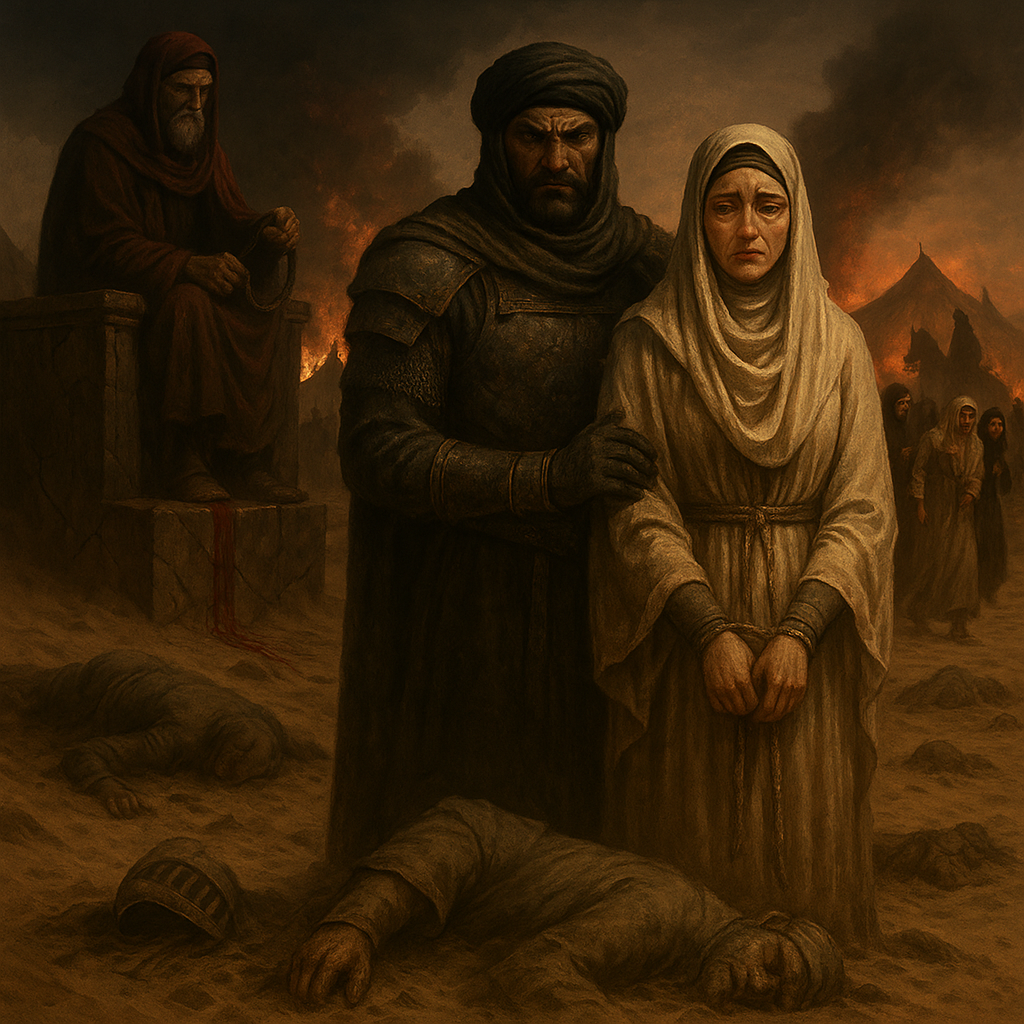
“Reinforcing the Critiques: A Scholarly Analysis Refuting the Claim of the Legitimacy of the First Caliphs” (13) The Rational Necessity of Infallibility: From the Tragedy of Malik ibn Nuwayra to the Crisis of Caliphal Legitimacy
Author: Hamed Sarem
The Rational Necessity of Infallibility in the Crucible of History: From the Crime against Malik ibn Nuwayra to the Crisis of the Caliphate’s Legitimacy
Drawing on the “rational necessity of infallibility in the Imamate,” this study examines the bloody case of Malik ibn Nuwayra in order to transform a merely historical dispute into a question of the criterion of legitimacy. The explicit contrast between Umar’s objection (textual proof and the demand for retribution) and Abu Bakr’s support for Khalid (interpretation and analogy) shows how absolute obedience to a non-infallible person marginalizes justice and calls crime “ijtihad.” Through a documented critique of Dehlawi’s defenses, the article demonstrates that arguments such as “your companion,” “rejoicing in Malik’s house,” and the woman’s status as fayʾ are neither textually reliable nor conclusive in implication; it concludes that Malik’s experience constitutes practical proof of the requirement of infallibility for safeguarding justice.
Abstract
Relying on the premise of the “rational necessity of infallibility in the Imamate,” this article shows that a non-infallible power structure—particularly when it demands absolute obedience—leads to the delegitimization of justice and the institutionalization of justifications for error and crime. To test this claim empirically, it analyzes the historical case of “Malik ibn Nuwayra”: Malik’s killing at the hands of Khalid ibn al-Walid and Khalid’s consummation with Malik’s wife, together with Abu Bakr’s support and Umar’s explicit objection (demanding retribution and the prescribed punishment), reveal a methodological rift involving the “prioritization of analogy over textual proof.” Through a documented and methodical critique of Shah Wali Allah Dehlawi’s defenses in Tuhfa-yi Ithna Ashariyya—citing reports by al-Tabari, Ibn Khallikan, Qadi Iyad, and hadith commentaries—the article demonstrates that arguments such as the expression “your companion,” the claim of “rejoicing in Malik’s house,” and “Malik’s wife being fayʾ” or “marriage after the waiting period” lack, in both implication and transmission, the capacity to establish apostasy or remove legal liability. Employing the “rule of ilzam” as well as the distinction between textual proof and analogy, it further concludes that preferring political expediency to religious justice results in the collapse of the criterion of legitimacy and the transformation of a “forbidden act” into “rewarded ijtihad.” The study consequently reinforces the rational argument for the requirement of infallibility in the Imamate and weakens the claim to the legitimacy of a non-infallible caliphate in light of the episode of Malik ibn Nuwayra.
Keywords: infallibility; Imamate; Malik ibn Nuwayra; Khalid ibn al-Walid; Abu Bakr; Umar ibn al-Khattab; Tuhfa-yi Ithna Ashariyya; Tashyid al-Mata'in; the rule of ilzam; analogy versus textual proof; the withholders of zakat; justice; the legitimacy of the caliphate; early Islamic history.
If imamate and leadership are not from God Almighty, they constitute the system of governance farthest from justice. Reason clearly judges this truth: the office of imamate can guarantee justice and human dignity only if its holder is infallible. For this reason, reason stands before a decisive dilemma: either one must accept that the Imam is infallible, so that justice and humanity may be safeguarded; or one must accept that oppression, bloodshed, and endless crimes will be inseparable from every non-infallible government. The bloody episode of Malik ibn Nuwayrah is living proof of this truth. In this incident, the killing of an innocent Muslim, the violation of his wife's honor, and the captivity or killing of the men and women of his tribe were carried out in the name of religion and in the name of God; and this crime was accompanied not merely by silence, but by the explicit support of the Caliph. Such conduct means that when a non-infallible ruler dominates society in God's name, no boundary remains for oppression. Accepting such an imamate and government is in fact accepting every possible crime, whether it occurs in actuality or remains a possibility. For once one regards an absolute ruler—against whom objection and uprising are deemed impermissible—as bindingly obeyed, what can restrain his hand from transgression and injustice? The various objections, including the episode of Malik ibn Nuwayrah's killing, not only testify to the incompetence of the earliest rulers, but also clarify a demonstrative principle: every theory that does not regard infallibility as a condition of imamate has, in practice, legitimized oppression and crime. These objections are not merely criticisms of individuals; they refute a theory that denies infallibility as a condition of imamate and has been advanced solely in an irrational defense of the earliest rulers. In the historical and theological examination of the conduct of the earliest rulers, one of the most important and decisive points of dispute is Umar ibn al-Khattab's reaction to Khalid ibn al-Walid's controversial actions and Abu Bakr's supportive stance toward them—a conflict with profound consequences not only ethically and juridically, but also for political legitimacy. In the previous article, focusing on the episode of Malik ibn Nuwayrah's killing and Khalid's relationship with Malik's wife, it was shown that Abu Bakr's defense of Khalid, in the face of Umar's explicit objection, reveals a serious gap between the “words and deeds” of the two Caliphs. Umar explicitly regarded Khalid's act as “the killing of a Muslim” and “adultery,” and demanded the enforcement of the prescribed punishment and his dismissal; but Abu Bakr, through an unfounded justification, deemed Khalid's conduct an “error in ijtihad” and exempted him. Therefore, this rational argument admits of no objection:
Major rational premise: If the Imam is not infallible, while absolute obedience to him is deemed obligatory in God's name and every form of objection and uprising is deemed impermissible, then no restraint or criterion will remain to prevent oppression, bloodshed, and crime; thus, accepting such an Imam means accepting all crimes, actually and potentially. Minor historical premise: In the event of Malik ibn Nuwayrah, absolute obedience and the prohibition of objection were accepted, and the result was manifest oppression—the killing of an innocent Muslim, the violation of his wife's honor, and the Caliph's support for these acts. Conclusion: Reason judges that the only way to guarantee justice is to make infallibility a condition of imamate; and historical objections, in addition to proving the incompetence of individuals, also invalidate the very theory of non-infallible imamate.
This may be stated in three sentences:
Reason faces a decisive dilemma: either imamate is infallible, so that justice and human dignity are guaranteed, or it is non-infallible, in which case endless oppression and crime become unavoidable. The episode of Malik ibn Nuwayrah is a living historical example that reveals this danger and shows that supporting a non-infallible ruler means conferring legitimacy upon crime. Therefore, historical objections show not only the unworthiness of individuals, but also refute, forcefully and demonstratively, the theory of imamate without infallibility.
From the perspective of the rule of ilzam, which is accepted in the science of theology—and particularly on the basis of the Sunni belief that Umar's words accord with the truth—such a position is conflict-ridden and indeed undermines Abu Bakr's fitness for the caliphate. If the truth lies with Umar, as Sunnis claim in their narrations, then Abu Bakr, by disregarding justice and retribution, was not merely an unjust Caliph, but fundamentally lacked the rational, legal, and moral qualifications for governance. In this article, which continues the preceding study, we intend, through a more precise examination of the dimensions of this conflict according to the rule of ilzam, to respond to some of Shah Wali Allah al-Dihlawi's most important defenses in “Tuhfah Ithna Ashariyyah”—especially in its tenth chapter, written in defense of Khalid ibn al-Walid's conduct. This response will be based on the documented and methodical analyses of the valuable book Tashyid al-Mata'in, authored by the late Sayyid Muhammad Quli Kinturi, a work that has played a key role in the scholarly refutation of Tuhfah Ithna Ashariyyah and in exposing its theoretical weaknesses. Along this path, we shall seek to expose the justificatory nature of certain readings of history and to reconsider the foundations of the religious and moral legitimacy of the caliphate in the light of Islamic texts, theological rationality, and justice-centeredness.
1) The Structure of Power in the Early Caliphate: From Prophetic Justice to Abu Bakr’s Politics
Studying the killing of Malik ibn Nuwayra solely as an individual violation is a superficial reading of the event. At the heart of this incident lies a fundamental conflict between the model of Prophetic governance and the political-military order prevailing under Abu Bakr’s rule. The Prophet of Islam (PBUH) made the preservation of the dignity of a Muslim human being the governing principle even in war, as he said: «أمرت أن أقاتل الناس حتى يقولوا لا إله إلا الله، فإذا قالوها عصموا مني دماءهم وأموالهم إلا بحقها» (Sahih al-Bukhari, Kitab al-Iman, Hadith 25). In contrast, Abu Bakr, responding to Umar ibn al-Khattab’s objection to the killing of Malik and his people on the basis of this hadith, said: «والله لأقاتلنّ من فرق بين الصلاة والزكاة، فإن الزكاة حق المال، ولو منعوني عقالاً كانوا يؤدونه إلى رسول الله صلى الله عليه و آله وسلم لقاتلتهم على منعه» (Sahih al-Bukhari, Kitab al-Zakah, Hadith 1399). This response clearly shows that, in the caliphal apparatus after the Prophet, the axis of legitimacy and warfare was not faith and religious rites, but financial and political submission. This fundamental shift marked the departure from Prophetic caliphate toward a fiscal-military system in which even withholding an «ʿiqāl» (a camel tether) was declared grounds for war and killing. These two reports from Bukhari clearly show that:
Abu Bakr’s rule had no connection with the Prophet of Mercy. The Prophet of Mercy based his government on gentleness, forbearance, and the call to monotheism. Yet the person who claimed his caliphate based his rule on greed, arbitrariness (pursuing a course without deliberation), killing, and oppression. In war, when someone from among the enemy professed monotheism, he became like all other Muslims and enjoyed all the rights of Islam: his life, property, and honor were secure. Under Abu Bakr’s rule, however, one who prayed, cited Qur’anic verses, and gave the call to prayer had his life, property, family, and honor violated because of wealth that Abu Bakr claimed. These two reports from Bukhari, together with the account of Malik ibn Nuwayra’s killing in Sunni sources alone, are sufficient to establish the conclusion that Abu Bakr was a usurper.
2) Covering Up a Crime in the Name of Ijtihad: The Killing of Malik and the Assault on His Wife
What Khalid ibn al-Walid did in killing Malik ibn Nuwayra and immediately assaulting his wife constitutes, under Islamic jurisprudence, two major crimes: the intentional killing of a Muslim who prayed, and adultery with a Muslim woman during her waiting period (ʿiddah). In Sunni sources, such as the History of al-Tabari, Abu Qatada is reported to have said: «فقلنا: إنا المسلمون، فقالوا: نحن المسلمون. فقلنا: فما بال السلاح معكم؟ قالوا: فما بال السلاح معكم؟ فقلنا: إن كنتم كما تقولون فضعوا السلاح، فوضعوا، ثم صلينا وصلّوا» (Tarikh al-Tabari, vol. 2, p. 274). That is, both sides regarded one another as Muslims and ultimately prayed together. Were these people apostates? Despite this clear evidence, Khalid killed Malik on the charge of apostasy and refusal to pay zakat and, according to the History of Ibn Khallikan, «cohabited with his wife that same night». Umar ibn al-Khattab, reacting to this conduct, said in severe terms: «عدوّ الله عدا على امرئ مسلم فقتله ثم نزا على امرأته كنازو الحمار» (Mir’at al-Zaman, al-Yafi‘i, vol. 1, p. 105; see also: Wafayat al-A‘yan, vol. 5, p. 120). This expression indicates not only adultery, but also portrays intense moral revulsion toward it. Ibn Umar and Abu Qatada likewise refused to participate in Khalid’s alleged marriage ceremony and advised him to report the matter to Abu Bakr. Yet Khalid independently took possession of the woman. (Kanz al-‘Ummal, Hadith 14307)
3) Collusion in Power: Why Did Abu Bakr Support Khalid?
The key question is this: although Ali ibn Abi Talib (may Allah’s blessings be upon them), Umar, Sa‘d, and Talhah all demanded retaliation against Khalid, why did Abu Bakr not only refrain from enforcing the prescribed punishment, but also retain and strengthen Khalid? The answer must be sought in the geography of power. At that time, Khalid ibn al-Walid was the most important military arm of the nascent caliphate. Consolidating the caliphate against the opponents of zakat and claimants to prophethood was impossible without his military force. Moreover, it was Abu Bakr’s practice to suppress his opponents in the harshest, most inhumane, and most brutal manner possible. Had Khalid been subjected to retaliation, the door to suppressing Abu Bakr’s opponents would have been closed at its root. Preserving this power therefore required countless acts of bloodshed and oppression—but oppression, wickedness, and bloodshed clothed by religious law and faith in the garb of deception, with religion serving as its justification. Hence Abu Bakr said: «لا أشيم سيفاً سله الله على الكافرين» (Tarikh al-Tabari, vol. 2, p. 279), meaning: “I will not sheath a sword that God has drawn against the unbelievers.” This statement sacrificed moral and religious legitimacy to military and political expediency. In reality, the killing of Malik and the seizure of his wife, Abu Bakr’s silence and then support for Khalid—in the face of the testimony of several upright Companions—indicate a form of collusion of power in which justice, legal punishments, and even the inviolability of Muslim women were sacrificed for the political consolidation of government. Put very simply, justice is whatever the ruling power desires, and oppression is whatever the ruling power does not desire. Thus, if Khalid ibn al-Walid had been subjected to retaliation, or the punishment for zina had been applied to him, or even if he had been removed from office, then what would have become of the killer of حضرت محسن? What would have become of the killer of حضرت زهرا, peace be upon her? The answer is clear: with great effort, the entire event is denied. Why? Because denial is a better solution than defending an oppressor and justifying the crime of a dangerous criminal who does not even spare a pregnant woman. Yet no one can deny the martyrdom of Sayyid al-Shuhada, peace be upon him. In this case, where they have been unable to deny the crime itself, his killer is praised and commended, and they say: the killer of al-Husayn ibn Ali is truthful and accepted in transmission, while the killer of Ali ibn Abi Talib was an rewarded mujtahid (Ibn Hajar al-‘Asqalani – Taqrib al-Tahdhib (entry 4903 concerning Umar ibn Sa‘d ibn Abi Waqqas): «عُمَرُ بنُ سَعدِ بنِ أبی وَقّاصٍ… صَدوقٌ، وَلَكِنْ مَقَتَهُ النّاسُ لِكَوْنِهِ كانَ أَميرًا عَلى الجَيشِ الّذینَ قَتَلوا الحُسَینَ بنَ عَلِيّ…».
Al-‘Ijli (as transmitted by al-Mizzi in Tahdhib al-Kamal) says of the same person: «…وَهُوَ الَّذی قَتَلَ الحُسَینَ، وَهُوَ تابِعیٌّ ثِقَةٌ.» There is no need for further words or discussion. Abu Bakr’s conduct laid the foundation for an intellectual current that justifies every crime—a justification driven by political objectives, even when such crimes constitute unequivocal opposition to the Prophet of Mercy and oppression and injustice toward him and his Ahl al-Bayt!
4) A Critique of the Evidences in Tuhfa Ithna ‘Ashariyya and an In-Depth Analysis of the Structure of Power
In the tenth chapter of Tuhfa Ithna ‘Ashariyya, Shah Wali Allah Dehlawi advances several key claims aimed at exonerating Khalid ibn al-Walid and defending Abu Bakr’s conduct. These are largely presented as historical propositions without textual-transmission or juristic analysis. The summary of these claims is as follows:
Malik ibn Nuwayra was an apostate, because he addressed the Prophet as «صاحبکم», which was a sign of his disbelief in the Prophethood. In his house, at the time of the Prophet’s death, tambourine-playing and rejoicing took place, indicating disbelief and mockery of religion. Malik ibn Nuwayra’s wife was considered among the fay’, and Khalid married her after completion of her waiting period. Abu Bakr defended Khalid’s act because he regarded it as legitimate ijtihad.
A Detailed Response to Dehlawi’s Evidences — The Claim of Apostasy Because of the Word «صاحبکم»
Following some later commentators, Dihlawi regarded the term “ṣāḥibakum” as evidence of Malik’s apostasy. In response to this baseless justification, the late Sayyid Muhammad Quli Kinturi argues as follows: As for the claim that “Malik ibn Nuwayrah used such expressions concerning the Noble Prophet (PBUH) as qāla rajulukum... or ṣāḥibukum... and because he referred to the Prophet with a pronoun other than his own (i.e., addressing others), this was the practice of the unbelievers and apostates of that age,” it is untenable. First, in reliable historical sources such as Ibn Khallikan’s History, al-Tabari’s History, and al-Shifaʾ by Qadi ʿIyad, only the expression “ṣāḥibakum” or “ṣāḥibuka” occurs; none of them mentions the word “rajulukum.” For example, al-Shifaʾ states: “واحتجّ ابراهیم بن حسین بن خالد الفقیه فی مثل هذا بقتل خالد بن الولید مالک بن نویره لقوله عن النبیّ صلی الله علیه [ وآله ] وسلّم: (صاحبکم)” (al-Shifaʾ, vol. 2, first chapter of the fourth section, p. 216). Its commentary, Nasim al-Riyad, explains that the argument was that Malik said “ṣāḥibakum,” which Khalid regarded as indicating separation or non-followership; Khalid therefore killed him on the charge of apostasy. Yet the text adds: “Khalid spoke with Malik concerning zakat. Malik said: I pray, but I do not pay zakat. Khalid said: Do you not know that God has joined prayer and zakat together, and that neither is accepted without the other? Malik said: Your companion did not say so. Khalid said: Do you not consider him your companion? By God, I intend to strike off your neck” (al-Shifaʾ, pp. 216–217). This report shows that Malik himself referred to the Prophet as “ṣāḥibakum,” and that no expression indicating actual apostasy or unbelief was uttered by him. The same report is confirmed in other sources. Second, the word “ṣāḥibakum” in itself does not indicate apostasy. As Abu ʿAli al-Muʿtazili also noted, Khalid merely construed this expression as a sign of apostasy. Sayyid al-Murtada writes in this regard: “وحکی – أی صاحب المغنی – عن أبی علی: إنه ذکر رسول الله (صلی الله علیه وآله) فقال: (صاحبک)، وأوهم بذلک أنه لیس به صاحب له، وکان عنده إن ذلک ردّه؛ وعلم عند المشاهده المقصد وهو أمیر القوم، فجاز أن یقتله، وإن کان الأولی أن لا یستعجل، وأن یکشف الأمر عن ردّته حتّی یتضح” (al-Mughni wa al-Shifaʾ, vol. 4, pp. 338–339). That is, although Khalid regarded this expression as an indication of apostasy, it would have been better to investigate the matter carefully before acting, so that apostasy could truly be established. Third, if applying the term “ṣāḥib” to the Prophet were evidence of Malik’s apostasy, this would also create a difficulty for Sunnis. Sahih al-Bukhari reports: “عن أبی وائل، قال: جلست مع شیبه علی الکرسی فی الکعبه، فقال: لقد جلس هذا المجلس عمر، فقال: لقد هممت أن لا أدع فیها صفراء ولا بیضاء إلاّ قسمته، قلت: إن صاحبیک لم یفعلاه؛ فقال: هما المرءان أقتدی بهما” (Sahih al-Bukhari, vol. 2, p. 159; Fath al-Bari, vol. 3, p. 364). In this example, “ṣāḥibayka” refers to the Prophet and Abu Bakr and has no implication of apostasy or unbelief (Sharh al-Qastallani, vol. 3, p. 340). The same point is confirmed in sources such as Rabiʿ al-Abrar (vol. 5, chapter 91, p. 340) and Kanz al-ʿUmmal. Fourth, Sunni juridical and uṣūl principles establish that “affirming something for one thing does not imply its negation from another.” Therefore, calling the Prophet “your companion” is neither a sign of unbelief nor evidence legitimizing murder. Fifth, and more importantly, if this expression signified Malik’s apostasy, why did ʿUmar say, “إنه قتل مسلماً فاقتله” — namely, recognizing him as a Muslim and deeming retaliation necessary? And why did Abu Bakr say, “ما کنت أقتله، إنه تأول” — namely, that Malik had erred through interpretation and that his killing was not based on apostasy (al-Shifaʾ, vol. 4, p. 338; Kanz al-ʿUmmal, ibid.)? Sixth, another claim made by the author of Tuhfa-yi Ithna ʿAshariyya in defense of Khalid ibn al-Walid is that Khalid supposedly considered Malik ibn Nuwayrah an apostate after hearing expressions such as “ṣāḥibakum” or “rajulukum” from him, and killed him on the basis of that expression. But even assuming this attribution to be correct, one must ask: if Malik became an apostate through this word, on what grounds were the other members of his tribe deemed deserving of death? Historical and theological analysis shows that this argument is not only indefensible in light of reliable historical and juridical sources, but is also flawed according to theological foundations and the principles of Islamic justice. An individual’s apostasy cannot justify collective killing or violations of others’ rights, and no text or rule regards the use of “ṣāḥibakum” as evidence of collective apostasy or as legitimizing widespread criminal violence. This point further clarifies the invalidity of the justifications in Tuhfa and similar defenses, showing that the claim of killing on account of this expression lacks any legal-religious or historical basis.
Scholarly Conclusion
Analysis of the sources and evidence demonstrates that:
The expression “ṣāḥibakum” in no way indicates Malik’s apostasy; it was merely Khalid’s personal interpretation. Khalid’s actions in killing Malik and taking possession of his wife on the basis of this expression had no legal-religious or juridical justification. The responses of ʿUmar and Abu Bakr, as well as Sunni juridical principles, clearly show that this expression cannot serve as a basis for legitimizing murder. Therefore, the claim that “Malik apostatized because he used the word ṣāḥibakum” is wholly untenable and has no historical, juridical, or logical support.
5) The Catastrophe of Institutionalizing the Justification of Oppression in the History of the Caliphate
5.1) From an Individual Error to the Consolidation of a Power-Centered Mechanism
The killing of Malik ibn Nuwayra and the seizure of his wife, had it been regarded merely as a juristic error by Khalid and redressed through the enforcement of the divinely prescribed punishments, could readily have been remedied in the memory of Islamic history. What turned this event into a historical tragedy, however, was not Khalid’s individual act, but the structure that supported this crime and recast it as “ijtihad.” Here, the issue changes in nature from an “unlawful act” to the “legitimation of what is unlawful”; and this is precisely when deviation assumes an institutional character. By declaring that Khalid “taʾawwala fa-akhtaʾa” (he exercised ijtihad and erred), and by refusing to enforce the prescribed punishment, Abu Bakr gave personal opinion precedence over the explicit text of the Sharia. This decision not only opened the way for the Companions’ non-accountability for grave crimes, but also became a model for later silences, the suspension of prescribed punishments, and the interpretation of crime as ijtihad, all in the service of preserving the structure of power.
5.2) Depoliticizing Justice: Replacing Sharia with Coercion
Abu Bakr not only exempted Khalid, but also, in his famous statement, “I will not sheath a sword that God has drawn against the disbelievers” (Tarikh al-Tabari, vol. 2, p. 279), called him the “Sword of God.” Despite the Companions’ اعتراضات, he neither removed him from office nor diminished his authority; rather, he granted him greater power. Here, “Sharia” was removed from the subject of discussion and “political expediency” took its place. This conceptual shift was not merely a juristic danger, but a threat to Islam’s justice-centered order. Instead of overseeing power, religion became an instrument for legitimizing power. From this point onward, Sharia could be set aside under the titles of “ijtihad” and “expediency”; and this was the most dangerous legacy of the caliphate.
5.3) A Caliphate without Justice Is a Caliphate without the Prophet
From a deeper perspective, it may be said that, in this system, legitimacy was derived neither from Prophetic texts, nor from justice, nor from the people’s vote, but from the power of the sword, military loyalty, and the continuity of the caliphal structure. Even a caliph such as Umar, who personally objected to the crime, served to consolidate this very structure instead of demanding retribution, and himself succeeded Abu Bakr. This silence shows that the principal concern was not religion, but preserving the cohesion of the political structure that had emerged from the choice at Saqifa. Therefore, Amir al-Mu’minin Ali (peace be upon him) never regarded their caliphate as legitimate—not because of a personal dispute, but on principled grounds. Not only did he refuse to pledge allegiance, but he explicitly said: “By God, so-and-so donned it, while he knew that my position in relation to it was that of the axis to the millstone” (Nahj al-Balagha, Sermon al-Shaqshaqiyya). In Imam Ali’s (a) view, the caliphate was not a transferable political office, but a divine station founded upon infallibility, knowledge, and justice. To accept a caliphate that calls adultery and murder ijtihad is to accept a distorted religion and a satanic caliphate clothed in the garb of Sharia.
5.4) Historical Consequences: From Khalid’s Innovation to the Caliphs’ Tradition
When adultery, murder, and the suspension of prescribed punishments were justified through ijtihād, the door was opened to innovations whose effects appeared throughout history in the form of unjust governments, corrupt caliphs, and violence such as Karbala. This style of caliphate was precisely what Yazid ibn Mu‘awiya inherited: a caliphate in which the inviolability of Muslim life and honor was sacrificed to preserve power. This chain began with the justification of a caliphate without infallibility and silence in the face of crime, and extended to the justification of raising the sword against Husayn ibn ‘Ali (a). Had infallibility been the criterion of legitimacy, none of these links would have taken shape.
Statement of the Claim and Intermediate Conclusion: Lack of Fitness for the Caliphate
The purpose of criticizing the early caliphs and rulers is not mere sectarian disputation; rather, it is to establish their practical impiety and major structural errors, demonstrating that the claimants to the caliphate not only lacked the qualifications to occupy the station of succession to the Prophet (s), but had also violated the standards of justice and trustworthiness even for administering a small district. In the case of the first caliph, the dispatch of Khalid ibn al-Walid against the Muslim tribe of Malik ibn Nuwayra, the mass killing, and the violation of women’s honor constitute the central grounds of criticism. Dehlavi’s defenses tend either to deny the event itself or to declare Malik and his tribe “apostates”; and both paths inadvertently yield two admissions: the occurrence of the tragedy is assumed to be certain, and Abu Bakr can be exonerated only by proving apostasy.
Yet, according to those same Sunni sources, the Islam of Malik and his people (the call to prayer, congregational prayer, and their insistence that the dispute be referred to the caliph) is established, and no evidence of apostasy has been presented. In the matter of the “return of alms,” it was either a local distribution—consistent with the text, «تُؤخَذُ من أغنیائِهم وتُرَدُّ فی فقرائِهم»—or, assuming that they were returned to the zakat-payers, it may be understood as a juristic interpretation that the collection of zakat was exclusively assigned to the person of the Messenger (s); neither entails apostasy. Therefore, Khalid’s crime and Abu Bakr’s overlooking of the prescribed punishment and retaliation cannot be justified by “he interpreted and erred” («تأوَّلَ فأخطأ»). Rather, they reinforce the judgment that justice and political fitness were absent, and show that in such a structure, “the expediency of power” was given precedence over “text and justice.”
The conclusion is clear: this case is a concrete example of how accepting the imamate of a non-infallible person together with absolute obedience practically opens the way to legitimizing oppression. Thus, this study—beyond its critique of individuals—elevates the rational necessity of infallibility in the office of imamate, from within history, to the level of a theoretical-practical principle.
Refuting Dehlavi’s Claim: Why Abu Bakr’s “Exoneration of Khalid” Is Unacceptable
1) The Claim and the Point at Issue
At the end, Dehlawi says the following to justify the legitimacy of the killing of Malik ibn Nuwayra: after questioning Khalid, Abu Bakr discovered the truth and, since “the right was with Khalid,” refrained from taking any action against him. This claim has no solid documentary basis, nor is it consistent with the historical, juridical, and behavioral evidence; rather, it brings into sharper relief the internal contradiction between the words and conduct of the caliphs—a contradiction Dehlawi overlooks.
2) Assessing the Evidence: “Apostasy” or “Interpretation”?
If Malik had truly been an apostate and his killing had rested on established legal apostasy, Khalid should plainly have declared precisely this in his defense. Yet—according to Sunni reports—his only basis was an expression of the kind “صاحبکم”; an expression that neither denotes disbelief in Arabic usage nor has been considered grounds for apostasy by major Sunni jurists, such as Qadi Iyad in al-Shifa and Mulla Ali al-Qari in its commentary. They explicitly state that, at the very least, haste in pronouncing apostasy should have been avoided and “the true state of affairs” investigated.
3) The Logical Implication of Umar’s Statement and Abu Bakr’s Reply
Umar ibn al-Khattab—who holds a special status among Sunnis—explicitly and repeatedly called Khalid “the killer of a Muslim” and asked Abu Bakr to subject him to retaliatory punishment. Abu Bakr’s reply, however, was: “He exercised interpretation and erred.” This reply is in fact an admission that Malik’s killing rested not on conclusive proof of apostasy, but on suspicion and an “error of independent legal reasoning”; otherwise, it should have been said: “Malik was an apostate, and Khalid was correct in killing him.”
4) The Fundamental Question: Why Extend Punishment to the Tribe? And What Does the Return of the Captives Indicate?
Even if—assuming the impossible—a statement by Malik were regarded as evidence of apostasy, why were the women, children, and other members of the tribe also killed and taken captive? Moreover, historical sources report that, after assuming the caliphate, Umar returned to Malik’s family and people the property and captives taken during Malik’s killing. Such an act clearly indicates that, in Umar’s view, an injustice had occurred; otherwise, what juristic justification could there have been for returning the fay’?
5) Giving Precedence to Text over Analogy: al-Nawawi’s Testimony
Imam al-Nawawi states explicitly in his commentary on Sahih Muslim that, in this incident, Umar’s argument rested on the “generality of the Prophetic texts,” whereas Abu Bakr’s argument rested on “analogy”; and it is clear that analogy has no probative force in opposition to a text. This judgment reveals the methodological difference between the two caliphs: Umar insists upon the text, while Abu Bakr relies on analogical interpretation; and this is precisely what weakens al-Dihlawi’s argument. Of course, from the Shi‘i perspective, this point does not preclude criticism of Umar for laying the foundation of an illegitimate caliphate and participating in its consequences. Nevertheless, according to the “rule of ilzam”—within the framework of principles accepted by Ahl al-Sunnah—this very methodological admission provides Abu Bakr’s supporters with sufficient proof that he was a usurper and an oppressor, and shows that whoever seeks the Shari‘a and the Muhammadan Sunnah cannot regard Abu Bakr as the Prophet’s rightful caliph.
6) Conduct After the Killing: Taking Malik’s Wife and the Ethical Critique
After Malik was killed, Khalid took possession of his beautiful wife and married her—an act strongly condemned even by some Companions, such as Abdullah ibn Umar and Abu Qatadah, who refused to attend Khalid’s wedding ceremony. Is such conduct compatible with the self-evident principles of Islamic ethics and judicial justice? Al-Dihlawi either overlooks these ethical-juristic evidences or seeks to downplay them under the label of “the disagreement of jurists in subsidiary matters.” Yet the matter at issue is the life of a Muslim and the inviolability of honor, not an insignificant subsidiary juristic question.
7) Conclusion of This Section: Exoneration or Cover-Up?
Taken together, the evidence indicates that the claim that “Khalid was in the right in Abu Bakr’s view” reflects less a historical reality than a political justification for concealing a grave error. The primary aim of these justifications was not to establish Khalid’s innocence, but to preserve the structure of Abu Bakr’s caliphate and legitimize his decision to forgo the prescribed punishment and retribution. Clearly, if Malik’s killing was unjust and lacked legal authorization—as extensive evidence indicates—then the caliphs’ silence, support, and continued trust in Khalid signal a structural defect in justice and political legitimacy after the Prophet (PBUH); a structure in which the Commander of the Faithful (PBUH) did not participate and whose legitimacy he did not accept.
Final Conclusion of the Article
This study has demonstrated, with documentation, that the “case of Malik ibn Nuwayra” establishes three fundamental points:
An evident violation of explicit textual proof and justice at the level of the highest political decision: the killing of a Muslim without proof of apostasy, the waiving of retribution and the prescribed punishment, and its justification as “interpretation and error.” A serious inconsistency between the caliphs’ words and deeds: on the one hand, Umar’s explicit characterization of it as the “killing of a Muslim” and his demand for retribution; on the other, Abu Bakr’s political exoneration of Khalid. The impossibility of guaranteeing justice under the model of an obeyed, non-infallible imamate: when power is founded upon “analogy and expediency” and “explicit textual proof and justice” are marginalized, the way remains open for legitimizing oppression.
Therefore, this event is not merely a critique of one commander or one particular decision; it is concrete proof of the rational necessity of infallibility in the imamate. Any model of imamate/government that does not make infallibility a condition while demanding absolute obedience will, sooner or later, sacrifice justice to power. This conclusion will be the cornerstone of our next article: an examination of the mechanisms that gave precedence to “analogy over explicit textual proof” and to “the expediency of power over justice,” and of how they became an enduring pattern for justifying oppression in history.