
Fortifying the Critiques: A Scholarly Analysis Refuting the Claim of the Legitimacy of the First Caliphs (3) (The Inseparability of Imamate and Historical Critiques)
Author: Hamed Sarem
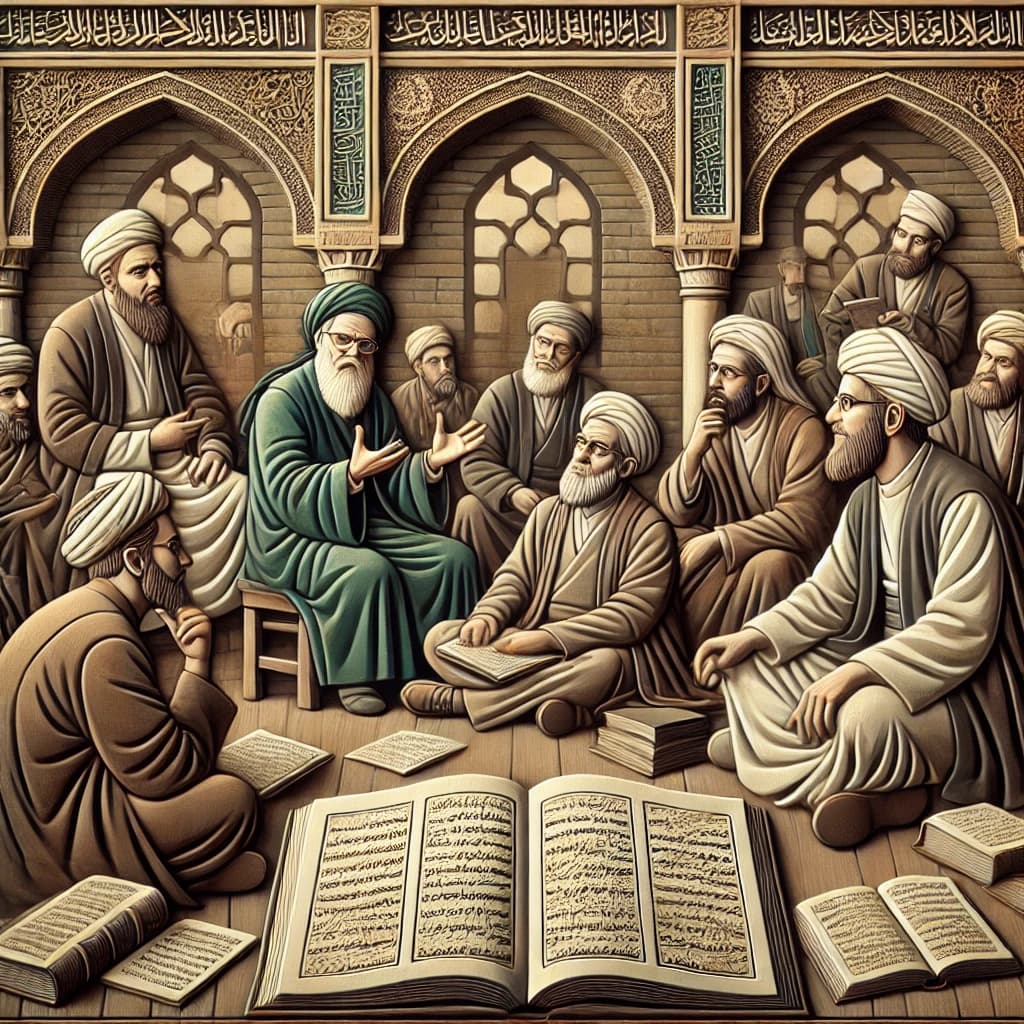
The Inseparability of Infallibility and Knowledge in Shi‘i Imamate and the Place of Criticisms in Challenging the Legitimacy of the Caliphate
Abstract
In the theological system of Shi‘ism, the Imamate, as the fundamental pillar of religious guidance, requires three foundational qualities: infallibility, knowledge, and divine designation. This article, while explaining the philosophy and necessity of these three conditions, examines the logical and functional relationship among them and demonstrates that the absence of any one of them disrupts the religion’s system of guidance. Moreover, in light of the introduction to the book al-Kāfī, the issue of the distinction between ignorant and knowledgeable worship is analyzed, and the role of the Imam’s knowledge and infallibility in the soundness of religious guidance is explained. The final section of the article is devoted to analyzing the concept of criticisms (maṭāʿin) in Imami theology; drawing on a critique of the book Tuḥfat al-Ithnā ʿAshariyya and a historical examination of the conduct of the first caliphs, it employs such criticisms as evidence for the invalidity of their Imamate and for establishing the immediate caliphate of Amīr al-Muʾminīn (peace be upon him). Through a rational-textual approach, this essay seeks to reconsider the foundation of the Imamate as grounded in firm principles.
Keywords:
- Imamate; infallibility; knowledge of the Imam; criticisms; Tuḥfat al-Ithnā ʿAshariyya

The Theological Foundations of Imamate in Shi‘ism: Explaining the Three Essential Conditions
In the Shi'a doctrinal system, the concept of Imamate rests on three fundamental pillars: infallibility, divinely bestowed knowledge, and divine designation. The Imam, as the figure entrusted with the grave duty of guiding the Islamic community, occupies an undeniable and indispensable position in the religious structure. Since the Imam's commands and actions carry legal obligation for his followers, his directions are regarded as being in accordance with the will and pleasure of God, the Exalted. Accordingly, the necessity for the Imam to avoid every kind of error in the matter of guidance is self-evident and firmly grounded in rational principles. If a guide charged with directing others were himself to cause misguidance, the existence of such guidance would defeat its very purpose and would, functionally, be futile and ineffective.
Explaining the Necessity of Knowledge in Worship: An Examination of the Views Presented in al-Kafi's Usul
From another perspective, this issue is addressed in the introduction to the noble book Usul al-Kafi as a foundational discussion concerning the possibility of ignorant worship as opposed to knowledgeable worship. This detailed discussion raises the essential question of whether worship of God, the Exalted, may be performed out of ignorance and without reliance on knowledge, or whether knowledge and awareness are necessary conditions for its validity and acceptance. A brief review of the arguments presented in this introduction leads to the final conclusion that accepting the validity of ignorant worship means that a person may engage in acts of worship without certainty and without recourse to reliable scholarly sources. This may include inventing arbitrary modes of worship, or deriving worship from sources lacking scholarly authority or from sources susceptible to error. The possibility of error in unreliable sources may likewise arise from factors such as ignorance, forgetfulness, or the dominance of carnal desires for the purpose of obtaining personal benefit and promoting incorrect religious innovations. Examples of this can be observed in the invention and promotion of certain forms of worship contrary to the Sunnah and divine teachings, which are justified under the title “ni'm al-bid'ah.” In religious terminology, bid'ah is defined as any innovation in religion that conflicts with the will of God and the tradition of the Prophet (PBUH). Therefore, ignorant worship—whether through personal invention, imitation of innovators, learning from the ignorant, or adoption from sources in which error is possible, whether due to forgetfulness, carnal desire, or other factors—faces fundamental objections.
The question now arises: is ignorant worship valid and acceptable before God, the Exalted? If we maintain the validity of such worship—meaning that God accepts worship arising from ignorance and lack of knowledge, grants reward for it, and makes no distinction between knowledgeable and ignorant worship—then the status and rank of both types of worship would be considered equal. This equality, in turn, raises the question of what is wrong with failing to distinguish between ignorant and knowledgeable worship. The answer lies in this: if any movement or action, without a basis in knowledge and merely according to a person's own conception, is regarded as worship and accepted by God, while worship is in fact required to rest on knowledge and to be derived from reliable sources in which divine pleasure is established, then treating these two approaches as equal would bring grave consequences upon the religious order.
One of the most important consequences is the nullification and futility of the mission of all prophets and the sending down of heavenly books. For the principal duty of the Imam and the Prophet is to guide humankind toward the path of truth and to warn against the paths of misguidance. If there were no difference between following the path of divine guidance and traversing deviant paths, and if both ways led to the same destination, then the existence of the Imam and the Prophet—whose task is to distinguish truth from falsehood—would be futile and useless. In other words, if ignorant and knowledgeable worship possessed equal value and reward, then the efforts of the prophets and the legatees to explain the correct way of worship and prohibit innovations would be deemed futile and contrary to divine wisdom. Glory be to God from attributing an ignorant act to His Sacred Essence.
The Inseparability of Infallibility and Knowledge in Imamate: A Necessity for the Infallible Guidance of the Community
Therefore, the preceding argument, which may be studied in detail in the introduction to the noble book al-Kāfī, emphasizes that the Imam possesses two fundamental and inseparable characteristics: infallibility and knowledge. These two qualities are closely interconnected and accompany one another. This means that the Imam’s answers to the questions of the community must necessarily be based on his divinely bestowed knowledge. Nevertheless, knowledge alone is not sufficient for the Imam to fulfill his guiding role; it is also indispensable to guarantee his immunity from error, forgetfulness, and inadvertence. This guarantee, which evokes the concept of infallibility, is among the necessities of Imamate.
In brief, if the Imam, despite being presumed to possess knowledge, lacks the guarantee of infallibility, then there remains the possibility of error, mistake, forgetfulness, or inadvertence in his answers. In such a case, the guidance sought by the community and the path it must follow will become subject to deviation and error. Consequently, worship founded upon such guidance acquires an ignorant character. Now, if God Almighty were to regard ignorant worship as equivalent to learned worship and accept it, then the very philosophy and necessity of prophethood, messengership, and Imamate would be called into question, and the role of the guide as a divine guide would be futile and without benefit. If worship is to be performed out of ignorance, and traversing a mistaken path is no different from following the correct path, then the existence of a person as a guide—one who warns the community against deviation and directs it toward the truth—would be absurd, meaningless, and devoid of wisdom. In light of the foregoing explanations, these two important principles, namely the necessity of infallibility and knowledge for the Imam, are conclusively and firmly established.
The Necessity of Divine Designation of the Infallible and Learned Imam: A Critique of Opposing Views in Tashyīd al-Maṭāʿin
As was briefly stated earlier, it is necessary and unavoidable for the Imam to possess the two essential qualities of infallibility and knowledge. Once the premise that the Imam must be infallible and learned is accepted, the fundamental question arises: who is the authority responsible for appointing such a person? The decisive argument in this regard is that the appointment of an infallible and learned Imam must be made by God Almighty. The reason is that ordinary human beings possess no reliable means or criteria for discerning a person’s comprehensive knowledge and genuine infallibility in all dimensions of religion. Recognizing infallibility—that is, immunity from ignorance, forgetfulness, error, and inadvertence—lies beyond human capacity. Are ordinary people able to identify a person with such qualities? Do they possess any means for doing so? The answer is no. This is especially true with respect to infallibility, for a person’s outward appearance cannot by itself serve as a criterion for judgment. This point becomes even more significant in view of the existence of hypocrites within the Muslim community, as explicitly stated in the Qur’an and in the historical sources of both schools. A hypocrite is someone who has an outwardly Islamic and peaceable appearance and even considers himself a reformer. Under such circumstances, ordinary people cannot distinguish a hypocrite from a non-hypocrite unless God Almighty or the Noble Prophet (PBUH) specifies clear signs and criteria for this purpose. Therefore, on the one hand, the lack of the necessary means to distinguish a hypocrite from a non-hypocrite and to identify an infallible person from a non-infallible one, and, on the other hand, the necessity of the Imam’s infallibility, leave only one logical solution: Imamate must be by divine designation. Accordingly, three fundamental features and essential conditions of Imamate were discussed: infallibility, intellectual and moral superiority, and divine designation. These discussions were introduced because the subject of the present research is an examination of the book Tashyīd al-Maṭāʿin, written in critique of the book Tuḥfat al-Ithnā ʿAshariyya. Tuḥfat al-Ithnā ʿAshariyya, in twelve chapters, criticizes and attacks Shiʿi beliefs and, in this critique, has extensively departed from scholarly principles and methods, failed to employ the principle of ilzām, and engaged in the dissemination of falsehoods and systematic, deliberate fabrication. Tashyīd al-Maṭāʿin was composed as a critique of the tenth chapter of Tuḥfat al-Ithnā ʿAshariyya. The tenth chapter of Tuḥfat al-Ithnā ʿAshariyya sought to refute the objections raised by Shiʿi theologians and traditionists concerning the early rulers—those whom, according to Shiʿi belief, usurped the right of the Commander of the Faithful, ʿAlī ibn Abī Ṭālib (PBUH). Tuḥfat al-Ithnā ʿAshariyya sought to justify and reject these objections. However, the late Muḥammad Qulī, father of the late Mīr Ḥāmid Ḥusayn al-Hindī, by writing Tashyīd al-Maṭāʿin, reinforced these objections in their proper place and argued for their existence. We shall now turn to defining the concept of maṭāʿin. In explaining its meaning, we referred to the three essential conditions of Imamate: infallibility, intellectual and moral superiority, and divine designation. Accordingly, any proposition or report showing that a person claiming the office of Imamate or the caliphate of the Prophet (PBUH) lacks infallibility—whether through deed or statement—or indicating the presence of errors in him, especially major errors, as well as any saying, deed, or act that reveals his ignorance concerning matters of which an Imam, as the guide of society and successor to the Prophet (PBUH), who expounds the Qur’an, must be knowledgeable, confirms that such a person is unworthy of occupying the station of Imamate.
Maṭāʿin as Evidence of the Ineligibility of Claimants to the Caliphate and Proof of the Immediate Imamate of the Commander of the Faithful (PBUH)
Thus, the concept of maṭāʿin has become clear. Maṭāʿin does not mean insults or abuse; rather, every proposition indicating the absence of infallibility, or ignorance and lack of knowledge, in a person claiming Imamate is regarded as maṭāʿin. Such propositions are important proofs of that person’s unfitness to assume the office of Imamate, the caliphate of the Prophet (PBUH), and the guidance of society and the Muslim community. This is the definition of maṭāʿin.
Now, after understanding the concept of taʿāʾin (criticisms), this question arises: what is the purpose and objective of raising taʿāʾin by Shiʿi theologians in theological works? In the discussion of imamate, there are two fundamental approaches. The first is to present proofs establishing the immediate succession of the Commander of the Faithful (ʿa) after the Prophet (ṣ). These proofs are themselves divided into several categories: rational proofs, which determine that the Commander of the Faithful (ʿa) must be the Prophet’s immediate successor (ṣ); Qur’anic proofs, including the verses of the Noble Qur’an that explain the rank, status, and lofty position of the Commander of the Faithful (ʿa) (which Shiʿi theologians refer to as the verses of walāyah); and transmitted and traditional proofs. The transmitted proofs are likewise divided into two parts: reports narrated in authoritative Shiʿi books, and reports found in the books of the opponents which, from their own perspective, are also authoritative and often mutawātir (mass-transmitted).
Therefore, there are four categories of proof for establishing the immediate succession of the Commander of the Faithful (ʿa): the indication of reason (such as the late ʿAllāmah al-Ḥillī’s book al-Alfayn, which contains one thousand rational proofs and one thousand transmitted proofs for establishing the succession of the Commander of the Faithful (ʿa)); Qur’anic verses (the verses of walāyah); authoritative reports in Shiʿi sources; and reports that are authoritative and mutawātir among Shiʿi opponents (such as the ḥadīth of Ghadīr, “Whomever I am his master, this ʿAlī is his master”; the ḥadīth of the bird; the ḥadīth, “I am the city of knowledge and ʿAlī is its gate”; and many others, concerning which the late Sayyid Mīr Ḥāmid Ḥusayn spoke in detail and extensively discussed their chains of transmission, tawātur, and indication). Shiʿi theologians have followed a defined course in establishing the succession of the Commander of the Faithful (ʿa) on the basis of these rational and transmitted proofs. This part is devoted to the affirmative proofs of the immediate succession of the Commander of the Faithful (ʿa), whose details are found in theological works.
However, in addition to these affirmative methods, there is another approach as well. Once we understand, on the basis of rational necessity, that the Imam must be infallible, knowledgeable, and divinely appointed, among the claimants to this office the Shiʿa hold that the Commander of the Faithful (ʿa) is the Prophet’s immediate successor (ṣ). Thus, one method of discussion and argument is to establish the immediate succession of the Commander of the Faithful (ʿa) in relation to the Messenger of God (ṣ) through the affirmative rational and transmitted proofs that were explained in detail earlier.
The second method is that the Shiʿa regard Imam ʿAlī (ʿa) as the immediate successor of the Messenger of God (ṣ), whereas all sects opposed to the Shiʿa have their first and most important disagreement precisely on the point that the immediate successor of the Messenger of God (ṣ) was a man named Abū Bakr. All Shiʿi opponents hold this belief and maintain the following order of caliphs: Abū Bakr, then ʿUmar ibn al-Khaṭṭāb, ʿUthmān, and finally, as the fourth caliph, the Commander of the Faithful ʿAlī ibn Abī Ṭālib (ʿa). After him, there is disagreement about the order of caliphs. Some regard Muʿāwiyah as caliph, and some regard Yazīd as caliph or do not do so. But concerning the first three caliphs, all sects opposed to the Shiʿa are in agreement.
One way of establishing the immediate succession of the Commander of the Faithful (ʿa) is to show that the claimants to the caliphate and leadership—such as these three aforementioned individuals—did not possess the conditions of imamate, namely infallibility and knowledge. This means citing definitive historical propositions found in the books of the opponents that indicate the errors and mistakes of these individuals—errors such that they can no longer be accepted as an infallible Imam, the leader of the community, and the guide of society. These errors demonstrate their lack of infallibility. Likewise, relating their actions, statements, and assertions that reveal their ignorance is also evidence of their unfitness for imamate, because the conditions of imamate were infallibility and knowledge. Therefore, if it is established that these individuals are not qualified for imamate, it necessarily establishes the Commander of the Faithful’s (ʿa) qualification for imamate.
It is clear that when the matter is confined to two options, “A” and “B,” and it becomes known that one of them (“B”) is certainly false, reason judges that the other option (“A”) is true. Regarding the Prophet’s immediate succession (ṣ), throughout the entire Muslim community no third option, other than the Commander of the Faithful ʿAlī ibn Abī Ṭālib (ʿa) and Abū Bakr, has been introduced as the immediate successor. Therefore, there are only two possibilities: either the Commander of the Faithful (ʿa) is the immediate successor or Abū Bakr is. If decisive proofs establish that Abū Bakr’s caliphate is false, reason judges that the Commander of the Faithful’s (ʿa) caliphate is true.
Therefore, the maṭāʿin themselves constitute a proof for establishing the immediate caliphate of the Commander of the Faithful (ʿa). From the Shiʿi perspective, maṭāʿin hold an important position and, independently, serve as an argument for proving the caliphate of the Commander of the Faithful (ʿa). Omitting, consigning to oblivion, or failing to discuss any of the maṭāʿin—regardless of the reason or justification—amounts in reality to removing one proof from the proofs establishing the walāyah and caliphate of the Commander of the Faithful (ʿa); this is reprehensible and constitutes a grave error. Thus, the close and significant connection between Imamate and maṭāʿin becomes clear.
Conclusion
The present study, aimed at elucidating the theological foundations of Imamate within the Shiʿi doctrinal framework, demonstrated that the three essential conditions of infallibility, knowledge, and divine designation are inseparable pillars of the office of Imamate. Rational and transmitted analysis of these conditions indicates that, in the absence of any one of these components, Imamate loses its function in religious guidance and suffers epistemic and structural disruption. A detailed examination of the narrations in al-Kāfī and an assessment of the concept of ignorant worship revealed the position of knowledge and infallibility in ensuring the soundness of religious guidance.
Subsequently, by introducing the concept of maṭāʿin as an instrument in Shiʿi theological argumentation, its role in critiquing the legitimacy of the first caliphs and explaining the invalidity of the caliphate of non-infallibles was analyzed. Maṭāʿin occupy a distinctive place in the argumentative system of Imami scholars, not as a tool for generating tension and discord, but as an epistemic criterion for assessing an Imam’s qualification. An analysis of the critical approach of Tuḥfah-yi Ithnā ʿAshariyyah and the reasoned response offered in Tashyīd al-Maṭāʿin showed that a combined rational and transmitted approach can provide a basis for proving the immediate Imamate of the Commander of the Faithful, ʿAlī ibn Abī Ṭālib (ʿa).
Finally, the article maintains that a precise conceptual rereading of Imamate, with emphasis on the three theological principles and through the use of sources from both schools, can provide a new path for a scholarly and robust defense of the principle of Imamate in the contemporary context of Islamic theology.
Author: Hamed Sarem
Related articles


Comments
No comments yet.
