
Tashyīd al-Maṭāʿin: A Scholarly Analysis Refuting the Claim of the Legitimacy of the First Caliphs (2) (Establishing the Truth)
Author: Hamed Sarem
An Analysis of the Book “Tashyīd al-Maṭāʿin” and Its Scholarly Importance in Responding to Historical Critiques
Abstract
The book “Tashyīd al-Maṭāʿin,” by Muhammad Qulī, the father of Mīr Ḥāmid Ḥusayn, is a prominent work defending Shiʿi beliefs against historical and theological critiques. This work is especially known for its use of the method of “ilzām,” meaning the presentation of irrefutable proofs. In this book, ilzām is used as a tool to challenge the arguments of opponents, such that critics are unable to refute them and are compelled to remain silent before these arguments. Sayyid Iʿjāz Ḥusayn, the son of Mīr Ḥāmid Ḥusayn, described this work as unique and unparalleled in the theological history of Islam and emphasized its scholarly importance.
The infallibility of the Imam is one of the key subjects of this book. In Islamic thought, the Imam’s infallibility is presented as a necessary condition for proper guidance and for explaining divine commandments to followers. In light of the critiques raised, the necessity of an infallible Imam for religious guidance and correct worship in society becomes clear. Based on rational and religious arguments, the Imam must be protected from error and mistake so that he may correctly convey religious rulings and guide people toward God. Therefore, the Imam’s infallibility is not merely a spiritual quality, but also a rational necessity for realizing divine purposes in Muslim society.
Keywords: Tashyīd al-Maṭāʿin, ilzām, infallibility of the Imam, historical critiques, theology, religious guidance, correct worship, Sayyid Iʿjāz Ḥusayn

Image description:
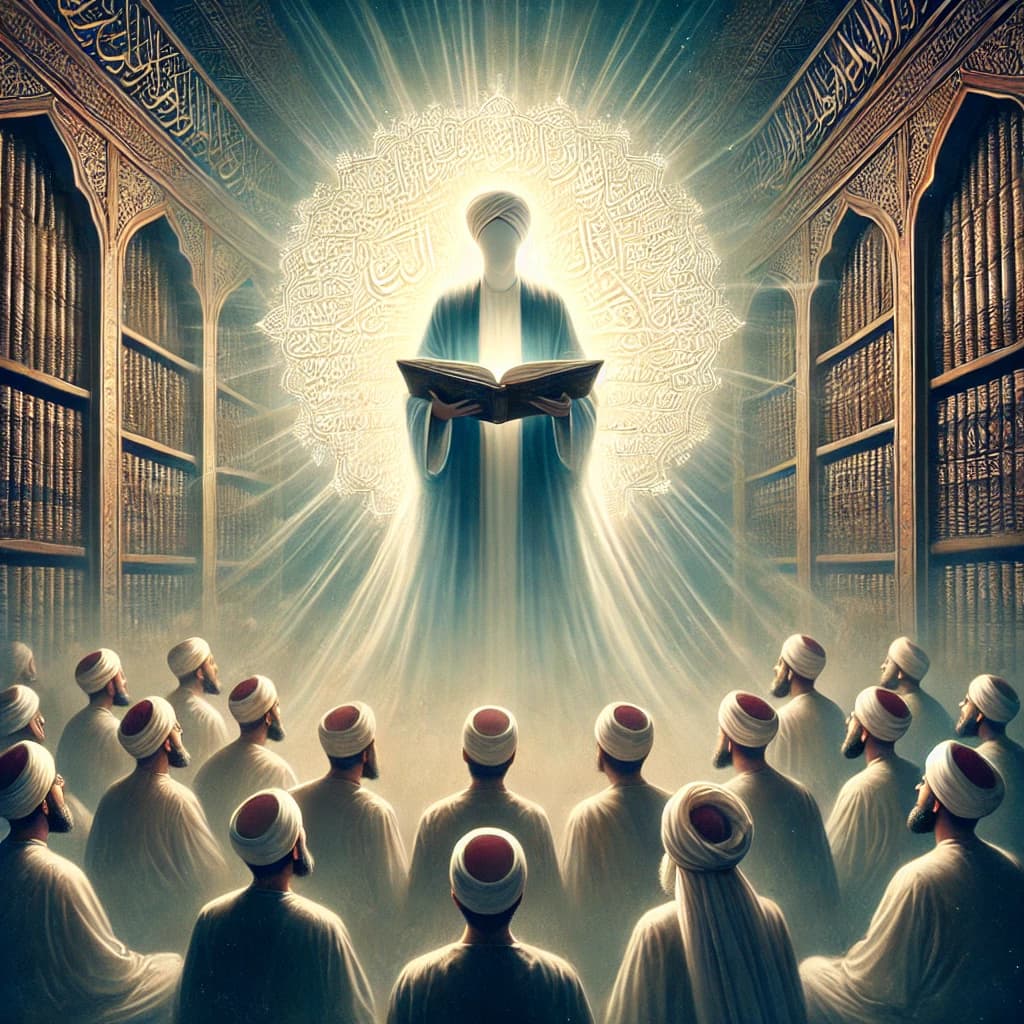
This conceptual image depicts an intellectual contest and irrefutable arguments. On one side, a radiant light represents firm logic and compelling proofs that illuminate the truth. On the other, a fading shadow symbolizes opposing arguments that lose their force before powerful evidence. This visual composition portrays the method of ilzām (binding argument) employed in the book Tashyīd al-Maṭāʿin—a method that confronts opponents with arguments they cannot refute and leaves them unable to respond. The image reminds the audience that truth, even if veiled amid darkness, will always become manifest through proof and reason.
“Binding Argument in Debate: Muhammad Qulī’s Legacy in Tashyīd al-Maṭāʿin”
One of the noteworthy works written in response to theological and historical criticisms in the Islamic sphere is the book Tashyīd al-Maṭāʿin, authored by Janāb Muhammad Qulī, the father of the late Mīr Ḥāmid Ḥusayn. In this regard, his son, Sayyid Iʿjāz Ḥusayn, wrote a book entitled Sayyid Iʿjāz Ḥusayn and discussed Tashyīd al-Maṭāʿin. Sayyid Iʿjāz Ḥusayn describes this book as unparalleled, saying that no work like it has ever existed. In his view, “This book is unique among all similar works, and time has never seen its like.”
One of the prominent features of Tashyīd al-Maṭāʿin is its use of the method of “ilzām” (binding argument). This term means presenting proofs that the opposing side cannot easily reject. In other words, the authors of this book have advanced arguments that challenge the adversary intellectually, leaving them with no answer.
Mīr Ḥāmid Ḥusayn and his father Muhammad Qulī emphasized the principle of ilzām in their works. Ilzām means that their books present documented and solid proofs and arguments that even critics cannot easily reject. Consequently, these books—especially Tashyīd al-Maṭāʿin—are regarded as collections of firm and indisputable arguments.
In describing this work, Sayyid Iʿjāz Ḥusayn states that Tashyīd al-Maṭāʿin contains material to which no other book can respond in such a manner and with such comprehensiveness. This book is not only the “decisive word” (faṣl al-khiṭāb), but is also recognized as the final word on the subjects discussed.
He further adds that some of these descriptions may initially seem exaggerated; however, after carefully examining and studying the book, readers will recognize the greatness and standing of this work. In other words, the book’s true value can be understood only when the reader becomes fully acquainted with its content.
Therefore, Sayyid I'jaz Husayn’s view of the book «Tashīd al-Maṭāʿin» is certainly not mere exaggeration. This book is an unparalleled work in the theological history of Islam which, by employing compelling arguments and firm proofs, has seriously defended Shi‘i beliefs against the criticisms leveled at them and remains an authoritative scholarly reference in this field.
An Analysis of the Necessary Conditions of Imamate and the Concept of Maṭāʿin in Islamic Thought
To correctly understand the concept of «maṭāʿin», one must first address the fundamental principles of imamate in Islamic thought and clarify that this concept goes beyond mere abuse or simple verbal attacks. In fact, «maṭāʿin» refers to profound and serious criticisms directed at religious figures, which may appear in the form of insults and attacks on the personal and spiritual qualities of those figures.
In this context, in order to explain the concept of «maṭāʿin», we must first examine the concept of «imamate» and consider the three basic conditions necessary for accepting a person in this position. From the perspectives of reason and religion, these conditions are as follows:
Infallibility (ʿiṣmah): One of the important conditions for the office of imamate is infallibility. The Imam must be immune from sin and error. This quality enables the Imam to remain free from wrong decisions in every sphere and always to proceed on the path of truth. As one of the fundamental pillars, infallibility causes the Imam to be regarded everywhere as an errorless guide.
Scientific and ethical superiority: The Imam must be superior to others in terms of knowledge and ethics. This superiority includes religious and juridical knowledge, such that he must possess a deeper understanding of religious matters than others; ethically, too, he must be a person who constitutes a complete exemplar of human and religious virtues. This condition specifically emphasizes the selection of a person who is a leader not only in knowledge but also in conduct and morality.
Divine designation: The third necessary condition for the Imamate is divine designation. This condition indicates that the Imam must be appointed by God and that the office of Imamate must be determined divinely rather than by human choice. Therefore, this divine designation grants legitimacy to the Imam and demonstrates the distinction of the Imamate from other offices.
In view of these three conditions, it can be said that «مطاعن» in this context are not merely superficial or minor criticisms; rather, they primarily address the religious, scholarly, ethical, and divine qualities of religious figures and subject them to criticism and examination. Therefore, studying and analyzing this concept, along with attending to the fundamental conditions of the Imamate, helps lead to a more accurate understanding of the objections and criticisms raised in this field.
The Necessity of the Imam’s Infallibility from the Perspectives of Reason and Religion
The infallibility of the Imam is one of the important and fundamental issues in Islamic thought, emphasized from both rational and religious perspectives. To understand why the Imam’s infallibility is necessary, we must first consider the principal purpose behind appointing an Imam and then examine why the Imam must be immune from error and mistake.
The Purpose of Appointing an Imam
The principal purpose of appointing an Imam is to guide society toward God and direct it toward the correct worship of Him. In any society without an Imam, people cannot properly discover the means of worship and God-consciousness. The Imam’s infallibility is necessary in this respect, because the Imam must explain the divine rulings without error or mistake and guide people toward God’s pleasure.
The Rational Necessity of Infallibility
From a rational perspective, the Imam’s infallibility is necessary. For if the Imam were not infallible, he might err in explaining religious rulings and guiding society; consequently, the principal purpose of the Imam’s existence would not be fulfilled. Reason dictates that one appointed to guide people toward God must be infallible and protected from every kind of error, so that people may proceed on the correct path.
Religious and Qur’anic Evidence
In addition to rational necessity, Qur’anic verses and mutawātir traditions also indicate the Imam’s infallibility. The Qur’an explicitly refers to the infallibility of certain individuals and presents this infallibility as a necessary characteristic for those charged with guiding people. Mutawātir traditions transmitted by both Shiʿi and non-Shiʿi sources likewise emphasize the necessity of the Imam’s infallibility.
The Purpose of the Imam’s Existence According to Opponents
Even opponents regard the existence of an Imam as necessary. When the Prophet (peace and blessings be upon him and his family) was martyred, some of the Companions abandoned duties such as performing the funeral prayer over the Prophet in order to attend to his washing, shrouding, and burial. They justified this by the greater importance of the issue of the community’s leadership, such that it can clearly be seen that even for opponents, the existence of an Imam is regarded as an essential and indispensable necessity in Muslim society.
In light of rational and religious proofs, the infallibility of the Imam is of particular importance. Without infallibility, the primary purpose of appointing an Imam—guiding people toward God—will not be fulfilled. Therefore, the Imam’s infallibility is a necessary condition for preserving the soundness and correctness of religious guidance in society.

This image symbolically depicts the concept of the Imam’s infallibility as a mediator between divine guidance and human society. The luminous rope extending from heaven to earth signifies the firm, divine connection that leads people from misguidance toward guidance. The hands reaching out from darkness toward this light express humanity’s need for the infallible Imam in order to find the right path. The brightness of the rope, contrasted with the dark background, emphasizes that only the infallible Imam can convey the truth to people without error or mistake.
The Necessity of Imamate for Preserving Religion and Worship
As is also evident from the viewpoint of opponents, Imamate is a necessary and undeniable matter. One of the important narrations transmitted by opponents states that if a person dies without having pledged allegiance to a caliph, his death is like the death of the Age of Ignorance. This narration, reported among both Sunnis and Shi‘a, explicitly emphasizes the importance of having an Imam and the necessity of knowing the Imam of one’s time. According to this narration: «من مات و لم یعرف امام زمانه مات میتة جاهلیة» (Whoever dies without knowing the Imam of his time has died the death of the Age of Ignorance).
This statement clearly shows that the absence of an Imam and failure to know the Imam mean that members of society are unable to practice religion and worship God. In other words, even if a person performs prayers, fasts, undertakes the pilgrimage, and believes in divine unity, his acts of worship will have no effect if he has not pledged allegiance to the Imam of his time. This view indicates that Imamate and knowledge of the Imam are necessary for the realization of proper worship of God.

This fantasy image depicts a dark and winding path fading away amid mist and shadows. The bright light at the end of the path symbolizes truth and guidance, while the surrounding darkness represents misguidance and bewilderment. The ghosts or silhouettes standing along the path represent people: some are moving toward the light, while others remain lost in darkness. This image beautifully portrays the concept of «the necessity of knowing the Imam of the Age», where, without knowing the Imam, a person remains in the darkness of ignorance and can move toward true guidance only by finding the right path.
The Necessity of the Imam’s Existence for Guidance and Worship
After these explanations, it can clearly be concluded that the Imam’s existence is necessary for preserving religion and for the proper worship of God in society. If there were no Imam, people would not be fully able to perform acts of worship correctly. Therefore, the appointment of an Imam is not merely for political guidance or the establishment of divine legal punishments; rather, it has a far greater and more fundamental purpose. The Imam must exist so that people may worship correctly through the divine proof and attain God’s pleasure.
Accordingly, Imamate is regarded as an essential condition for sound religion and genuine worship in society. Without an infallible Imam and divine proof, people will not be able to properly understand and implement the true religion.
The Necessity of the Imam’s Infallibility for Sound Guidance and the Worship of God
In Islam, worship means performing an act that has been prescribed by God. This act must be carried out according to divine instructions and cannot be determined on the basis of individual desires. To attain correct worship that is pleasing to God, it is necessary that there be an infallible person who can properly explain God’s commands.
Worship Is a Divine and Prescribed Matter
Worship is something that God must determine. Human beings cannot arbitrarily determine the ways of worship. What we perform as worship must accord with God’s commands. Worship is, in a sense, a divine institution, and there is no way to attain correct worship except through an infallible person chosen by God, who introduces the proper manner and method of worship.
The Necessity of the Existence of an Infallible Imam
The realization of correct worship requires an infallible Imam. The infallible Imam is one who, after the Prophet of Islam, bears the responsibility of conveying divine commands to the people. The Imam must guide correctly and without error, so that people may know what is pleasing to God and how they should worship.
The Importance of the Imam’s Infallibility in Realizing Divine Aims
If the Imam is not infallible, the possibility of error in transmitting or implementing divine commands will exist. If the Imam makes a mistake in carrying out his duties, suffers from forgetfulness, or even deliberately lies, this will lead to deviation from the correct path of worship and religious practice. Therefore, the Imam’s infallibility is necessary so that divine aims may be fully secured and people may be guided correctly.
The Imam’s Duties in Establishing Religious Punishments and Defending Islam
Some believe that the Imam need only carry out duties such as establishing religious punishments, defending Muslims, and forming an army. This view, however, is incorrect, because even the establishment of religious punishments must be carried out in accordance with divine instructions. The infallible Imam must possess complete knowledge of all the Prophet’s instructions and make no error whatsoever in implementing them. Otherwise, the purpose of appointing the Imam will be undermined.

A surreal-style image depicts a dark, winding road stretching through a misty and eerie atmosphere. In the distance, a mysterious, radiant light can be seen, drawing the path toward itself. Vague, formless shadows are scattered along the sides of the road—some moving toward the light, while others are trapped in darkness and unawareness. This scene symbolically portrays the contrast between knowledge and ignorance, guidance and bewilderment, conveying a profound meaning about the necessity of recognizing the Imam and avoiding ignorance.
Conclusion: The Infallibility of the Imam Is a Necessary Condition for Divine Guidance
Ultimately, for divine purposes to be realized and for people to be properly guided toward correct worship, an infallible Imam must exist. The Imam’s infallibility is a necessary condition; without it, divine instructions will not be transmitted correctly and the purpose of appointing the Imam will not be fully fulfilled. Therefore, the Imam’s infallibility is necessary for the continuation of divine guidance in society.
The book «Tashyīd al-Maṭāʿin», authored by Muhammad Qulī and his son Mīr Ḥāmid Ḥusayn, is an outstanding work in defense of Shiite beliefs and in response to theological and historical criticisms. Using the method of «ilzām», meaning the presentation of arguments that opponents are unable to refute, the book scientifically challenges the criticisms raised against Shiite doctrines. Sayyid Iʿjāz Ḥusayn, the son of Mīr Ḥāmid Ḥusayn, introduced this work as an unparalleled source in the field of theology, asserting that no comparable book can respond so comprehensively to the criticisms raised.
The infallibility of the Imam, as a necessary condition in Islamic thought, is a fundamental subject in this work. Based on rational and religious proofs, the Imam’s infallibility is necessary for the correct transmission of divine instructions and for guiding society toward God. Since this characteristic of the Imam protects him from mistakes and errors, it ensures that religious rulings are conveyed correctly to the people and that they are able to worship properly and realize divine aims. Therefore, from the Islamic perspective, the presence of an infallible Imam in society is necessary for religious guidance and for preserving the soundness of acts of worship.
Ultimately, the analysis of this work shows that the necessity of the Imam’s infallibility and the correct explanation of divine instructions by the infallible Imam are of particular importance for preserving religious guidance and realizing proper worship in society; this characteristic is necessary for securing divine aims in society.
Article text in English
Author: Hamed Sarem
Related articles

Comments
No comments yet.

