Strengthening the Critiques: A Scholarly Analysis Refuting the Claim of the Legitimacy of the First Caliphs (7) (Imam Hasan, peace be upon him, pulling Abu Bakr down)
Author: Hamed Sarem
In Islamic history, the objections of the Ahl al-Bayt, peace be upon them, to the legitimacy of Abu Bakr’s caliphate have been among the most prominent and contentious subjects. One of the most important and explicit of these objections was Imam Hasan’s, peace be upon him, act of pulling Abu Bakr down from the Prophet’s pulpit, blessings and peace be upon him and his family. This act not only demonstrates an open objection to his caliphate, but also testifies to Imam Hasan’s scholarly and religious character, for even in childhood he possessed a profound understanding of the rightful nature of the caliphate.
Abstract
This article critically examines the approach of Abd al-Aziz Dehlavi in the book Tuhfa-yi Ithna Ashariyya, in which he attempts to limit the number of objections raised against Abu Bakr—especially by the Shi‘a—to approximately ten or fifteen cases. Dehlavi’s purpose in making this claim is to diminish the importance of the Shi‘a’s historical and religious objections. In response, the late Sayyid Muhammad-Quli, may God have mercy on him, adopts a scholarly, documented approach, regarding this numerical restriction as unjustified not only from a rational perspective but also from an inductive one, and stressing the need for unvarnished criticism in history. This article also examines the first objection to Abu Bakr’s caliphate and critiques Abd al-Aziz Dehlavi’s response in the book «تحفه اثناعشریه». The objection in question concerns Imam Hasan’s and Imam Husayn’s, peace be upon them, protest against Abu Bakr’s sitting on the Prophet’s pulpit, blessings and peace be upon him and his family, and explicitly challenges the legitimacy of his caliphate. This objection, issued by two important and trusted figures, challenges the standing of Abu Bakr’s caliphate and is presented as one of the fundamental issues of Islamic history. Dehlavi seeks to neutralize this objection by arguing that the words of Imam Hasan and Imam Husayn in childhood lack authority. By contrast, the late Sayyid Muhammad-Quli, citing reliable and widely transmitted historical and religious sources, emphasizes that none of the sayings and actions of the infallible Imams, even in childhood, is devoid of authority, and that the objection of Imam Hasan and Imam Husayn, peace be upon them, must be taken seriously as a valid critique. Ultimately, this study stresses the importance of recognizing and validating historical objections when examining the legitimacy of Islam’s early caliphates and the rational and scholarly understanding of the Imams of the Ahl al-Bayt, peace be upon them.
Keywords: objection of Imam Hasan and Imam Husayn; Tashyid al-Mata‘in; Tuhfa-yi Ithna Ashariyya; legitimacy of the caliphate; objections to Abu Bakr; infallibility of the Imams; Sunni and Shi‘a historical books; teachings of the Ahl al-Bayt; the knowledge and reason of Imam Hasan and Imam Husayn; critique of the caliphate in Islamic history; Shi‘a and Sunnis; response to Dehlavi’s doubts.
In Islamic history, the question of the caliphate and its legitimacy has always been among the most important subjects of discussion and dispute. One objection, especially raised by the Shi‘a concerning Abu Bakr’s caliphate, addresses the legitimacy of this caliphate in relation to حضرت علی علیهالسلام and the Ahl al-Bayt of the Prophet, blessings and peace be upon him and his family. In this regard, the objection of Imam Hasan and Imam Husayn, peace be upon them, to Abu Bakr’s caliphate—particularly raised in the incident of the Messenger of God’s pulpit, blessings and peace be upon him and his family—has been presented as one of the turning points in the history of critiques of the first three caliphates.
The present article is based on an analysis and interpretation of the book «تشیید المطاعن», in which certain objections and historical critiques concerning Abu Bakr’s caliphate and various responses to them are examined. In this writing, the objection of Imam Hasan and Imam Husayn, peace be upon them, to Abu Bakr’s caliphate is specifically analyzed within the framework of this book. The purpose of this article is to examine the various dimensions of these objections, the different reactions to them, and the diverse theological and historical analyses mentioned in the book «تشیید المطاعن».
These examinations not only address criticism of the legitimacy of Abu Bakr’s caliphate, but also consider the role of the status of the Prophet’s Household (Ahl al-Bayt) and Islamic teachings in these critiques and objections. Accordingly, by drawing on various religious and historical sources, an effort will be made to assess the validity and effects of these objections in a scholarly and documented manner.
An Analysis of the Restriction of Criticisms of Abu Bakr in Tuhfa-yi Ithnā ‘Ashariyya: A Shi‘i Scholarly Critique of Dihlawī’s Claim
One of the prominent approaches found in ‘Abd al-‘Azīz Dihlawī’s book Tuhfa-yi Ithnā ‘Ashariyya is his effort to reduce and limit the number of criticisms directed at the first caliphs, especially the first caliph, Abu Bakr. In this work, Dihlawī claims that the criticisms of Abu Bakr do not exceed ten or fifteen cases, thereby attempting to portray these critiques as limited and insignificant. This claim, which apparently seeks to lessen the force of the criticisms made against Abu Bakr, in fact not only raises suspicions of intellectual laxity, but also clearly aims to depict the volume of Shi‘i historical and religious objections as baseless and ultimately unimportant. Yet this attempt to reduce the criticisms—or, more precisely, to reduce the evidence for Abu Bakr’s lack of qualification for the caliphate—is itself a kind of admission that the existing historical reports are evidence of Abu Bakr’s unfitness for the caliphate. More precisely, every criticism raised is firm evidence that Abu Bakr was a usurper.
In response to this claim, the late Muhammad Qulī (may God have mercy on him), replying to Dihlawī, offers a scholarly and reasoned critique of this theory and maintains that such numerical restriction is acceptable neither rationally nor inductively. Addressing the matter scientifically, he says: “Restricting the criticisms of Abu Bakr to fifteen cases is not only incorrect from a rational perspective, but reliance on such statistics through induction also lacks a scholarly basis.” This statement clearly shows that limiting historical criticism to a specific number is not only outside the framework of scholarly logic, but is in practice contrary to the principles of historical and academic criticism.
Such a critique can more precisely clarify that reason cannot affirm that every historical figure is subject to only a specified number of criticisms and reproaches. In the field of history and biographical criticism, there is in principle no precise criterion for setting a fixed ceiling on criticism, unless such a view has been broadly and unanimously accepted by authoritative and primary historiographical sources. In this particular case, not only does no such consensus exist, but many Shi‘i scholars have explicitly declared that the criticisms of Abu Bakr are more numerous than those mentioned in concise works.
For example, the great Shi‘i scholar Muhammad Bāqir Majlisī (may God have mercy on him), in his well-known work Ḥaqq al-Yaqīn, explicitly writes, while referring to the criticisms of Abu Bakr: “The first subject concerns the criticisms of Abu Bakr; they are numerous, and in this treatise we suffice with a few.” This sentence clearly indicates that the subject of the criticisms of Abu Bakr is broader than can be restricted to one or several cases, and that only part of them has been mentioned merely for the sake of brevity.
Consequently, Dihlawī’s claim in Tuhfa-yi Ithnā ‘Ashariyya that the criticisms of Abu Bakr are limited to 10 or 15 cases lacks scholarly credibility on several grounds. First, rationally, there is no logical criterion for proving or setting a numerical ceiling for historical criticism. Second, inductively and textually, Shi‘i scholars have repeatedly stated that their criticisms have never been limited to particular cases. These critiques have been continually transmitted, especially in various books and across different periods.
These extensive critiques, especially in past centuries, have often arisen in response to efforts to exonerate historical figures and reduce their historical responsibilities. The broad volume of Shi‘i objections and criticisms, particularly concerning figures such as Abu Bakr, is far greater than what Dihlawī refers to in his book.
Accordingly, it may be said that the approach of Shiʿi scholars in this regard, unlike that of al-Dihlawī, is not only devoid of any attempt to conceal historical weaknesses; rather, it seriously seeks to open the way for candid and scholarly criticism of history. Shiʿi scholars have explicitly stated that historical criticism is by no means limited to a specific number, and that, because of the abundance of criticisms and objections concerning Abū Bakr, each theologian or traditionist has transmitted a portion of them.
This criticism stands in direct opposition to al-Dihlawī’s approach, which seeks, by reducing the instances of criticism and restricting them to a small number, to portray the objections raised against historical figures—especially concerning the first caliphs—as insignificant and unfounded. Shiʿi scholars in this field insist on a comprehensive and unrestricted approach that is consistent both rationally and textually.
Misleading the Reader in Other Parts of Tuḥfa-yi Ithnā ʿAshariyya
ʿAbd al-ʿAzīz al-Dihlawī’s criticisms in Tuḥfa-yi Ithnā ʿAshariyya are not confined to the objections concerning Abū Bakr; rather, this deceptive method is repeated in other chapters of the book as well. One of the fundamental weaknesses of this work is its deliberate and intentional selectivity in choosing subjects and omitting important parts of the scholarly evidence. This approach not only diminishes the book’s scholarly value, but also significantly violates intellectual integrity in scholarly criticism.
For example, in the seventh chapter of the book, which addresses criticism of the doctrine of Imamate, al-Dihlawī does not transmit any of the principal and fundamental Shiʿi proofs for establishing the Imamate. This deliberate and selective act causes the reader wrongly to conclude that Shiʿi proofs for the Imamate are weak and incomplete. In another part of the book, in the discussion of infallibility, al-Dihlawī does not mention any of the Qurʾanic verses or traditions cited by the Shiʿa to establish infallibility. This kind of manipulation in transmitting and presenting material—especially when he is acting as a defender of the caliphs—clearly shows that al-Dihlawī seeks, by omitting parts of the truth, to restrict the field of criticism and offer only controlled answers. It also indicates the major reality that the school of the caliphs cannot be defended by sound methods and scholarly reasoning.
This method is not only scholastically objectionable, but is also ethically questionable. The deliberate omission of facts and information in order to avoid entering more complex discussions and responding to scholarly objections clearly demonstrates weakness in the capacity to answer. By doing this, al-Dihlawī is in fact making an indirect admission of his inability to answer all objections raised against the first caliphs, or an admission that the legitimacy of the first three caliphs is indefensible.
This deceptive method in Tuḥfa-yi Ithnā ʿAshariyya may be regarded as a major flaw in its scholarly approach and historical criticism, because:
1. Al-Dihlawī does not adopt a comprehensive approach and, instead of examining issues fully and impartially, has only selected and presented particular materials. 2. Scholarly integrity has not been observed in presenting and analyzing the discussions, and many important points have been deliberately omitted. 3. The principles of debate and scholarly dialogue have been violated in this work, because only selective and incomplete answers have been given for every major claim.
Ultimately, these critiques and analyses by Muhammad Quli (may God have mercy on him) are not merely a scholarly and documented response to the historical distortions in Dehlawi’s work; they may also be regarded as part of the legacy of Shi‘i scholarly critique in the face of historical distortions in past centuries. The Shi‘i scholarly approach in this field has always rested on comprehensiveness, trustworthiness, and adherence to the principles of debate, whereas Dehlawi’s approach clearly disregarded these principles and sought to offer incomplete and controlled answers by manipulating the facts.
The First Objection to Abu Bakr’s Caliphate and Dehlawi’s Response in Tuhfa-yi Ithna ‘Ashariyya
At the beginning of the section on objections in the book Tuhfa-yi Ithna ‘Ashariyya, ‘Abd al-‘Aziz Dehlawi responds to one of the objections raised by the Shi‘a against Abu Bakr’s caliphate. This objection implies the negation of the legitimacy of Abu Bakr’s caliphate. Although the objection appears simple, it carries a weighty meaning that ultimately entails profound historical and religious consequences. It is not merely presented as a criticism of Abu Bakr; rather, it explicitly challenges the legitimacy of the caliphate and the historical course of the three caliphates.
Narration of the First Objection
According to what has been reported in Sunni sources, one day Abu Bakr was seated on the pulpit of the Noble Prophet, peace and blessings be upon him and his family, in order to deliver a sermon. At that moment, Imam Hasan and Imam Husayn, peace be upon them, came toward him and addressed him, saying:
«Yā Abā Bakr, descend from the pulpit of our grandfather!» “O Abu Bakr, come down from the pulpit of our grandfather!”
This statement, uttered by the two infallible Imams and the sons of ‘Ali and Fatima, peace be upon them, indicates—more deeply than appears on the surface—a serious challenge to Abu Bakr’s legitimacy. At that time, the pulpit was a symbol of caliphate and religious authority, and Imam Hasan and Imam Husayn’s request that Abu Bakr descend from the pulpit was, in fact, a challenge to his position as caliph of the Muslims. This objection becomes all the more serious and sensitive when it is uttered by the grandsons of the Noble Prophet, peace and blessings be upon him and his family, Imam Hasan and Imam Husayn.
A point that must be noted is that, in Islamic history, the status of Imam Hasan and Imam Husayn as the two Sayyids of the youth of Paradise (the two chosen youths of the people of Paradise) is so exalted and indisputable that their words cannot be ignored under any circumstances. By making such a statement concerning Abu Bakr’s caliphate, the two Sayyids of the youth of Paradise convey a clear message that cannot be considered simple or insignificant. This statement plainly points to the concept of the usurpation of the caliphate, for only those who truly deserve the caliphate may assume the Prophet’s religious and social positions. This hadith is among the mutawatir hadiths, transmitted from the Prophet, peace be upon him and his family, by 19 Companions and 24 Successors. Given the large number of narrators from different generations, the possibility of collusion and agreement upon a lie in this hadith is unlikely. Therefore, according to the well-known Sunni view, this hadith is mutawatir. In addition, many Sunni scholars have explicitly affirmed the tawatur of this hadith, including al-Suyuti and al-Albani, who regarded it as mutawatir. Other prominent Sunni scholars, such as al-Hakim al-Nishapuri and Ibn ‘Abd al-Barr, have also acknowledged the soundness and various aspects of this hadith. This hadith has been widely used by Sunni scholars in introducing Imam Hasan and Imam Husayn, peace be upon them, as «the Sayyids of the youth of Paradise».
For example, Abu Nuʿaym al-Isfahani writes in the book «Ḥilyat al-Awliyāʾ» concerning Imam Hasan, peace be upon him: «الحسن بن علي بن أبي طالب الحسن بن علي بن أبي طالب بن عبد المطلب بن هاشم، أبو محمد سيد شباب أهل الجنة» (Hasan ibn Ali, son of Ali ibn Abi Talib and Fatimah al-Zahra, Abu Muhammad, is the master of the youths of Paradise). A similar statement has also appeared in other sources, including Ibn ʿAsakir’s History of Damascus, Ibn al-Athir’s Usd al-Ghabah, al-Mizzi’s Tahdhib al-Kamal, al-Dhahabi’s Siyar Aʿlam al-Nubalaʾ, and Ibn Hajar al-ʿAsqalani’s Tahdhib al-Tahdhib; all of them emphasize the primacy of Imam Hasan and Imam Husayn, peace be upon them, among the youths of Paradise.
It is highly important that this is a noble prophetic narration; that is, all of his words and deeds are true, and there is not the slightest falsehood or error in his speech.
ʿAbd al-ʿAziz al-Dihlawi’s Response
In the book Tuḥfah Ithnā ʿAshariyyah, ʿAbd al-ʿAziz al-Dihlawi attempts to render the criticism raised against Abu Bakr ineffective and to strip it of its theological and religious content. Al-Dihlawi’s responses to this criticism—especially his effort to weaken the credibility and probative force of this narration—are advanced chiefly to reduce its psychological and political impact. He seeks to show that this objection was voiced only by a child and therefore cannot in any way mean that Abu Bakr lacked merit or legitimacy. In fact, al-Dihlawi openly and explicitly disregards the hadith «سيدا شباب اهل الجنة». This hadith is only one of many narrations that portray, in the words of the Prophet, peace and blessings be upon him and his family, the virtues and special status of Imam Hasan and Imam Husayn, peace be upon them.
He also attempts, by focusing on peripheral matters, to downplay the main event. In al-Dihlawi’s view, since this statement was made by two children, it cannot be interpreted as a serious challenge to the legitimacy of Abu Bakr’s caliphate. In other words, he seeks to characterize this criticism merely as an ineffective and superficial act, with no significant historical or religious consequences.
Sayyid Muhammad Quli’s Scholarly Critique of al-Dihlawi’s Efforts: A Documented and Authoritative Examination of Imam Hasan and Imam Husayn’s Objection to Abu Bakr’s Caliphate
In contrast to al-Dihlawi’s efforts, the late Sayyid Muhammad Quli (may God have mercy on him), in a precise and documented critique, carefully examines all of al-Dihlawi’s responses and answers them independently and academically. He first cites al-Dihlawi’s entire statement and then addresses it methodically, sentence by sentence. This method of examination demonstrates a scholarly and fair-minded approach that makes no attempt to oversimplify or reduce the issue.
In his critique, Sayyid Muhammad Quli, citing reliable historical and religious sources, shows that the aforementioned narration has been recorded not only in Sunni sources but also in many authoritative historical books, and therefore cannot be ignored. He demonstrates with documentation that this narration also appears in the sources of opponents, which in turn reinforces its credibility. Consequently, through a logical and scholarly analysis of these sources, Sayyid Muhammad Quli establishes that the words of Imam Hasan and Imam Husayn must be considered not only a reliable historical narration, but also decisive and religious proof that Abu Bakr’s caliphate was usurped. He emphasizes that this criticism, issued by the Prophet’s grandsons, is not a superficial or childish matter; rather, it must be taken seriously in historical and religious analyses. The late Sayyid Muhammad Quli (may God have mercy on him), in a comprehensive and documented critique, carefully examines all of al-Dihlawi’s responses and answers each part. This critique establishes the authenticity and credibility of the narration by citing diverse, reliable sources and, through reference to the sources of opponents, establishes the validity of this criticism.
Multiple Sources for This Criticism in Islamic Works
Shi'a Sources
One of the most important and authoritative Shi'a sources that explicitly mentions this criticism is al-Muhaqqiq al-Tusi in his book Tajrid al-I'tiqad. He clearly states that Imam Hasan and Imam Husayn, peace be upon them, rejected Abu Bakr's caliphate, and that this criticism was raised as a serious objection. Tajrid al-I'tiqad states:
“The two Hasans objected to him when allegiance was pledged to him.”
This report shows that the rejection of Abu Bakr's caliphate by Imam Hasan and Imam Husayn was not merely a religious objection, but a profound religious act confronting the legitimacy of his caliphate.
Sunni Sources
This criticism is not found only in Shi'a sources; the event has also been recorded in authoritative Sunni works. Ibn Hajar al-Haytami, in al-Sawa'iq al-Muhriqah, narrates from al-Daraqutni that Imam Hasan, peace be upon him, said to Abu Bakr when he was sitting on the pulpit of the Messenger of God, peace and blessings be upon him and his family:
“Step down from my father’s seat.”
In response to Imam Hasan, Abu Bakr said: “By God, you have spoken the truth; this is your father’s place, not mine!” Then he embraced Imam Hasan and wept.
This narration indicates Abu Bakr’s acceptance of the challenge that the position of the caliphate in fact belonged to the father of Imam Hasan and Imam Husayn, namely Imam Ali (a).
Al-Suyuti and Other Sunni Sources
Al-Suyuti, too, in his book Tarikh al-Khulafa’, relates a similar narration from Abu Nu‘aym and ‘Abd al-Rahman al-Isfahani, which clearly confirms this incident. These sources also state that Imam Hasan directly objected to Abu Bakr and demanded that he come down from the pulpit.
Kanz al-‘Ummal and Other Sources
Likewise, Kanz al-‘Ummal confirms this incident and mentions it alongside other reliable sources. The convergence of various sources, including Sunni and Shi‘a sources, indicates the importance and authenticity of this narration.
Al-Majlisi (may God have mercy on him) and Reports from Opposing Books
This incident has also been reported in detail in Shi‘a books. Al-Majlisi (may God have mercy on him), in Bihar al-Anwar, reports this event with full precision, citing Fada’il al-Sam‘ani, Sa‘adat Tarikh al-Khatib, and also Riyad al-Nadrah by Muhibb al-Din. These reports have likewise been recorded in detail in other historical and religious books, demonstrating the fame and credibility of this incident in various sources.
The Historical Authenticity of Imam Hasan and Imam Husayn’s Objection to Abu Bakr’s Caliphate
The multiplicity of sources and the renown of this report leave no room for doubt regarding its historical authenticity. In terms of both chain of transmission and content, this objection is considered one of the most serious and fundamental critiques of the legitimacy of Abu Bakr’s caliphate. What might initially appear to be a simple objection has in fact been comprehensively and documentedly recorded in various Islamic sources, becoming one of the historical turning points in examining the legitimacy of the caliphate. Citing numerous Sunni and Shiʿi sources, this shows that the objection was not raised merely by one particular group, but has been presented throughout Islamic history as a serious and important critique. It should not be overlooked that Dehlawi, in refuting this objection, did not cast any doubt on the credibility of the report and accepted the narration itself. In fact, his effort was focused more on showing that this hadith does not indicate the usurpation of Abu Bakr’s caliphate.
When Silence Is a Confession
In this narration, Abu Bakr not only does not defend himself, but clearly confirms the words of Imam Hasan, peace be upon him. He states with complete frankness:
“You have spoken the truth; it is your father’s seat, not my father’s seat.”
This statement is, in fact, a kind of confession that his caliphate lacked legitimacy. Abu Bakr explicitly acknowledges that the position of the caliphate truly belonged to the father of Imam Hasan, Imam Ali, peace be upon him, rather than to himself. This admission by one who regarded himself as the caliph of the Muslims clearly shows that inwardly he was aware of the legitimacy of his own caliphate.
Yet what makes this event more significant than any reaction is Abu Bakr’s weeping at its conclusion. This weeping not only expresses his feeling of weakness and remorse, but also indicates his inner awareness that the caliphal position he occupied was improper. This silence and this reaction of Abu Bakr show that he himself knew well that the caliphate did not legitimately belong to him.
Even if Abu Bakr had given a harsh response to this objection and displayed an aggressive reaction, this criticism would still have retained its force, because Imam Hasan’s objection—as the Prophet’s grandson and the master of the youths of Paradise—could in no way be considered insignificant or baseless. Therefore, Abu Bakr’s silence and acceptance in the face of Imam Hasan’s objection only mean a further confirmation of this criticism of the legitimacy of his caliphate.
Alongside this, the explicit statement of the Commander of the Faithful, Ali, peace be upon him, who said:
“It was not by my opinion.”
(I did not send Imam Hasan for this matter.)
also clearly shows that this action arose from Imam Hasan’s own direct judgment, peace be upon him, and was not merely the execution of an order from his father. This point is of great importance, for it shows that this act was not merely a symbolic protest; rather, it was an independent and conscious protest by the Master of the Youth of Paradise, who undertook it with full awareness of the historical and political condition of Islamic society.
Therefore, contrary to Abdulaziz Dehlawi’s attempts to downplay this event and diminish its significance, the extensive and numerous transmission of this reproach in the sources of the two groups (Ahl al-Sunnah and Shi‘a), together with the explicit statements of key figures such as Imam Hasan, peace be upon him, and Imam Ali, peace be upon him, has turned this event into one of the foundational reproaches against the legitimacy of Abu Bakr’s caliphate. This reproach was issued not merely by a political opponent, but by the beloved descendants of the Prophet—Imam Hasan and Imam Husayn, peace be upon them—so it cannot possibly be ignored or lightly passed over.
The attempt to render this reproach ineffective not only does not lessen its gravity, but increases its force. For these attempts show that no logical or historical answer exists for this protest, and that it can only be bypassed through unsupported justifications, evasion of the reports, and begging the question. This itself indirectly adds to the credibility and weight of this reproach and shows that this protest remains one of the fundamental and unanswered critiques in the criticism of the first three caliphs.
Examining Dehlawi’s First Response to the Pulpit Reproach and Its Scholarly Critique from the Imami Perspective
In addressing the first reproach raised concerning the incident of Abu Bakr sitting on the pulpit of the Messenger of God, peace and blessings be upon him and his family, and the protest of Imam Hasan and Imam Husayn, peace be upon them, Abdulaziz Dehlawi raises one of his initial objections by emphasizing Imam Hasan al-Mujtaba’s childhood, peace be upon him. He asks rhetorically: are the statements and actions issued by these two noble figures during childhood and minority considered authoritative according to the Shi‘a, and do legal rulings apply to them or not?
In this statement, Dehlawi seeks, in view of the young age of Imam Hasan and Imam Husayn, peace be upon them, at the time of that event, to raise the question of whether Shiʿa regard their words and conduct as authoritative and citable. From this perspective, he attempts to cast the validity of this objection entirely into doubt and to portray it as a childish, baseless, and unworthy remark. Dehlawi tries to show that this criticism is not valid even from the Shiʿi point of view, let alone being acceptable in the view of Ahl al-Sunnah.
Sayyid Muhammad Quli’s Critique of Dehlawi’s Ignorance of Imami Principles Concerning the Authority of the Sayings of Imam Hasan and Imam Husayn
The late Sayyid Muhammad Quli (may God have mercy on him), in a clear and fundamental critique, considers Dehlawi’s objection to arise from his ignorance of the definitive beliefs of the Imami school, and writes in refutation of it:
“This doubt and questioning regarding the authority of the sayings and actions of Imam Hasan and Imam Husayn, peace be upon them, is clear evidence of Dehlawi’s ignorance of the beliefs of the Imami school.”
Sayyid Muhammad Quli emphasizes that, in Shiʿi thought, the established and consensual principle is that none of the actions or sayings of the Twelve Imams, peace be upon them, from the beginning of their lives to the end of them, has been or will be contrary to infallibility and purity. Therefore, young age or childhood is never considered an obstacle to the validity and probative authority of their words and actions. In other words, even during childhood, the infallible Imams are protected, by virtue of their divine infallibility, from every kind of mistake, error, and corruption; this is unanimously accepted among the Shiʿa. This principle is so self-evident in Shiʿi sources that Sayyid Muhammad Quli implicitly states that, for anyone who has undertaken even a little investigation in the theological and hadith books of this school, it will be “clearer than the sun and more perceptible than the touch of the hand.” In fact, the question of whether the words of Imam Hasan and Imam Husayn, peace be upon them, are authoritative during childhood is not merely incorrect; it is fundamentally contrary to the accepted principles of the Imami school. This school explicitly rests on the belief that all actions and sayings of the Imams, peace be upon them, at every age—especially in childhood—are endowed with infallibility and are always free from every kind of human mistake or error. Even in the view of opponents, according to the hadith «سیدی شباب اهل الجنه», all of their sayings and actions are authoritative. Therefore, Dehlawi’s objection in raising this question, besides revealing his ignorance of the foundational principles of the Imami school, indicates that he did not possess sufficient command even of the elementary doctrinal foundations of Shiʿism. Yet this matter is entirely clear and self-evident in authoritative Shiʿi sources, including theological and hadith books. Such questions, which are fundamentally contrary to the indisputable and consensual principles of Shiʿism, not only weaken Dehlawi’s arguments but also reveal his scholarly deficiency in correctly understanding and analyzing theological and religious discussions.
The Secret of Intellectual Maturity in Religion: Why Understanding the Principles of Religion Transcends Age
Sayyid Muhammad Quli (may God have mercy on him) points to a subtle and highly precise point that has received less attention in theological literature, yet plays a key role in this discussion. He says:
“Maturity is the criterion for legal obligation in subsidiary matters, not in matters of fundamental principles.”
In other words, Sayyid Muhammad-Quli wishes to say here that although the age of puberty is recognized as the criterion for the beginning of the obligation of practical rulings such as prayer, fasting, zakat, and pilgrimage, the situation is different with respect to the principles of religion. Knowledge of the principles of religion—upon which, in particular, a person’s faith and eternal salvation depend—is not confined merely to chronological puberty; rather, this knowledge must arise through the attainment of reason and a person’s independent understanding. Put more simply, puberty is an indicator for the beginning of practical duties, whereas the principles of religion and faith in them require rational comprehension and awareness, which are realized at different ages after one reaches intellectual understanding.
This precise distinction between principles and branches teaches us that:
Subsidiary matters (the rulings of the Sharia): After legal puberty, practical duties such as prayer, fasting, zakat, and pilgrimage become obligatory for a person, and these acts must be performed in accordance with the Sharia’s instructions after puberty. Fundamental matters (Divine Unity, Prophethood, Imamate): As soon as reason and independent understanding are attained, the duty to know and believe in them becomes established, not necessarily with chronological puberty. In other words, to know the principles of religion, a person must have attained the necessary understanding and awareness; this goes beyond physical puberty and depends on the individual’s intellectual and mental development.
This distinction between principles and branches is an issue that holds a special place in the Imami school. According to it, a person’s rational and intellectual understanding takes precedence over physical puberty for knowing the principles of religion. This point is significant because knowledge of the principles of religion—which is directly connected to one’s eternal salvation—is possible only through individual rational understanding and awareness, not merely on the basis of age or physical puberty.
The Criterion of Rational Understanding and the Exceptional Intellect of the Two Imams
In the continuation of his arguments, the late Sayyid Muhammad-Quli (may God have mercy on him) points to a highly important and pivotal matter, the understanding of which is necessary for grasping the depth of the issue. He says:
“In Imam Hasan and Imam Husayn, peace be upon them, complete intellect had certainly been attained even in their childhood years.”
This claim is clear and indisputable not only from a doctrinal perspective, but also on the basis of reliable reports. Therefore, statements issued by these two masters of the people of Paradise on matters such as the caliphate and legitimacy are not only neither futile nor childish; their probative authority surpasses even that of all mature elders. In truth, Imam Hasan and Imam Husayn, peace be upon them, possessed from the very beginning complete intellect and qualifications that are not attained by other human beings, let alone by those who are young in age.
Indeed, when we speak of an issue such as Imamate as one of the principles of religion—upon which faith and eternal salvation depend—then naturally, any position expressed by those endowed with complete intellect, even at a young age, is entirely valid and authoritative. This rational awareness and profound understanding expressed by Imam Hasan and Imam Husayn, peace be upon them, are in no way comparable to those who attained complete intellect merely through advancing age and physical maturity. It should also be noted that, from the Sunni perspective as well, the issue of the caliphate holds such a status that opposition to it is regarded as disbelief.
Ultimately, Dehlawi’s objection concerning “young age and the invalidity of the statements of Imam Hasan and Imam Husayn, peace be upon them,” is not only incompatible with Shi‘i doctrinal foundations, but also conflicts with historical realities and numerous pieces of evidence. By the admission of both parties—Shi‘a and Sunnis—Imam Hasan and Imam Husayn, peace be upon them, possessed outstanding qualities from childhood, such as knowledge, discernment, eloquence, and understanding. These qualities caused their words, even at a young age, to possess complete authority in divine discourse and on the path of guidance.
For this reason, the criticism issued by these two infallible Imams not only does not lose its effect, but has been recorded in history as an important document rejecting the legitimacy of Abu Bakr’s caliphate. This criticism has been reflected in numerous Shi‘i and Sunni sources and, from that time to the present, has been recognized as one of the prominent points in the critique of the legitimacy of Abu Bakr’s caliphate.
Sayyid Muhammad-Quli’s Citation of Sahih al-Bukhari to Establish the Authoritativeness of Imam Hasan’s Words During Childhood
In continuing his response to Dehlawi’s objection concerning Imam Hasan’s young age in the incident of the pulpit criticism, the late Sayyid Muhammad-Quli, may God have mercy on him, cites Sunni sources to establish Imam Hasan’s intellectual maturity, in order to show that even in the view of opponents, Imam Hasan, peace be upon him, was not an ordinary child; rather, he possessed elevated understanding and awareness.
One of his key evidences is a well-known narration from Sahih al-Bukhari, a book regarded by Sunnis as the most authentic book of hadith after the Qur’an. The narration states:
“He said: Al-Hasan ibn ‘Ali, peace be upon them, took a date from the charity dates and put it in his mouth. The Prophet, blessings and peace be upon him and his family, said: ‘Kakh, kakh!’ Then he said: ‘Did you not know that we do not eat charity?’” (Bukhari, Book of Zakat)
Translation of the narration: Imam Hasan, peace be upon him, took a date from the charity dates and placed it in his mouth. The Prophet, blessings and peace be upon him and his family, said to him: “Kakh, kakh!” (that is, “Take it out!”) He then added: “Do you not know that we do not eat charity?”
Analysis of the Narration: An Indication of Imam Hasan’s Awareness and Capacity for Understanding
This narration, apart from its juridical status concerning the prohibition of charity for the Ahl al-Bayt, clearly indicates Imam Hasan’s understanding and perception even in his childhood. Why?
The Prophet, peace and blessings be upon him and his family, addresses Imam Hasan, peace be upon him, in the language used with people of reason: “Do you not know…?” This manner of address shows that the child in question was capable of understanding religious concepts and rulings. Had the Prophet, peace and blessings be upon him and his family, known that Imam Hasan, peace be upon him, was unable at that age to grasp this point, he would not have spoken in this manner or expressed such reproach.
Therefore, this narration itself testifies to Imam Hasan’s lofty understanding and complete intellect during his childhood.
An Important Doctrinal Point: Imam Hasan Was Not an Ordinary Child
Sayyid Muhammad Quli further concludes that, contrary to Dihlawi’s تصور, Imam Hasan, peace be upon him, was never like the other children of his time. Not only did he grow up under the Prophet’s direct upbringing, peace and blessings be upon him and his family, but, according to authentic prophetic narrations, he possessed infallibility, intellect, and knowledge from childhood.
Thus, those who seek to undermine the probative force of Imam Hasan’s criticism by invoking “young age” are in fact disregarding established historical facts and their own beliefs; for the Sunnis themselves, in their most authoritative book, have portrayed Imam Hasan, peace be upon him, as possessing great understanding and perception. More importantly, in mutawatir narrations he is the master of the youths of Paradise.
Citing Sahih al-Bukhari and the narration of the Prophet’s interaction, peace and blessings be upon him and his family, with his beloved child Imam Hasan, peace be upon him, to establish that Imam’s intellectual maturity and rational understanding is not only a reasoned response to Dihlawi, but also a point of common convergence between Shi‘a and Sunnis in recognizing Imam Hasan’s character. Accordingly, Imam Hasan’s criticism of Abu Bakr in the incident of the pulpit was not the statement of an emotional child, but a measured, conscious, and learned declaration by the Prophet’s grandson, which—based on profound understanding and divine guardianship—reveals the usurpatory nature of Abu Bakr’s caliphate.
Shaykh Abd al-Haqq al-Dihlawi’s Commentary on the Narration and His Acknowledgment of Imam Hasan’s Intellect, Peace Be Upon Him
In support of this understanding, Shaykh Abd al-Haqq al-Dihlawi—one of the eminent Sunni scholars and a commentator on Mishkat al-Masabih—writes as follows in his commentary on this very hadith, in the chapter “Those for Whom Alms Are Not Lawful”:
“The apparent sense of this statement indicates that Imam Hasan, peace be upon him, had prior knowledge of this ruling. This is not unlikely, for he—may God’s blessings be upon him—was an intelligent child.” That is, the Prophet’s statement, peace and blessings be upon him and his family, “Do you not know that alms are forbidden to us?” itself indicates that Imam Hasan, peace be upon him, was aware of this ruling before this incident. Al-Dihlawi likewise affirms this meaning and explicitly states that, although the Imam was a child, he was an “intelligent child.”
He continues:
“Indeed, these two Imams (Hasan and Husayn, peace be upon them) received the Prophet’s hadiths, peace and blessings be upon him and his family, at a young age.”
In the hadith sciences, the term tahammul al-hadith means hearing, understanding, retaining, and being prepared to transmit a hadith. The reception of hadith by these two noble figures clearly indicates their intellectual maturity, their ability to comprehend religious propositions, and to preserve them.
Shaykh Abd al-Haqq al-Dihlawi also explicitly states:
“At the time of the Prophet’s death, peace and blessings be upon him and his family, they were eight years old, since their birth was in the second year after the Hijrah.”
Muhammad-Qoli’s Analysis: Knowledge of the Caliphate Is Also among the Fundamental Doctrines
The late Sayyid Muhammad-Qoli (may God have mercy on him), drawing on Shaykh Abd al-Haqq Dehlavi’s explicit admission, reaches a key conclusion. He writes:
“Once it is established by Shaykh Abd al-Haqq’s admission that al-Hasan and al-Husayn, peace be upon them, were rational at a young age, retained the Prophet’s hadiths, and were knowledgeable about subsidiary rulings, it is impossible that they did not know to whom the rightful caliphate belonged and who the rightful caliph was.”
Indeed, if Imam Hasan, peace be upon him, at that age knew and understood subsidiary rulings such as the prohibition of charity, then knowledge of the caliphate—which is among the fundamental matters of religion—would naturally be more primary and necessary for him.
For:
Knowing the rightful caliph is a constituent of faith and a condition of salvation. This matter belongs to the “fundamental matters,” whose criterion is “reason,” not merely juridical maturity. If reason is present and the capacity for discernment exists, then objecting to an illegitimate caliphate likewise becomes meaningful and probative.
This part of Sayyid Muhammad-Qoli’s argument not only reinforces Shi‘i theological foundations, but, by citing Sunni sources, effectively invalidates doubt and uncertainty concerning the probative force of Imam Hasan’s objection, even from an inter-sectarian perspective.
From this perspective, the Imam’s objection to Abu Bakr’s sitting on the Prophet’s pulpit was not childish behavior; rather, it was a considered act by a person possessing complete reason, religious understanding, and precise political insight. This is an argument that both Sunnis and Shi‘is have preserved in their reports and analyses.
Answer to the Doubt: If Imam Hasan, peace be upon him, was knowledgeable, why did he take charity dates?
After establishing the rationality and knowledge of Imam Hasan, peace be upon him, during childhood by drawing on a narration in Sahih al-Bukhari, the late Sayyid Muhammad-Quli also considers a possible doubt and answers it himself:
The Doubt: If Imam Hasan, peace be upon him, knew that charity was forbidden to him, then why did he take a charity date and put it in his mouth?
In response, Sayyid Muhammad-Quli first points out that, assuming the hadith is authentic (because the original hadith is from al-Bukhari and its exact wording does not appear in the words of the author of Tuhfah), it may be analyzed as follows:
Imam Hasan’s, peace be upon him, purpose in this act was to make manifest his own status in the assembly of the Messenger of God, blessings and peace be upon him and his family, and to prepare the ground for the expression of a prophetic message.
In fact, taking the charity date was a pretext for the Prophet, blessings and peace be upon him and his family, to explicitly declare that the Prophet’s household enjoy a special status and cannot even use charity. This statement, in the form of social instruction, showed those present that the status of Imam Hasan, peace be upon him, as a member of the family of the prophetic mission, was above that of others.
Comparison with Surah al-Baqarah: Abraham’s, peace be upon him, conversation with God
For a better understanding of this event, the late Sayyid Muhammad-Quli compares it with a verse from Surah al-Baqarah:
“Have you not believed?” He said, “Yes, but [I ask] so that my heart may be reassured…” (Surah al-Baqarah, verse 260)
God asks Prophet Abraham (peace be upon him): “Have you not believed?”
Although God knew that Abraham had believed, the purpose of this question was not genuine inquiry; rather, it prepared the ground for Abraham’s virtue to become manifest and for others to learn of the firmness of his faith.
Al-Baydawi writes in his commentary on this verse:
“He said this to him although He knew that he was the most deeply rooted of people in faith, so that he would give the answer he gave and the listeners would know his purpose.” (Tafsir al-Baydawi)
That is, God raised this question although He knew that Abraham possessed complete faith, so that Abraham would answer and others would better understand his rank through this dialogue.
The Intellect and Pure Understanding of the Imams in Childhood: Wisdoms That Astonished Their Enemies
In another part of Tuhfa Ithna Ashariyya (Chapter Two), Abd al-Aziz Dehlawi himself acknowledges the rationality of the Imams of the Ahl al-Bayt during childhood and relates a story in which:
Abu Hanifa comes to Medina, visits the grave of the Prophet, peace and blessings be upon him and his family, and then goes to the house of Imam al-Sadiq, peace be upon him. There, Musa ibn Ja‘far, peace be upon them both, who is a young child, comes out of the house. With a mocking intention, Abu Hanifa asks the child several jurisprudential questions, including one about the etiquette of relieving oneself. Yet Imam al-Kazim, peace be upon him, gives answers that astonish Abu Hanifa. In the end, he says:
“Allah knows best where He places His message” (God knows best in which family and among which individuals He places His message.
Dehlavi concludes from this story that:
“It is understood from these answers that even the children of Ahl al-Bayt possess extraordinary intellect and acumen, and that the questioner’s purpose is more to make their scholarly rank known than to challenge or ridicule them.”
Imam Hasan’s Conscious Objection to Abu Bakr’s Caliphate: A Doubt No Rational Person Can Entertain
The late Sayyid Muhammad Quli (may God have mercy on him), drawing on this very admission by Dehlavi, advances a decisive argument:
“If Imam Musa ibn Ja‘far, peace be upon him, possessed in childhood such knowledge that it compelled an adversary like Abu Hanifa to praise him, can it be accepted that al-Hasan and al-Husayn, peace be upon them both—who were directly raised by the Prophet, peace and blessings be upon him and his family, Imam Ali, the Commander of the Faithful, peace be upon him, and Fatimah al-Zahra, peace be upon her—would be unaware of such fundamental matters of religion as the caliphate?”
He emphasizes that:
“It is impossible that Imam Hasan, peace be upon him, would say to Abu Bakr out of ignorance or unawareness: ‘انزل عن منبر جدّنا.’”
Rather, this statement was a conscious objection to the usurpation of the caliphate, and it clearly indicates the rejection of the legitimacy of Abu Bakr’s caliphate.
Accusing the Imams of Ignorance Is the Path of the Nawasib!
In conclusion, Sayyid Muhammad Quli directs his strongest criticism at Dihlawi and writes:
“Permitting such an abhorrence regarding the two Imams, peace be upon them—namely, attributing unawareness to them—can issue only from the Nawasib, or from those who outwardly claim love but inwardly are enemies.”
In other words, if someone attempts to dismiss the authority of the words of the two Hasans, peace be upon them, through justifications such as “young age,” he is in practice following the path of the Nawasib, even if he verbally claims to be a lover of the Ahl al-Bayt.
Conclusion
The narration of Bukhari and Dihlawi’s statement: both show that Imam Hasan, peace be upon him, possessed complete reason and understanding in childhood. If he was forbidden from eating charity: it was because he knew the ruling, not because of unawareness. The example of God’s conversation with Abraham, peace be upon him: shows that at times an apparently simple act provides the setting for manifesting the lofty rank of a divine personality. Dihlawi himself, in relating the account of Imam al-Kazim, peace be upon him: acknowledged this truth, that the children of the Ahl al-Bayt possess knowledge and merit above the entire community. Thus, denying Imam Hasan’s knowledge, peace be upon him, is a denial of the clearest historical and doctrinal certainties and, in Muhammad Quli’s words, a movement along the path of enmity toward the Ahl al-Bayt.
Scholarly Debates in Childhood: Evidence of the Imam’s Intellectual Greatness at Every Age
Imam al-Jawad’s Superior Intellect at the Age of Nine: A Sign of Intellectual Perfection in Childhood
This event, narrated in the book Al-Sawa'iq al-Muhriqah, testifies to Imam al-Jawad’s exceptional intellect and wisdom even in childhood. In this account, after the martyrdom of Imam al-Rida, Imam al-Jawad—only nine years old—stood before the Abbasid caliph al-Ma'mun, while the other children had fled from fear of him. Amazed, al-Ma'mun asked him why he had not left, and Imam al-Jawad replied: “There was no constriction in the road that needed to be widened.”
This answer was not merely a childish reaction; rather, it revealed Imam al-Jawad’s profound understanding and lofty intellect even in that period of childhood. Al-Ma'mun, astonished by these words, showed Imam al-Jawad special respect after this conversation and accepted this event as evidence of Imam al-Jawad’s intellectual and scholarly perfection. This account shows that the Ahl al-Bayt, peace be upon them, possessed from childhood distinctive intellectual qualities and wisdom that influenced even rulers and high-ranking officials.
Imam al-Jawad’s Knowledge and Courage in Childhood: Wisdom Beyond Age
This answer of Imam al-Jawad, peace be upon him, issued by a nine-year-old child, not only demonstrates the perfection of his intellect but also shows that from the very beginning he possessed deep understanding and maturity regarding his circumstances and situation. Al-Ma'mun was astonished by this answer and asked Imam al-Jawad: “What is your name, and what is your father’s name?” Imam al-Jawad, peace be upon him, replied: “I am the son of Ali ibn Musa al-Rida, may God’s blessings be upon him.” After hearing this reply, al-Ma'mun prayed for Imam al-Jawad’s father and set his horse in motion.
This event clearly shows that even in childhood, the children of the Ahl al-Bayt, peace be upon them, possessed unparalleled intellectual perfection and insight, through which they displayed authority and courage even before those in positions of power.
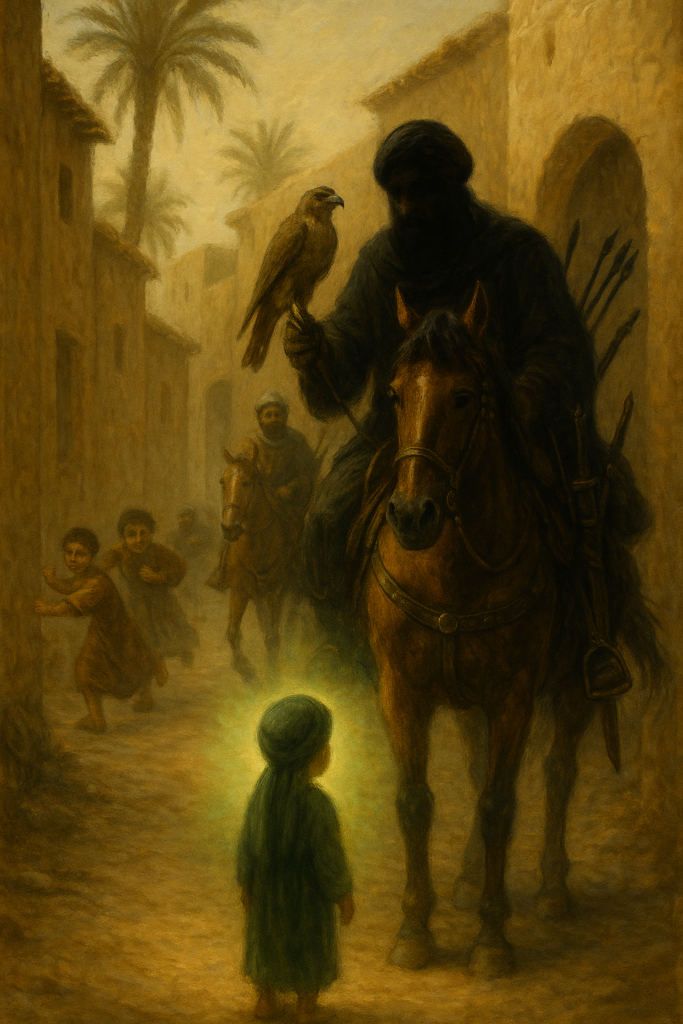
Then al-Ma'mun, while carrying out a hunt, released his falcon into the air, and after some time the bird returned. In the falcon’s beak was a small fish that was still alive. Al-Ma'mun was astonished by this, and when he returned to the place, the children again fled in fear. But Imam al-Jawad, peace be upon him, remained in the same place, just as he had stood before. Al-Ma'mun approached Imam al-Jawad and asked him: “What is in my hand?” Imam al-Jawad, peace be upon him, replied: “Indeed, God the Exalted has placed tiny little fish in the sea of His power, which are caught by the falcons of kings and caliphs; and these fish are a means of testing the progeny of the Household of the Messenger of God, blessings and peace be upon him and his family.”
This statement of Imam al-Jawad, peace be upon him, clearly demonstrated his profound knowledge and wisdom even in childhood. Upon hearing this precise and wise answer, al-Ma'mun could not overcome his astonishment and said in amazement: "You are truly the son of Imam al-Rida, peace be upon him."
After this conversation, al-Ma'mun showed Imam al-Jawad, peace be upon him, special respect and received him with particular honor. Al-Ma'mun, who had been influenced by Imam al-Jawad's intellect and insight, thereafter showed him great respect. In addition to emphasizing the perfection of Imam al-Jawad's intellect, this event demonstrated the exalted station of the Ahl al-Bayt, peace be upon them, before the rulers and kings of the time, for they possessed profound insight and wisdom even in childhood.
The Scholarly Examination of Imam al-Jawad, Peace Be upon Him: Demonstrating the Perfection of Knowledge and Insight before the Greatest Scholars of the Age
As time passed and the knowledge, perfection, and virtues of Imam al-Jawad, peace be upon him, became evident at a young age, al-Ma'mun decided to marry him to his daughter, Umm al-Fadl. However, the Abbasids opposed al-Ma'mun's decision, because they feared that Imam al-Jawad, peace be upon him, like his father Imam Ali ibn Musa al-Rida, peace be upon him, would attain the caliphate. The Abbasids opposed this because they did not want Imam al-Jawad, peace be upon him, to be put forward as heir apparent to the caliphate.
To ensure Imam al-Jawad's worthiness, peace be upon him, al-Ma'mun ordered that Yahya ibn Aktham be sent to the Imam's presence to test him. Yahya ibn Aktham, who had been chosen by the Abbasids for this examination, went before Imam al-Jawad, peace be upon him, and put questions to him.
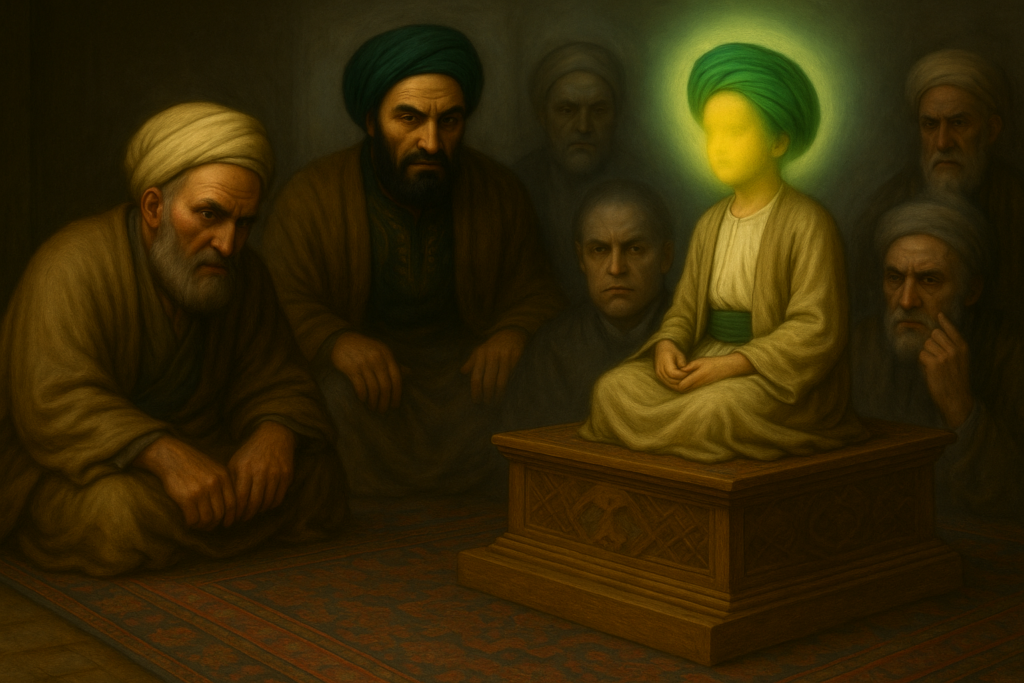
After Yahya ibn Aktham entered the presence of Imam al-Jawad, peace be upon him, al-Ma'mun, in the presence of other state dignitaries, ordered that a fine carpet be spread for Imam al-Jawad and that he be seated upon it. Yahya ibn Aktham posed his questions, and Imam al-Jawad, peace be upon him, answered all of them in the best and most precise manner possible. Al-Ma'mun, impressed by the astonishing answers of Imam al-Jawad, peace be upon him, said: "You have answered well, O Abu Ja'far! Now, if you wish, ask Yahya ibn Aktham a question as well, even if it is only one question."
Then Imam al-Jawad, peace be upon him, said to Yahya ibn Aktham: "What do you say about a man who, at the beginning of the day, looked at a woman who was forbidden to him? Then, near noon, that woman became lawful to him, but again at noon she became forbidden to him. After that, in the afternoon, that woman became lawful to him again, but at sunset she became forbidden to him again. At the time of the night prayer, that woman became lawful again; after midnight, she again became forbidden to him; and finally, near dawn, that woman became lawful to him again."
Yahya ibn Aktham, astonished by the complexity of this question, replied: "I do not know the answer to this matter."
This question posed by Imam al-Jawad (peace be upon him) clearly demonstrates the depth of his knowledge and insight. By raising this issue, Imam al-Jawad (peace be upon him) was able to show that his knowledge was extraordinary not only in various jurisprudential and religious fields, but also in complex and subtle matters.
After Yahya ibn Aktham did not know the answer to Imam al-Jawad’s question (peace be upon him), and Imam al-Jawad himself gave the precise and complete answer, Yahya was defeated in this scholarly contest. Al-Ma'mun, who witnessed this event, said to the Abbasids: “Now that you have truly come to know what you had denied, this truth has become clear.” Then, in that same gathering, in view of Imam al-Jawad’s scholarly superiority, al-Ma'mun decided to marry him to his daughter, Umm al-Fadl, and made this marriage official.
Imam al-Jawad (peace be upon him): Decisive Scholarly Answers to the Greatest Challenges and the Scholars of His Time
This event was not only evidence of Imam al-Jawad’s scholarly perfection at a young age; it also showed that even in the face of the major scholarly and intellectual challenges posed by the greatest scholars and authorities of his time, he could respond in the best possible manner. Al-Ma'mun’s acceptance of this fact is evidence of Imam al-Jawad’s scholarly greatness and special status, such that even the fiercest enemies—such as al-Ma'mun, Yahya ibn Aktham, and the Abbasids—bowed before him.
In this narration, which Ibn Hajar relates in al-Sawa'iq al-Muhriqah, there are several important points that are highly significant in responding to al-Dihlawi. The first point is that, in this incident, Imam al-Jawad (peace be upon him) did not flee, although the flight of the other children at that moment was natural. When al-Ma'mun asked Imam al-Jawad why he had not fled, Imam al-Jawad gave an answer that clearly demonstrates the perfection of his intellect. This answer not only indicates Imam al-Jawad’s wisdom and knowledge in childhood, but also proves that, despite his young age, he possessed profound understanding and insight.
The next point observed in Ibn Hajar’s report concerns the game that al-Ma'mun was using while hunting. Al-Ma'mun was astonished that several live fish were in the beak of the falcon and did not know where these fish had come from. When al-Ma'mun came to Imam al-Jawad (peace be upon him) and saw that the Imam was still standing in the same place and was not fleeing, he asked him: “What is in my hand?” Imam al-Jawad (peace be upon him) was not only aware of a matter of which al-Ma'mun himself was ignorant, but also recognized al-Ma'mun’s inner intention. This is certainly knowledge of the unseen; and even if someone does not accept knowledge of the unseen, it at least clearly manifests Imam al-Jawad’s perfect intellect in childhood.
The third point apparent in this report concerns the presence of Yahya ibn Aktham for a debate with Imam al-Jawad (peace be upon him). The purpose of bringing Yahya ibn Aktham, who was among the greatest Abbasid scholars, was in some way to expose Imam al-Jawad’s alleged ignorance and prove that a child could not possess sufficient knowledge. Yet nowhere in the world is the most learned person brought to confront a child in order to prove that child’s ignorance. Yahya ibn Aktham came into the presence of Imam al-Jawad (peace be upon him) and began asking questions. But Imam al-Jawad not only answered his question; he divided Yahya ibn Aktham’s question into numerous questions and different branches, such that Yahya ibn Aktham was astonished by the precision and detail of Imam al-Jawad’s answers. The very fact that Imam al-Jawad (peace be upon him) could divide one question into so many different branches demonstrates his scholarly mastery and the depth of his knowledge.
Thus, after these answers, Yahya ibn Aktham admitted his inability and could not provide an answer to all the branches and details of Imam al-Jawad’s questions (peace be upon him). Finally, Imam al-Jawad (peace be upon him) posed a question to Yahya ibn Aktham that was so precise and complex that Yahya did not even have the opportunity to think about it and said only one word: “I do not know.”
These points in Ibn Hajar’s account clearly show that Imam al-Jawad, peace be upon him, not only possessed mastery of religious and juristic sciences, but that even the greatest Abbasid scholars were but children before Imam al-Jawad, peace be upon him.
The Knowledge, Intellect, and Perfection of Imam al-Jawad, Peace Be upon Him: A Criterion for the Validity of the Ahl al-Bayt’s Critiques, Peace Be upon Them
Thus, when the ninth Imam is the son of Imam al-Rida, peace be upon him, and possesses such a level of knowledge, intellect, and perfection that even his opponents and enemies acknowledge his merit, knowledge, and intellect, then if Imam al-Jawad, peace be upon him, says something or offers a critique, that critique is certainly valid and trustworthy. This truth applies not only to Imam al-Jawad, peace be upon him, but also to all the immaculate Imams, peace be upon them. For example, if Imam al-Hasan, peace be upon him, and Imam al-Husayn, peace be upon him, pulled Abu Bakr down from the pulpit and told him to come down from the pulpit of their grandfather, then this action and statement of those great figures are certainly valid and clearly indicate that Abu Bakr was not worthy of the caliphate.
From the Knowledge of Imam al-Jawad, Peace Be upon Him, to the Imamate Knowledge of Imam al-Zaman, Peace Be upon Him: A Great Admission
The late Muhammad Quli further states: Ibn Hajar al-Makki, in al-Sawa‘iq al-Muhriqah, after mentioning some of the virtues of Imam Hasan al-‘Askari, peace be upon him, makes a statement that is highly significant in its own right. He says: “و لم یخلف غیر ولده ابوالقاسم محمد الحجة و عمره عند وفاة ابیه خمسة سنین لکن آتاه الله فیها الحکمة و یسمی القائم المنتظر”. “No one remained after him except his son Abu al-Qasim Muhammad al-Hujjah, who was five years old at the time of his father’s death; yet God granted him wisdom at that age, and he was called the Awaited Qa’im.”
In simpler terms, Ibn Hajar explicitly states that Imam Hasan al-‘Askari, peace be upon him, left only his son as his successor, whose kunya was Abu al-Qasim and whose name was Muhammad; he was in fact the Hujjah, or Proof of God, and the Awaited Qa’im. The noteworthy point is that Ibn Hajar, one of Shi‘ism’s staunch opponents, here clearly mentions the name and kunya of Imam Hasan al-‘Askari’s son and then continues by saying that, at the time of his father’s death, Imam Muhammad ibn Hasan (Imam al-Mahdi, may God hasten his relief) was only five years old. Yet, at that young age, God had granted him wisdom and knowledge, and he was called the Awaited Qa’im.
The Knowledge and Perfection of Imam al-Hasan and Imam al-Husayn, Peace Be upon Them: Rejecting Abu Bakr’s Caliphate from a Rational and Religious Perspective
The late Muhammad Quli then draws a beautiful conclusion that emphasizes the importance of this matter. He says: “Whenever the condition of the noble descendants of the two Hasans and Husayns, peace be upon them, is such that one of them, while still young, informs people of unseen matters, manifests evident miracles and brilliant wonders, humiliates and silences eminent scholars and distinguished learned men, and guides people in answering juridical questions and particular rulings with elegance of expression and eloquence of speech—such that it astonishes the intellects of famous scholars and well-known learned men—and while still in childhood God has bestowed upon him great wisdom, namely knowledge of the divine laws and the signs of truth, then what religious person or rational person can accept that al-Hasan and al-Husayn, peace be upon them, did not possess complete intellect and abundant knowledge? Or that, if they did possess such knowledge, they knowingly and deliberately rejected a rightful caliphate? God forbid.”
This statement of the late Muhammad Quli clearly shows that Imam Hasan, peace be upon him, and Imam Husayn, peace be upon him, like Imam al-Jawad, peace be upon him, who shone in that event with al-Ma'mun and Yahya ibn Aktham, possessed complete knowledge and abundant virtues. If anyone wishes to claim that these two noble Imams were deprived of such knowledge and perfections, he has in fact leveled a grave accusation against them. Likewise, if they objected to Abu Bakr's caliphate and rejected his caliphate, this act was not merely an act of disobedience or a great sin; rather, it was a truth that rightly proves that Abu Bakr was not qualified for the caliphate. According to this argument, Imam Hasan's and Imam Husayn's rejection of Abu Bakr's caliphate was in fact grounded in their high intellect and knowledge, and it involved no error or sin whatsoever.
The Scholarly Perfection of Imam Hasan and Imam Husayn, Peace Be upon Them: A Comparison with Other Figures in History and Confirmation of Childhood Intelligence among the Ahl al-Bayt
They continue by saying that it has even been reported in the biography of the noble al-Sharif al-Radi that Sayyid al-Radi had memorized the Qur'an before reaching the age of 9. He says: “This person is not infallible; this person’s grandfather is not the Commander of the Faithful, Ali, peace be upon him, and his mother is not al-Siddiqa al-Tahira; this person did not receive knowledge from the Messenger of Allah, peace and blessings be upon him and his family, yet he holds such a rank—then what of Imam Hasan and Imam Husayn, peace be upon them?”
He has related an account from Abu al-Fath Ibn Jinni, the grammarian, who says: “Sayyid al-Radi—or, in another expression, al-Sharif al-Radi—was studying with Ibn Sirafi while he had not yet reached the age of 10.” Ibn Sirafi was teaching him Arabic grammar. One day, Ibn Sirafi was discussing and teaching grammar with Sayyid al-Radi and asked him: “What is the sign of the accusative case in the sentence ‘رأیت عمراً’?” Sayyid al-Radi, may Allah have mercy on him, replied: “The hatred of Ali, peace be upon him.” This answer, issued by a child under 10 years of age, astonished Ibn Sirafi and those present. Although Sayyid al-Radi was very young and should have given a simple answer such as “fatḥah,” he referred, in response to a grammatical question, to a theological matter and said: “The reason for the accusative case of ‘Amr is his hatred toward the Commander of the Faithful.”
This person was an ordinary individual and not the Prophet’s grandson, peace and blessings be upon him and his family, yet he possessed such intelligence and rapidity in understanding and analysis. “Know that if the sharp intelligence and quick understanding of Sayyid al-Radi reached this level in childhood, then the existence of such perfection in the Ahl al-Bayt of the Messenger, peace be upon them—especially Imam Hasan and Imam Husayn, peace be upon them, who were among the Five of the Cloak and were taught by the Prophet, peace and blessings be upon him and his family—is not at all surprising or astonishing.” Therefore, if Sayyid al-Radi, who was not infallible, had such intelligence and quickness of understanding, how can one not expect Imam Hasan and Imam Husayn, peace be upon them, who belong to the Household of Prophethood and the Ahl al-Bayt of Infallibility, to possess scholarly and intellectual perfection during childhood?
This argument clearly shows that we should feel no surprise at the scholarly perfection of Imam Hasan and Imam Husayn, peace be upon them, during childhood. Having arisen from parents such as the Commander of the Faithful, Ali, peace be upon him, and al-Siddiqa al-Tahira, peace be upon her, and having been directly taught by the Prophet, peace and blessings be upon him and his family, their scholarly and intellectual perfections in childhood are entirely natural and grounded in reality.
Therefore, the response to the first objection raised by al-Dihlawi concerning Imam Hasan and Imam Husayn, peace be upon them, has been clearly presented here.
Final Summary and Analysis
The objections of Imam Hasan and Imam Husayn, peace be upon them, to Abu Bakr’s caliphate—particularly in the incident in which Abu Bakr was brought down from the pulpit—were not only a symbol of opposition to the usurpation of the caliphate, but also a sign of the intellectual and rational perfection of these two infallible Imams in their childhood. These objections, widely recorded in reliable Shiʿi and Sunni sources, possess historical and religious credibility and cannot simply be disregarded. The analyses presented in this article show that ʿAbd al-ʿAziz Dihlawī’s attempts to reduce these objections to childish and insignificant remarks are, in fact, a disregard for historical truth and for the rational knowledge of the Imams of the Ahl al-Bayt, peace be upon them.
Many opponents, especially in their efforts to defend the early caliphates, have sought to deny these objections legitimacy. Yet, as discussed in this article, these objections were uttered by infallible figures endowed with complete understanding, who in all periods possessed perfect reason and profound insight into religious and political matters. This is particularly and clearly demonstrated through reference to reliable Shiʿi and Sunni sources.
This article is not merely a response to the historical distortions in the book Tuḥfah Ithnā ʿAshariyyah; it also demonstrates that historical critiques—especially those advanced by the Ahl al-Bayt of the Prophet, blessings and peace be upon him and his family—are of great importance and must be assessed with precision and scholarly rigor. Therefore, the objections of Imam Hasan and Imam Husayn, peace be upon them, cannot simply be passed over, for they are not only a critique of Abu Bakr’s caliphate, but also reveal the depth of the religious understanding and insight of these two infallible Imams throughout every stage of their lives.