
The Place of Guidance in the Qur'an and the Role of Lady Fatimah al-Zahra (peace be upon her) in Elucidating the Straight Path
Author: Hamed Sarem

“The Noble Qur’an presents guidance as the loftiest divine blessing, not as an abstract concept, but as a human-centered path recognized through the exemplars of ‘those upon whom You have bestowed favor’ (الذین أنعمت علیهم). Adopting an analytical approach, this article examines the relationship between Qur’anic guidance and wilayah, demonstrating that the proclamation of wilayah at Ghadir completed guidance, while its preservation was realized in the events of Fatimiyyah. Based on reliable sources, Lady Fatimah al-Zahra (peace be upon her), through her political stance and her unjust martyrdom, became the criterion for discerning the straight path and those who incur wrath; to this day, her presence remains a cornerstone in understanding divine guidance.”
Abstract:
Guidance is the central axis of human life and the loftiest divine blessing in the Noble Qur’an. Among all blessings, guidance is the greatest gift that God has ordained for human growth and perfection. Surah al-Hamd, which is the summary and essence of the entire Qur’an, depicts the path of guidance as a living, person-centered way: the way of those upon whom favor has been bestowed: “صراط الذین أنعمت علیهم”. In this perspective, guidance is not merely an abstract concept; rather, it is manifested in the beings of people who are the perfect embodiment of divine light. With an exegetical and analytical approach, this article examines the concept of guidance in the Qur’an and explains its relationship with wilayah and the role of Lady Fatimah al-Zahra (peace be upon her) in the continuation and elucidation of divine guidance. The findings show that Ghadir was the point at which guidance was completed, and Fatimiyyah its manifestation of continuity; through her suffering and enlightenment, that sacred Lady kept the straight path alive in history.
Keywords:
Guidance, the straight path, Fatimah al-Zahra (peace be upon her), wilayah, Ghadir, Fatimiyyah, the Noble Qur’an
Introduction:
God Almighty has said in the Noble Qur’an: “And if you were to count the blessings of Allah, you could not enumerate them” (al-Naḥl, 16). God’s blessings are limitless; yet among them all, guidance holds a distinctive rank. Guidance is a light through which all blessings acquire meaning. Without guidance, other blessings not only fail to bring a person to the destination, but may at times become instruments of misguidance.
For this reason, the Noble Qur’an regards humanity’s most important supplication and request as “Guide us to the straight path” (al-Fātiḥah, 6)—a prayer repeated every day in the ritual prayer, lest we forget that at every moment the human being is in need of renewed guidance. Immediately in the following verse, God introduces the reality of the straight path: “the path of those upon whom You have bestowed favor” (al-Fātiḥah, 7). In this expression, guidance is not an abstract mental path, but a living course recognized through persons and their conduct. These are the very people whom God has distinguished through His special favor.
Guidance: the Great Blessing and the Purpose of Creation
In the Qur’anic view, guidance is not merely one blessing among others; it is the goal of all blessings. God has endowed the human being with the blessing of reason, free choice, and abundant resources so that he may choose the path of truth. Yet if divine guidance does not shine within his soul, all these endowments will bear no fruit.
Guidance is, in truth, the bond of connection between the human being and God. Hence, the Noble Qur’an emphasizes that the true blessing is neither wealth nor power, but divine guidance itself. When we say, “Guide us to the straight path,” we are in fact asking God to lead us upon the way of those who hold the station of “the specially favored ones”; namely, those who, in the light of faith and walāyah, are the way and path of guidance for all worlds.
The Straight Path: The Way of the Guided
In Sūrat al-Ḥamd, the Qur’an introduces the Straight Path with the expression “the path of those upon whom You have bestowed favor” («صراط الذین أنعمت علیهم»). This verse shows that guidance has become embodied in certain individuals. Notably, in this supplication we do not say, “Guide us to the way of the Qur’an,” or “Guide us to Your own way”; rather, we ask God to lead us onto the way of those who have themselves been guided.
In this sense, guidance is a person-centered concept: one must find those who are the complete embodiments of guidance and follow their path. These individuals are the bearers of truth and God’s proofs on earth. Thus, knowing them is a fundamental pillar of faith and the precondition for every other form of guidance.
The Perfection of Religion and the Elucidation of the Straight Path at Ghadīr
In the divine order, humanity’s guidance was not completed merely through the revelation of the Qur’an; it also required the proclamation of wilāyah. In the verse, “O Messenger, convey what has been sent down to you from your Lord; and if you do not, then you have not conveyed His message” («یَا أَیُّهَا الرَّسُولُ بَلِّغْ مَا أُنزِلَ إِلَیْکَ مِن رَّبِّکَ وَإِن لَّمْ تَفْعَلْ فَمَا بَلَّغْتَ رِسَالَتَهُ») (al-Mā’idah, 67), God warns the Prophet that without delivering the message of wilāyah, the mission would not be brought to completion.
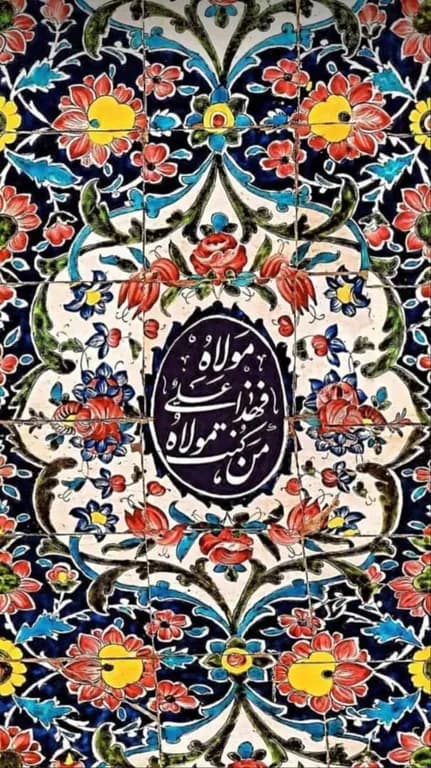
On the day of Ghadīr, the Noble Prophet (PBUH) fulfilled the divine command and, by proclaiming, “Whomever I am his master, then ʿAlī is his master” («من کنت مولاه فهذا علی مولاه»), identified the embodiment of “those upon whom You have bestowed favor” («الذین أنعمت علیهم»). Ghadīr was the apex of guidance: the place where religion reached perfection and the divine blessing was completed.
Yet the path of guidance in human history was not confined to this proclamation; for after the Prophet, tribulations arose and the truth of Ghadir was exposed to distortion. It is here that the role of Fatimah al-Zahra (PBUH) as the guardian of the Straight Path becomes meaningful.
Fatimah al-Zahra (PBUH): The Manifestation of Guidance and the Criterion of Truth and Falsehood
The Messenger of God (PBUH) said concerning his daughter: “O Fatimah, indeed Allah is pleased when you are pleased and is angered when you are angered.” This hadith shows that God’s pleasure lies in Fatimah’s pleasure, and His wrath in her wrath. In truth, Fatimah (PBUH) is the divine criterion for distinguishing guidance from misguidance. Whoever incurs her anger belongs among «those with whom He is angry», and whoever attains her pleasure proceeds upon the path of guidance.
After the Prophet’s passing (PBUH), when the truth of wilayah was endangered, Lady al-Zahra (PBUH), through her sermons and her divinely inspired patience and steadfastness, made the faces of those who had incurred wrath clear to history. Through an eloquent silence and an oppressed martyrdom, she demonstrated that true guidance lies only in following the path of wilayah.
The Martyrdom of Fatimah al-Zahra (PBUH): A Practical Interpretation of the Straight Path
Historical accounts relate that after the event of Saqifah, the Lady of the Two Worlds, through her patience and oppression, separated the path of truth from falsehood. The fire of injustice was kindled at the door of the House of Revelation, and Fatimah’s cry of “O my father!” awakened the conscience of history.
Safadi, one of the Sunni scholars, writes: “إن عمر ضرب بطن فاطمه یوم البیعة حتی أسقطت المحسن”. This event is not merely a historical incident; rather, it signifies the confrontation between two paths: the path of guidance that flowed in Fatimah’s home, and the path of misguidance that took shape at Saqifah.
Lady Zahra (s), through her testament in which she said: “یا علی، حنّطنی و غسّلنی و کفّنی باللیل...”, wished for her burial in the darkness of night itself to be a sign of the light of truth, so that the line of guidance would forever remain distinct from darkness.
The Secret of the Hidden Grave and the Meaning of Enduring Guidance
The concealment of Lady Zahra’s (s) grave is not a sign of forgetting, but a sign of awakening. She did not want her grave to be an outward symbol; rather, she wanted her memory to become a lamp within souls. The Qur’an states: “إِنَّا هَدَيْنَاهُ السَّبِيلَ إِمَّا شَاكِرًا وَإِمَّا كَفُورًا” (al-Insan, 3). Through her silence, Fatimah (s) elucidated this very dichotomy: one must either be grateful for the blessing of guidance and safeguard her path, or join those who deny this blessing and who believed in Jibt and Taghut (al-Nisa’, 51).
Those grateful for guidance are the guardians of Fatimiyyah: those who recognized Fatimah and continued along her path. Those who deny guidance, meanwhile, are the very people who contented themselves with appearances and grew distant from the reality of the path.
The Continuity of Fatimid Light in the Face of the Darkness of Doubts
Fatimah al-Zahra (peace be upon her) is the manifestation of the Divine Will and the abode of God’s providence. She willed that the light of Ali’s guardianship (peace be upon him) remain radiant until the Day of Resurrection. Before this light, Iblis and his followers possess only one instrument: the dissemination of doubt. They say, “Fatimah was not martyred,” “the houses of Medina had no doors,” or “her martyrdom is a recent tale”; yet these words arise not from truth, but from the darkness of hearts.
Those who love Fatimah (peace be upon her) cling to the hem of her chador, and through its blessing they will pass over the Sirat. They know that every doubt raised against Fatimah is, in reality, an attempt to deny Ghadir and extinguish the light of guidance.
Yet the fire of Fatimiyyah will not be extinguished, for its flame arose from the light of Ghadir. Fatimah kept Ghadir alive in the heart of history, so that every believer, in every prayer, may remember upon saying “اهدنا الصراط المستقیم” that the path of guidance is precisely the path of guardianship and love for Fatimah.
Conclusion
In the light of the verses of the Qur’an and the conduct of the Ahl al-Bayt (peace be upon them), guidance is the loftiest Divine blessing, and its realization depends upon following the exemplars of “الذین أنعمت علیهم”. Ghadir was the formal proclamation of this guidance, and Fatimiyyah its continuation and preservation.
Lady Fatimah al-Zahra (peace be upon her) played an unparalleled role in Islamic history in safeguarding the truth of guidance. Through her suffering, she became the criterion between truth and falsehood and distinguished the straight path from the path of those who incur wrath. Divine guidance was embodied in her being, and knowledge of her became a condition for soundness upon the path of faith.
Thus, it may be said: whoever recognizes Fatima and holds fast to her wilāya is upon the straight divine path, and whoever turns away from her will be among those who incur wrath. We repeat this meaning every day in our prayers when we say: «صراط الذین أنعمت علیهم، غیر المغضوب علیهم»—that is, O God, keep us on Fatima’s path and keep us far from the way of Fatima’s enemies.
Related topics:
Author: Hamed Sarem
Related articles

Comments
No comments yet.