
The Jewish Student: An Analysis of the Influence of Jewish Sources on the Structure of Umar’s Caliphate (5)
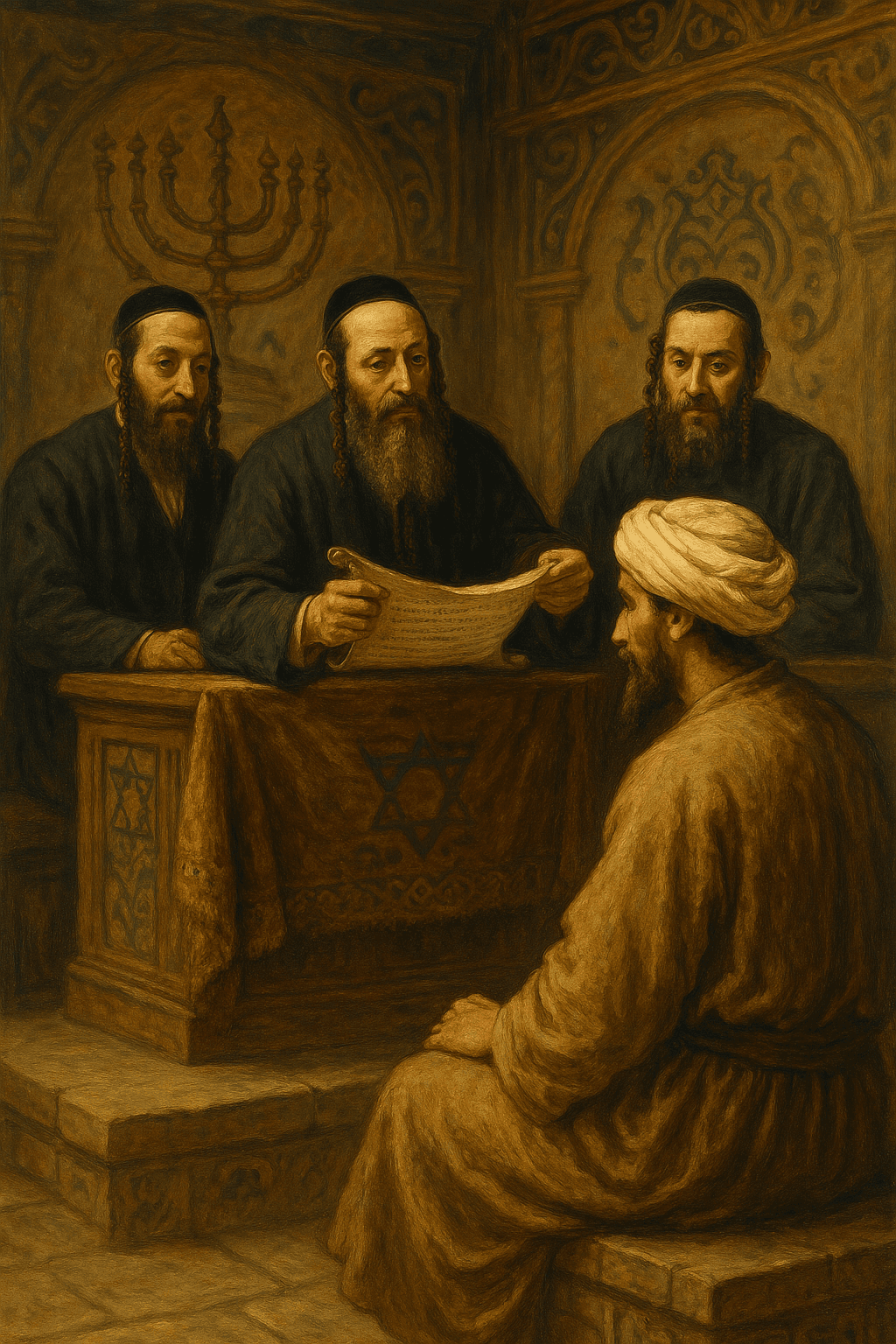
Umar ibn al-Khattab and Hidden Relations with the Jews: An Analysis of an Unseen Historical Current
Introduction
In Islamic history, some events and the conduct of prominent figures require a more precise analysis than may at first appear. One such matter is Umar ibn al-Khattab’s relations with the Jews, which outwardly may seem to be a matter of simple scholarly curiosity; yet, especially in light of historiography and deeper analysis, it may be regarded as an important clue for uncovering more hidden aspects of Islamic history.
In this article, we intend to examine Umar ibn al-Khattab’s relations with the Jews briefly, uncover the hidden points in this conduct, and consider its consequences in Islam’s political and religious sphere. This inquiry, not only from the perspective of his political and religious views but also from the standpoint of his relations with the Jews and on the basis of the text of the Qur’an and Islamic history, may reveal new dimensions of Islam’s internal policies.
1. Umar’s Complete Reliance on the Jews: Deep Interest as a Sign of Deception
Throughout Islamic history, one feature seen in many prominent figures is direct learning from the Prophet of Islam and following the line of guidance of revelation. In the case of Umar ibn al-Khattab, however, this pattern is meaningfully disregarded. Whereas the Prophet of Islam brought knowledge and guidance from God for the Muslim community, Umar not only did not learn knowledge from the Prophet in these matters, but instead went more often to the Jews and remained continually in contact with them. At first glance, this conduct may be interpreted as curiosity, but his extensive and constant instruction from the Jews was something far beyond curiosity. The Qur’an contains many warnings concerning the Jews—warnings that refer to lying, the confounding of truth, and the concealment of truth by the Jews.
But the more important point is that, at that time, Jews normally never allowed non-Jews to benefit from their sacred teachings. That Jews taught Umar knowledge and accepted him as one of their own appears not only to be an exception, but must also be analyzed within a political and strategic framework. Therefore, these connections between Umar and the Jews cannot be regarded merely as scholarly and cultural relations; rather, they must be seen as a complex political conspiracy, which was the hidden layer of the current of hypocrisy and ultimately became an instrument of Umar’s power in Islamic society.
2. The Jews’ Political Acumen: Why Umar? Why Now?
A noteworthy point is that the Jews did not merely teach Umar knowledge; they also held him in special devotion and respect. It is related that the Jews spoke of Umar as someone more esteemed by them than any of the Prophet’s Companions. This matter must be carefully analyzed. Why did the Jews, who ordinarily did not accept learning from non-Jews, accept Umar as a Muslim and open the doors of their knowledge to him? The Jews repeatedly welcomed Umar because they knew that he would soon attain power. Thus, accepting Umar could have meant, on the one hand, an effort to draw close to Muslim power and, on the other, to preserve their interests under a new government. More precisely, the Jews ruled in Umar’s shadow, or, by incarnating in Umar, took hold of the reins of government.
If the Jews welcomed Umar at that time, it is highly likely that this acceptance was a calculated move on their part. For in the history of political relations between Jews and Muslims, such an opportunity had never arisen in which Jews allowed a Muslim to benefit extensively from their religious knowledge. This indicates that the Jews sought cooperation with someone such as Umar, who could in the future play a prominent role in major Islamic policies.
3. The Claim of Confirming the Qur’an and the Torah: A Path toward Weakening Islam and Reviving Jewish Law
The claim that the Qur’an and the Torah confirm one another, attributed to Umar ibn al-Khattab, is a key point in analyzing his relations with Jews. In this report, Umar directly states that the Qur’an and the Torah must confirm each other. Such a statement, especially from someone known as the caliph of the Muslims, may carry deep and dangerous implications. This remark by Umar is not only a denial of the Qur’an as the final heavenly book, but also, in a sense, initiates a process that leads to aligning and conforming the Qur’an with Jewish teachings.
The claim that the Torah is a “confirmer” means regarding the Torah as equal to the Qur’an and even making the authority of the Qur’an dependent on the Torah’s confirmation; this, in a sense, roots a tree of Jewish thought within Islam. Such thinking ultimately makes Islam dependent upon Jewish confirmation and diminishes the revelatory authority of the Qur’an. In other words, Umar was, whether unconsciously or deliberately, reviving Jewish law and restoring that law as a religious proof and authority.
This issue shows that Umar’s efforts to secure confirmation between the Qur’an and the Torah could provide grounds for winning the Jews’ trust in him, as well as for turning the Qur’an into a text dependent on Jewish teachings. Consequently, this approach not only becomes a threat to Islam, but also opens the way for the acceptance of Isra’iliyyat teachings in Muslim society. Thus, by accepting this line of thought, Umar effectively opens a gateway to promoting Jewish teachings in the Islamic world.
4. Umar and Ignorance of the Qur’an: How Can an “Ignorant Person” Confirm the Qur’an?
Another point that must be considered in this analysis is Umar’s lack of complete knowledge of the Qur’an. There is no report showing that Umar learned the Qur’an precisely and completely during the Prophet’s lifetime, or even during his caliphate. In fact, Surat al-Baqarah, one of the most important surahs of the Qur’an, was so difficult for Umar that he was unable to memorize it. How can such a person, who lacks complete knowledge of the Qur’an, express an opinion concerning the confirmation of the Qur’an and the Torah?
This issue reveals a major contradiction. Umar, who is officially recognized as the caliph of the Muslims, was at times unable even to learn the Qur’an; yet he nevertheless expressed opinions on matters such as affirming the Qur’an and the Torah. This conduct is not only contradictory, but may also indicate a political conspiracy within the Islamic community aimed at promoting Jewish thought and legitimizing its teachings alongside the Qur’an.
5. A Path toward Undermining the Qur’an and Betraying the Religion of the Prophet of Islam
Ultimately, the question must be raised: was Umar attempting to undermine the Qur’an and its standing among Muslims? What meaning can be attributed to his relations with Jews and his claim to affirm both the Qur’an and the Torah, especially when he lacked sufficient knowledge of the teachings of the Prophet of Islam and the Qur’an? This current indirectly served to weaken the religion of the Prophet of Islam and even to create deep divisions within the Islamic community. Clearly, Umar reports his extensive contacts with Jews during the time of the Prophet. He gives this report at a time when he had become the ruler of the community. This plainly indicates that the statement seeks to justify the widespread presence of Jews in his government and to justify rulings, judgments, and governance based on Jewish interests. The least consequence of spreading this thought is the Judaization of the Muslims who followed him, and this claim becomes clear and evident upon examining the books of Umar’s school.
These hidden policies pursued by Umar not only harmed Islam, but ultimately led to the promotion of Jewish thought within the Islamic world. This act was a great betrayal of the religion of the Prophet of Islam, deliberately undertaken by Umar, and it laid the groundwork for historical deviations that would later cast a shadow over Islam and the Muslim community.
Conclusion:
Ultimately, the relations of Umar ibn al-Khattab with the Jews and his effort to affirm the Qur’an and the Torah constitute a hidden current in Islamic history that requires more precise analysis. These relations had profound effects not only in the political sphere but also in the religious sphere, and may indirectly have served to weaken the teachings of the Qur’an and legitimize Jewish teachings within Muslim society. Such a process is not only tantamount to betrayal of the religion of the Prophet of Islam, but also indicates a hidden and strategic policy pursued by Umar to strengthen his own position as well as his alliance with the Jews.
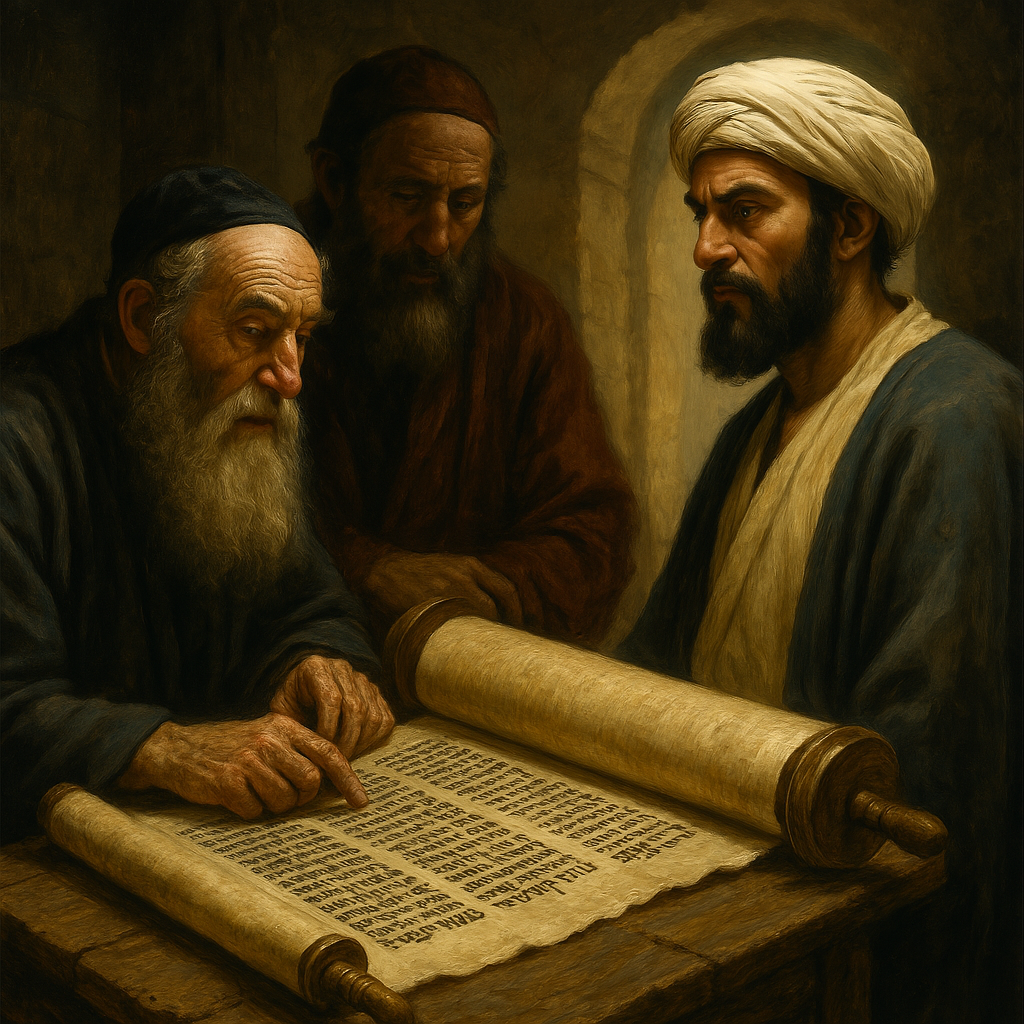
Umar ibn al-Khattab’s visits to, and esteem among, the Jews
1️⃣ From al-Sha‘bi: Ibn Abi Shaybah in al-Musannaf, Ishaq ibn Rahawayh in his Musnad, Ibn Jarir, and Ibn Abi Hatim narrated from al-Sha‘bi, who said: Umar, may Allah be pleased with him, stopped at al-Rawha’ and saw people rushing toward some stones. He said: “What is this?” They replied: “They say that the Prophet, peace and blessings be upon him, prayed facing these stones.” He said: “Glory be to Allah! The Messenger of Allah, peace and blessings be upon him, was only riding through a valley when the time for prayer came, so he prayed.” Then he related and said: “I used to visit the Jews on the day of their study, and they would say: ‘None of your companions is more esteemed by us than you, because you come to us.’ I said: ‘Why is that? It is only because I am amazed at the Books of Allah, at how some of them confirm others. How do the Torah and the Furqan confirm the Torah?’ One day the Prophet, peace and blessings be upon him, passed by while I was speaking with them, so I said: ‘I adjure you by Allah and by what you read from His Book: do you know that he is the Messenger of Allah?’ They said: ‘Yes...’”
Its chain of transmission is sound, but al-Sha‘bi did not meet Umar. Content of the narration: Umar said that during the Jews’ time of study, he would go to them, and they would say to him: “None of your companions is more esteemed by us than you, because you continually come to us.” Umar said: “This is because I am amazed at how the Torah and the Qur’an confirm one another...” and the narration continues. This hadith is sound, but al-Sha‘bi had not seen Umar. al-Durr al-Manthur, al-Suyuti
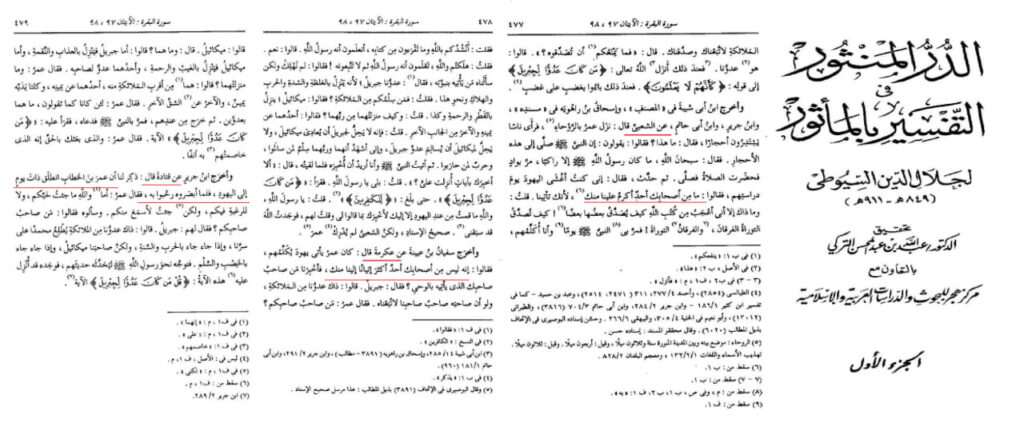
However, al-Sha‘bi’s mursal reports are accepted by most Sunni scholars: in the view of Sunni scholars, al-Sha‘bi’s mursal reports are sound, and they know of no mursal report from him that is incorrect. He was also among the eminent scholars who were well versed in the hadith of Ali, peace be upon him, and the reliable transmitters among his companions. Ibn Taymiyyah says that al-Sha‘bi’s mursal report is sound because the scholars know of no unsound mursal reports from him, and he was highly knowledgeable in recognizing hadith and reliable transmitters. al-Sarim al-Maslul, Ibn Taymiyyah
Al-‘Ijli said: “Al-Sha‘bi’s mursal reports are sound; he hardly ever narrates mursal except what is sound.” Al-‘Ijli considers al-Sha‘bi’s mursal report authentic and says that all his mursal reports are authentic. Al-Sha‘bi said: “I met five hundred of the Companions of the Messenger of Allah.” Al-Sha‘bi met 500 Companions and heard many of his narrations from them. Tarikh al-Islam, al-Dhahabi
2️⃣ From ‘Ikrimah: Sufyan ibn ‘Uyaynah narrated from ‘Ikrimah, who said: “Umar used to visit the Jews and speak with them. They said: ‘None of your companions comes to us more often than you. So tell us about the companion of your companion who brings him revelation.’ He replied: ‘Gabriel.’ They said: ‘That is our enemy among the angels; if his companion were the companion of our companion, we would have followed him...’”
Meaning of the narration: Umar would go to the Jews and speak with them. The Jews said: “None of your companions comes to us more often than you.” They then asked him who the companion of the Prophet—the one who brought revelation to him—was. Umar replied: “It is Gabriel.” The Jews responded: “He is our enemy among the angels; had his companion been our companion, we would have followed him.” Al-Durr al-Manthur, al-Suyuti
From Qatadah: Ibn Jarir narrated from Qatadah, who said: “It was mentioned to us that Umar ibn al-Khattab once set out for the Jews. When they saw him, they welcomed him. Umar said: ‘By Allah, I have not come out of love for you or desire for you; rather, I have come to hear from you...’”
Meaning of the narration: Umar went to the Jews, and they welcomed him. Umar said: “By Allah, I have not come out of love or affection for you; rather, I have come here to hear from you...” Al-Durr al-Manthur, al-Suyuti
Note: As mentioned, Umar repeatedly went to the Jews, and they were pleased that he came to them. Some may say that Umar went to the Jews out of defiance; that he learned knowledge from them and used it to oppose Islam. Moreover, we previously noted that Umar prevented the transmission of hadith, yet instead of learning hadith and Islam, he went to the Jews and learned knowledge from them. For this reason, they also fabricated hadiths to narrate from the Children of Israel.
This matter shows that the Jews loved Umar; therefore, Umarite justifications will be of no benefit to them.
In what follows, we will present further evidence of Umar’s connection with the Jews and of his questions to them.
Related articles

Comments
No comments yet.
