
A Disciple of Judaism; An Analysis of the Influence of Jewish Sources on the Structure of Umar’s Caliphate (3)
Author: Hamed Sarem
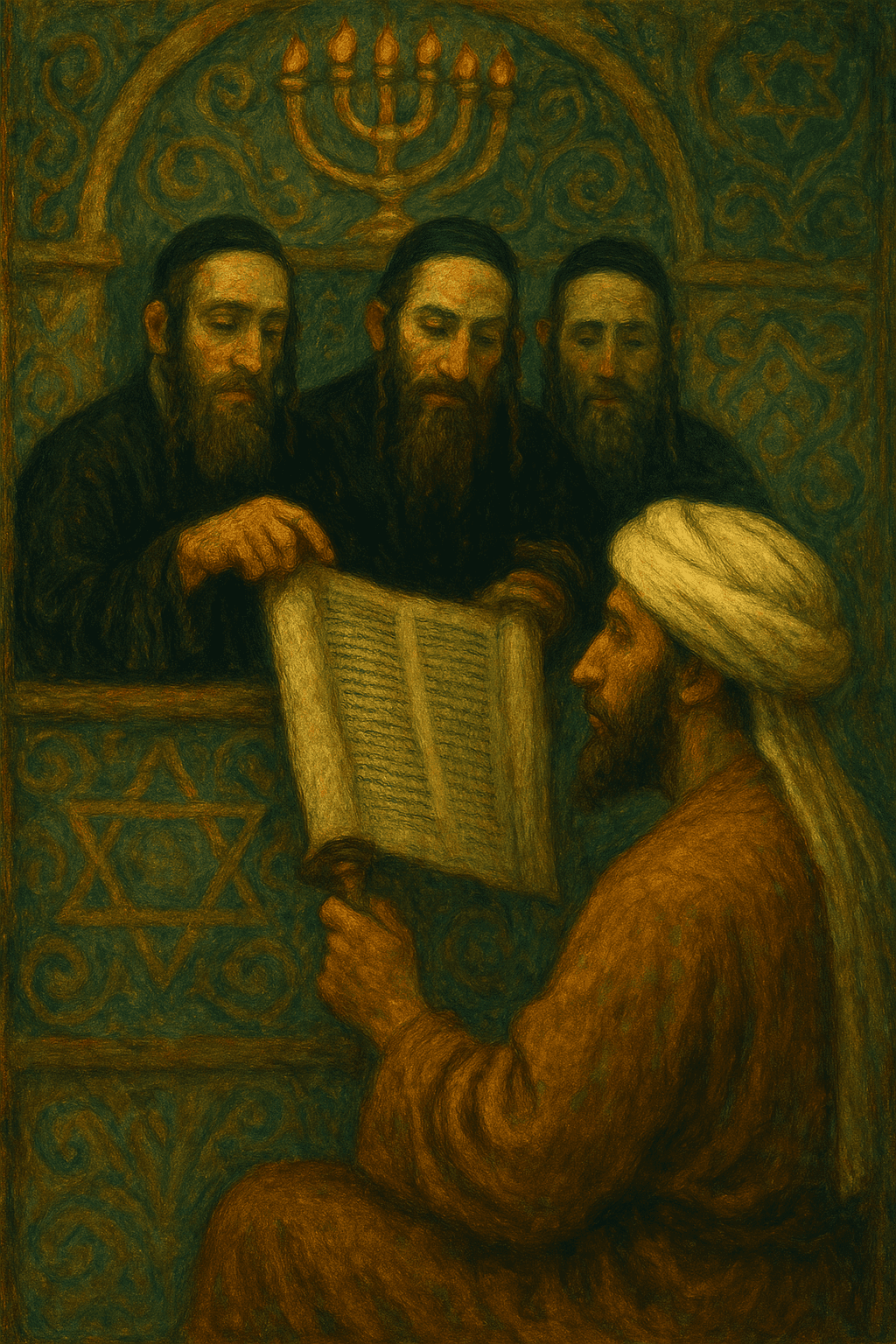
Reassessing a Strategic Deviation: Umar ibn al-Khattab and Fascination with Jewish Teachings
The Missing File: Umar, Judaism, and a Deviation at the Heart of Tradition
Deciphering a Silent حلقه in Islamic History
History, in a suffocating silence, sometimes leaves behind signs; some texts contain indications which, if read with open eyes, open gateways to the hidden layers of history. One such sign is the account of Umar ibn al-Khattab’s relationship with Jews: not a superficial acquaintance, but a profound fascination, an undisguised inclination, and conduct that stood in conflict with the Prophet’s repeated prohibitions and even with the logic of the Qur’an. This note, organized around six key themes, lifts the veil from a reality that, over the centuries, few have dared to address.

Image description
In this conceptual image, a man with a calm and contemplative face is touching or looking at a beautiful, radiant, and enticing object that, at first glance, appears attractive and harmless. But upon closer inspection, one realizes that signs of destruction are concealed within that beauty: hidden flames, deep cracks, or symbols of corruption and ruin.
The man is unaware of this danger, or has become so captivated by it that he can no longer retreat.
The overall atmosphere of the image conveys a bitter contrast: outward attraction versus hidden threat.
Without any text, this image depicts infatuation with something that is destructive in its essence—a concept that acquires particular meaning in the context of intellectual deviation or dependence on harmful external elements (such as distorted teachings or an invasive culture).
1️⃣ The Jews: “the most intense in hostility” and Umar’s hidden relationship with them
The Noble Qur’an states in a firm and unequivocal tone:
“You will surely find the Jews to be the most intense of the people in hostility toward those who believe…”
(Al-Māʾidah/82)
Given such an explicit statement, one would expect a committed Muslim to have not even the slightest intellectual, doctrinal, or behavioral closeness to Jews. Yet, conversely, ʿUmar ibn al-Khaṭṭāb, in numerous reports—including those transmitted by ʿAbd Allāh ibn Thābit and al-Ḥasan al-Baṣrī—speaks of an intimate and ongoing relationship with the People of the Book.
Worse still, in an explicit expression, he calls one of the Jews «أخٌ لي من يهود» (“a brother of mine from among the Jews”). This expression goes beyond ordinary social interaction; it points to an emotional and intellectual bond wholly at odds with the policy of revelation. This fundamental contradiction must be reconsidered: are we dealing with a project of intellectual infiltration whose results later emerge in Islamic sources in the form of “Isrāʾīliyyāt”?
2️⃣ The Pleasing Words of the Jews; ʿUmar’s Heart Captivated by Torah Narratives
The report of al-Ḥasan al-Baṣrī is a key document for understanding ʿUmar’s inner inclination. He says candidly:
“Indeed, the People of the Book relate to us reports that have taken hold of our hearts…”
“The People of the Book tell us things that settle in our hearts.”
The central question is this: what was there in those words that captivated Umar’s heart?
The mythical and fanciful structure of the distorted Torah?
The disparaging view of the prophets that weakens religious conscience?
The presentation of a religion laden with exceptions, racism, and the exoneration of power-seeking leaders?
The appeal of the teachings of the People of the Book to Umar did not arise from a search for truth, but from the weakness of monotheistic knowledge and a deficient understanding of prophethood. When the heart is emptied of Muhammadan wisdom, even the stories of the Children of Israel become pleasing.
3️⃣ The Prophet’s Prohibition: A Barrier Against Distortion with Prophetic Evidence
The Prophet’s response to ʿUmar was like a whip upon the body of deviation:
“Are you bewildered, just as the Jews and Christians were bewildered?”
“Have you become confused, just as they became confused?”
This statement is not merely a prohibition; it is a profound declaration comparing ʿUmar’s error with the historical bewilderment of the Jews.
The Prophet then said:
“I have brought it to you pure and spotless…”
“I have brought you a pure and sincere religion.”
But why did the Prophet react with such intensity? Because he knew that these very tendencies would, in the future, call the foundations of his tradition into question. And so it happened: Isra’iliyyat, contaminated interpretations, and fabricated Judaizing hadiths found their way into the heritage of the Muslims.
4️⃣ Stranger still: an Arabic speaker unable to understand the Qur’an, yet capable of understanding the Torah?
Numerous reports state that ‘Umar was incapable and slow even in learning Surat al-Baqarah. He himself admitted that he spent years on this surah, and Ibn Kathir reported that, until the end of his caliphate, he still remained puzzled by the meaning of many verses.
Now the question arises:
How could someone who was Arabic-speaking yet unable to grasp the Qur’an fluently and profoundly possess such an intense inclination and aptitude for understanding the Torah?
Was this merely out of curiosity? Or was there, behind the scenes, a mind searching for another model for leading society? Surah al-Baqarah, in particular, more than any other surah, exposes the corruption of the Jews. Was Umar’s inability to understand it a technical incapacity, or an inability to bear a truth that openly disgraced the Jews?
5️⃣ Writing Down the Torah, Eliminating the Prophetic Tradition: Two Opposing Policies or One Hidden Strategy?
In every culture, writing means perpetuating, preserving, and transmitting content. Umar was not only interested in learning the teachings of the People of the Book; he also insisted on writing them down and preserving them.
Yet this same person, during his caliphate, strongly prevented the writing of hadith. Issuing orders that prohibited writing, burning hadith records, and threatening and exiling transmitters of the Sunnah are all recorded in Umar’s record.
An analysis of this contradiction shows that the objective was not “preventing the intermingling of the Sunnah and the Qur’an,” but rather replacing Prophetic authority with new intellectual structures.
Did Umar, during his period of power, not secretly promote the teachings of the People of the Book?
Were the Isra'iliyyat not established during his time?
Was this inclination merely emotional, or was it purposeful and organized?
Final Conclusion: A Systematic Deviation, Not a Personal Mistake
In light of these six points, it can be concluded that Umar ibn al-Khattab’s inclination toward the Jews and their teachings:
was not merely a linguistic or momentary mistake.
Not a mere scholarly curiosity,
but rather a covert, deliberate project aimed at weakening the authority of the Prophetic Sunnah and introducing foreign teachings into Islam.
And the starting point of this deviation was the very moment Umar’s heart inclined toward the narratives of the People of the Book.
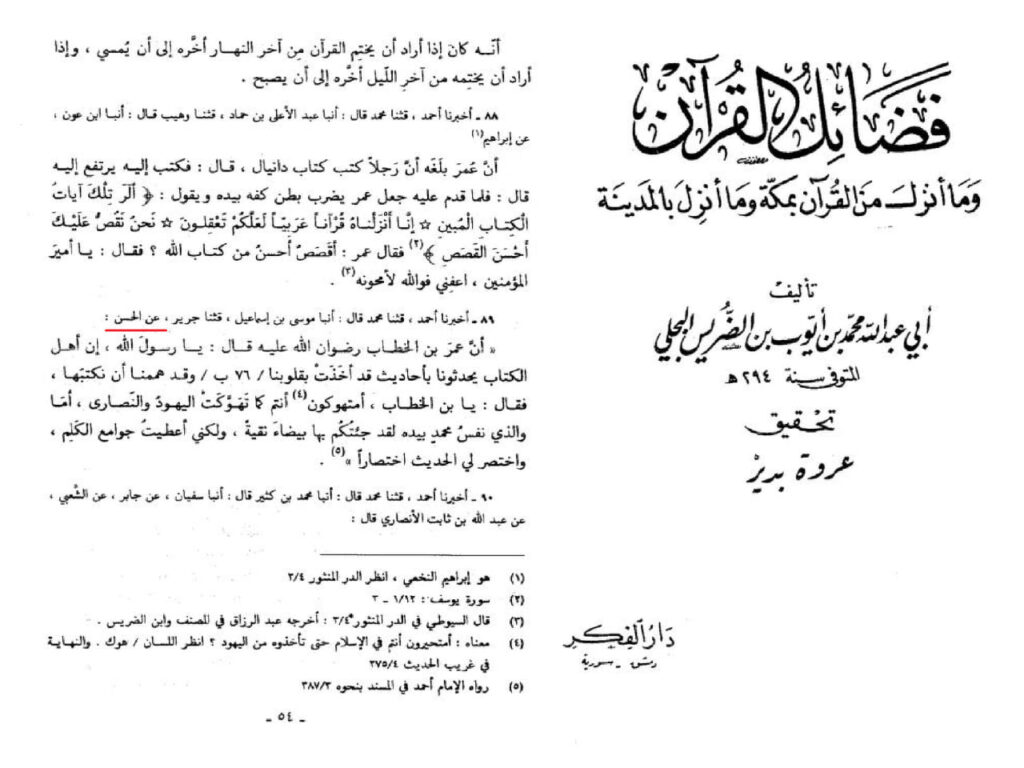
Umar said: “O Messenger of Allah, the Jews and Christians recite to us narrations that appeal to our hearts, and we intend to write them down.” The Prophet said: “O son of al-Khattab, have you become perplexed [in your religion] just as the Jews and Christians did? By Allah, I have brought you a pure and wholesome religion ...”
Key evidence: the narration of Hasan al-Basri
From Hasan al-Basri: Umar ibn al-Khattab said:
“The People of the Book tell us reports that have captivated our hearts, and we have resolved to write them down.”
Then he (PBUH) said:
“O son of al-Khattab, are you bewildered as the Jews and Christians were bewildered? By Him in whose hand is Muhammad’s soul, I have brought it to you pure and clear…”
Virtues of the Qur’an
Shuʿayb al-Arnaʾūṭ: The narrators of the report are trustworthy, but the report is mursal. Al-Ḥasan al-Baṣrī did not hear it from the Companions; rather, he transmitted it later.
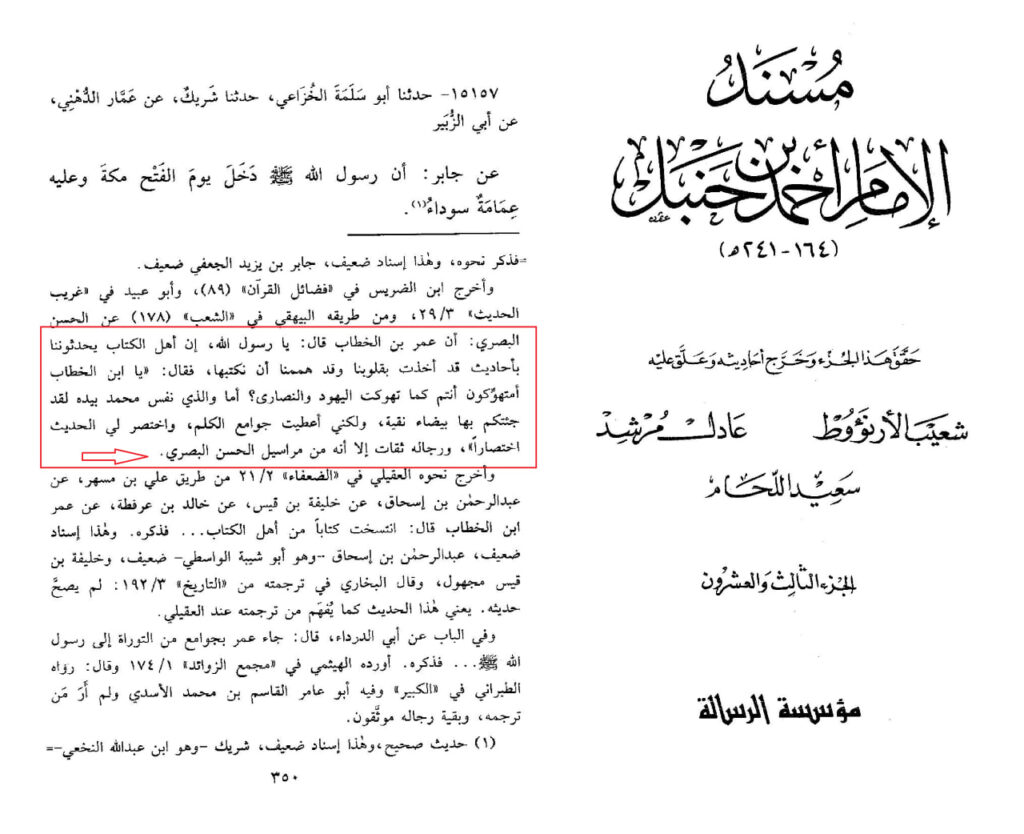
Shuʿayb al-Arnaʾūṭ considers the narrators trustworthy, but it is among the mursal reports of al-Ḥasan al-Baṣrī: «ورجاله ثقات إلا أنه من مراسيل الحسن البصري».
Musnad Ahmad — Al-Resalah edition
Hasan al-Basri was born two years after the death of Umar; therefore, he heard from the Companions.
Author: Hamed Sarem
Related articles

Comments
No comments yet.
