
Mubahala: The Pride of the Shi'a School
Author: Hamed Sarem
Mubahala is the scene of an intellectual confrontation between Islamic monotheism and Christian trinitarianism. It is commonly said that Christianity suffered a severe defeat in the event of Mubahala and that Islam prevailed over Christianity. Yet this is not the whole of Mubahala. The truth is that, in Mubahala, the front of truth defeated the front of falsehood, and the entire front of falsehood—including the Jews and the Meccan and Medinan hypocrites—suffered a severe defeat in the arena of Mubahala.
The fronts of truth and falsehood have been in conflict and confrontation since the beginning of creation. When God placed a vicegerent on earth and commanded the angels to prostrate to Adam after the spirit was breathed into him, Satan, out of arrogance, refused to prostrate to God’s vicegerent. After that event, the confrontation and conflict between the fronts of truth and falsehood continued, and there has never been a time when this confrontation ended or ceased. This confrontation and war between the two fronts of truth and falsehood is the setting for people’s trial and test in this world. People must first discern which front is truth and which is falsehood; then they must defend the front of truth and oppose the front of falsehood.
The Argument with the Christians of Najran
In a letter, the Prophet of mercy asked the Christians of the region of Najran to accept Islam, believe in the one God, and acknowledge his prophethood and messengership. If they refused to accept Islam, they were to sign a treaty with Islam and pay jizya (tax) to the Islamic authority. If they rejected the second option as well, they were to prepare for war.
The people of Najran travelled to Medina to speak with the Prophet of Islam. Their journey was for negotiations concerning the Prophet’s letter. On the one hand, the Christians remained firm in their belief, insisted on the Trinity, and denied the prophethood and messengership of the Messenger of God; on the other hand, the Prophet of mercy argued for his monotheism and prophethood and for the invalidity of their belief.
The central point of Christianity’s argument concerned Jesus. They claimed that because Jesus was born without a father, he was the son of God. Before Mubahala took place, the Noble Qur’an refuted belief in the Trinity by comparing the birth of Jesus with the creation of Adam. The Qur’an stated that Adam too entered this world without a father. Although the Christians believed that Adam was also without a father, they did not call him the son of God. Thus, Adam’s manner of creation—which was a shared belief of Christianity and Islam—was a refutation of Christianity. The Noble Qur’an says: “Indeed, the likeness of Jesus before God is like that of Adam: He created him from dust, then said to him, ‘Be,’ and he came to be.” (Āl ʿImrān 3:59) The resemblance between Adam and Jesus was that both came into existence without a father and both are creatures of God.
Mubahala: The Result of the Najran Christians’ Obstinacy
The Christians of Najran had no answer to this argument, yet they still persisted in denying monotheism and denying the prophethood and messengership of the Messenger of God. Therefore God commanded His Prophet to engage in Mubahala: to ask God that whoever was lying be kept far from God’s mercy and that punishment descend upon him. God Almighty says:
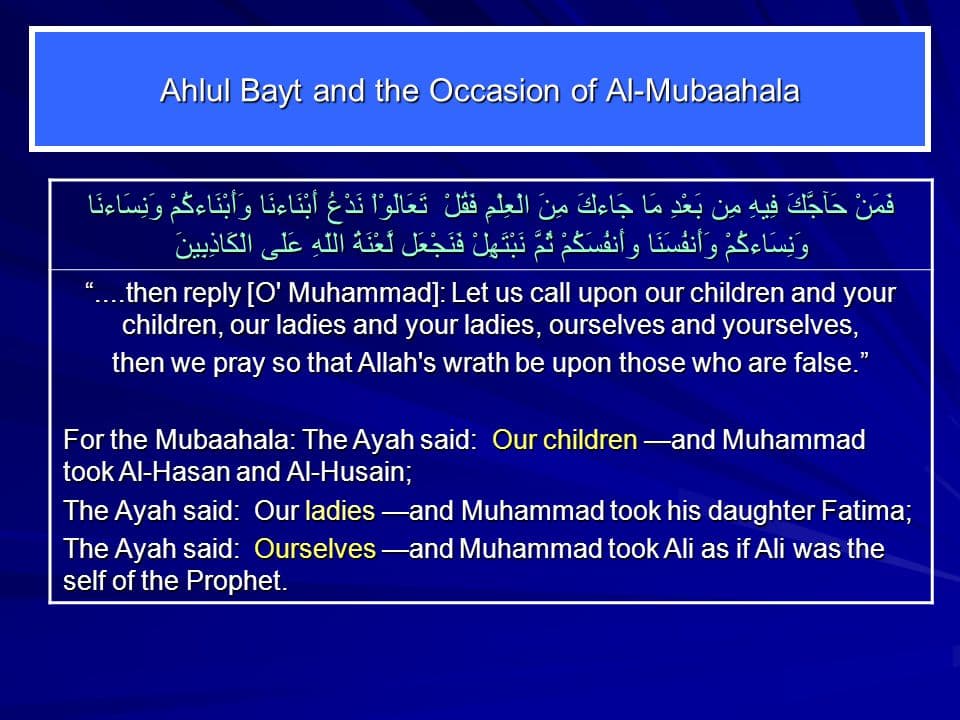
“So whoever disputes with you concerning him after the knowledge that has come to you, say: Come, let us call our sons and your sons, our women and your women, ourselves and yourselves; then let us invoke God’s curse upon the liars.” That is: whoever disputes with you about the servitude and messengership of Jesus after the knowledge you have received, tell them: let us bring our children and yours, our women and yours, and ourselves and yourselves; then let us engage in Mubahala and ask that those who lie—whether us or you—be removed from God’s mercy.”
The Prophet of mercy left Medina for Mubahala with Imam Hasan and Imam Husayn, the referents of “our sons”; Lady Fatima, peace be upon her, the referent of “our women”; and the Commander of the Faithful, Imam Ali, peace be upon him, the referent of “ourselves.” But when the Christians saw the Prophet’s companions, they feared carrying out Mubahala. Some of them understood the truth of his prophethood and embraced Islam. They said to themselves that, if he were a liar, he would not bring with him for Mubahala the people closest, dearest, and most beloved to him. Therefore, they agreed to write a treaty and pay jizya (tax).
Mubahala: An Occasion to Introduce the Ahl al-Bayt
A little reflection on the noble verse reveals important points about Mubahala. God Almighty says that God’s curse should be placed upon “the liars.” Who is a liar? A liar is someone who makes a statement or claim that does not correspond to reality. Therefore, one who has said nothing or made no claim cannot be described as a liar. Thus, the liars in this noble verse are those who make claims, and the assumption is that they may not be truthful in those claims. Moreover, the referent of “the liars,” which is also expressed in the plural, includes all those who take part in Mubahala and curse the opposing side. Therefore, the Messenger of God was not alone before the people of Najran; everyone accompanying the Prophet stood before them as well. If only the Prophet of mercy had stood opposite the Christians, naturally an expression applicable to one person would have been used, such as: let us place God’s curse upon the one who lies. But the noble verse says: “let us place God’s curse upon the liars.” It therefore includes all those who participated in Mubahala on the side of the Messenger of God and on the side of Najran. Accordingly, all who are present in Mubahala are themselves partners in the claim: those who came for Mubahala on behalf of Christianity do not differ from the chief bishop in the claim of the Trinity, and those who came with the Prophet are partners with the Messenger of God in his claim and call.
This is an immensely great merit for those who accompanied the Prophet in Mubahala: the Prophet’s Household—Lady al-Siddiqa al-Tahira, the Commander of the Faithful, Imam Hasan, and Imam Husayn, peace be upon them—are those who share in the Prophet’s call and claim. Among all the Prophet’s companions and supporters, this group alone occupies this rank and station.
Only the Prophet’s Intimates Were Present at Mubahala
It is extremely important to note that the Messenger of God did not bring these people merely as an example of the community of believers. If that had been the case, their accompanying the Prophet would not have been a virtue. Even if we were to suppose that the Prophet brought them as examples of people who believe in God, then he should have brought at least three people as the referent of “our sons,” since this is a plural term and the plural applies to three or more. Likewise, he should have brought three women as the referent of “our women” for Mubahala. Yet the Prophet brought two persons as children and one person as the referent of “our women.” This means that no one other than these persons was a referent of this command. For if other women in Medina—from the Prophet’s wives to other women—had been referents of “our women,” then, in obedience to the command of the Lord, the Prophet would have brought them with him. Therefore, in the station of obedience and submission to God Almighty, these persons alone and alone were the referents of the noble verse.
The Prophet’s Claim Rests upon Himself and His Household
This point must be recalled in order to understand the matter: in this event, the only one facing the Christians of Najran was the Messenger of God, not those who had believed in him. The Najran delegation had come to dispute the Prophet’s messengership. The Prophet’s messengership was based on revelation and rested upon the person of the Prophet; therefore, those who believed in and followed him had no role in this claim, and the Christians of Najran had no concern with the rest of the believers. Hence, in this noble verse the address is to the Prophet himself: “whoever disputes with you after the knowledge has come to you”; that is, the party to the argument is the Prophet alone, unlike verse twenty of the same surah, where the disputation of the Prophet and his followers is also mentioned.
Therefore, bringing these people along cannot have been merely because they possessed faith; rather, they were partners with the Prophet of mercy in the dispute. If they were not partners with the Prophet in his claim and assertion, there would have been no reason for them, were the Messenger of God—God forbid—a liar, to be subject to punishment and curse. Thus, the Prophet’s claim rested both upon himself and upon the people who accompanied him. Of course, their partnership in the Messenger of God’s claim does not mean that those four possessed prophethood like the Prophet. Although proclamation is among the functions of prophethood and messengership, not everyone charged with calling and proclaiming is necessarily a prophet. In other words, God may appoint a group to proclaim and call people to His religion without their being prophets or messengers.
The Commander of the Faithful Is the Prophet’s Self
Based on what has passed, the coming of the Ahl al-Bayt, peace be upon them, indicates their high rank and their partnership in proclaiming and calling to the message of the Messenger of God. The culmination of this point in the noble verse is when the Commander of the Faithful is described as the Prophet’s self: that is, Imam Ali, peace be upon him, is the Prophet’s very soul. Whatever virtues, merits, and knowledge the Messenger of God possesses, the Commander of the Faithful Ali, peace be upon him, possesses as well, except prophethood, for God’s established way is that prophethood ends with the Seal of the Prophets.
Mubahala Clarifies the Path of Guidance
Reflection on the verse shows that the Noble Qur’an seeks to display the path of guidance. Those who wish to be on the path of guidance recognize the front of truth clearly through this noble verse. This point alone is enough to show how much error and misguidance there is in turning to the Saqifa to appoint the ruler of society while the Prophet’s Household and the Messenger of God’s self are present among the community—an error and misguidance greater than that of the Christians of Najran, who believed in the Trinity. For when they saw the Household of the message, they abandoned obstinacy and agreed to write a treaty, whereas these people showed only rebellion and transgression. This is a question that, as long as heaven and earth endure, shakes the foundations of Saqifa: how could you gather at Saqifa, with the Prophet’s self and Household present, and argue over appointing the Prophet’s successor? With the Prophet’s self present, can anyone claim a share in government because of ethnicity, race, tribe, or anything else? Even if Ghadir Khumm had not occurred, and even if there had not been hundreds of verses, narrations, and historical reports concerning the immediate caliphate of the Commander of the Faithful, the verse of Mubahala alone would have completed the proof and sealed the invalidity of the imams of Saqifa.
The Wonders of the Verse of Mubahala
The wonders of the verse of Mubahala were not clear when the verse was revealed. They became apparent when the Prophet departed this mortal world. If we place the verse of Mubahala beside the historical events after the Prophet’s passing, we must write a letter of astonishment, full of question marks, before the rulers descended from Saqifa. Perhaps more astonishing than the gathering at Saqifa was the time when they demanded witnesses from the only woman present at Mubahala for her claim concerning Fadak: a woman whom God had chosen to say amen to the Prophet’s supplication, a woman who was a partner in the Prophet’s claim and call. She was required to bring witnesses for Fadak, which had been granted to her by God’s command during her father’s lifetime and which was in the possession of that noble lady after the passing of the Noble Prophet of Islam.
It is profoundly astonishing that the Muslims either martyred the Prophet’s children with poison or dragged them, thirsty, into blood and dust upon the scorching land of Taff.
The followers of Saqifa can never erase from themselves this stain of shame: for decades, those claiming to represent the Prophet’s community cursed and insulted the Prophet’s self and soul from the pulpits—the very one whose amen was to make the Prophet’s curse against the people of Najran answered.
Mubahala: The Pride of the Shi'a School
Yes, Mubahala is not merely the defeat of Christianity. Rather, it illuminates the path of the front of truth and invalidates the front of falsehood. Mubahala shows that the presence of the Messenger of God among his community continues through his Household, and that anyone who claims the religion of Muhammad al-Mustafa, peace and blessings be upon him and his family, must not separate from his family. Mubahala means one must follow the imams of Ghadir; and Mubahala means that the imams of Saqifa were always appointed contrary to the Qur’an, ruled contrary to the Qur’an, lived contrary to the Qur’an, and departed this mortal world while opposing the Qur’an.
Mubahala must not be regarded as insignificant. If we interpret it merely as a dispute in a specific geography between the Messenger of God and the people of Najran, we have committed a great injustice against Mubahala and the Qur’an, for the Qur’an is living and flows like the sun, always showing the correct path of the front of truth.
Mubahala is proof of the truthfulness of Shi'ism and an honor for the Shi'a school, because Shi'a take pride in having remained beside the Messenger of God throughout history and in having taken the Prophet’s self as their guide. Shi'a take pride in finding the sacred presence of the Messenger of God, peace and blessings be upon him and his family, in his progeny and infallible Household.
Author: Hamed Sarem
Related articles
Comments
No comments yet.
