
Shahrivar 22, 1395 APOccasions
The Mosque: God’s House and a House of Learning
Author: Hamed Sarem
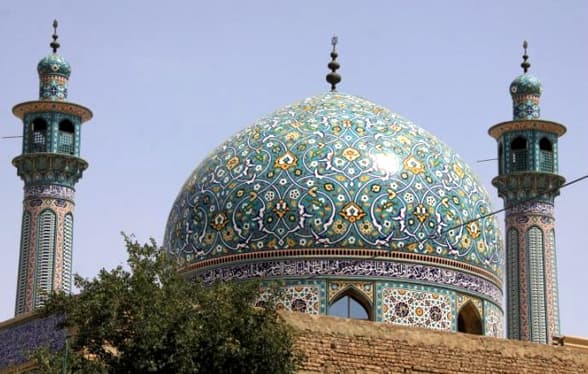
God’s creation is wholly flawless, complete, and beautiful. The Wise God did not create all lands alike: some are desert-like, dry, and low in rainfall, while others are green and receive abundant rain. Some lands have a dry, scorching climate, while others have a mild and life-giving climate. Yet whatever they may be, and whatever climate they have, God Most High has made all lands a mosque and a means of purification for His final Prophet.(1) This means that one can pray and worship God on any land and in any region.
Among the lands, God has given superiority to certain places. Some of these preferred places are mosques. Although prayer and worship of God are possible and desirable everywhere, the mosque is a special place for worshipping God Most High and drawing near to Him. The mosque’s functions throughout Islamic history have not been confined to worship; it has had many political and military functions and has been the source of many political transformations. Yet its most important function has been as a place of worship and nearness to the divine presence. For this reason, the mosque has long held a special sanctity and reverence for all Muslims.
In Islamic culture, the mosque has attained such a special position that the mosque and its distinctive architecture have become symbols of Islamic culture and civilization.
The Status of the Mosque
The Ahl al-Bayt, peace be upon them, have explained an exalted status for the mosque. The Messenger of God and his pure Ahl al-Bayt described the mosque as God’s house.(2) The Noble Prophet said that it is written in the heavenly books that mosques are My houses—God’s houses. God, who is the Creator of place and Himself beyond place,(3) attributes the mosque to Himself and calls it “My house” in order to make its nobility understood. Just as a guest visits the owner of a house, another narration describes those who go to the mosque as visitors of the Owner of the House, God Most Glorified. Imam Hasan al-Mujtaba, peace be upon him, says: “The people of the mosque are God’s visitors, and it is incumbent upon the owner of the house to give a gift to his visitor.”(4) Besides indicating the mosque’s sanctity and rank, these narrations encourage and urge believers and Muslims to go to the mosque. On the one hand, they state that the mosque has such a great station; on the other, they create a duty for monotheists: care for and attention to the mosque.
Revering the Mosque
Just as the mosque has a special status, everyone has a duty to revere and honor it. Imam al-Sadiq, peace be upon him, said: “إِنَّمَا أُمِرَ بِتَعْظِیمِ الْمَسَاجِدِ لِأَنَّهَا بُیُوتُ اللَّهِ فِی الْأَرْضِ” — “People have been commanded to revere mosques because they are God’s houses on earth.”(5) Those who maintain mosques are also distinguished members of society, through whom God repels punishment from the people of the earth.(6)
Those who neglect the mosque have been severely censured. Neighbors of a mosque who do not perform prayers there have been condemned in narrations: “If a neighbor of the mosque has no obstacle and is healthy, yet does not attend the mosque for an obligatory prayer, his prayer will not be accepted by God.”(7) Although jurists have not ruled that prayer in the mosque is obligatory for its neighbors, it is clear that these narrations strongly condemn neglect of the mosque.
Whoever insults the mosque is accursed: “مَلْعُونٌ مَلْعُونٌ مَنْ لَمْ یُوَقِّرِ الْمَسْجِدَ” — “Accursed, accursed is whoever does not revere the mosque.”(8)
Building and Cultivating the Mosque
Building and maintaining mosques carry great value and reward. Numerous narrations on this subject have been transmitted from the Ahl al-Bayt of infallibility and purity. Mosques are truly flourishing when, in addition to their buildings, their content is also founded on guidance. Therefore, just as effort and expense are devoted to constructing mosque buildings, attention must also be given to the cultural and guiding dimension of mosques; many times more should be spent on it, and careful planning should be undertaken. The mission of the mosque and its people is to breathe the spirit of spirituality and keep the path of guidance illuminated for the people of society. If this matter is attended to, many cultural and doctrinal problems will not arise. If mosques flourish in their cultural dimension and in religious education, we should not witness behavioral abnormalities and the emergence of un-Islamic lifestyles and dress. The mosque’s departure from this very important function creates a huge vacuum in society that other institutions cannot easily fill, because the mosque has roots extending back a thousand years and arises from the heart of the Qur’an, the Prophet’s Sunnah, and the narrations of the Infallibles. What institution can attain this level of sanctity, spirituality, and acceptance among Islamic societies?
Education in Mosques
To attain this important aim—cultural flourishing—mosques must become trusted and strong places for teaching religious knowledge at different levels. The mosque must be able to serve every segment of society with differing levels of awareness. In other words, the mosque must promote pure Islamic thought and the culture of Shi‘ism among the various levels of society in such a way that, first, no one considers himself intellectually independent of the mosque, whether teaching or learning; and second, when people of every educational level encounter religious questions and doubts, the first place able to resolve their intellectual problem or question is the mosque.
The Messenger of God says: “Every gathering in the mosque is vain, except when it is for one of three purposes: reciting the Qur’an, remembering God, or acquiring knowledge.”(9) There are noteworthy points in the Messenger of God’s words, including that not every sitting in the mosque is praiseworthy. A person may sit in the mosque in a frivolous and useless manner. Such sitting is not useless in three cases, two of which relate to education: acquiring knowledge and reciting the Qur’an. Reciting the Qur’an is itself a form of worship and, at the same time, a form of learning, for the Qur’an is a divine book and the source of many sciences. Therefore, if the mosque is said to be a place of worship, three important instances of worship should be identified: prayer, supplication, intimate prayer with God, and similar devotional acts—which must themselves be accompanied by knowledge; recitation of the Qur’an—which must be accompanied by reflection, contemplation, and instruction; and acquiring knowledge, knowledge centered on the Noble Qur’an and the interpretation of the Ahl al-Bayt, peace be upon them. Thus, the mosque is God’s house and a house of learning, and the people of the mosque must be people of knowledge and religious understanding. Apart from these three acts, sitting and staying in the mosque is pointless, as the Messenger of God said. Another narration from the Messenger of God states: “No group sits in one of the mosques of God Most High to recite and learn the Qur’an without tranquility descending upon them, divine mercy encompassing them, and God mentioning them among those who are with Him.”(10) Thus, the value of reciting and learning the Qur’an in the mosque is clear, and the narration states the spiritual effects that a flourishing mosque has in society, including the descent of tranquility and mercy upon them; this brief piece has no room to elaborate on it.
The Ruin of Mosques at the End of Time
Attention to the content of mosques and striving to worship God and acquire knowledge are very important, because worship without learning and gaining understanding will always be led to rigid literalism and deviation. Worship detached from the Noble Qur’an and the guidance of the Ahl al-Bayt, peace be upon them, will lead to the Islam of the Kharijites—worship whose outcome will not be the growth, perfection, and advancement of the individual and society. Whenever mosques are emptied, in any way, of teaching the Qur’an and the narrations of the Ahl al-Bayt, peace be upon them, we must expect society’s deviation from religious commitment and the deviation of the religiously committed from true Islam. Undoubtedly, whenever the teachings of the Ahl al-Bayt and the teachings of valuable Shi‘i books such as Nahj al-Balagha, Usul al-Kafi, and al-Sahifa al-Sajjadiyya are suspended in mosques alongside the Qur’an, it will be a great alarm for all society. Without doubt, distancing the religiously committed in our Islamic societies from the teachings of the Qur’an and Nahj al-Balagha will make them Kharijite-like, and young people will find mosques devoid of content. This is a warning that the Messenger of God gave to Islamic society. The Noble Prophet, peace and blessings be upon him and his family, said: “سیأتی على الناس زمان لا یبقى من القرآن لا رسمه و من الإسلام إلا اسمه یسمون به و هم أبعد الناس منه، مساجدهم عامرة و هی خراب من الهدی”(11): A time will soon come upon people when nothing of the Qur’an remains except its writing, and nothing of Islam except its name. People will call themselves Muslims, while being the furthest people from the truth of Islam. Their mosques will be structurally flourishing but ruined in respect of guidance.
Yes, a Qur’an without the words of the Ahl al-Bayt is no more than a form and writing on paper; and mosques whose outward appearance is beautiful and flourishing, yet which are not guided by the Messenger of God, his progeny, and the Qur’an, are ruined.
Truly, if Muslims in all the mosques of the Islamic world had learned divine unity from Nahj al-Balagha and al-Sahifa al-Sajjadiyya, would we today witness the most heinous and horrifying crimes in the name of divine unity and Islam?
If the interpretation and explanation of the sacred phrase “Allahu Akbar” had been given in mosques through Nahj al-Balagha, the noble Usul al-Kafi, and al-Sahifa al-Sajjadiyya, would anyone commit such horrifying crimes in this sacred name?
Should we not today appreciate the blessing of security in our Shi‘i society? And in gratitude for this security, which is a blessing from the Hidden Imam, حضرت مهدی عجلاللهتعالیفرجهالشریف, should we not devote ourselves to cultivating mosques and become proclaimers of the teachings and hadiths of the Ahl al-Bayt of infallibility and purity in them?
If this commitment does not exist, our mosques will be “ruined in guidance.”
Notes
إِسْمَاعِیلَ الْجُعْفِیِّ أَنَّهُ سَمِعَ أَبَا جَعْفَرٍ ع یَقُولُ قَالَ رَسُولُ اللَّهِ ص أُعْطِیتُ خَمْساً لَمْ یُعْطَهَا أَحَدٌ قَبْلِی جُعِلَتْ لِیَ الْأَرْضُ مَسْجِداً وَ طَهُوراً وَ... . Imam al-Baqir, peace be upon him, said that the Messenger of God stated: “I have been given five gifts that were not given to anyone before me: the earth has been made for me a mosque and a means of purification...” Al-Amali (al-Saduq), text, p. 216, session thirty-eight.
Bihar al-Anwar (Beirut edition), vol. 80, p. 373.
Imam al-Rida, peace be upon him: “... هُوَ أَیَّنَ الْأَیْنَ بِلَا أَیْنٍ...” Al-Kafi (Islamiyya edition), vol. 1, p. 78, chapter on the origination of the world and proving the Originator.
Irshad al-Qulub ila al-Sawab (al-Daylami), vol. 1, p. 77, chapter eighteen, counsels and eloquent maxims, p. 72.
Bihar al-Anwar, vol. 81, p. 14.
Wasa'il al-Shi'a, vol. 5, p. 205.
Wasa'il al-Shi'a, vol. 3, p. 479, narration 5.
Bihar al-Anwar (Beirut edition), vol. 80, p. 361.
Bihar al-Anwar, vol. 77, p. 86.
Mustadrak al-Wasa'il, vol. 3, p. 363.
Al-Kafi, vol. 8, p. 308.
Author: Hamed Sarem
Related articles
Comments
No comments yet.
