
Was Fatimah’s House, Peace Be Upon Her, Not the House of Revelation?
Author: Hamed Sarem
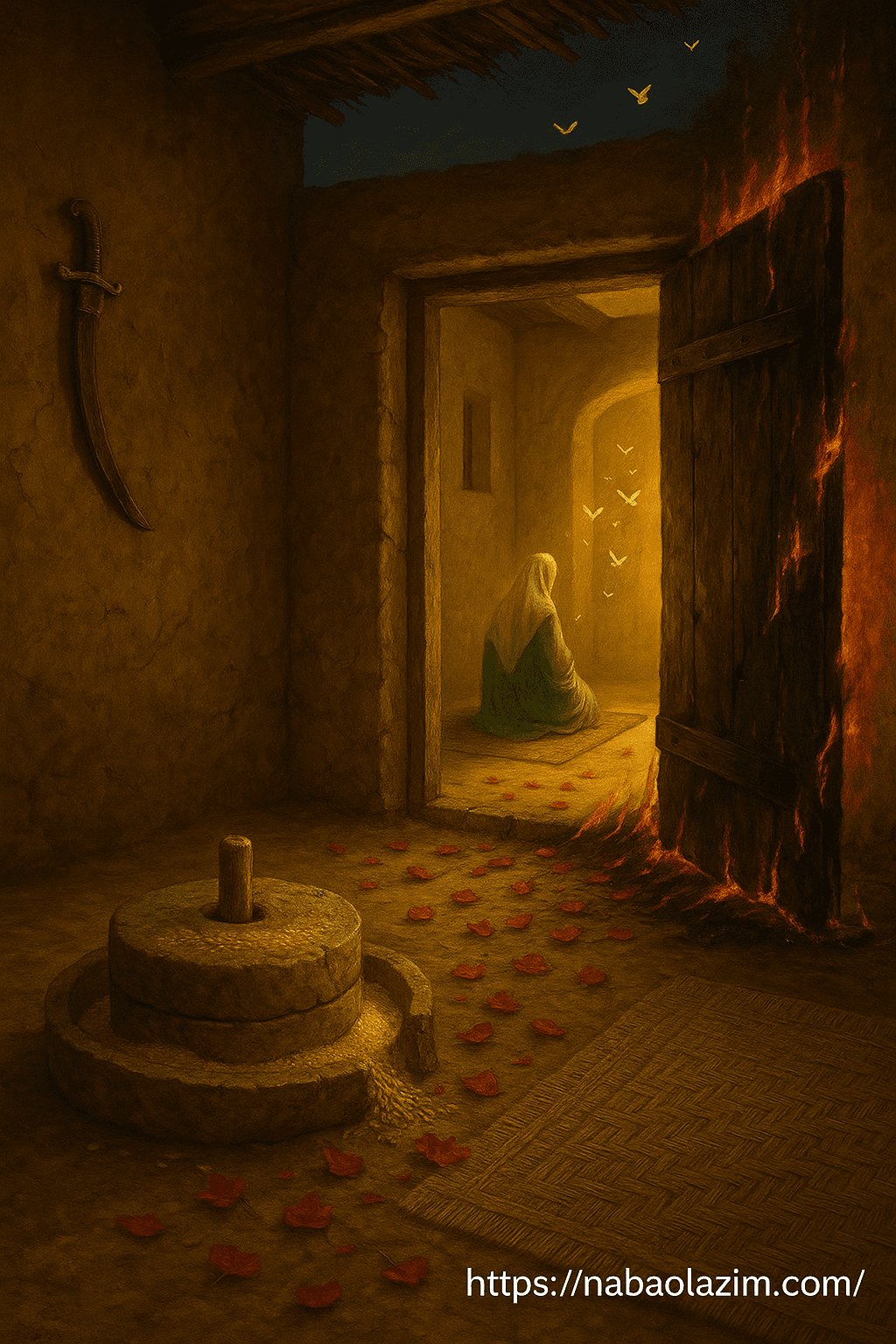
From the Luminous Reality of the Greatest Truthful Lady to the Distortion of Fatimid Sufferings in the Official History of the Caliphate
Fatimah (PBUH), the Divine Word and the Niche of God’s Light
The Prophet’s fragrant flower, the Greatest Truthful Lady, Fatimah—peace be upon her—possesses exalted stations and peerless virtues throughout every degree of existence. She is that very light which, at the beginning of creation, manifested alongside God’s first creature: the Greatest Prophet (PBUH) and the Commander of the Faithful (PBUH). Thus, Adam (PBUH) saw her name inscribed upon the leg of the Throne and implored God by her right, and by the right of her father, husband, and children, whereupon his repentance was accepted. Fatimah (PBUH) is one of those divine “words” manifested in the verse, «فَتَلَقّی آدَمُ مِن رَبِّهِ کَلِماتٍ فَتابَ عَلَیهِ…»; there Adam supplicated: «اللهم بحقّ فاطمه و أنت فاطر السّماوات و الأرض…». The fragrant flower of the Messenger of God (PBUH) is also that blessed niche through which the likeness of God’s light shines in the heavens and the earth: «… مَثَلُ نُورِهِ کَمِشکاةٍ…».
Fatimah (PBUH), Beyond a Name: A Mystery Coextensive with Laylat al-Qadr
The truth is that one cannot suffice, in speaking of her rank, with the brief expression, “Fatimah is Fatimah,” for Fatimah is not merely a name. She is Mansurah and al-Zahra’; she is the lady who received the title “al-Batul” and became known, through the words of the Noble Prophet (PBUH), as “Umm Abiha.” Lady al-Zahra’—peace be upon her—is the mistress of the women of both worlds, of the first and the last. It has been said of her: «فُطِمَ شیعتُنا عن معرفتها»—that is, even our Shi‘a have been cut off from comprehending the reality of her being. Who can know Fatimah al-Zahra’ (PBUH) as she truly is? Whoever knows her has apprehended the reality of Laylat al-Qadr. And how beautifully God said: «وَ ما أدرَاکَ ما لَیلَةُ القَدر»—What can make you know what Laylat al-Qadr is?
Lady Fatimah—peace be upon her—a ray from the Prophet’s light
The sacred being of Fatimah al-Zahra—peace be upon her—is an inseparable part of the light of the Noble Prophet (PBUH), as the Messenger of God himself said: «فاطِمَةُ بَضعَةٌ مِنّی؛ Fatimah is a part of my very being; whoever harms her has harmed me.» Thus, every heart that places a thorn in her path has, in truth, affronted the sanctity of the Messenger of God and falls under this divine warning: «إِنَّ الَّذینَ یُؤذونَ اللهَ وَ رَسولَهُ لَعَنَهُمُ اللهُ فِی الدُّنیا وَ الآخِرَةِ وَ أَعَدَّ لَهُم عَذاباً مُهِیناً» (Al-Ahzab, 57).
Accordingly, whatever bears the mark of hurting or dishonoring Fatimah al-Zahra (PBUH) is, on the scale of the Qur’an, deemed an injury to God and His Messenger, carrying His curse and remoteness from His mercy. To demonstrate the sensitivity of this sanctity, the Noble Qur’an recalls the etiquette of being in the Prophet’s presence: «یَا أَیُّهَا الَّذینَ آمَنوا لا تَرفَعوا أَصواتَکُم فَوقَ صَوتِ النَّبِیِّ وَ لا تَجهَروا لَهُ بِالقَولِ کَجَهرِ بَعضِکُم لِبَعضٍ أَن تَحبَطَ أَعمالُکُم وَ أَنتُم لا تَشعُرون» (Al-Hujurat, 2): O you who believe, do not raise your voices above the voice of the Prophet, nor speak loudly to him as you speak loudly to one another, lest your deeds come to nothing while you are unaware.
In another verse, the sanctity of his house is safeguarded thus: «یَا أَیُّهَا الَّذینَ آمَنوا لا تَدخُلوا بُیوتَ النَّبِیِّ إِلّا أَن یُؤذَنَ لَکُم…» (Al-Ahzab, 3): Do not enter the Prophet’s houses without permission.
If raising one’s voice in the presence of the Messenger of God entails the fear that one’s deeds may be nullified, and entering his house without permission violates the Lord’s command, then to what extent must the sanctity of the heart and home of Fatimah—peace be upon her—be preserved: she who is a part of the Prophet’s flesh and the trust of his light?
Fire upon Fatimah’s House (PBUH): Fire upon the House of Revelation
All these etiquettes and warnings also apply to the fragrant flower of the Messenger of God, Lady al-Ṣiddīqah al-Kubrā (peace be upon her), for her house is the house of light and the abode of revelation. Now reflect: if merely raising one’s voice in the presence of the Prophet (PBUH) entails the danger of all one’s deeds being rendered void, and entering his house without permission is counted among harming the Messenger of God, then what can be said of one who casts firewood behind the door of Fatimah’s house, prepares a fire, and, accompanied by a group, threatens to burn the house of the Prophet’s daughter?
Has the hand that places fire upon the door of the house of revelation ever tasted faith in revelation? Does its owner’s heart accord even the slightest sanctity or worth to the Prophet who regarded this house as his own sanctuary? The truth is that such audacity can issue only from a heart filled with rancor and hatred toward the Messenger of God (PBUH) and his cherished legacy.
In a land where the face of truth remains veiled, making decisions is like walking in darkness: difficult, and at times impossible. Satan is always lying in wait to conceal truth and present falsehood to people clothed in the guise of truth; his greatest deception is precisely to show darkness in the color of light. In such a field, whoever unveils the face of falsehood is in truth placing the cup of guidance, sip by sip, into humanity’s hands. Lady al-Ṣiddīqah al-Ṭāhirah (peace be upon her) did not herself thirst for suffering and calamity; rather, she drank bitterness sip by sip so that she might let human beings taste the sweetness of guidance sip by sip—so that, on the day when the veils are lifted, no one may have an argument against God on the Day of Resurrection, saying: «We did not recognize the path.»
Yes, through her protest and through the resounding cry she raised against the deviation of the community, Fatimah (PBUH) kindled the lamp of guidance. She stripped from him the cloak of deception worn by the Iblis of her age, so that his true face would be revealed to all; so that everyone would know that the one who hypocritically spoke of the community’s welfare and good had never, in the depths of his heart, believed in prophethood. For had even an atom of faith in the Prophet and revelation existed within him, threatening to burn the abode of revelation would have had no place in his code of conduct.
Distortion to Exonerate the Criminal
Those who have understood the truth of these events yet chosen the crooked path and placed their pens in the service of the front of hypocrisy can never bear for the events and calamities suffered by Fatimah to reach the present and future of history clearly and without concealment. For this reason, driven by sectarian prejudices and in defense of figures dear to them, they have recorded only those portions of the events that deflect the arrow of accusation from the ruling caliphal order and do not direct the reader’s heart toward the righteousness of the conduct of the Commander of the Faithful (PBUH) and Lady Fatimah al-Zahra (PBUH).
Along this path, many of the Fatimid events and sufferings—such as the incident of the beating and injury of Lady Fatimah (PBUH)—have either been entirely erased from the pages of history or recounted in a distorted and attenuated form. In some cases, what partisan historians have written is merely a faint shadow of the bitter truth of reality; such as the incident of setting fire to Fatimah’s (PBUH) house, which, instead of a frank admission of burning, has been reduced merely to a “threat to burn.”
Nevertheless, even the few statements that have reached us through these layers of censorship and distortion, on their own constitute a firm proof of the truth of Shi‘i thought—a proof whose fruit is to establish the unfitness of the usurpers for the caliphate, unveil their profound lack of belief in the truth of revelation, and demonstrate their disregard for the many verses revealed concerning the Household of the Messenger of Allah (PBUH). For this reason, in examining the Fatimid sufferings, and especially the episode of the “threat to burn the House of Revelation,” we turn to certain reliable Sunni sources so that we may hear history’s testimony from their own tongues.
Examining the Threat to Burn the House of Revelation in Sunni Sources
One of the transmitters of this grave violation of sanctity is Ibn Qutaybah al-Dinawari. In his account, he writes: The first caliph asked about a group who had refused to pledge allegiance to him and had gathered around Amir al-Mu’minin ‘Ali (PBUH), and he sent the second caliph to compel them to pledge allegiance. The second caliph came to ‘Ali’s (PBUH) door and called them out, but received no reply. At that point, he requested firewood and swore: “By Him in Whose hand is my soul, if you do not come out, I shall set fire to the house with everyone in it.” He was asked: “What if Fatimah (PBUH) is in this house?” They received the answer: “Even if she is in it.” In the end, everyone except ‘Ali (PBUH) left the house and pledged allegiance. (1)
The recording of this explicit threat to set fire to Fatimah’s (PBUH) house does not appear only in the book al-Imāmah wa al-Siyāsah; rather, explicit statements and reports confirming the occurrence of this episode are also found in other reliable sources of the school of the caliphs. Therefore, no doubt remains concerning the very fact of “the second caliph’s threat to burn the house of Fatimah al-Zahra (PBUH),” and this event stands among the definite and undeniable incidents of Islamic history. Remarkably, these explicit statements have been recorded in works whose attribution to their authors is itself accepted and indisputable even among Sunnis. (2)
Threatening to Burn the House of Revelation Means Denying Revelation
Although some reports speak only of a “threat to set the House of Revelation on fire” and do not explicitly mention flames being kindled in the home of Fatimah al-Zahra (peace be upon her), some have seized upon this point in an attempt to spare the perpetrator of this crime from disgrace and exonerate him. Yet one must heed the fact that even if we take as our criterion this minimal account reported by partisan historians, it is sufficient to reveal the unworthiness of one who threatens to burn the very House of Revelation.
This small amount transmitted by opposing sources is enough to prove the violation of the sanctity of the noble daughter of the Prophet of Islam (peace be upon him), a lady who is among the unique instances of the Verse of Purification and among the highest manifestations of the Verse of Affection. Put more plainly, one who stands at Fatimah’s door (peace be upon her) and says, “Even if Fatimah is in the house, I will set it on fire,” cannot possess even the slightest share of true faith in the Qur’an and revelation. Nevertheless, we do not confine ourselves to this amount; in search of clearer evidence for the burning of the door of Lady al-Zahra’s house (peace of Allah be upon her), we turn page by page through the books of Ahl al-Sunnah.
Evidence for the Burning of the Door of Fatimah’s House (peace be upon her)
- 1—“Al-Baladhuri (3), who died in 224,” writes: “The first sent for Ali to obtain his allegiance, but he did not pledge allegiance; therefore the second (4) came holding a wick (5).” (6)
- 2—“Abu al-Fida (7), who died in 732,” writes: “The second came forward with a piece of fire in order to set the house on fire.” (8)
- Likewise, in the report of “Ibn Abd Rabbih, who died in 328,” we read: “He came forward with a piece of fire in order to burn the house down over the heads of its inhabitants.” (9).
Indications in the Sources for the Burning of the Door of Fatima’s House, Peace Be Upon Her
Ibn Abi al-Hadid al-Mu'tazili, who died in 656 (10), writes: “As for the incident of kindling the fire ... only the Shi'ites have transmitted it, although a group among the ‘Ahl al-Hadith’ have also narrated something similar.” (11)
Continuing the view of Ibn Abi al-Hadid al-Mu'tazili, we refer to the writing of one of the distinguished Imamite jurists and theologians: “Dhu al-Majdayn, Sayyid Murtada ‘Alam al-Huda, may his secret be sanctified, who died in 436,” writes in reply to “Qadi ‘Abd al-Jabbar, who died in 415”: “We have made clear that the report of kindling the fire has also been transmitted by a group of non-Shi'a narrators—who are not accused in the view of Ahl al-Sunna.” (12)
Footnotes:
1. Quoted from: al-Imamah wa al-Siyasah, vol. 1, p. 12. 2. Some of these sources are: 1—“Ansab al-Ashraf” (authored by Baladhuri, died 279), vol. 1, p. 586, no. 1184, Egypt edition. 2—“Tarikh al-Umam wa al-Muluk” (authored by Tabari, died 310), vol. 2, p. 443, Beirut edition. 3—“al-‘Iqd al-Farid” (authored by Ibn ‘Abd Rabbih, died 328), vol. 5, pp. 13–14, Beirut edition, 1404 AH (= vol. 3, p. 64, Egypt edition, 1353 AH). 3. “Dhahabi, died 748,” writes of him: He was a memorizer of numerous hadiths, knowledgeable in history, and a learned individual. (Tadhkirat al-Huffaz, vol. 3, p. 892) 4. Regarding the manner of “‘Umar’s coming,” we read: ‘Umar came toward ‘Ali’s house in order to burn the house with those inside it. See: “Rawdat al-Manazir” (authored by Ibn Shahnah, died 882), printed in the margin of the book “al-Kamil” (authored by Ibn al-Athir, died 630), vol. 11, p. 113, al-Afandi edition, 1301 AH (= vol. 7, p. 164). 5. A wick is a twisted cord that is set aflame in order to kindle a fire. 6. Ansab al-Ashraf, vol. 1, p. 586. 7. “Dhahabi, died 748,” writes of him: al-Mu'ayyad [‘Imad al-Din, Abu al-Fida’, Isma‘il ibn ‘Ali] was a generous, virtuous person, knowledgeable about legal rulings. (Siyar A‘lam al-Nubala’, vol. 23, p. 274) 8. al-Mukhtasar fi Akhbar al-Bashar, vol. 1, p. 156. 9. al-‘Iqd al-Farid, vol. 5, p. 13. 10. “Dhahabi, died 748,” explicitly states that “Ibn Abi al-Hadid” was a Mu'tazili, writing: فَإنَّ الْعِزَّ مُعْتَزِلیٌّ. عزّ الدين [‘Abd al-Hamid ibn Hibat Allah, known as Ibn Abi al-Hadid] was a Mu'tazili. (Siyar A‘lam al-Nubala’, vol. 23, p. 274) 11. Sharh Nahj al-Balaghah, vol. 2, p. 21. 12. al-Shafi fi al-Imamah, vol. 4, p. 119.
Author: Hamed Sarem
Related articles
Comments
No comments yet.
