
The Prophet: On the Day of Resurrection I Will Intercede for Abu Talib in a Way That Astonishes All Jinn and Humankind
Author: Hamed Sarem

On the anniversary of the passing of Abu Talib, the father of Ali
Abstract
This article examines the role of Abu Talib in supporting the Prophet of Islam and defending Islam. Satan has always sought to extinguish the light of divine guidance, but God, by His power, prevented the path of guidance from being destroyed. At Ghadir Khumm, Satan’s last hope of extinguishing the light of guidance was disappointed. Nevertheless, the enemies of Islam, especially the party of the Samiri, sought to divert the path of guidance by creating seditions and innovations. One such plot was the insult directed at the father of the Commander of the Faithful, Abu Talib, and the fabrication of hadiths such as the hadith of “Dahdah,” spread by al-Mughira ibn Shu‘ba, an enemy of the Banu Hashim household. Imam al-Rida, in rejecting these fabricated hadiths, affirmed Abu Talib’s faith and counted him among the companions of prophets and the righteous. Through unparalleled sacrifices—including placing his own son in the Prophet’s place to protect him, and threatening to kill the leaders of Quraysh—Abu Talib played a major role in supporting Islam. After Abu Talib’s death, the Prophet attended his funeral and promised him a great intercession on the Day of Resurrection. Relying on reliable Shi‘i sources, this article examines Abu Talib’s faith and stations and highlights his role in Islamic history.
The Prophet attended Abu Talib’s funeral and told those present: “On the Day of Resurrection, I will intercede for Abu Talib in such a way that all jinn and humankind will be astonished.”
Satan always seeks to extinguish the divine light and spares no effort in this path. At times he teaches Nimrod’s followers to kindle a fire so that they may burn Abraham, the idol-breaker in the history of the prophets; once he instructs the Samiri to replace monotheism with a calf; and at another time he teaches satanic people to crucify Jesus so that the light of guidance may be extinguished. Yet “the hand of God is above their hands”: Jesus ascended to heaven by God’s will, someone resembling him was crucified, the Samiri’s calf was burned by Moses, the fire became a garden for Abraham, and God will not allow the path of guidance to be closed.
Satan’s final hope was likewise disappointed at Ghadir, for the disbelievers would no longer be able to extinguish the light of guidance: “Today those who disbelieve have despaired of your religion.”
Although Satan knew the truth of his Lord’s word, he did not prostrate before Adam; indeed, despite knowing of divine punishment, he stood against God and said that he would lead God’s servants astray. Satan also knew that Islam had been perfected through Ghadir and that, with Ghadir, there would be no deviation or crookedness in religion for anyone seeking the truth. Yet Saqifa still came to be, so that the story of the Samiri and his calf might be repeated. This time, however, those whose hearts had been illuminated by Ghadir did not submit to prostration before the Samiri’s calf, even though they sacrificed their lives to preserve Ghadir.
Insulting the Father of the Commander of the Faithful: An Injustice Done to Him
The party of the Samiri did not cease its mischief; whenever it could, it sought to extinguish the path of guidance by creating sedition, deviation, and innovation, and each time it produced a new sedition, deviation, or innovation.
Their innovations never found their way into the school of the followers of Ghadir throughout history. Among the plots of these satanic people was insulting and abusing the father of the Commander of the Faithful, Ali ibn Abi Talib. The party of the Samiri spared no oppression or injustice against the Commander of the Faithful Ali—from insulting him to cursing him from pulpits.
Although they knew that Ali was the Prophet’s very life, they did not stop there and also attacked the faith of the Commander of the Faithful’s father. This false attribution demeans the rank of the Commander of the Faithful, and they called his noble father an unbeliever—God forbid.
Fabricating a False Hadith
They fabricated for Abu Talib the false hadith of “Dahdah.” The hadith of Dahdah in hell was circulated by al-Mughira ibn Shu‘ba, the intimate supporter and kind drinking companion of Abu Sufyan during the Age of Ignorance. It claims that Abu Talib is in a shallow pool of fire and wears fiery sandals whose heat makes his brain boil. Here, of course, we must apologize to the Imam of the Age and the Commander of the Faithful for recounting this fabricated narration. All these reports trace back to al-Mughira ibn Shu‘ba, who was among the haters of the Banu Hashim household, among the killers of Lady Fatima, and among the devoted followers of the Umayyad dynasty.
They take the verse, “Indeed, you do not guide whom you love, but God guides whom He wills,” meaning: O Prophet, you do not guide whomever you love; rather, God guides whomever He wills, to concern Abu Talib, even though this verse was revealed in Medina. As stated in the book al-Hujjah ‘ala al-Dhahib, its occasion of revelation was the polytheists at the Battle of Uhud, when they broke the Prophet’s tooth and he said, “O God, guide my people, for they do not know,” and God sent down this verse regarding them. Others have said that it concerned those who held back from migration... (1) When this fabricated report was presented before Imam al-Rida, he said: “The enemies of God lie. Indeed, Abu Talib is among the companions of the prophets, the truthful, the martyrs, and the righteous—and excellent are they as companions.” He also said that if you doubt Abu Talib’s faith, your end is the Fire. (2)
Enmity toward the Ahl al-Bayt
Sayyid Ibn Tawus writes: “We have neither seen nor heard that they consider themselves in need of the strictness they apply to Abu Talib when recognizing anyone else as a Muslim. For the method we know of them is that, on the basis of the slightest single report they find, they count every unbeliever as a Muslim, even if that report contains no more than a tiny indication of their purpose. Yet their enmity toward the Hashimites has reached such a point that they deny Abu Talib’s faith, even though clear proofs establish it...” (3)
Who, truly, was Abu Talib, that there has been such disagreement over his faith? And what importance does his belief or unbelief have? Many of the Prophet’s relatives did not believe, while many who were not his relatives did believe. Why do some insist that Abu Talib did not believe, while others insist upon his faith?
The answer is that the followers of Satan’s path could find no flaw whatsoever in the Commander of the Faithful Ali, and could never raise even the slightest objection against him. Since they also harbored hatred and rancor toward him, they attacked his noble father and tried to portray him as an unbeliever, hoping in their vain imagination thereby to diminish the lofty rank of the Commander of the Faithful. But it must be said: “O fly, the arena of the Simurgh is not your playground; you disgrace yourself and trouble us.”
One whose rank is comparable to that of the successors of the prophets cannot reasonably be imagined to be an unbeliever. Therefore, Shi‘a unanimously believe in his faith. Some of his characteristics are mentioned below so that we may pay greater attention to his rank and establish the necessary implication of Abu Talib’s faith.

Threatening to Kill the Leaders of Quraysh
Abu Talib, may God’s exalted pleasure be upon him, put both his own life and that of his tribe at risk in Mecca in support of the Messenger of God. In defending the Prophet, he went so far as to order the killing of Mecca’s leaders. On the night when the Prophet went on the Ascension, Abu Talib did not see him in Mecca. He summoned all his sons and servants, armed them, and ordered them to go beside the Ka‘ba in the morning, each standing beside one of the leaders of Quraysh seated there—all of them prominent men of Mecca. If they did not find the Messenger of God in the morning or receive news of him, Abu Talib was to signal the killing of Mecca’s leaders, and they were to carry it out. At sunrise the Prophet arrived. When Abu Talib saw him, he went toward him joyfully, kissed him between the eyes, and said: “O son of my brother, by God, had you delayed, not one of Mecca’s leaders would have remained alive...” (4)
Sacrificing His Son for the Prophet
The valley of Abu Talib was among the harshest days of the Prophet’s life. During this severe blockade, the men of Banu Hashim defended the Prophet’s life lest the enemy attempt to assassinate him at night. Abu Talib’s defense of the Prophet’s life was remarkable and showed the strength of his faith in the Prophet. At night, he made his son sleep in the Prophet’s place, so that if an attempt were made on the Prophet’s life, Abu Talib’s son would be the sacrifice. (5)
Can it be claimed that Abu Talib, who defended the Prophet with such intensity and sacrifice, did not believe in his mission? If there is even a little fairness, one must acknowledge that faith had penetrated Abu Talib’s very being. After Abu Talib’s death, Ali washed his body by the Prophet’s order, and the Prophet attended his funeral and addressed those present: On the Day of Resurrection, I will intercede for Abu Talib in such a way that all jinn and human beings will be astonished. (6)
During Abu Talib’s Lifetime, the Prophet Was Honored through His Support
As long as Abu Talib was alive, the Prophet was honored in Mecca and no one dared harm him. When Abu Talib died, Quraysh united in harming the Prophet and obstructing his call. Gabriel descended to the Prophet and said: “God sends you greetings and tells you: Leave Mecca; your protector and supporter has died.” (7)
There is much to say about Abu Talib’s stations and faith, and Shi‘i scholars from the past to the present have written many books about his rank, which cannot be listed in this brief piece. (8) Therefore, only the narration from Imam al-Rida is mentioned, for it indicates both the knowledge and greatness of the father of Ali and proves Abu Talib’s true faith and conviction.
The Inscription on Abu Talib’s Ring
Imam al-Rida says that the following words were inscribed on Abu Talib’s ring: “I am pleased with God as Lord, with my nephew Muhammad as Prophet, and with my son Ali as his successor.” (9)
Notes
1. Al-Khisal, trans. Kamara’i, vol. 2, p. 39; “Why Did Abu Talib Not Officially Join the Party of Islam?”, p. 36.
2. Bihar al-Anwar, al-‘Allama al-Majlisi, vol. 35, pp. 110–111.
3. Sayyid Ibn Tawus, Tara’if, p. 87; quoted in: al-Ghadir (Persian), Shaykh al-Amini, trans. by a group of translators, vol. 14, pp. 343–346.
4. Iman Abi Talib, Shaykh al-Mufid, pp. 23–24. Shaykh al-Mufid writes that this account is unanimously accepted by biographers and historians.
5. Al-Sahih min Sirat al-Imam Ali, Sayyid Ja‘far Murtada al-‘Amili, vol. 2, pp. 81–84.
6. Iman Abi Talib, Shaykh al-Mufid, pp. 25–26.
7. Iman Abi Talib, Shaykh al-Mufid, pp. 24–25.
8. Some of these books are: Iman Abi Talib by Shaykh al-Mufid; al-Hujjah ‘ala al-Dhahib ila Takfir Abi Talib by Sayyid Fakhar ibn Ma‘add al-Musawi, who died in 630 AH; Abu Talib Mu’min Quraysh by Abdullah al-Khunayzi; and Abu Talib Batal al-Islam by Sayyid Haydar Muhammad Sa‘id al-‘Urfi. The book al-Sahih min Sirat al-Imam Ali also addresses this subject in one of its sections.
9. Al-Sahih min Sirat al-Imam Ali, Sayyid Ja‘far Murtada al-‘Amili, vol. 2, pp. 102–104.
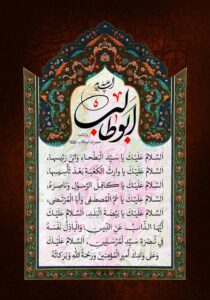
Explanation of the Ziyara Image in the Text
Some later books contain ziyara texts for which no trace was found when their wording was searched in earlier sources. Research has identified two ziyara texts concerning Abu Talib. Beyond examining their chains of transmission, these texts can also be examined in terms of content. Searching phrases from these two ziyara texts in earlier books can lead to certain narrations and historical statements on the subject. For example, the phrase “guardian of the Messenger” is reflected in a form in the ziyara of the Prophet. Other passages in these ziyara texts also correspond with Abu Talib’s faith, his relationship with the Prophet and Ali, and his support for these two noble figures. Yet because these ziyara texts have not been found in ancient writings, it may be said that they bring together meanings from historical and narrative statements in a collection; indeed, they became a model for later researchers and scholars.
Author: Hamed Sarem
Related articles
Comments
No comments yet.
