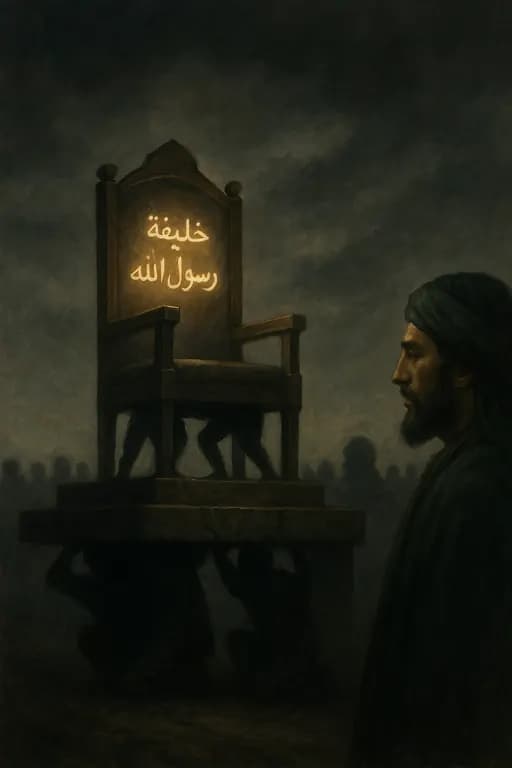
Sunnis themselves acknowledge: Fatimah (peace be upon her) was angry, estranged, and buried at night; how long will her martyrdom be denied?
Author: Hamed Sarem
A Comparative Analysis of the Reports of al-Bukhari, al-Tabari, al-Dhahabi, and Ibn Hajar on the Fate of Lady Fatimah al-Zahra (peace be upon her), Based on Authoritative Sunni Sources
Abstract:
This study seeks to examine the oppression and martyrdom of Lady Fatimah al-Zahra (peace be upon her), not on the basis of Shi‘i narrations, but solely by relying on authoritative and well-known Sunni sources. The author demonstrates that, based on explicit acknowledgments in works such as Sahih al-Bukhari, Tarikh al-Tabari, Siyar A‘lam al-Nubala’, al-Isabah, and other Sunni hadith and historical sources, at least several definitive propositions can be established:
Lady Fatimah’s (peace be upon her) anger and estrangement toward the first caliph; her failure to reconcile with him until the end of her life; her nighttime burial and the concealment of her grave; the threat to burn Fatimah’s (peace be upon her) house; and her early death at a young age, shortly after the Prophet’s (peace be upon him) passing.
It is then shown that the totality of this evidence is incompatible with the assumption of a “natural and ordinary death”; according to Sunni intra-traditional criteria, the reading of martyrdom and oppression is more logical and more acceptable.
Introduction:
The question of the martyrdom or natural death of Lady Fatimah al-Zahra (peace be upon her) is among the most sensitive discussions in the history of early Islam and in Shi‘i–Sunni discourse. In this disagreement, Shi‘is generally cite their own specific narrations, while Ahl al-Sunna, owing to religious partisanship, do not accept those narrations.
In this article, Shi‘i narrations are entirely set aside, and the criterion of discussion is the primary and well-known Sunni sources, especially:
Sahih al-Bukhari and its commentaries (Fath al-Bari, ‘Umdat al-Qari); biographical and rijal works (al-Isabah, Siyar A‘lam al-Nubala’, al-Thiqat…); historical works (Tarikh al-Tabari, Ansab al-Ashraf, Muruj al-Dhahab…); and certain Sunni or Sunni-inclined theological-historical works (Sharh Nahj al-Balaghah of Ibn Abi al-Hadid, al-Wafi bi al-Wafayat, Lisan al-Mizan, and…).
The aim is to derive the following conclusions from within Sunni sources:
Fatimah (عليها السلام) was wronged and was not satisfied with the prevailing situation; she became angry with the caliph of the time and broke off relations with him; she did not speak with him until the end of her life; her burial took place at night and without the caliph being informed; and her grave has remained hidden to this day.
We shall then see how this set of reports, in light of hadiths such as “Whoever angers her angers me” and “Indeed, God becomes angry at Fatimah’s anger,” conflicts with the assumption of a “natural and ordinary death.”
1. Lady Fatimah’s Anger with and Estrangement from Abu Bakr in Sahih al-Bukhari
1–1. Bukhari’s Explicit Text
Sahih al-Bukhari, Book of Khums, hadith 3093, states:
“Fatimah, the daughter of the Messenger of God, became angry and forsook Abu Bakr; she did not speak to him until she died.”
Translation: “Fatimah, the Prophet’s daughter, became angry with Abu Bakr, abandoned him, and did not speak to him until her death.”
This report appears in the most authoritative Sunni hadith collection after the Qur’an—a book whose authenticity Sunni scholars themselves regard as so foundational that denying it would amount to shaking the very basis of religion.
1–2. Corroboration and Commentary in Other Sunni Sources
The same content is repeated in similar form elsewhere in Sahih al-Bukhari (in the chapters on khums, inheritance obligations, and military campaigns). Major commentators on al-Bukhari, such as:
Badr al-Din al-‘Ayni in ‘Umdat al-Qari; Ibn Hajar al-‘Asqalani in Fath al-Bari
They have explained this hadith in detail; none of them denied the original fact of Fatimah’s anger and estrangement (peace be upon her), but merely sought to justify or reinterpret it.
In addition to al-Bukhari, some other Sunni sources (such as Musnad Ahmad and Sunan al-Nasa’i) report the account of the claim to Fadak and the dispute between Fatimah (peace be upon her) and the first caliph in greater detail, indicating a serious conflict and rupture rather than a mere juristic disagreement.
1–3. Connection with the Hadith: “Whoever Angers Her Has Angered Me”
In Sahih al-Bukhari, hadith no. 3714 is narrated from the Prophet (PBUH):
“Fatimah is a part of me; whoever angers her has angered me.”
“Fatimah is a part of my very being; whoever provokes her anger has provoked my anger.”
The combination of Bukhari’s two definitive propositions:
Fatimah (PBUH) became angry with Abu Bakr and did not speak with him until her death. Whoever angers Fatimah has angered the Prophet;
This makes the following conclusion unavoidable:
“According to the intra-sectarian standard of Ahl al-Sunnah, whoever incurs Fatimah’s (peace be upon her) wrath also incurs the wrath of the Messenger of God (peace be upon him).”
2. The Nighttime Burial and the Concealment of the Grave
2–1. The Explicit Statement in Sahih al-Bukhari
Sahih al-Bukhari, Hadith 1341, states:
“When she passed away, Ali buried her at night and did not inform Abu Bakr of her [death].”
Translation: “When Fatimah passed away, Ali buried her at night and did not inform Abu Bakr of her burial.”
This statement contains three key points:
Burial at night; the principal person responsible for the burial: Ali (peace be upon him); withholding notice from the caliph of the time regarding the greatest lady among Muslim women.
2–2. Confirmation in Other Sunni Sources
Commentators on al-Bukhari, such as Ibn Hajar in Fath al-Bari, add—by citing other reports from Ibn Sa‘d’s al-Tabaqat—that:
The nighttime burial and the failure to inform the caliph took place in accordance with Lady Fatimah al-Zahra’s own will (peace be upon her).
Some other hadith scholars and historians, including Ibn Hibban in al-Thiqat, have reported that:
Fatimah (peace be upon her) lived only a short time after her father; Ali (peace be upon him) performed the funeral prayer over her body; he buried her at night; and he did not notify anyone to attend her funeral procession.
Some reports also narrate from Aishah that Ali (peace be upon him) did not inform Abu Bakr of the funeral procession and burial.
2–3. Historical Questions
If:
the relationship between Fatimah (peace be upon her) and the caliph of the time was normal and free of tension; and if neither injustice had occurred nor any serious dispute;
Then the following question arises:
Why did the Prophet’s daughter (peace be upon him) stipulate in her will that the caliph should not attend her funeral procession? Why was she buried at night and away from public view? Why has her grave remained hidden to this day?
In the logic of history and the social conventions of that time, concealing the grave of the Prophet’s only daughter was a silent protest and an enduring symbol of dissatisfaction.
3. Early Death and the Short Interval after the Prophet’s Demise (peace be upon him)
3–1. Sunni Historical Consensus on the Short Interval
Most Sunni historians and biographical authorities—including:
Ibn Ḥajar al-ʿAsqalānī in al-Iṣābah fī Tamyīz al-Ṣaḥābah, Shams al-Dīn al-Dhahabī in Siyar Aʿlām al-Nubalāʾ, and others—
have reported that Lady Fāṭimah (peace be upon her):
lived for between 75 and 95 days—or, at most, approximately five to six months—after the Prophet’s (peace be upon him) death; and she passed away at roughly eighteen to her early twenties.
These data are also repeated in contemporary Sunni fatwas and writings; although they portray her death as “natural,” they nevertheless:
do not deny the fact of the short interval and her young age at the time of death
.
3–2. Absence of a Clear Report of a Specific Illness
In Sunni historical texts, her condition is usually described in general terms such as:
“مَرِضَت” (she became ill); “وَهَنَت” (she became weak and debilitated).
These accounts refer to Fatimah’s (peace be upon her) physical condition after the Prophet’s (peace be upon him) passing; yet none of them identifies a specific medical cause for her illness.
By medical and rational standards, the sudden death of a young woman—especially within a short time after intense political and psychological pressures—cannot simply be regarded as a “natural death,” particularly when it:
accompanied by intense anger, estrangement, a nighttime burial, and the concealment of her grave.
4. Threat to Burn Fatima’s (peace be upon her) House
4–1. The Reports of al-Tabari and al-ʿIqd al-Farid
In al-Tabari’s History, concerning the pledge of allegiance and the opposition of a group of the Muhajirun and the Ansar, a report states that Umar ibn al-Khattab came to Ali’s (peace be upon him) house and said:
“By God, I shall surely burn it over you unless you come out to give the pledge of allegiance.”
“By God, you must either come out to give the pledge of allegiance, or I will set the house on fire over you.”
In al-ʿIqd al-Farid, by Ibn Abd Rabbih al-Andalusi, too, within its account of the events of Saqifa, there is a report of Umar’s threat to burn the house and a statement to the effect that, when he was told, “Fatima is in this house,” he replied:
“Even if it is Fatimah” — “Even if it is Fatimah, I will still burn it.”
4–2. Confirmation in Some Other Sunni Sources
In other Sunni historical works, such as:
Al-Baladhuri’s Ansab al-Ashraf, as well as quotations transmitted by al-Safadi in al-Wafi bi al-Wafayat and al-Shahrastani in al-Milal wa al-Nihal from the Muʿtazilite al-Nazzam,
Reference has been made to the attack on Fatimah’s house (peace be upon her), the threat of fire, and even beating and mistreatment. Although some later Sunni hadith scholars have sought to weaken or deny these reports, the very existence of such narrations in the Sunni written heritage is undeniable.
4–3. The Implication of This Threat
The house that Muslims regarded as the “House of Fatima” and the “House of Revelation,” and in which:
Ali (a), Fatima (a), and al-Hasan and al-Husayn (a)
resided, became the target of a threat of arson. Such a threat—even if, hypothetically, it was never carried out—demonstrates the intensity of the political tension and the rift between the Ahl al-Bayt (a) and the ruling authority of the time, and is regarded as laying the groundwork for subsequent events.
5. Explicit Affirmation of Fatima’s oppression in Sunni Works
Alongside classical hadith and historical sources, a number of Sunni thinkers and historians have also referred to the oppression of Lady al-Zahra (a) and the direct impact of the events following the Saqifa on her death; among them:
Jalal al-Din al-Suyuti in some of his historical-hadith works; Ibn Abi al-Hadid al-Mu‘tazili in Sharh Nahj al-Balagha, who, citing major Sunni historians (al-Tabari, al-Baladhuri, al-Waqidi, and others), speaks of the assault on the house, the threat to burn it, and the mistreatment of Fatima (a); al-Mas‘udi in Muruj al-Dhahab, who mentions the political pressures on Ali (a) and Fatima’s profound grief; al-Safadi in al-Wafi bi al-Wafayat, who, in his biographical entry on al-Nazzam, refers to striking Fatima’s abdomen and the miscarriage of Muhsin; Ibn Hajar al-‘Asqalani in Lisan al-Mizan, who cites reports concerning the “inspection of Fatima’s house” (tafaḥḥuṣ bayt Fāṭima) and Abu Bakr’s expression of remorse, although he discusses their chains of transmission critically.
This body of evidence seriously strengthens the claim of “oppression and death under the pressure of political and social events.”
6. The Hadith: “Fatimah’s Pleasure Is God’s Pleasure; Fatimah’s Wrath Is God’s Wrath”
6–1. Its Transmission in al-Hakim’s al-Mustadrak and Other Sources
Al-Hakim al-Nishapuri narrates a hadith with this meaning in al-Mustadrak ‘ala al-Sahihayn:
“Indeed, God becomes wrathful because of Fatimah’s wrath and is pleased because of her pleasure.”
“Indeed, God becomes wrathful because of Fatimah’s wrath and is pleased because of her pleasure.”
This meaning is also found in other sources, such as:
Kanz al-‘Ummāl by al-Muttaqī al-Hindī and al-Mu‘jam al-Kabīr by al-Ṭabarānī
It has likewise been reported. Some Sunni hadith scholars have discussed this hadith from the standpoint of its chain of transmission and deemed it weak; however, the important point is that:
6–2. Consistent in Content with a Hadith in Sahih al-Bukhari and Sahih Muslim
The hadith transmitted with an authentic chain in Sahih al-Bukhari and Sahih Muslim, and accepted by all Sunnis, is as follows:
“Fatimah is a part of me; whoever angers her has indeed angered me.”
In terms of meaning, this hadith in fact conveys the same point:
Fatimah’s (peace be upon her) anger is the criterion for the Messenger of God’s (peace be upon him and his family) anger; and given the Messenger’s standing before God, the Prophet’s pleasure and anger are regarded as identical to divine pleasure and divine wrath.
Therefore, from within the Sunni authentic sources themselves, one may infer the following principle:
Fatimah’s (peace be upon her) anger = the Prophet’s (peace be upon him and his family) anger = God’s anger
Now, if—according to al-Bukhari’s own admission—Fatimah (peace be upon her) became angry with Abu Bakr and did not speak to him until the end of her life, the question is:
Can someone who has incurred the wrath of God and His Messenger nevertheless be considered “in the right and innocent”?
This is a question that must be answered within the framework of Sunni theology.
Conclusion
Based on the foregoing, and solely relying on authoritative Sunni sources—without using Shi'a narrations or weak reports—the following propositions can be established from within the school itself:
Lady Fatima al-Zahra (peace be upon her), during the incident of Fadak and thereafter, became angry with the first caliph and did not speak to him until the end of her life (Sahih al-Bukhari and its commentaries). Her body was buried at night by Ali (peace be upon him), in accordance with her own bequest, and the caliph of the time was not informed of her funeral procession; her grave also remains hidden to this day. Lady al-Zahra (peace be upon her) died at a young age, within a very short period—approximately three to six months—after the Prophet’s (peace be upon him) death, without any clear report of a prolonged and identifiable natural illness. In Sunni historical sources, threats to burn Fatima’s (peace be upon her) house, and even reports of assault and harm, have been transmitted, although some later scholars have sought to weaken them. A number of Sunni-leaning historians and theologians have explicitly spoken of Lady al-Zahra’s (peace be upon her) oppression and of the direct effect of political pressures and the events following Saqifah upon her death. In Sunni hadith texts, Fatima’s (peace be upon her) anger has been regarded as equivalent to the Prophet’s (peace be upon him) anger and, consequently, to divine anger.
Now, placing these data side by side raises this central question:
Can the death of such a figure—with all the signs of anger, estrangement, threats, nighttime burial, and the concealment of her grave—be regarded as a “natural and ordinary death”?
Or is the recitation of the testimony of martyrdom at the height of being wronged (being wronged), given this volume of intra-religious evidence, more reasonable and fair?
If this question is answered by setting aside prejudice and relying solely on the internal criteria of Sunni Islam itself, it will pave the way for a deeper understanding of early Islamic history and the status of the Ahl al-Bayt (a).
Special Section: Debate Version (Four Decisive Questions)
In debates, all the foregoing discussions can be condensed into several questions. This section may be displayed on the website as a highlighted box or callout:
Two-line debate version based on Sunni sources 1. If Lady Fatimah (peace be upon her) was not martyred and no injustice was inflicted upon her, why has her grave remained hidden to this day, with no one knowing its precise location? 2. If her relationship with the Caliph was ordinary and free of dispute, why does Sahih al-Bukhari state that she became angry with Abu Bakr and did not speak to him until her death? 3. If her death was natural, why did she pass away at a young age, only three to six months after the Prophet’s (peace be upon him) passing, while Sunni sources contain no clear report of a prolonged and natural illness? 4. If everything was ordinary, why did she instruct that she be buried at night, that the Caliph not attend her funeral, and that her grave remain concealed? If no clear, documented answer exists for these questions, the fair-minded reader must concede that: the reward of the Prophetic mission was squandered, and the Prophet’s (peace be upon him) daughter passed away at the height of oppression—not through a simple, natural death, but through the reality called martyrdom.