
Fortifying the Critiques: A Scholarly Analysis Refuting the Claim of the Legitimacy of the First Caliphs (4) (An Analysis of the Critiques in Shi‘i Theology)
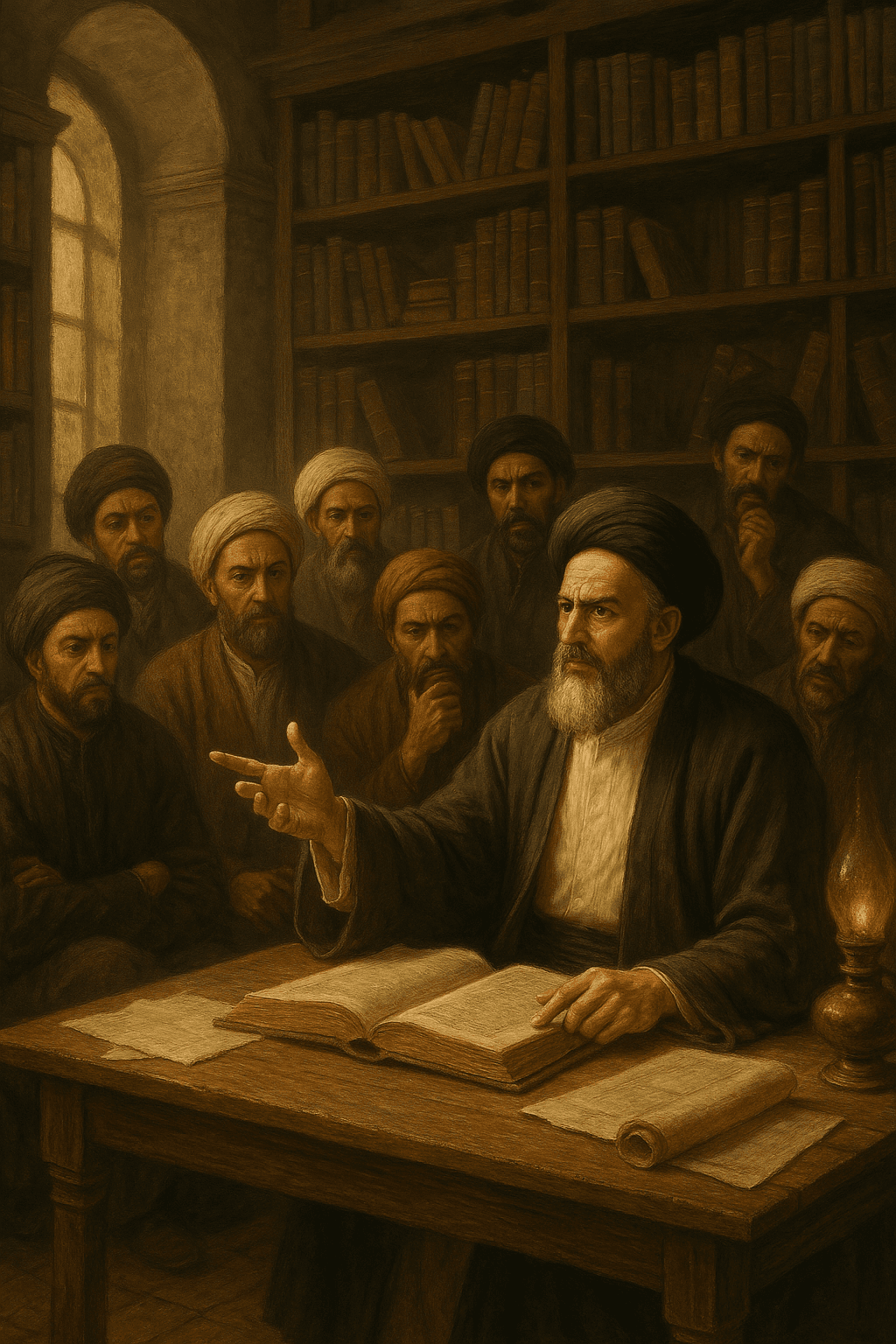
The Close Connection Between Imamate and Criticisms in Shi‘i Thought: An Examination of the Approach of Tuhfat al-Ithna ‘Ashariyyah
Abstract
This study examines the close connection between the concept of Imamate and the discussion of criticisms (mata‘in) within the theological thought of Twelver Shi‘ism. Focusing on a critical analysis of the approach of ‘Abd al-‘Aziz Dihlawi in his work “Tuhfat al-Ithna ‘Ashariyyah,” which seeks to separate these two epistemic domains, this article argues that Imamate, as the immediate succession to the Noble Prophet (PBUH), and criticisms, as objections grounded in the lack of qualification of the earliest rulers, have a fundamental and unavoidable connection. By examining Dihlawi’s argumentative fallacies in justifying the conduct of the caliphs and Companions, and by presenting the reasoned and illuminating responses of the late Sayyid Muhammad Quli in the book “Tashyid al-Mata‘in,” this research shows that, from the perspective of Shi‘i theology, infallibility and knowledge constitute essential pillars of Imamate, and that the commission of error—especially grave errors affecting faith and justice—removes legitimacy and eligibility from this divine office. The aim of this study is to explain the internal coherence of the Shi‘i belief system in logically linking Imamate and criticisms, and to critique a view that seeks to weaken this strategic connection in Shi‘i theology.
Keywords: Imamate, criticisms (mata‘in), Tuhfat al-Ithna ‘Ashariyyah, Sayyid Muhammad Quli, Twelver Shi‘i theology, infallibility, justice, immediate succession, theological critique
Introduction
One of the fundamental questions raised in the field of Shi‘i theological studies is why there is a profound and inseparable connection between the concept of Imamate and the discussion of criticisms (mata‘in). In this writing, Imamate is understood to mean the immediate succession and caliphate of the Noble Prophet (PBUH), whereas criticisms refer to objections raised against the first three caliphs, certain Companions, and even ‘A’ishah, emphasizing their lack of entitlement to assume the office of governance. Accordingly, these two discussions have a close and undeniable connection in Shi‘i thought.
Nevertheless, in the book "Tuhfat al-Ithna ‘Ashariyya," ‘Abd al-‘Aziz Dihlawi, in a noteworthy approach, has separated these two domains of discussion from one another and thereby disrupted the logical coherence of the discussion’s structure. In arranging the chapters of his book, Dihlawi first examines how the Shi‘i school emerged, then proceeds to Shi‘i theological discussions and an examination of the views of scholars and their works among the early Shi‘a. In the seventh chapter, he addresses the subject of Imamate, whereas the eighth chapter is devoted to resurrection and the Shi‘a’s differences with other schools, and the ninth chapter deals with jurisprudential issues, which constitutes a departure from doctrinal discussions. In this chapter, Dihlawi claims that the Shi‘a have acted contrary to the Two Weighty Things (al-Thaqalayn) in jurisprudential matters, a claim that has been answered in numerous critiques. Finally, in the tenth chapter, Dihlawi discusses the criticisms directed at the first three caliphs, ‘A’isha, and other Companions.
This arrangement of chapters in the book "Tuhfat al-Ithna ‘Ashariyya" appears to have been deliberate and intended to create a distance between the discussion of Imamate and that of the criticisms. As noted earlier, these two discussions are closely connected: whether a researcher, through an affirmative approach, seeks to explain the Imamate of the Commander of the Faithful, ‘Ali (a), or an investigator, by examining the criticisms, seeks to establish the unfitness of those claiming succession to the Messenger of God (s), both proceed along the same path. Logically, it would have been appropriate for Dihlawi, after addressing Imamate in the seventh chapter, to turn to the subject of the criticisms. Yet this deliberate separation between the two discussions was probably intended to downplay the earlier discussions and prevent the audience from paying close attention to the weaknesses in the responses offered to the criticisms. This approach constitutes a kind of device in the arrangement of discussions adopted by Dihlawi.
Critique and Examination of Dihlawi’s Fallacies in Justifying the Conduct of the Early Rulers
1. Critique and examination of Dihlawi’s fallacies in justifying the conduct of the early rulers: In the continuation of his efforts to justify the conduct of the three rulers, certain Companions of the Prophet (s), and ‘A’isha, ‘Abd al-‘Aziz Dihlawi introduces a premise which, in his view, paves the way for accepting their actions. In this premise, by advancing claims lacking scholarly support and, in some cases, containing falsehoods, he seeks to defend these figures.
1.1. Dihlawi’s fallacious arguments in exonerating the early rulers
At the beginning of his remarks, Dihlawi argues that no human being throughout history has been immune from the harm of the tongues of slanderers and critics, and that even the sacred Divine Essence is not exempt from this rule. In support of this claim, he refers to the Mu‘tazilite denial of the infallibility of prophets and to the Jews’ lack of belief in the infallibility of angels; he also cites, as examples, the criticisms raised by the Kharijites and the Nawasib against Imam ‘Ali (a) and the Ahl al-Bayt (a). Dihlawi goes on to regard these criticisms as having no effect on the rank and standing of the figures in question, likening them to the barking of dogs before the moon’s radiance, on the grounds that such slanders cannot diminish their lofty worth. He also emphasizes the exalted status of the caliphs, the Companions, and ‘A’isha, claiming that their opponents, despite deep hostility and rancor, have been unable to present more than a few baseless doubts against them. In justifying the possible errors of these individuals, Dihlawi states that if a person commits only ten or twelve mistakes throughout his life and none of them is criticized, this itself counts as evidence of his greatness. He even considers ordinary mistakes within a family to be excusable if one’s conduct in other matters is sound.
1.2. Critique of the Late Sayyid Muhammad Quli of Dihlawi’s Fallacies
In responding to this part of Tuhfah-yi Ithna ‘Ashariyyah, the late Sayyid Muhammad Quli considers the restriction of the denial of the prophets’ infallibility to the Mu‘tazilites to lack a sound basis, attributing it to Dihlawi’s insufficient familiarity with theological views and schools. Referring to the division of Shi‘a opponents into the two major groups of the Mu‘tazilites and the Ash‘arites, he states that most Ash‘arites likewise agree with the Mu‘tazilites on the permissibility of prophets committing sin and do not accept their absolute infallibility. Therefore, Dihlawi’s criticism of the Mu‘tazilites regarding the denial of prophetic infallibility also applies to himself and the adherents of the Ash‘ari school. Citing the authoritative theological work of the opponents, al-Mawaqif and its commentaries, the late Sayyid Muhammad Quli emphasizes the Ash‘arite view that prophets may commit major sins before their mission. In contrast, he refers to the predominant Mu‘tazilite view that prophets may not commit major sins, even if they repent, because this would cause people to turn away from them. Notably, ‘Abd al-‘Aziz Dihlawi himself, in other parts of Tuhfah-yi Ithna ‘Ashariyyah, explicitly acknowledges the existence of verses and narrations indicating the possibility of prophets’ error, rebuke, and repentance, and regards denying this and ascribing absolute infallibility to them as a kind of exaggeration and excess. This evident contradiction in Dihlawi’s words shows that denying the prophets’ absolute infallibility was not confined to the Mu‘tazilites and that he himself is inclined toward this belief. Continuing his critiques, the late Sayyid Muhammad Quli refutes Dihlawi’s claim that the denial of the angels’ infallibility should be attributed to the Jews, and then challenges the claim that only a few baseless objections exist against the earliest rulers. In his valuable work Tashyid al-Mata‘in, he stresses that the most effective method for explaining truths is to rely on the proofs and narrations accepted by the opposing party (the method of ilzam). On this basis, Shi‘a scholars (may Allah have mercy on them), in responding to opponents, have mentioned objections established on the basis of their own narrations and reports. The late Sayyid Muhammad Quli considers the abundance of objections found in the books of the defenders of the earliest rulers—despite their extensive efforts to conceal or justify these shortcomings—to be a clear sign of the superiority and truthfulness of the Ahl al-Bayt (peace be upon them). He states that the earliest rulers and their followers possessed such reprehensible qualities and so many objections that even many volumes could not contain their account. Given the extreme caution exercised by the opponents of the Ahl al-Bayt (peace be upon them) in transmitting historical events that implicitly or explicitly call the fitness of those rulers for leadership into question, this itself is clear testimony to the exalted rank and unquestionable truthfulness of the Ahl al-Bayt (peace be upon them).
2. Critique of Dihlawi’s View Regarding the Tolerable Measure of Error by Rulers and the Response of the Late Sayyid Muhammad Quli (continued)
In continuing his arguments, Dihlawi, by advancing the statement that “if a person commits only 10 or 12 mistakes over the course of his life and none of those mistakes is criticized, this itself is a sign of his greatness,” seeks to portray the few errors of his intended rulers as natural and even as evidence of their greatness. In this way, while implicitly acknowledging the existence of at least ten to twelve errors in the conduct of these persons, he seeks to offer a lenient justification for the objections raised by the Shi‘a against the earliest rulers.

2.1. Critique of the Late Sayyid Muhammad Quli of the Restriction and Justification of Rulers’ Errors
In refuting this view of Dihlawi, the late Sayyid Muhammad Quli considers limiting the errors and objections concerning the three rulers to ten or twelve cases to be incorrect and unrealistic. He emphasizes that Shi‘a scholars (may Allah have mercy on them) have never mentioned the objections concerning these individuals in a limited and definite form; rather, these cases have always been presented illustratively and in accordance with the capacity of the discussion and the available opportunity, and every Shi‘a scholar has explained these objections to the extent of his ability. The late Sayyid Muhammad Quli then critiques Dihlawi’s analogy concerning the responsibility of managing a house and the grave office of caliphate and rulership. Dihlawi had claimed that if a person were responsible for a household and made ten mistakes daily while the rest of the affairs were conducted properly, he should be regarded as an exceptional and rare person. The late Sayyid Muhammad Quli replies that this is a false analogy, because the situation of one who holds leadership after acquiring this responsibility through force and domination is altogether different. One who has attained rule by relying on power, coercion, and domination, and through a coup, will naturally be prone to committing numerous errors, even more than ten or twelve. This statement of the late Sayyid Muhammad Quli implicitly refers to the theory of divine designation in contrast to the theory of election—which opponents present as the outward face of the discussion, while in practice power and domination have played the principal role.
2.2. The Fundamental Difference Between the Error of One Divinely Designated and One Who Usurps Power
Emphasizing this essential distinction, the late Sayyid Muhammad Quli states that the words of Shi‘a scholars concern a person designated by Almighty Allah and His Messenger (may Allah bless him and his family) for the office of Imamate. In such circumstances, even the commission of a single error calls such a person’s fitness for that grave responsibility into question, let alone if ten or twelve errors issue from him—especially if one of those errors is so great that it leads to the loss of faith. This view of the late Sayyid Muhammad Quli rests on rational necessity, Qur’anic verses, and Prophetic narrations concerning the Imam’s infallibility, to which reference was made earlier. From the perspective of reason, if one who undertakes the leadership and guidance of a community is continually prone to error, that community will be led toward destruction. The late Sayyid Muhammad Quli subtly states that even with respect to an ordinary human being, accepting ten or twelve errors over a lifetime is difficult, let alone in the case of a person claiming the station of Imamate and divine leadership. Under these conditions, even the slightest error can render him unfit.
2.3. Citing the Noble Qur’anic Verse to Refute the Permissibility of the Error of a Wrongdoer in the Office of Imamate
The words of the late Sayyid Muhammad Quli in this regard are derived from the noble Qur’anic verse that states: “And [recall] when Abraham was tested by his Lord with words and he fulfilled them. He said, ‘Indeed, I will make you an Imam for the people.’ He said, ‘And of my descendants?’ He said, ‘My covenant does not reach the wrongdoers.’” (al-Baqarah/124). This verse indicates that Almighty Allah chose Abraham (peace be upon him) for the office of Imamate after testing him and after he fulfilled the test. When Abraham (peace be upon him) requested Imamate for his descendants, Allah said: “My covenant does not reach the wrongdoers.” Since Imamate is a divine covenant, how can it be accepted that a person who commits ten or twelve errors—errors that may lead to oppression and injustice—is worthy of this divine covenant?
2.4. The Effect of Grave Errors on the Removal of an Imam’s Fitness
The late Sayyid Muhammad Quli then points to a very important matter: the nature and magnitude of an error. Although the very commission of error by an infallible Imam is unacceptable, woe when that error is so grave that it results in the loss of faith. For example, actions such as violating the sanctity of the house of Lady Fatimah al-Zahra (peace be upon her) and harming and tormenting the only daughter of the Prophet (may Allah bless him and his family), to the point of her martyrdom and her anger at the perpetrators of this crime, are among the grave errors which, if attributed to a person in a position of leadership, would certainly remove his fitness and even render him an apostate. After such a grave error, none of that person’s actions or words can any longer be regarded as being on the path of guidance.
2.5. Emphasis on the Leader’s Disqualification through Even a Single Mistake
The late Sayyid Muhammad Quli stresses that this issue becomes doubly significant when such errors are committed by a person charged with leadership or the caliphate. In that case, even one mistake can disqualify him from that office. To confirm this point, the late Wali Allah, father of Abd al-Aziz Dihlawi, narrates in the book "Izalat al-Khafa" a report from Salman al-Farsi, according to which Umar asked him: "Am I a king or a caliph?" Salman replied: "If you take even one dirham more or less from the wealth of the Muslims and spend it in an improper place, then you are a king, not a caliph." This report clearly shows that even a small error in disposing of public funds removes the title of caliph from a person and places him among worldly kings. Accordingly, how can one accept that a person who has committed dozens of major errors should still be worthy of the office of caliphate and succession to the Prophet (PBUH)?
The analysis and examination of the views presented in "Tuhfat Ithna Ashariyyah" and the critical responses of the late Sayyid Muhammad Quli in "Tashyid al-Mata'in" clearly show that, in Shi‘i thought, there is an inseparable connection between the concept of Imamate and the discussion of mata'in. Dihlawi’s attempt to separate these two domains and justify the errors of the early rulers by resorting to fallacies and disregarding
Conclusion
An analysis of the structure and content of the book Tuhfat Ithna Ashariyyah showed that separating the discussions of Imamate and mata'in—contrary to the logical and methodological foundations of the Shi‘i theological system—was a deliberate and conscious approach on the part of Abd al-Aziz Dihlawi. This separation not only disrupted the thematic coherence of the discussion, but also obscured the inseparable connection between proving the Imamate and criticizing the legitimacy of the early caliphs.
The critiques of the late Sayyid Muhammad Quli, relying on authoritative theological sources, showed that Dihlawi’s fallacies—including the improper generalization of the denial of the prophets’ infallibility to a particular sect, the false analogy between the office of caliphate and family responsibilities, and the disregard for Qur’anic criteria for the legitimacy of the Imamate—lack rational and transmitted validity.
From the perspective of Shi‘i thought, the Imamate is a divine covenant that does not reach an oppressor, and even the commission of one grave error can remove a person from this office. Consequently, efforts to exonerate the caliphs’ conduct by justifying their numerous mistakes are contrary to the rational and revealed principles of the Imamate.
Accordingly, the close connection between the Imamate and the polemical objections is not merely historical or disputational; rather, it is rooted in the internal logic of Imami theology and is inseparable from the process of establishing the legitimacy of the Ahl al-Bayt (peace be upon them).
Author: Hamed Sarem
Related articles

Farvardin 9, 1404 AP
Fortifying the Critiques: A Scholarly Analysis Refuting the Claim of the Legitimacy of the First Caliphs (3) (The Inseparability of Imamate and Historical Critiques)Author: Hamed Sarem
Comments
No comments yet.

