
A Jewish Disciple: An Analysis of the Influence of Jewish Sources on the Structure of Umar’s Caliphate (1)
Author: Hamed Sarem
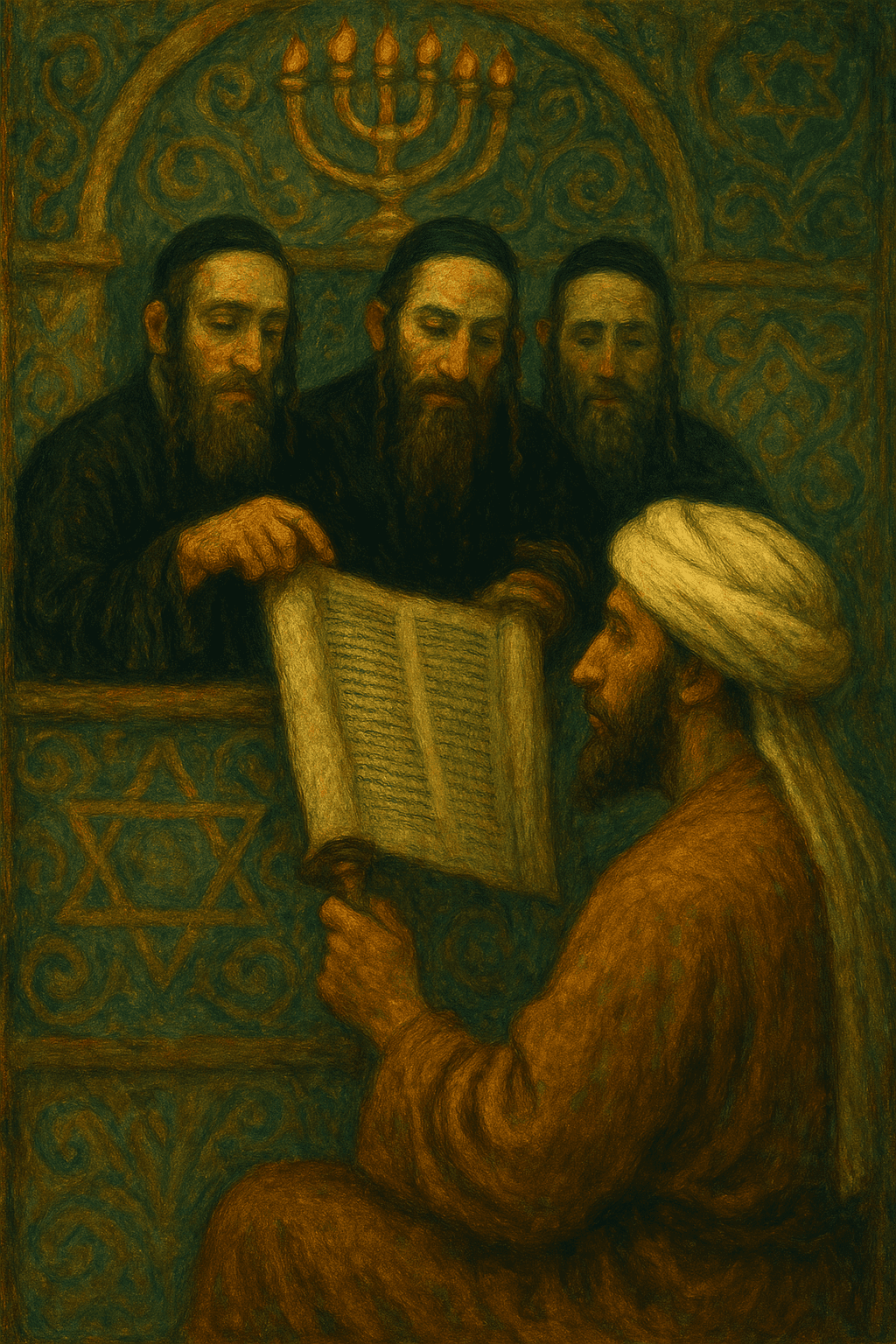
ʿUmar and the Torah: From Secret Copying to the Anger of the Prophet of Islam
A study of authoritative Sunni hadith sources, including Musannaf ʿAbd al-Razzāq, al-Maṭālib al-ʿĀliyah, Shuʿab al-Īmān, Kanz al-ʿUmmāl, and other works, unveils one of the most sensitive events of early Islam: the direct connection of ʿUmar ibn al-Khaṭṭāb with the teachings of the People of the Book, and the Prophet of Islam’s extremely severe response to this conduct.
Below, we review documented and reliable narrations from Sunni sources that report ʿUmar’s effort to copy books of the Jews, present them to the Prophet, and the Prophet’s explicit and unprecedented confrontation with this behavior.
1. The Narration of Khālid ibn ʿArfaṭah
From Khālid ibn ʿArfaṭah:
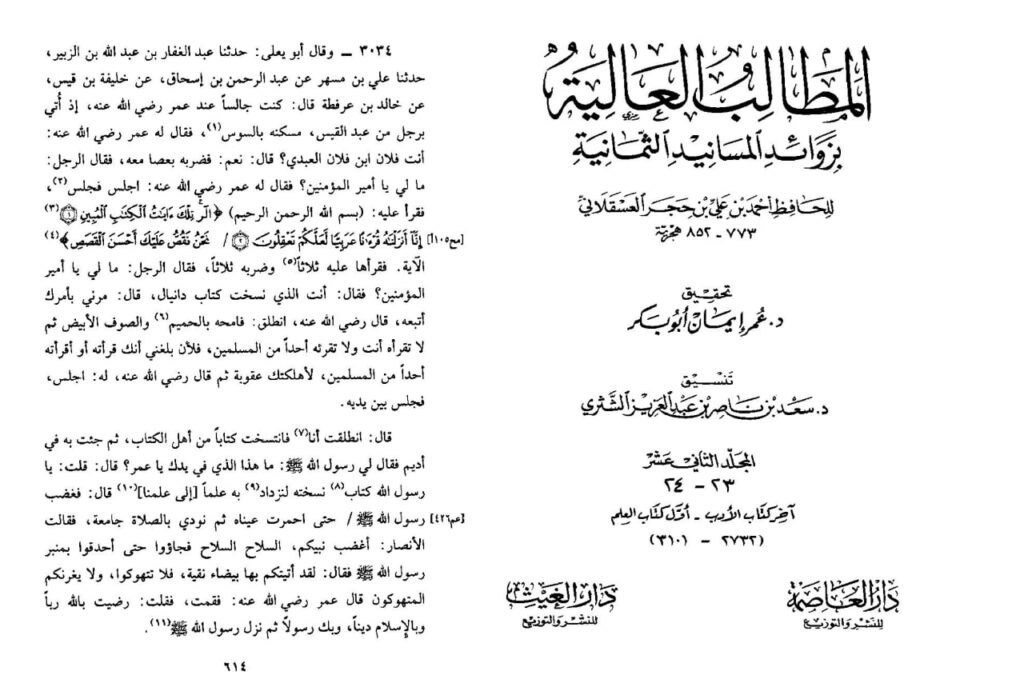
[p. 614] 3034 — Abū Yaʿlā said: ʿAbd al-Ghaffār ibn ʿAbd Allāh ibn al-Zubayr narrated to us; ʿAlī ibn Mushir narrated to us, from ʿAbd al-Raḥmān ibn Isḥāq, from Khalīfah ibn Qays, from Khālid ibn ʿArfaṭah, who said: I was sitting with ʿUmar, may Allah be pleased with him, when a man from ʿAbd al-Qays, whose residence was in Susa, was brought to him. ʿUmar, may Allah be pleased with him, said to him: “Are you so-and-so, son of so-and-so, al-ʿAbdī?” He replied: “Yes.” So he struck him with a staff he had. The man said: “What have I done, Commander of the Faithful?” He said to him: “Sit.” So he sat, and he recited to him: “In the Name of Allah, the Most Merciful, the Most Compassionate. Alif, Lām, Rā. These are the verses of the clear Book. Indeed, We have sent it down as an Arabic Qur’an so that you may understand. We relate to you the best of stories...” [the verse]. He recited it to him three times and struck him three times. The man said: “What have I done, Commander of the Faithful?” He said: “Are you the one who copied the Book of Daniel?” He replied: “Command me as you wish, and I shall follow your command.” He, may Allah be pleased with him, said: “Go and erase it with hot water and white wool; then neither read it yourself nor teach it to any Muslim. For if word reaches me that you have read it or taught it to any Muslim, I shall destroy you as a punishment.” Then he said to him: “Sit,” so he sat before him.
He said: I set out and copied a book from the People of the Book, then brought it on a parchment. The Messenger of Allah, peace and blessings be upon him, said to me: “What is this in your hand, O Umar?” He said: I replied: “O Messenger of Allah, it is a book I copied so that we may increase our knowledge with knowledge.” The Messenger of Allah, peace and blessings be upon him, became angry until his eyes reddened. Then the call was made: “The prayer is to be held collectively.” The Ansar said: “Has your Prophet been angered? To arms, to arms!” They came until they gathered around the pulpit of the Messenger of Allah, peace and blessings be upon him. He said: “I have brought it to you pure and white; therefore, do not become bewildered, and do not let those who are bewildered deceive you.” Umar, may Allah be pleased with him, said: Then I stood and said: “I am pleased with Allah as Lord, with Islam as religion, and with you as Messenger.” Then the Messenger of Allah, peace and blessings be upon him, descended.
The content of the narration of Khalid ibn Urfutah
Khalid ibn Urfutah says:
One day, a man was brought before Umar ibn al-Khattab. Umar struck him with the stick in his hand, then recited to him three times the opening verses of Surah Yusuf and struck him again. The man said in astonishment: “O Commander of the Faithful, why are you striking me?” Umar replied: “I am punishing you because you have written the book of the Prophet Daniel.”
The man said: “Then tell me what I should do.”
Umar said: “Go and erase those writings with hot water and white wool; then neither read it yourself nor recite it to anyone else. If I hear that you have read it again or read it to someone, I will punish you severely.”
Then Umar said: “Now sit down; I want to tell you a story.”
He said: “One day, I myself went and copied a writing from the People of the Book (the Jews) from a parchment, and I brought it to the Messenger of God, peace and blessings be upon him and his family. The Prophet asked me: ‘O Umar, what is this in your hand?’”
I said: ‘O Messenger of God, I have copied a book from the People of the Book so as to increase my knowledge.’”
The Messenger of God, peace and blessings be upon him and his family, became so angry at these words that his cheeks reddened. Then he ordered that a public call to prayer be made and that the people come to the mosque. When the Ansar heard that the Prophet was angry, they said: “The Prophet has become angry; take up your weapons, take up your weapons!” The people hurried over and gathered around the pulpit of the Messenger of God.
Then the Prophet, peace and blessings be upon him and his family, said: “O people! I have brought you a pure, clear, and complete religion. All knowledge has been gathered for me.
Do not be deceived by the deficient bewildered ones. Do not fall into doubt!”
At this point, Umar rose and said: “O Messenger of God, I am pleased with God as Lord, with Islam as religion, and with you as Prophet.”
Then the Prophet came down from the pulpit.
Sources
Al-Maṭālib al-ʿĀliyah bi-Zawāʾid al-Masānīd al-Thamāniyah, by Ibn Ḥajar al-ʿAsqalānī
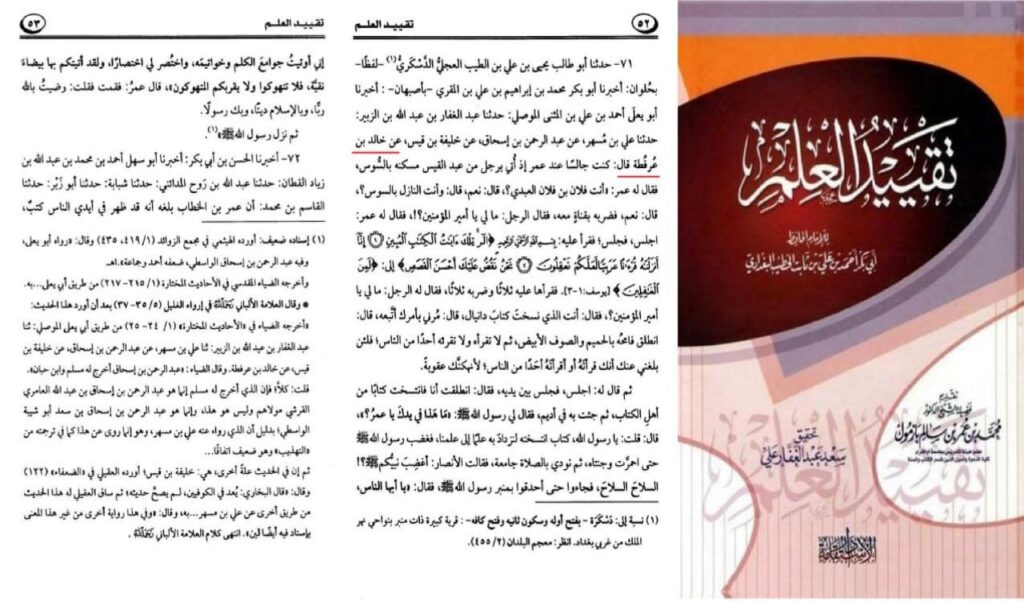
Taqyīd al-ʿIlm
Al-Muttaqī al-Hindī found a second chain of transmission for this account:
Ibn al-Mundhir, Ibn Abī Ḥātim (ʿAq), and Naṣr al-Maqdisī (Ṣ) [reported it] in al-Ḥujjah; and it has a second chain in al-Marāsīl.
He says that it has a second chain in al-Marāsīl.
Kanz al-ʿUmmāl
2. The narration of Abū Qilābah
This narration states that ʿUmar heard a book from the People of the Book and liked it. He obtained parchment and copied it. Then he came to the Prophet and began reading. At that very moment, the color of the Prophet’s face changed. One of the Anṣār cried out:
“May your mother be bereaved of you, O son of al-Khaṭṭāb! Do you not see the face of the Messenger of Allah?”
And the Prophet said:
“Indeed, I was sent as an opener and a seal, and I was given comprehensive words… So do not let the reckless destroy you.”
10163. ‘Abd al-Razzaq informed us, from Ma‘mar, from Ayyub, from Abu Qilabah, that ‘Umar ibn al-Khattab passed by a man reading a book that he had heard for an hour. He found it pleasing and said to the man: “Do you write from this book?” He replied: “Yes.” So he bought a parchment for himself, then brought it to him and copied it on its inner and outer sides. Then he brought it to the Prophet ﷺ and began reading it to him. The face of the Messenger of Allah ﷺ began to change color. A man from the Ansar struck the book with his hand and said: “May your mother be bereaved of you, O Ibn al-Khattab! [p. 113] Do you not see the face of the Messenger of Allah ﷺ since you began reading this book today?” At that, the Prophet ﷺ said: “I was sent only as an opener and a seal, and I was given comprehensive words and their openings. Speech has been condensed for me in a condensed form, so do not let the reckless destroy you.”
Translation
One day, ‘Umar ibn al-Khattab passed by a man who was reading a book. ‘Umar stopped and listened, then took that book—the Torah—from the man and wrote a copy of it for himself. A few days later, he came to the Prophet and read part of this book. At that moment, the color of the Prophet’s face changed out of anger. A man from the Ansar was there and said to ‘Umar: “Can you not see that the Prophet’s face has changed? Do not read it.” The Prophet then said: “I was sent while I was the completer and seal of the previous religions, and I brought everything for you.”
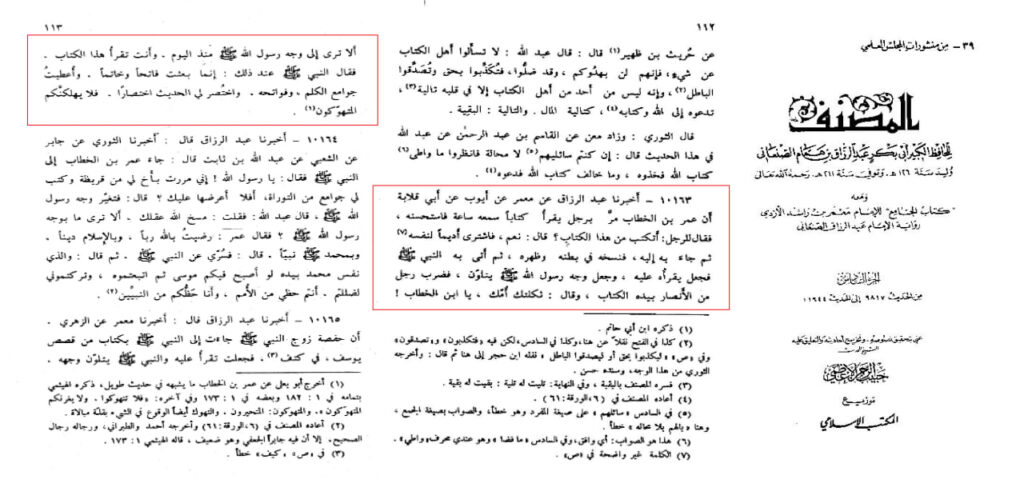
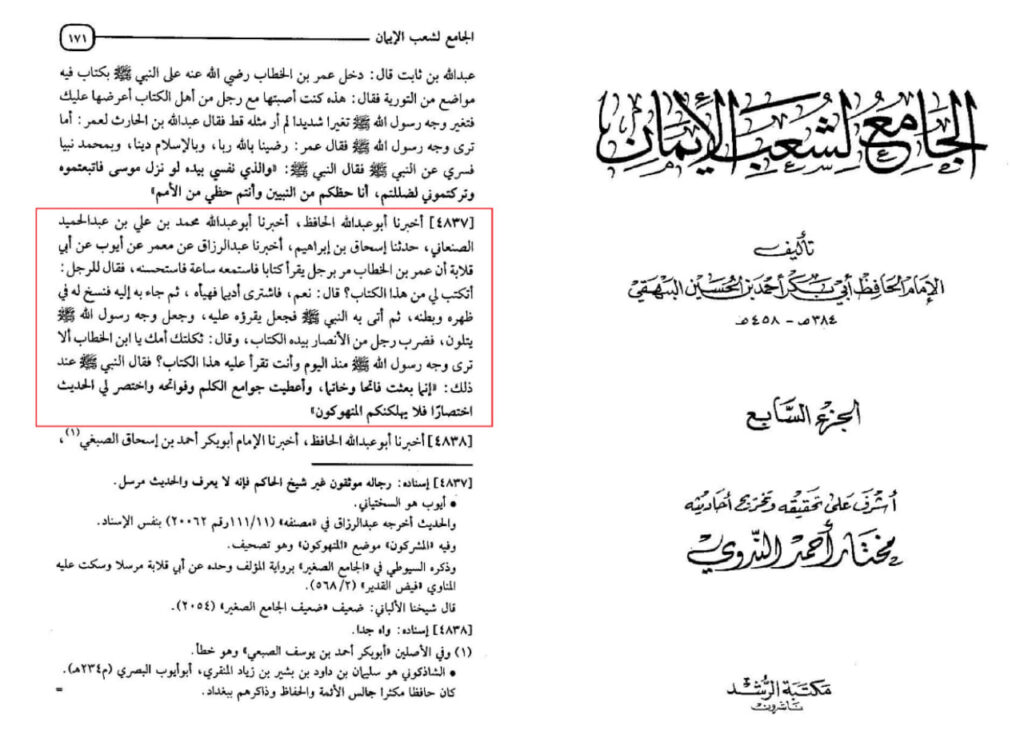
Musannaf of ‘Abd al-Razzaq al-San‘ani
Shuʿab al-Īmān, al-Bayhaqī
Analytical Note | Umar: A Student of the Jews and the Gateway to Isra'iliyyat
A review of the previously mentioned chains of transmission and narrations presents a very clear, yet troubling, picture of one of the most prominent figures in the history of the Sunni caliphate: a figure who not only maintained contact with the sources of the People of the Book, especially the Jews, but also copied directly from them, presented those writings to the Prophet, and in some cases punished others on the basis of those very teachings!
In the narration of Khālid ibn ʿArfaṭah, we do not merely witness Umar confronting someone who had copied the Book of Daniel; rather, we hear a more significant admission:
Umar himself had written out a copy of the Torah and brought it to the Prophet in order to complete his knowledge. This action met with the Prophet’s intense anger, to the point that the Prophet’s face turned red and a general order was issued for the Muslims to assemble in the mosque. The Prophet’s striking statement is likewise unforgettable:
“Indeed, I have brought it to you pure and clear; so do not become confused, and do not let those who are confused mislead you.”
In other words, the Noble Prophet, peace and blessings be upon him and his family, regarded this act not merely as a manifest deviation, but as a prelude to the misguidance of the community by the mutahawwikūn (= people who are confused and unstable in belief).
In the narration of Abī Qilābah as well, ʿUmar is again influenced by the words of the People of the Book; he quickly proceeds to procure parchment and make copies, and despite Islam’s revealed text, considers himself in need of Jewish knowledge. This conduct is a serious indication of ʿUmar’s intellectual inclination toward, and susceptibility to the teachings of, the People of the Book.
The key point here is that, in these narrations, ʿUmar is not a mere curious inquirer; rather, he is a “student of the Jewish school.”
He learns material from them, writes it down, brings it to the Prophet, defends it, and, in the face of the explicit text of the Qur’an and the Prophetic Sunnah, presents it as a supplementary source.
Moreover, the expression “أخی من یهود” (“my Jewish brother”) in other narrations completes this picture. ʿUmar not only regarded Jews as people of knowledge, but also trusted them to such an extent that he took notes from them, presented them to the Prophet, and awaited confirmation.
All of this shows that the path by which Isrāʾīliyyāt entered Islamic tradition undoubtedly passed through a gateway opened by ʿUmar ibn al-Khaṭṭāb.
Conclusion
History does not remain silent in the face of truth. The above reports not only recount an individual error, but also show how a man who later came to the head of the caliphate experienced discipleship under Jewish teachings and, knowingly or unknowingly, reopened the path for their intellectual influence within the body of the Ummah.
Today, if Sunni tradition contains reports replete with distortions, tales of the Children of Israel, and concepts alien to the spirit of the Quran, it should not be forgotten that the founder of this deviation was the very person who took pride in copying the Torah himself.
This note, alongside the official documents, is being published in the Persian-speaking sphere with scans of the primary sources so that fair-minded readers may judge for themselves.
Author: Hamed Sarem
Related articles

Comments
No comments yet.
