
Azar 23, 1403 APTasheed al-Mata'en
Strengthening the Objections to Uncover Malice
Author: Hamed Sarem
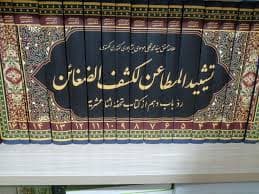
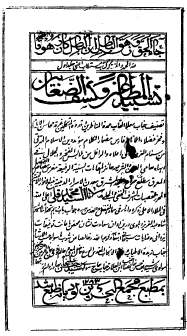
Tashīd al-Maṭāʿin
Imam al-ʿAskari, peace be upon him, narrated from Imam al-Sadiq, peace be upon him: Whoever strives to defeat the Nawāṣib—those who take a hostile stand against the Shiʿa—and shows chivalry and nobility for us, the Ahl al-Bayt; restrains them from misleading the weak among the Shiʿa; humiliates them before the Shiʿa; exposes their disgraces and plainly clarifies their faults; and praises and extols the cause of the Prophet, may God bless him and his family and grant them peace, and his family, peace be upon them, God will direct the efforts of the angels of Paradise toward building houses and palaces for him. For every letter he uses against the enemies, God will employ angels for him in a number greater than all the people of the world. How many palaces there are whose value none knows except the Lord of the worlds. (al-Iḥtijāj, p. 19)
The author’s son, Sayyid Iʿjāz Ḥusayn, says regarding the book Tashīd al-Maṭāʿin:
It is a book such as no one has seen its like, nor has time obtained an equal to it. It contains severe compelling arguments and sound refutations, and includes decisive, healing answers that no other book has contained. Direct knowledge makes report seem insignificant, and when one obtains the very thing itself, one does not concern oneself with its trace. Whoever finds it and recognizes its merit will regard my words about it and my praise of it as little.
That is: Tashīd al-Maṭāʿin is a book whose like no one has seen, and for which time will not find an equal. It contains powerful and firm arguments and crushing answers. It includes material that settles disputes through satisfying answers, the like of which is found in no other book. Perhaps these words may lead you to think lightly of the matter and suppose that I have exaggerated; but if you see it and know its worth, you will realize that my words and praise are very insignificant beside the greatness of that book. (Kashf al-Ḥujub wa al-Astār, p. 122)
Author: Hamed Sarem
Related articles


Comments
No comments yet.