The Brave One Who Accepted Peace
Author: Hamed Sarem
In the name of God, the Most Compassionate, the Most Merciful.
The Ahl al-Bayt of infallibility and purity are the divine caliphs on earth. The duty the angels had before Adam is the duty that all creatures today have before the Prophet's pure family. The difference is that humility and submission before God's caliph appeared in the command to prostrate before Adam. All human beings are obliged to submit completely to the Imam, because the Imam is God's caliph. Therefore, the Imam is not questioned by the follower in a manner of objection. The follower has no right to say 'why' to his Imam. His only duty before God's caliph is submission. He may say 'why' before his Imam only when the question is not for interrogation, but for deeper understanding, acquiring knowledge, increasing certainty, removing doubts, or an aim of that kind. Therefore, when we discuss why Imam Husayn, peace be upon him, went to Karbala, why he did this, and why he did not do that, these questions, God forbid, are not meant as criticism of the Imam's judgment. The direction of these questions is the perfection of the questioner.
Moving Toward the Imam Is a Test in This World
The infallible Imams, peace be upon them, according to what Imam al-Hadi, peace be upon him, taught in Ziyarat al-Jami'a al-Kabira, are the gate through which people are tested. This means that God tests people in this world through the pure Imams. Whoever moves toward the Imam and submits completely to the Imam is saved in this test. Whoever does not move toward the Imam, does not bring himself to the infallible Imam, and disobeys him, is destroyed in this world and after death. It makes no difference whether the Imam rises and takes up the sword, or remains silent and does not rise. Criticizing the infallible Imam is the height of foolishness and lack of intellect, even if some consider it a sign of enlightenment and rationality. Of course, properly understanding the lives of the infallible Imams is valuable, but not with the audacity of criticizing their positions.
The Peace of Imam Hasan Was the Result of the Kufans' Betrayal
Imam Hasan, peace be upon him, is the grandson of the Prophet and the second Imam of the Shi'a, the one who, together with Imam Husayn, peace be upon him, is the master of the youth of Paradise. The peace of Imam Hasan, peace be upon him, with Mu'awiya is among the most prominent historical points in the life of that noble Imam. The peace of Imam Hasan, peace be upon him, has been discussed, analyzed, and questioned so much that the various dimensions of the existence of that proof of God have been neglected.
Examining the peace of Imam Hasan, peace be upon him, is important because it reveals the betrayal of the enemies of Islam to people today. Without doubt, Imam Hasan, peace be upon him, did not desire that peace, because Mu'awiya was not only an oppressor; he was the number one enemy of Islam at that time. Mu'awiya, son of Abu Sufyan, continued the path of the polytheists of Quraysh in fighting Islam and destroying religion. But Imam Hasan, peace be upon him, was left alone in the war against Mu'awiya. His loneliness reached the point that even the commanders of his army and the tribal leaders allied with him had promised cooperation to Mu'awiya. They were even ready to martyr Imam Hasan, peace be upon him, for Mu'awiya's gold.
The People's Disobedience Began in the Time of the Commander of the Faithful
Lethargy, delay in war, and flight from the battlefield had arisen among these people from the time of Imam Ali, the Commander of the Faithful, peace be upon him. During his rule, after the arbitration, however much he tried to send the people again to war against Mu'awiya, they refused to fight the army of Syria. The Commander of the Faithful addressed the people of Kufa and said: 'In summer you refuse to go to war under the pretext of the heat, and in winter you do not go to war under the pretext of the cold. How can someone who fears the cold and heat of the weather resist the enemy's sword?'
This sermon of Nahj al-Balagha describes the condition of the people of Kufa: people who fled from war against Mu'awiya, people who gave no weight to the invitation of the Commander of the Faithful, Ali, peace be upon him, to fight Mu'awiya. This was while Mu'awiya's assassination groups had created insecurity on the borders and frontiers. The story of taking the anklet from the foot of that Jewish woman is famous. Even though they had been attacked and violated by Mu'awiya, they still showed no movement to fight and repel Mu'awiya's corruption.
Some Reasons for the People's Disobedience
The tribal system and the customs of ignorance had not left the people, because they had been deprived of Alawi training and had been pushed backward by the coup of Saqifa. Although the name of Islam was upon them, they had not separated from their former customs. They could not accept that they should take part in a long war like Siffin, or fight in a difficult war like Jamal, but after victory the property of the defeated would not become theirs, nor would their women be taken as bondwomen. After the Battle of Jamal, the soldiers insisted that the women should be taken as bondwomen. They insisted on this until Ali, peace be upon him, asked them: Which of you is willing to own Aisha as a bondwoman and war booty? It was then that they gave up insisting on taking the women and property as booty.
If the war with Mu'awiya had ended in victory, they would not have been able to obtain much financial gain. The effects of the ominous event of Saqifa had settled in their souls in such a way that they had no divine motivation to fight Mu'awiya, except for a few who possessed special insight into the realities of affairs.
The tribal system required that, for survival and life, one obey the head of the tribe. In this system, it rarely happened that a person from a tribe would move against the elder and leader of the tribe. In any case and by any means, the tribal chief was supported by the members of the tribe, even if he made a mistake or went astray. This was while many elders, tribal chiefs, and influential figures in society were not pleased with the just Alawi government of the Commander of the Faithful, God's blessings be upon him, because in distributing the public treasury he made no discrimination. There was no difference between a tribal chief and ordinary members of a tribe, and there was not even a difference between slave and master in their rights from the public treasury.
The Opposition Between the Policy of the Commander of the Faithful and the Usurpers
Umar's government was an Arab government. Arabs had absolute authority and enjoyed greater rights, and among Arabs, Quraysh had a special superiority. No political or economic office was given to anyone other than Quraysh. Of course, positions were granted to all of Quraysh except Banu Hashim.
Ali, the Commander of the Faithful, peace be upon him, not only overturned the policy of Arab-centered racial discrimination, made no difference between Arab and non-Arab, and made no difference in giving rights from the public treasury between the veterans of Badr and those who had newly entered Islam; he also changed the political composition. In choosing governors of different cities and various offices, the Commander of the Faithful used both Quraysh and non-Quraysh. Some who claimed entitlement to posts and governments were left disappointed, people such as Talha and Zubayr, who seemed to think they had a claim to the governorship of Basra or elsewhere. But the Commander of the Faithful rejected those who had no merit for these posts except that they belonged to Quraysh, or in other words were aristocrats.
The Peace of Imam Hasan Continued the People's Disobedience from the Time of the Commander of the Faithful
These matters caused tribal chiefs to delay in supporting Ali, the Commander of the Faithful, peace be upon him, and they withdrew from supporting him. What happened in the army of Imam Hasan, peace be upon him, had in reality happened in another form in the army of the Commander of the Faithful. The difference was that the Commander of the Faithful was trying to equip an army to fight Mu'awiya, while in the time of Imam Hasan, peace be upon him, Mu'awiya had moved with his armies toward Kufa. Just as in the time of Ali, the Commander of the Faithful, peace be upon him, those people did not move to remove the trial, those same people delayed in repelling Mu'awiya's armies in the time of Imam Hasan, peace be upon him.
When Mu'awiya's army lined up against the army of Imam Hasan, peace be upon him, the deception of Amr ibn al-As and the bribes of Mu'awiya began: the deception of Amr ibn al-As and Mu'awiya's bribes among soldiers most of whom did not wield the sword for God and were bound by their own desires. Some of them claimed religiosity and piety, but from their religiosity the trial of Nahrawan and the Kharijites had arisen: religious people without reason, religious people whose lack of intellect and blind fanaticism resembled today's Wahhabism. They were a group that was the ominous result of Saqifa. Only a very small number of believers in God and people of insight remained in the army of Imam Hasan, peace be upon him.
The same people who repeatedly broke the structure of the army at Nukhayla and prevented the army from moving toward Syria to finish Mu'awiya's affair also broke the structure of Imam Hasan's army. In reality, no army remained before Mu'awiya to confront him.
One must not forget that when the sword of Malik al-Ashtar al-Nakha'i had reached the rope of Mu'awiya's tent and he was on the threshold of absolute victory, these same soldiers prevented the continuation of the war and forced the Commander of the Faithful to end the war unilaterally, at the very moment when Mu'awiya's vile neck was under the sword of Malik al-Ashtar, the commander of the army of the Commander of the Faithful.
The Betrayal of Ubayd Allah ibn Abbas
Ubayd Allah ibn Abbas, who was the commander of the vanguard of Imam Hasan al-Mujtaba's army, had had his two sons killed by Mu'awiya, and his wife had gone mad because of that calamity. In reality, Ubayd Allah ibn Abbas, the cousin of Imam Hasan al-Mujtaba, peace be upon him, had lost his entire family, and Mu'awiya had committed this crime against him. Despite all this, he betrayed Imam Hasan, peace be upon him, and out of greed for Mu'awiya's gold and coins abandoned the army and joined Mu'awiya.
Ubayd Allah ibn Abbas was an example of the commanders and military leaders of Imam Hasan's army. In reality, except for a handful of the Imam's true companions, no one remained for Imam Hasan, peace be upon him, and the people openly declared to him that they were tired of war and had no objection to accepting Mu'awiya's rule, even though he was an Umayyad and the Prophet had commanded that if Mu'awiya ascended the pulpit, he should be killed.
Peace Was the Only Path to Saving Islam
Peace was the final option: the final option for preserving Islam and the only path to preserving Ghadir. Without doubt, Imam Hasan, peace be upon him, like his noble father Ali, the Commander of the Faithful, peace be upon him, is an instance of the noble verse, 'No blame of any blamer takes hold of him in the way of God'; someone who did not fear the blame of those who blame in the path of God. He accepted the peace imposed by his own companions and did not fear hurtful words so that the religion completed at Ghadir would remain firm. Imam Hasan al-Mujtaba accepted peace in the utmost oppression so that the soldiers of Saqifa could not erase Ghadir from the page of time. Without doubt, the peace of Imam Hasan, peace be upon him, was the protection of the blood of his oppressed mother, a mother who unjustly endured heavy pains, calamities, blows, and wounds so that Ghadir would remain alive, and in the end, to preserve the truth and light of Ghadir, his mother, the only daughter of the Prophet, was martyred.
Allegiance No, Peace Yes
Here it is necessary to note that the proposal of peace did not come from Imam Hasan al-Mujtaba. For this reason, although Imam Hasan, peace be upon him, was left alone, he entered this peace from a position of strength and imposed the conditions of the peace treaty on Mu'awiya. Although historians try to hide the contents of the treaty, or distort it to preserve the nonexistent honor of the Umayyads, the word 'peace' is very different from the word 'allegiance.' The peace of Imam Hasan, peace be upon him, did not mean allegiance to Mu'awiya or recognizing his caliphate. Historical sources use the word peace to report this event; therefore, interpreting peace as allegiance is a great error. After the peace, we do not witness the silence of Imam Hasan, peace be upon him, just as after Saqifa and the usurpation of the caliphate, the Commander of the Faithful, peace be upon him, did not remain silent and wherever possible did not fail to expose the usurpers. In reality, the peace that the people imposed first harmed those very people.
The Brave One Who Accepted Peace
The courage of Imam Hasan, peace be upon him, is beyond doubt. Peace was required by the circumstances, not by a lack of courage. Like his father, the Commander of the Faithful, in difficult battlefields he rubbed the enemy's nose in the dust. His brave attacks in Jamal defeated the trial of the followers of the camel: a war in which the soldiers of Satan, instead of a banner, had chosen a camel named Askar, one of Satan's offspring, as their banner. The rider of that camel, because of her connection to the Prophet, had increased the darkness of the trial. That trial did not subside until the camel was hamstrung and the camel-rider fell to the ground. One of the hardest parts of the Battle of Jamal was hamstringing the camel. The soldiers of deception and hypocrisy defended that camel with all their strength, and in the end it was the sword of Imam Hasan, peace be upon him, that destroyed the camel of trial and made that camel-riding woman taste defeat. With the hamstringing of that camel, Aisha's schemes of sedition were ruined, and Aisha's threads for returning the caliphate to the family of Abu Bakr were undone.
Seventy Arrows on the Pure Body of Imam Hasan, Peace Be Upon Him
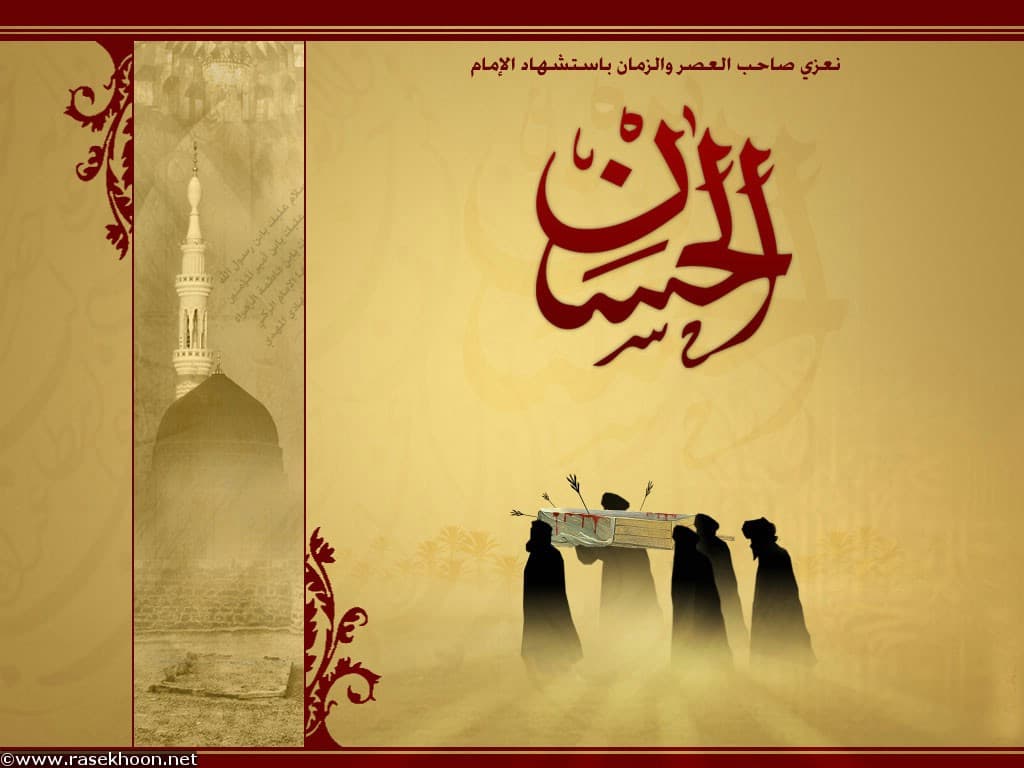
Aisha was a woman exemplary in harboring rancor. She kept the rancor of that day of Jamal in her chest. But what was she compared with the Haydari firmness of Imam Hasan al-Mujtaba? She was never able to take revenge on the Noble One of the Ahl al-Bayt except after the martyrdom of that oppressed Imam. The arrows of Aisha's oppression once again left the bow and struck the pure, lifeless body of Imam Hasan, peace be upon him, adding another oppression to the oppressions of the Ahl al-Bayt and making Aisha's dark record even darker. What a great calamity Aisha, together with the Umayyads, created. Aisha held the rancor of Jamal against Imam Hasan, peace be upon him, in her heart, and the Umayyads had added the disgrace of Uthman's burial in the cemetery of the Jews to their other disgraces. Chests full of hatred and rancor toward the family of Ali and Imam Hasan, peace be upon them, were in Medina. The sky should weep blood that the pure body of Imam Hasan, peace be upon him, martyred by the poison of Banu Umayya's cruelty, became the target of seventy arrows of Aisha's rancor. Aisha, who once rode the camel and created the trial of Jamal, on that day rode a black-and-white mule and inflicted that oppression upon the pure household of the Messenger of God.
Tajammalti, tabaghalti, wa law ishti tafayyalt / laki al-tus'u min al-thumn wa fi al-kull tasarraft.
Meaning: O Aisha! One day you rode a camel, another day you rode a mule; if you live longer, you will ride an elephant too. You have one-ninth from one-eighth of the Prophet's house as inheritance, yet you took possession of all of it. That is, although you own only a portion of the house of the Noble Prophet, blessings and peace be upon him and his family, you took control of all of it and prevented Imam Hasan, peace be upon him, from being buried in that house.
Meaning: O Aisha! One day you rode a camel, another day you rode a mule; if you live longer, you will ride an elephant too. You have one-ninth from one-eighth of the Prophet's house as inheritance, yet you took possession of all of it. That is, although you own only a portion of the house of the Noble Prophet, blessings and peace be upon him and his family, you took control of all of it and prevented Imam Hasan, peace be upon him, from being buried in that house.
Author: Hamed Sarem
Related articles


Comments
No comments yet.